The 107 Drops of Blood: Taiwan’s First Murder Conviction Without a Body
The Da’an District in Taipei is known for its quiet, tree-lined alleys and upscale residences—a place where the chaotic hum of the city fades into a comfortable, wealthy murmur. In 2001, it was the perfect sanctuary for forty-year-old Chang Ching-hua. Having recently returned from the United Kingdom with a master’s degree, she rented a spacious apartment, living alone and teaching English and piano.
Chang was a woman who seemed to have it all. Born into a highly affluent family with a net worth estimated at 440 million NTD (roughly 14 million USD), she was vibrant, outgoing, and loved to dance. She was deeply integrated into the local social scene, participating in matchmaking groups and enjoying the attention of numerous suitors. She was smart, beautiful, financially independent, and fiercely protective of her wealth after a few bad romantic investments.
But on June 14, 2001, the music in Chang Ching-hua’s life abruptly stopped. And the silence that followed would plunge Taiwanese law enforcement into one of the most baffling, complex, and chilling investigations in its history. This is the story of the perfect crime that wasn’t, a locked-room mystery, and the ghost that guided the detectives.
Chapter 1: The Pristine Apartment and the Howling Husky
The timeline of the disappearance was incredibly tight. On the morning of June 14, Chang’s current boyfriend, a man surnamed Wu, left her apartment around noon. When he tried calling her just an hour later, the phone rang endlessly. This was entirely out of character; Chang was a social butterfly, tethered to her phone. When her family and her piano students also failed to reach her throughout the day, a cold sense of dread began to settle.
The next day, Wu arrived at the apartment. Her favorite pair of shoes, the ones she always wore when going out, were sitting neatly by the door. Yet, no one answered the bell. Panic setting in, Wu called a locksmith, but the high-security locks defied picking. Desperate, Wu contacted the Da’an Police Precinct.
Captain Lee Wen-chang, sensing the urgency, called the fire department. Using a ladder truck, firefighters scaled the building, breached a window, and unlocked the front door from the inside.
When the investigative team stepped in, they were met with a scene that was terrifyingly… normal.
The living room was immaculate. There were no overturned chairs, no shattered glass, no signs of a struggle. In the master bedroom, clothes were folded with mathematical precision on the bed. It looked as though Chang had just stepped into the kitchen for a glass of water.
But as Captain Lee surveyed the room, his seasoned instincts flared. It was too clean. The living room floor gleamed with an unnatural, freshly-mopped brilliance. A single woman living alone doesn’t spontaneously deep-clean her floors to a mirror finish in the middle of a Thursday afternoon.
Then, they heard the howling.
Chang owned a Husky, which was currently locked on the balcony. When the officers opened the balcony door, the dog didn’t greet them. It bolted past them, making a beeline straight for the master bathroom, scratching frantically at the closed door and howling with a mournful, distressed pitch.
The officers opened the bathroom door. At first glance, it mirrored the rest of the apartment—tidy and organized. But anomalies quickly began to surface. The shower curtain was missing. Two large bath towels were gone. A large, empty bottle of body wash lay in the trash. The bath mat had vanished.
But the most glaring inconsistency sat on the floor, replacing the trash can. It was an electric fan, plugged in and pointing towards the tiles. Who brings an electric fan into a wet, enclosed bathroom?
Upon closer inspection, nestled deep in the grout lines where the bathtub met the wall, investigators found a few tiny, dark red specks. Blood.
Chapter 2: The Luminol Reveal
The Da’an detectives knew they were looking at something beyond a simple missing person case. They called in the Taipei Forensic Center, led by Director Hsieh Sung-shan.
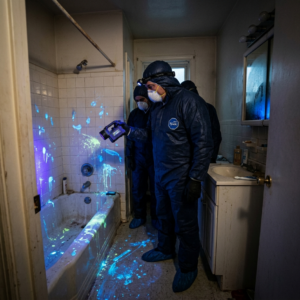
The forensic team took one look at the fan and the unnaturally clean floor and knew exactly what had happened. They sealed the bathroom, plunged the apartment into absolute darkness, and sprayed the chemical reagent Luminol across the tiles.
When the blacklights clicked on, the bathroom exploded in a terrifying, luminescent blue glow.
It wasn’t just a few specks. The walls, the sink, the floor, the underside of the window sill—the entire two-square-meter room was glowing. They counted exactly 107 distinct blood splatters. The fan hadn’t been there to cool someone down; it had been used to rapidly dry the floor after the killer had desperately tried to wash away a massive hemorrhage. Furthermore, they found a single, bloody footprint—too large to belong to Chang—and a partial fingerprint near a bathroom scale.
DNA testing of the blood confirmed their worst fears: it belonged entirely to Chang Ching-hua.
The volume of blood indicated an injury so severe it was practically unsurvivable. Yet, there was no body. There were no severed limbs, no bone fragments. This wasn’t a dismemberment; the killer had likely wrapped Chang’s body in the missing shower curtain and towels, hauling her out of the apartment.
But how? The locks were untouched. The windows were secure. The killer had to be someone Chang knew and trusted—someone she had willingly let into her home, someone who knew her habits.
Chapter 3: The Man from Mainland China
The police immediately pivoted to Chang’s inner circle. Her phone records revealed a final, crucial call made on the morning of June 14. The number belonged to a man named Li Cheng-wei.
Li was a Taiwanese businessman who had previously operated a factory in Mainland China. He had met Chang two years prior through mutual friends. Digging into Li’s background, detectives uncovered a desperate man. His business had collapsed, leaving him drowning in tens of millions of dollars in debt. He had returned to Taiwan just months before the murder.
Cell tower pings placed Li’s phone squarely in the Da’an District—specifically near Chang’s apartment—on the exact day she vanished.
The motive suddenly crystallized when detectives returned to Chang’s bedroom. A specific drawer had been rifled through, and several of her bankbooks and credit cards were missing. It was a classic, brutal equation: a desperate, indebted man murders a wealthy woman for her fortune.
When police contacted Li for an interview, he agreed, but repeatedly canceled, citing sudden business meetings or oversleeping. By the time they went to apprehend him, they discovered Li had already boarded a flight back to Mainland China.
Just days later, a security camera at a bank captured Li Cheng-wei forging checks and swiping Chang’s stolen credit cards. He had fled, but he had left a trail.
Chapter 4: The Bleeding Trunk
If Li had moved a dead body, he needed a vehicle. Li didn’t own a car, and his brother’s truck was broken down. However, the police discovered that Li had a sister, Li Kuei-fang.
When they brought Kuei-fang in for questioning, she admitted to having Chang’s credit cards, claiming her brother had given them to her to “settle a debt.” More importantly, she revealed that her brother frequently borrowed her car while he was in Taiwan. In fact, she had driven that very car to the police station.
The vehicle was parked in the precinct’s underground garage. Detectives approached the standard, unremarkable sedan. The moment they opened the driver’s side door, the metallic, sickening scent of blood hit them.
The front seats looked clean, but lifting the seat covers revealed dark, dried bloodstains. The real horror, however, was in the trunk.
When they opened it, they found blood smeared across a sunshade. Lifting the sunshade revealed blood on the trunk’s carpet. Beneath the carpet, the wooden spare-tire cover was soaked. The forensic team realized the horrifying truth: the blood hadn’t just dripped; it had pooled and seeped through three thick layers of material.
They estimated that between 100 to 200 milliliters of blood had seeped into the trunk lining. This meant Chang’s bleeding, dying—or already dead—body had been curled inside that trunk for an extended period.
The police had the murder scene, the motive, the weaponized vehicle, and the suspect. All they needed was a confession and a body.
Chapter 5: The Arrogant Return
It took three agonizing months, but Li’s sister eventually convinced him to return to Taiwan, likely arguing that without a body, the police couldn’t prove murder. Li, arrogant and calculating, flew back to Taipei on September 12, believing he had outsmarted the system. He was immediately arrested.
The interrogation was a masterclass in sociopathic deflection.
When asked why he had Chang’s credit cards, Li smoothly claimed they were business partners; she was investing in his new mainland company, and he simply “forgot” to return them.
When asked about his cell phone pinging in Jinshan, a coastal area in northern Taiwan, on the night of the murder, he claimed he was visiting an old army buddy. Police quickly verified the buddy hadn’t seen Li in over twenty years.
When presented with his bloody footprint in the bathroom, Li didn’t flinch. He claimed Chang had been weighing herself, and he had simply stepped into the bathroom to “help her read the scale.”
Li had an excuse for everything. Because there was no body, he could spin any narrative he wanted. The prosecutors knew they were dealing with a highly intelligent, manipulative liar. They decided to take an unprecedented risk: they indicted Li Cheng-wei for murder without a corpse.
Chapter 6: The Trial and the Supernatural Echoes
The trial was a historic legal battle. Li’s defense leaned heavily on the absence of a body, arguing that Chang could simply be missing or in hiding.
However, the prosecutors meticulously dismantled Li’s character. They brought in Chang’s former boyfriends—wealthy businessmen who had borrowed heavily from her and left her with massive debts. They proved that Chang had become incredibly fiercely protective of her finances. She would never willingly hand over her bankbooks and credit cards to a casual acquaintance like Li, especially a man known to be drowning in debt. The financial transfer was clearly theft, not an investment.
In June 2003, nearly two years after the murder, the Taipei District Court found Li Cheng-wei guilty. During the appeals process, Li’s arrogance reached new heights. He paced the courtroom, shouting curses at the judge, claiming the police had planted the blood in his sister’s car. His lack of remorse infuriated the court, initially resulting in a death sentence. Ultimately, due to a controversial legal technicality regarding his “voluntary” return to Taiwan, the sentence was reduced to life in prison.
But for the investigators who worked the case, the closure of the courtroom did not bring peace. The case was plagued by bizarre, unexplainable phenomena.
Investigator Tsai, who had worked the crime scene, recounted how his video cameras would repeatedly freeze and shut off the moment he entered the bloody bathroom, only to work perfectly in the hallway. Frustrated, Tsai had stood in the bathroom and silently pleaded: “Miss Chang, please come to us. Show us where you are. Let us help you.”
Days later, Tsai had a vivid, terrifying dream. A petite woman grabbed his hand and led him down a rural road, bordered by mountains on one side and the ocean on the other, passing a small elementary school. The dream ended when an old man stepped into the road and blocked their path.
The next morning, Tsai called his superior, Director Hsieh. Before Tsai could speak, Hsieh described the exact same dream.
Driven by this shared vision, the investigative team drove the coastal roads of Jinshan. They drove until Tsai yelled to stop. They were parked in front of a small, rural temple. Inside, the central deity statue bore the exact face of the old man from the dream. Surrounding the temple was a landscape matching the vision perfectly: mountains, the ocean, and a small elementary school at the base of the hill.
The police launched a massive excavation of the mountainside. During the dig, Tsai received a phone call from an unknown number at midnight. When he answered, he heard nothing but the weeping of a woman.
“We are on the mountain looking for you,” Tsai whispered into the receiver. The line went dead.
Despite weeks of searching, Chang Ching-hua’s body was never found.
Deep Reflection: The Weight of the Unseen
The case of Chang Ching-hua stands as a monumental moment in Taiwanese legal history—the first time a killer was convicted of murder without the recovery of a body. It is a testament to the power of forensic science, the tenacity of investigators, and the inescapable truth written in a drop of blood.
Yet, it remains a story defined by absence.
Li Cheng-wei sits in a prison cell, carrying the secret of Chang’s final resting place in a mind completely devoid of empathy. He stole not just a life, but the basic human right of a family to lay their daughter to rest.
The story forces us to confront the terrifying reality that monsters do not always lurk in dark alleys; sometimes, they are the charming acquaintances we invite into our living rooms. It reminds us that greed is a corrosive acid that can dissolve a man’s humanity until nothing is left but the calculated mechanics of murder.
Chang Ching-hua was a vibrant, successful woman whose light was extinguished by a man who saw her only as a bank account. Her physical form may be lost to the mountains or the sea, but her spirit, crying out through the silence of the evidence, ensured that her killer would never walk free again.
Does the conviction of a murderer without a body change your perspective on the justice system? Do you believe the supernatural elements of this case were mere coincidence, or a desperate plea from beyond? Share your thoughts, your theories, and your respects for Chang Ching-hua in the comments below. Let us keep her memory alive.
Disclaimer : This content may be created by AI for entertainment purposes. Any resemblance to real persons, events, or places is coincidental.






