A Chilling Tale of Domestic Nightmare and the Freezer that Held a Father
The sweltering heat of late June 2018 hung heavy over Kaohsiung, Taiwan, but for Officer Phan Minh Hoang of the Qianzhen Precinct, a different kind of chill was creeping in. It started as a subtle unease—a missed call, an unreturned message. His old friend of over a decade, Mr. Dinh Thinh Phuong, had seemingly vanished into thin air. Phan and Dinh were close; they often chatted, and Dinh’s small sushi stand was just a stone’s throw from the police station. But now, the silence was deafening, and the shadows around the Dinh family home were growing longer and darker.
This is not merely a true crime story. It is a profound, devastating exploration of the cyclical nature of violence, the crushing weight of domestic abuse, and the terrifying lengths to which a fractured family will go to break free from their tormentor. Prepare yourself for a narrative that exposes the darkest corners of the human heart, revealing that sometimes, the monsters we fear are the ones we sit down to dinner with.
Chapter 1: The Illusion of Reform
To understand the sudden disappearance of Dinh Thinh Phuong, one must first understand the man he used to be. For years, Dinh was the quintessential prodigal son. Having inherited a staggering fortune of 30 million NTD (roughly 1 million USD) from his ancestors, he lived a life of reckless abandon. He bought a sleek, expensive Mercedes CLA 250, but instead of using his wealth to build a legacy, he squandered it on alcohol, hostesses, and an insatiable gambling addiction. Within a few short years, the ancestral fortune evaporated like smoke.
But as 2018 rolled in, a miraculous transformation seemingly took place. The 47-year-old Dinh, perhaps feeling the inevitable weight of aging and the stark reality of his depleted bank account, claimed he was turning over a new leaf. He opened a modest sushi stand, selling rolls for a meager 43 NTD each. The daily income was paltry—barely enough to sustain his wife, Hong Thi Man, and their four children: the 24-year-old eldest son, Dai Van, and three younger siblings aged 17, 14, and 4.
To the outside world, and particularly to Officer Phan, the change was commendable. Dinh traded his luxury Mercedes for a small, beaten-up scooter. He was seen working side-by-side with his wife, Hong. He even excitedly told Phan in May about his plans to buy a new chest freezer for the upcoming summer heat to keep his sushi ingredients fresh. Phan felt a wave of relief; his old friend was finally settling down, tied to the responsibilities of a small business rather than the allure of the casinos.
However, beneath this veneer of sudden domestic tranquility, the foundation of the Dinh family was rotting from the inside out. The brutal, violent tyrant who had terrorized his wife and children for two decades had not disappeared; he had merely put on an apron.
Chapter 2: The Silence and the Unsettling Calm
By late June, Dinh was gone. Officer Phan’s calls went straight to voicemail. After a week of relentless trying, someone finally answered. It was Hong Thi Man.
“Where is your husband?” Phan asked, his voice laced with concern.
Hong’s response was unnervingly calm, utterly devoid of the panic one would expect from a wife whose husband had been missing for weeks. “He went to Pingtung for business,” she stated flatly. “He didn’t take the car, he didn’t take his phone, and he just walked out in his slippers.”
Phan’s police instincts flared instantly. He knew Dinh. Dinh was a man of extreme vanity. He never left the house in slippers; he always wore proper shoes. And in the modern era, who travels for business without a mobile phone? Hong’s placid demeanor was a glaring red flag.
The suspicion deepened a few days later when Hong actively contacted Phan—not to ask for help finding her husband, but to ask for his assistance in recovering 2 million NTD Dinh had entrusted to a mutual friend. A family of six, and not a single soul—not the wife, not the adult son, not the teenagers—seemed remotely concerned that their patriarch had vanished. The only person who cared was Dinh’s elderly mother, who eventually filed a missing person’s report.
Phan began conducting informal surveillance on the Dinh residence, a modest four-story house. He noticed a bizarre change in their routine. The main roll-up door on the ground floor, usually left open for the scooter, was now permanently, tightly shut. The family exclusively used a small side door to enter and exit. It was as if they were trying to seal the house off from the outside world.
Chapter 3: Divine Intervention and the Macabre Dream
As September approached, the mystery deepened. Phan, desperate for a breakthrough, turned to a local Taiwanese tradition. He visited the City God Temple (Cheng Huang Temple) to seek divine guidance through Jiaobei blocks (moon blocks used for divination).
He asked the deity: Is Dinh Thinh Phuong alive or dead? Where is he? Three times he threw the blocks, and three times he received inconclusive answers. The final reading simply implied: When the time is right, you will know. Frustrated, Phan returned home and recounted the baffling case to his wife. What happened next shattered the boundaries of logic. His wife gasped, her face draining of color. “He’s dead,” she whispered, her voice trembling. “He’s been coming to me in my dreams for days.”
Phan stared at her in disbelief. But she continued, describing a chilling, vivid nightmare. She saw Dinh’s spirit, trapped and suffering. She described a vision of a large freezer, cold and suffocating, and the undeniable presence of death. She pointed towards their own refrigerator to emphasize her point.
Armed with this surreal, terrifying intuition, Phan knew he had to breach the closed doors of the Dinh household.
Chapter 4: The 99 Days of Ice
On the evening of September 10, 2018, Officer Phan saw his opportunity. He spotted Hong Thi Man opening the side door. He approached her, his demeanor shifting from friendly neighbor to hardened investigator.
He decided to employ a psychological shock tactic. “Hong,” he said, his eyes locked onto hers. “Dinh just called me. He told me to come here right now.”
Hong’s face instantly paled, her composure shattering. Phan pressed harder. “Where is he? A living person needs a home; a dead person needs a grave. He can’t just disappear.”
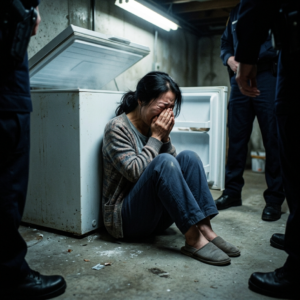
Hong remained frozen, completely speechless. But her eyes betrayed her. Involuntarily, her gaze drifted past Phan, settling on the ground floor of the house, specifically towards the back wall where two large chest freezers sat—one new, one old.
Phan followed her gaze. The old freezer sat silently in the dim light, humming with a low, menacing vibration. Guided by an inescapable sense of dread, Phan walked past Hong. He grasped the handle of the old freezer and pulled the lid open.
The stench hit him first—a sickening, overwhelming wave of decay, partially masked by the biting cold of the ice. Inside, curled into a tight, unnatural fetal position, was the body of Dinh Thinh Phuong. He was wrapped tightly in a thick bedsheet, encased in a solid block of ice that was over 10 centimeters thick. He had been stuffed into a freezer meant for sushi ingredients, a space only 1.5 meters long, forcing his 1.65-meter frame into a grotesque, frozen contortion.
He had been in there for exactly 99 days.
Hong collapsed to the floor, weeping hysterically, finally confessing that her husband was dead. The Qianzhen District exploded with sirens as forensic teams swarmed the quiet street. The extraction of the body was a nightmare in itself. The ice was so thick that investigators had to spend hours carefully chipping it away, pouring hot water, and using hairdryers to free Dinh’s frozen corpse without damaging the evidence.
Chapter 5: The Web of Lies and the Son’s Confession
In the sterile interrogation room, Hong Thi Man spun her first narrative. She claimed it was self-defense. She tearfully recounted a terrifying night where Dinh, drunk and enraged, had pulled a knife on her on the third floor. She claimed she managed to disarm him and, in a blind panic, stabbed him to death. She then hauled his body downstairs and stuffed it into the freezer.
But the investigators, looking at her slender, fragile frame, knew she was lying. It was physically impossible for her to drag a dead weight of 1.65 meters down two flights of stairs and maneuver him into a chest freezer alone.
Under immense pressure, she broke again, admitting she had help. She pointed the finger at her eldest son, Dai Van.
When police brought in the 24-year-old Dai Van, they were struck by his chilling apathy. He showed no remorse, no sorrow. He calmly confessed, but his story mirrored his mother’s: a spontaneous act of defense against a violent father. He even showed a small scar on his hand, claiming it was from wrestling the knife away.
But dead men tell tales, especially on the autopsy table.
When Dinh’s body was finally thawed, the forensic pathologists made a crucial discovery. First, Dinh had zero defensive wounds on his forearms or hands—meaning he was attacked by surprise, likely while sleeping. Second, the sheer variety of the fatal wounds—deep stabs to the neck and lungs, and three distinct, massive blunt force traumas to the skull—indicated multiple weapons were used simultaneously.
One person did not kill Dinh Thinh Phuong. It was a coordinated, brutal assassination.
Confronted with the autopsy photos, Dai Van’s facade crumbled. He confessed the full, horrifying truth. He hadn’t acted alone. He had hired two of his friends, Thai and Cao, to help him execute his father.
Chapter 6: The Architect of the Assassination
The investigation unraveled a family dynamic so toxic it bred murder. Dinh Thinh Phuong was not just a strict father; he was a monster. For over two decades, he had subjected Hong and their children to unimaginable physical and psychological torture. He beat them with helmets, with electric batons. He held them hostage with knives. The police had been called multiple times, but the brief restraining orders offered no permanent salvation. The family was trapped in a perpetual cycle of terror.
However, Dai Van was not merely a protective son; he was a terrifying reflection of his father. Despite despising his father’s violence, Dai Van had inherited his worst traits. He was an alcoholic, deeply in debt from gambling and lavish spending at host clubs. His mother, Hong, in a misguided attempt to compensate for the abuse, had spoiled him, secretly giving him credit cards to fund his extravagant lifestyle. Dai Van was driving his father’s old Mercedes while the family struggled to buy groceries.
When Dai Van learned that his father still possessed a hidden cache of 2 million NTD, his motive shifted from pure protection to calculated greed.
The plot was hatched in the dark hours of June 4th. Dai Van promised his friends Thai and Cao 1 million NTD each to help him kill his father. Hong, the abused, desperate matriarch, was entirely complicit. She took her younger children to school early that morning, knowing exactly what was about to happen in the master bedroom on the third floor.
At 7:00 AM, the three young men crept into Dinh’s room. They attempted to strangle him in his sleep, but the 47-year-old fought back with ferocious, adrenaline-fueled strength. In the chaotic struggle, Dai Van signaled Thai to grab a knife from the nightstand. As Thai stabbed him, Cao brought a heavy club crashing down on Dinh’s skull.
When Hong returned at 9:00 AM, the deed was done. The three men had fled to a hotel to tend to their minor injuries, leaving her with the bloody aftermath. For three days, Dinh’s body lay decomposing in the third-floor bathroom before Hong and Dai Van finally managed to haul him down and seal him in the ice. They planned to keep him frozen for seven years, the legal timeframe required to declare a missing person dead, allowing them to claim the 2 million NTD.
Deep Reflection: The Inheritance of Violence
The Kaohsiung Freezer Murder concluded with lengthy prison sentences. Dai Van received over 18 years, while his mother Hong received 8 years. The accomplices, Thai and Cao, were sentenced to 15 and 13 years, respectively.
But the true tragedy of this story lies far beyond the courtroom verdicts. It is a chilling exploration of how violence, left unchecked, infects the very soul of a family. Dinh Thinh Phuong created an empire of terror within his own home, ruling through fear and physical dominance. In doing so, he inadvertently forged his own executioner. Dai Van, the son who hated the father’s cruelty, ultimately utilized the very same violence to solve his problems. He became a more terrifying, calculated version of the monster he sought to destroy.
What of the younger siblings? The 17-year-old and 14-year-old boys lived in the house for 99 days, knowing their father was missing, knowing their mother had sealed the ground floor. They chose silence. Their trauma had numbed them so profoundly that the disappearance of their tormentor was met with quiet, complicit relief. The second son, once a gifted musician, had already dropped out of school, his potential crushed by the oppressive atmosphere of his home.
Hong Thi Man, a woman who endured 26 years of beatings, lost the final shred of her morality when she sanctioned the murder of her husband by her own son. The family was frozen long before Dinh was placed in the freezer; they were paralyzed by a cycle of abuse that offered no escape route other than death.
This tragic saga is a harrowing reminder that domestic violence is an insatiable beast. It does not merely inflict physical wounds; it destroys the capacity for empathy, distorts the perception of love, and breeds a desperation so profound that murder becomes a rational solution. The Dinh family lived in a freezer of their own making, a cold, isolated hell where the only way out was to shatter the ice with blood.
Does this story change how you view the psychological impact of long-term domestic abuse? How can society better intervene to prevent families from reaching such a terrifying breaking point? Share your thoughts, your empathy for the younger children, and your reflections on this tragic cycle of violence in the comments below. Let us shed light on the darkness.
Disclaimer : This content may be created by AI for entertainment purposes. Any resemblance to real persons, events, or places is coincidental.






