A Mother’s Twisted Love and the Silence of Two Innocents
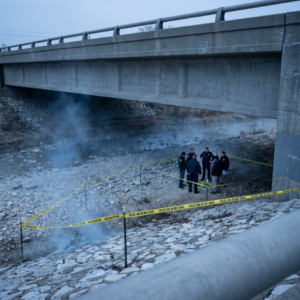
The morning of December 11, 2005, began with a deceptive peace in the village of Thuy Nguyen, Hualien County, Taiwan. As the golden light of dawn touched the misty mountain peaks, local residents stepped out for their ritual morning walks, breathing in the crisp, rural air. However, beneath the towering Thuy Nguyen Bridge, the tranquility was about to be shattered forever. Near a pile of jagged rocks in a dry creek bed, a passerby noticed a pale shape that did not belong to the landscape.
Upon closer inspection, the man’s curiosity turned to pure horror. Sprawled amidst the stones was the body of a young woman, discarded like a broken doll. Panic surged through the quiet village as the realization set in: this was not a dream, but a gruesome reality. Little did the villagers know that this discovery was merely the first layer of a mystery so dark and calculated it would soon shock the entire nation.
The investigation that followed would peel back the skin of a seemingly ordinary family to reveal a conspiracy born of misguided protection, legal desperation, and a mother’s lethal devotion to her son. This is the chronicle of a crime that began with a bridge and ended with a tragedy that two families will never escape.
The Double Discovery Beneath the Concrete
When the forensic teams and Hualien police arrived, the atmosphere was thick with tension. The bridge, standing fifteen meters above the rocky creek, became a stage for a grim theatrical production. Investigators noted that the first victim, an indigenous Atayal woman in her early twenties, was found partially unclothed, wearing only underwear. The signs of violence were unmistakable: clear ligature marks around her neck and blunt force trauma to the back of her head.
As officers fanned out to sweep the surrounding area, they pushed through thick, tall weeds about sixty meters away. There, the investigation took a terrifying turn. A second body, also an Atayal female, was discovered hidden in the brush. She, too, was nearly unclothed. The discovery of two bodies transformed the case from a singular tragedy into a high-stakes double homicide.
The initial profile was confusing. Both victims had been cleaned—meticulously wiped of forensic evidence—and stripped of their clothing after death. Detectives initially speculated that the victims might be workers from the local entertainment industry, such as karaoke bars or nightclubs, based on the specific style of underwear found on the bodies—one pair even featuring a bold tiger-head print. However, as the news spread through the local community, the truth about their identities began to surface, proving far more heartbreaking than anyone had imagined.
From “Entertainment Workers” to Schoolgirls: The Identity Crisis
The first breakthrough came not from the crime scene, but from a sharp-eyed officer at a nearby station. He recognized the description of one of the victims from a previous encounter involving a suspected stolen motorcycle. The trail led back to a local school. It turned out the police had been searching for the wrong demographic.
The victims were not adult workers; they were children.
One was a fifteen-year-old girl surnamed Chen, a student who had recently completed junior high. The other was her inseparable best friend, a thirteen-year-old girl surnamed Li. They were described by teachers as “unconventional” students who often skipped class to visit internet cafes, but they were still just children. Chen was remembered as a helpful, polite student despite her poor grades, while Li was known for her wandering spirit.
The autopsy results added a layer of chilling brutality to the case. Neither girl had been sexually assaulted. They had been strangled to death by hand. The sheer force used was enough to fracture their tracheal cartilage, indicating a killer—or killers—of significant physical strength. Furthermore, bruising on their arms suggested they had been held down while being murdered. The investigators were now looking for at least two perpetrators: one to strangle, and one to restrain.
The Mother, the Son, and the Boxer Briefs
As the investigation narrowed, Chen’s father provided a vital lead. He mentioned a young man his daughter had been seeing—a twenty-year-old named Quach (Xiao Quach). When police arrived at Quach’s home, they were met by his mother, Lin Le-er. She claimed her son had gone to Taipei for work and she hadn’t heard from him.
But the house told a different story.
On the balcony, men’s clothes were drying in the sun. Quach’s motorcycle was still parked in the yard. Inside, the detectives made a pivotal discovery. In the laundry basket, they found a pair of boxer briefs and a pair of tiger-head underwear—identical to the ones found on the victims under the bridge. Lin Le-er claimed the underwear was hers, but the lie was transparent. Deep inside the washing machine, they found a pair of men’s jeans stained with blood.
In the pocket of those jeans were three receipts from a convenience store timed at 5:30 AM on the day the bodies were found. Surveillance footage from the store showed Lin Le-er leading her son and four other young men as they frantically bought large quantities of instant noodles and canned food—supplies for a long hideout. The “ordinary housewife” was actually the quartermaster for a group of killers.
The Mastermind in the Kitchen
The arrest of Quach and his four accomplices—one of whom was a transgender individual and two of whom were mentally challenged—brought the horrifying truth to light. The most shocking revelation was not the identity of the killers, but the identity of the mastermind.
It was Lin Le-er.
This mother had meticulously planned every step of the murder to “save” her son. The motive was a twisted attempt to resolve a legal conflict. Quach had been in a relationship with the fifteen-year-old Chen, which led to a sexual assault charge from her family. Despite attempts to negotiate a settlement of 100,000 TWD, the case proceeded to the prosecutor’s office. Lin Le-er, blinded by a primitive belief that the lawsuit would vanish if the plaintiff disappeared, decided the girl had to die.
She didn’t just wish for it; she organized it. She provided her son with sedatives to spike the girls’ drinks at an internet cafe. When the girls refused the drinks, she ordered the group to lure them to a secluded flood levee. There, under her instructions, the group used heavy stones to beat the girls before strangling them.
Lin Le-er even organized the disposal of the bodies. They used three motorcycles to transport the corpses, sandwiched between riders to look like sleeping passengers in the dark. She was the one who ordered the bodies to be stripped and cleaned, not just to confuse the police, but out of a superstitious fear. She believed that if the victims were naked, their spirits would be too “ashamed” to return and haunt their killers.
The Final Verdict and the Echo of Loss
The legal battle ended with a sentence of life imprisonment for Lin Le-er and her son. The court acknowledged her role as the director of the tragedy, though she attempted to show remorse by selling property to compensate the families and kneeling in apology during the trial. The accomplices received varying sentences, some reduced due to mental health factors.
But for the families of the victims, there is no closure. For the father of the girl surnamed Li, his daughter was a bystander—killed simply because she was a loyal friend who refused to let Chen go to the meeting alone. Half a year later, Chen’s father still sits in her untouched bedroom, surrounded by photos of the two best friends, watching old family videos and waiting for a daughter who will never come home.
The tragedy of Thuy Nguyen Bridge serves as a haunting reminder of how a lack of legal understanding and a “distorted” sense of maternal protection can lead to utter depravity. Lin Le-er thought she was saving her son’s future; instead, she ensured he would spend the rest of his life behind bars, while two young lives were snuffed out over a misunderstanding of the law.
Deep Reflection: The Weight of Silence
As we look back at the events of December 2005, we are forced to confront the dark side of devotion. This case teaches us that secrets and the refusal to face the consequences of our actions can spiral into a darkness from which there is no return. It reminds us of the value of life and the devastating ripple effect that a single act of violence has on a community.
To our global audience: What do you believe is the root cause of such a calculated act? Is it a failure of education, or a deeper moral collapse?
We invite you to share your thoughts in the comments. Let us remember the names of the innocent and honor their memory by advocating for a world where such tragedies are never repeated.
Disclaimer : This content may be created by AI for entertainment purposes. Any resemblance to real persons, events, or places is coincidental.






