The House of Silent Screams: The 1986 Hejiang Street Massacre and the Butcher of Taipei
The afternoon of Friday, May 29, 1986, in Taipei was thick with the humid anticipation of the coming summer. For businessman Chuang Wen-hua, the day should have been one of sentimental farewells. His parents, Chuang Shu-duo and Chuang Thai-cau, were preparing to migrate to Argentina on the 31st to begin a new chapter of their lives. It was a common story of the era—families seeking new horizons, leaving behind the bustling streets of Taiwan for the vast plains of South America.
But as Wen-hua and his wife, Li Li-hua, stood before the heavy door of Apartment 2, No. 131 Hejiang Street, the air felt unnaturally still. The silence from within wasn’t the peaceful quiet of a packing household; it was a heavy, vibrating void that chilled the bones. Little did they know, they were standing at the threshold of one of the most gruesome chapters in Taiwanese criminal history—a case so horrific that even under the strict Martial Law of the time, the details were whispered in terror.
This is the extensive chronicle of a betrayal so deep it defied human comprehension, involving a son-in-law’s greed, a night of psychological chess, and a discovery that would haunt the city for decades.
Chapter I: The Note on the Door
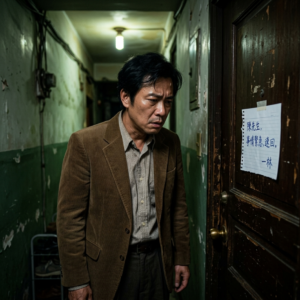
By 15:30, Wen-hua had knocked until his knuckles were sore. There was no answer. He reached out and turned the handle of the outer iron security gate; to his surprise, it was unlocked. However, the inner wooden door remained firmly shut. Taped to the center was a chillingly mundane note written in a familiar hand:
“The parents-in-law are moving to Argentina in two days. Today we are heading south to say goodbye to relatives and friends. Please excuse the inconvenience. — Chen Van-huy.”
The sight of the note sent a cold shiver down Wen-hua’s spine. Only three hours earlier, he had spoken to his father on the phone. His father had been cheerful, explicitly stating he was staying home to wait for Wen-hua’s visit. Why would they suddenly leave for the south? And why was his brother-in-law, Chen Van-huy, the one writing the note?
In 1986, communication was a luxury of landlines and physical presence. Wen-hua had lost his spare key months prior. With a heavy heart and a growing sense of dread, he and his wife retreated to her parents’ home, but the unease sat in his stomach like a lead weight. He called his parents’ house every hour. Silence. Until 22:30.
Chapter II: The Midnight Encounter
When the phone finally picked up, Wen-hua didn’t even wait for a greeting. “Dad? Is that you? Why did you change your mind? Where is Van-huy?”
“It’s your brother-in-law,” a calm, low voice replied. “The parents are flying straight to Argentina tomorrow. They asked me to clean up the house. I’m busy now, we’ll talk later.” The line went dead.
Wen-hua broke into a cold sweat. His parents’ tickets were from Taipei’s Chiang Kai-shek International Airport. If they were in the south, they couldn’t possibly “fly straight” anywhere. Furthermore, his father had promised Wen-hua this very apartment to live in after they moved. Why would they leave without giving him the keys?
Driven by a primal instinct, Wen-hua and Li-hua hailed a taxi. They arrived at Hejiang Street at 11:30 PM. The man who opened the door was Chen Van-huy. He was dressed in a simple undershirt, but his appearance was terrifying. His eyes were bloodshot, his face was a strange, flushed red, and he looked physically exhausted, as if he had just finished a marathon. Yet, he forced a tight, unsettling smile.
“Why are you back so late?” Van-huy asked, his voice dripping with irritation.
Wen-hua stumbled over his words, pretending the heat had kept them awake. As they stepped into the foyer, the sensory assault began. The air was thick with a faint, metallic tang—the unmistakable smell of blood. As Wen-hua walked barefoot, the floor felt unnaturally sticky and slick. Under the dim hallway light, he noticed dark, reddish-brown droplets splattered across the pristine white walls.
Chapter III: A Banquet of Deception
The atmosphere inside was a suffocating pressure cooker. Li-hua, sensing her husband’s mounting panic, signaled him with a sharp look. They had to play along. If Van-huy had done what they feared, he was a cornered predator. Van-huy was a large man who had spent years working in a slaughterhouse in Argentina. He knew exactly how to use a knife.
“The parents are so biased,” Van-huy suddenly blurted out, lighting a cigarette with trembling fingers. “They always favor you. I’ve treated them well, yet I get nothing. I’m the one who needs the money.”
Wen-hua, catching the drift of his brother-in-law’s resentment, played the part of the disgruntled son. “I agree, honestly. Why leave us with this old house and no cash? My business hasn’t been great either.”
This fake empathy acted like a key. Van-huy began a tirade against the parents, his voice rising in excitement as he found a “partner” in his bitterness. For hours, they sat in the dimly lit living room, a surreal meeting of minds where Wen-hua fought to keep his voice steady while his heart hammered against his ribs.
Meanwhile, Li-hua made her move. She excused herself to the bathroom. What she saw there confirmed their darkest fears. In the cracks of the floor tiles, there were thick traces of blood that hadn’t been fully scrubbed away. Caught in the drain were strands of hair and tiny, unrecognizable fragments of flesh. The master bedroom door was locked tight, but a nauseating, sweet scent of decay seeped through the ventilation slats above.
Chapter IV: The Escape and the Horror
By 04:00 AM, the air in the living room was grey with cigarette smoke. Li-hua stood up, forced a smile, and said, “Brother-in-law, stop smoking so much. It’s almost dawn. Let me clear out these trash bags and tidy up the kitchen so I can make us all some breakfast.”
Van-huy, lulled into a false sense of security by the five-hour conversation, gestured toward a pile of heavy black plastic bags by the shoe rack. “Sure, go ahead. I’m getting hungry.”
Li-hua seized the bags, her hands shaking, and walked calmly down the stairs. She knew the sanitation workers arrived at 4:00 AM. As she reached the street, she saw a garbage truck—and right behind it, a police patrol car. She dropped the bags and ran toward the officers, her composure finally shattering into hysterical sobs as she told them there was a killer in apartment 131.
When the police entered, Van-huy was still sitting on the sofa, seemingly unbothered. However, as two officers went to investigate the bedroom, a fatal lapse in judgment occurred: the third officer failed to keep his eyes on the suspect.
In the bedroom, Wen-hua boosted his wife through the transom window above the door. She unlocked it from the inside. The smell that hit them was a physical blow. On the bed sat three large travel bags. Wen-hua unzipped one, and a human ribcage slid into view, fresh blood dripping onto the floor. “Murder! There’s been a murder!” he screamed.
In the chaos of the discovery, the police realized their mistake. They rushed back to the living room, but the sofa was empty. Chen Van-huy had vanished into the Taipei night.
Chapter V: The 32 Fragments of Betrayal
The forensic investigation revealed a scene of industrialized slaughter. Chuang Shu-duo and Chuang Thai-cau had been dismantled into 32 separate pieces, packed into five large travel bags and one small one. The father had been killed by a blunt force blow to the head with a hammer, followed by stabbings. The mother had died from a single, precise thrust to the heart.
The motive was as old as time: greed. The elderly couple held over 2 million TWD in cash. Van-huy, a failed businessman who had treated his in-laws like an infinite ATM, had finally been cut off. When he learned they were moving to Argentina to live with his estranged wife—who had accused her parents of “indulging” Van-huy into ruin—he realized his lifeline was being severed forever.
But the most bone-chilling detail was found in the kitchen. When the police searched the appliances, they opened the electric rice cooker. Inside, they found a human heart and a liver, steamed to a pale grey. The implication—that the killer had intended to, or had already begun to, consume the organs—was so disturbing that the authorities suppressed the detail from the public for years to prevent a national panic.
Chapter VI: The Final Bullet
Van-huy’s run didn’t last long. Penniless and haunted, he surrendered four days later. However, he attempted a final, desperate legal maneuver. He claimed he was a member of a secret political “Taiwan Independence” organization and that the murders were a directed hit. In the era of Martial Law, political cases required years of investigation, often delaying executions.
The police spent months chasing phantoms, only to realize Van-huy had pulled every name and “plan” from old newspaper clippings. There was no organization. There was no accomplice. It was just a man with a butcher’s knife and a black heart.
In a final twist of incompetence, Van-huy managed to escape from medical custody in October 1987 while his guards slept. He fled to the mountains, living on wild fruit, but hunger eventually drove him back to the city. He sought out a former mistress for money, only to find she had moved. As he stood dejected on the street, a patrol car spotted him.
On January 11, 1988, at 05:30 AM, Chen Van-huy was led to the execution grounds. The man who had dismantled his family was ended by a single, final volley of gunfire.
Deep Reflection: The Silence of the Predator
The Hejiang Street Massacre remains a scar on the collective memory of Taipei. It serves as a terrifying reminder that the greatest dangers often reside within our own circles, masked by the titles of “brother,” “son,” or “friend.” The Chuang parents were victims of their own kindness, having nurtured the very monster that would eventually consume them.
The mystery of the rice cooker remains—a silent testament to the depravity that greed can birth. But perhaps the most haunting lesson is the five hours Chuang Wen-hua spent “complaining” about his parents to a man who had their blood under his fingernails. It was a night where silence was a shield, and a facade was the only thing standing between life and a travel bag.
Call to Action: This story reminds us that intuition is our strongest weapon. Have you ever had a “gut feeling” that saved you from a dangerous situation? Share your thoughts on this tragic chapter of history in the comments below. Let us remember the Chuangs not for how they died, but for the life they tried to build.
Disclaimer : This content may be created by AI for entertainment purposes. Any resemblance to real persons, events, or places is coincidental.






