The Echoes of the Caged: Surviving the Concrete Jungle and the Redemption Within
There is a profound, chilling silence that precedes the slamming of an iron cell door. It is a sound that separates the free world—a world of choices, sunlight, and open roads—from a world of rigid routine, concrete walls, and survival. Imagine, for a moment, the heavy, metallic clang echoing down a sterile, fluorescent-lit corridor. Imagine the eyes of a stranger, stripped of empathy, commanding you to strip away your identity along with your clothes. They point you toward a communal shower, a place where vulnerability is not just felt, but weaponized.
Could you survive a single day in this environment? Perhaps you believe your resilience would carry you through. Perhaps you fear the psychological weight would crush you instantly. But the truth is, until you have breathed the stale, recycled air of a penitentiary, you cannot fathom the depths of human endurance or the darkness of the human condition.
The Joe Rogan Experience has served as a campfire for these harrowing tales. Men who have walked through the fire of the American justice system sit down, the ghosts of their pasts lingering in their eyes, and recount stories that challenge our understanding of fear, karma, and redemption. These are not just stories of incarceration; they are sagas of the indomitable human spirit.
Chapter I: The Desperate Sprint of Nick Yaris
The year was 1985. The biting, relentless cold of February 15th gripped Pennsylvania like a vice. Nick Yaris, a man who had spent two agonizing years in total, enforced silence on Death Row at the notoriously brutal Huntingdon prison, was finally tasting the crisp winter air. In Huntingdon, a single spoken word could result in a savage beating from the guards. Silence was survival.
Nick was being transported to a courthouse in Philadelphia. His mother and his lawyer were waiting for him, armed with evidence of prosecutorial misconduct that promised a review of his trial. The possibility of freedom danced in his mind like a flickering candle. The two sheriffs transporting him were older, seemingly relaxed men, engaging in casual banter about city life.
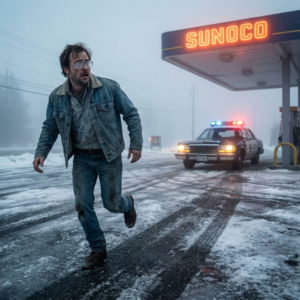
The transport vehicle pulled into a gas station in Exton, Pennsylvania. The mundane act of a bathroom break was about to ignite a desperate, chaotic chain of events. As Nick stepped out of the warm car into the freezing air, his glasses instantly fogged, blinding him. The world dissolved into a hazy, white blur. He entered the small restroom cubicle, but the cramped space, coupled with his impaired vision, created a sudden disorientation. He turned, ducked under the arm of the officer holding the door, and headed back toward the car.
He did not realize that the second officer, smoking a cigarette nearby, had lost sight of his partner.
In the officer’s mind, a horrifying narrative unfolded: a Death Row inmate was running loose, and his partner was nowhere to be seen. Panic, sharp and unforgiving, took over. As Nick jogged back, the officer drew his weapon.
“Pow!”
The gunshot shattered the quiet morning. The bullet whipped past Nick’s face, the violent displacement of air a terrifying reminder of his fragile mortality. Instinct, honed by years of surviving the worst humanity had to offer, took over. Nick hit the freezing pavement. He scrambled, ripping the skin from his hands as he tore around the corner, his heart hammering a frantic rhythm against his ribs.
He sprinted past a restaurant, the large glass windows framing diners engaged in ordinary, peaceful meals. He knew the officer wouldn’t risk firing into a crowd. He ran with the reckless abandon of a hunted animal, tearing through the woods for four grueling hours. Branches whipped his face, his muscles screamed in agony, his hamstrings tore, and his feet were shredded. But the terror of the bullet—and the cage—pushed him forward.
He made it to Florida, a fugitive stealing wallets to survive. He was on the verge of fleeing the country, but in the sweltering heat of the South, an epiphany struck him. The running, the hiding, the constant fear—it was a different kind of prison. He realized that to truly be free, he had to face the system that had condemned him. He turned himself in, enduring a brutal, torturous beating upon his return to Death Row. But in the darkness of his cell, broken and bruised, Nick made a vow not for vengeance, but for transformation: he would survive, and he would reclaim his capacity for love.
Chapter II: The Blood on the Gymnasium Floor
Survival in jail often demands a currency paid in blood and physical dominance. Jacob Benny, an MMA fighter, learned this harsh reality immediately upon his arrival. The prison hierarchy is a complex, terrifying ecosystem governed by unspoken rules and violent retribution.
Jacob had inadvertently crossed the wrong group. Through the ventilation system—the prison’s whispering gallery—a neighboring inmate, a “keyholder” for a powerful gang, confirmed that a hit had been placed on Jacob. The warning was stark: when the cell doors popped for shower time, assassins would be coming. The guards knew. His cellmate knew, fleeing the moment the doors opened.
Jacob posted up at the back of his small, concrete cell, his body coiled tight with adrenaline. The metallic clack of the doors unlocking sounded like a starting bell. Two men charged in, blades glinting in the harsh light. The cell erupted into a chaotic, desperate struggle. They tumbled out of the cell and down the metal stairs, a tangled mass of limbs and violence.
Exhausted, battered, and gasping for air, Jacob looked up. The guards were standing by, watching the spectacle unfold with chilling apathy. Realizing he was entirely alone, survival instinct took over. He dragged one unconscious attacker over his body, using him as a human shield against the second assailant. In front of an audience of inmates and indifferent guards, Jacob fought with the primal ferocity of a man refusing to die. When it was over, he stood bloodied but victorious.
The “reward” for his survival was a transfer to the gymnasium, housing 300 men. The guards praised his fighting skills, but Jacob felt only a deep, sinking dread. He had established a reputation as a dangerous fighter. In prison, that reputation is a magnet for challengers. He was surrounded by men who wanted to learn his skills or test their own against him. The gymnasium, intended as a slightly less restrictive environment, threatened to become a daily gladiator arena.
Chapter III: The “Communist Land” and the Milk Trade
The prison experience is not a monolith. For comedian Joey Diaz, his incarceration in the late 1980s for kidnapping and aggravated robbery offered a starkly different, almost surreal perspective.
Joey recalls the Boulder County Jail in 1991 with a bizarre sense of nostalgia. It was a facility so lenient, so accommodating, that homeless individuals would intentionally commit specific crimes during the winter, knowing the sentence would provide them with 60 days of warmth, regular meals, and even tobacco. It was, in Joey’s words, “Paradise.”
But paradise was lost when a new facility was built, bringing strict rules, mandatory uniforms, and the elimination of cigarettes. Joey decried the new system as “Communist Land.” He navigated the prison economy with the shrewdness of a street hustler. He despised the milk provided at meals, realizing its immense value to the bodybuilding inmates who viewed it as a potent supplement. He traded his milk for Kool-Aid and cigarettes, establishing himself as a vital node in the prison’s black market.
He manipulated the system, securing a job taking out the garbage, which allowed him 15 minutes of unsupervised access to a local store. He would pre-order Chinese food, returning to the prison with takeout and groceries. He became a “holder” for smuggled steroids and pills, charging rent to the inmates who needed his hiding spots.
Yet, beneath the bravado and the hustle, Joey acknowledged the profound, initial degradation of the system. The mandatory strip searches, the invasive physical examinations—they were designed to break a man down, to strip him of his dignity and establish absolute authority.
Chapter IV: The Unyielding Quest of Derek Hamilton and Bruce Bryan
The most devastating stories are not of those who belong in the cage, but of those who are unjustly thrown into it. Derek Hamilton was only 17 years old when he was falsely convicted of a murder he did not commit and sentenced to 25 years to life.
Faced with the crushing weight of a stolen future, a young Derek realized that his only salvation lay in his own intellect. He plunged into the prison law library, transforming his cell into a classroom. For over six years, he studied legal precedents, procedures, and the intricacies of the justice system. His relentless pursuit paid off when an appellate court recognized the gross misconduct of his trial, reversing his conviction.
But the corrupt machinery of the system was not finished with him. Eight months later, a rogue detective, dissatisfied with Derek’s release, orchestrated another false arrest. Derek found himself back in the nightmare, convicted again based on the coerced testimony of a frightened witness. It took another grueling legal battle, during which the witness finally admitted she had been threatened by the police with the loss of her children and her freedom if she did not lie on the stand.
Derek’s eventual, permanent release did not end his journey. His story became a beacon of hope for others, including Bruce Bryan, another man serving time for a homicide orchestrated by a corrupt prosecutor.
Bruce described the profound isolation of serving time in maximum-security prisons located in remote, freezing towns near the Canadian border. In these areas, the prison is the sole economic engine, leading to deeply entrenched nepotism among the guards. It is a dark, cold environment where men frequently succumb to despair, ending their lives in their cells.
Faced with this abyss, Bruce made a profound, conscious decision. “I made up my mind that if you were going to have me incarcerated for a crime I did not commit, then I was going to take this time and use that cell as if it was an office.” He refused to simply “serve time”; he demanded that the time serve him. He read voraciously, studying philosophy and finding light within the darkest corners of the human experience. With Derek’s inspiration and the help of dedicated lawyers, Bruce, too, eventually won his freedom.
Deep Reflection: The Alchemy of the Cell
The American justice system is a labyrinth of concrete, steel, and human fallibility. The stories of Nick Yaris, Jacob Benny, Joey Diaz, Derek Hamilton, and Bruce Bryan offer a kaleidoscope of the prison experience. They reveal a system capable of horrific abuse, profound corruption, and the systematic stripping of human dignity.
Yet, these narratives also illuminate the astonishing resilience of the human spirit. A cell can be a tomb, a place where hope is slowly suffocated until nothing remains but bitterness and despair. But it can also be an alchemical crucible. For men like Derek Hamilton and Bruce Bryan, the cage became a university, a sanctuary for profound intellectual and spiritual growth. They refused to allow their unjust confinement to define their souls.
Their stories force us to confront uncomfortable questions about justice, rehabilitation, and the true cost of incarceration. They remind us that behind every inmate number is a human being, capable of monstrous acts, yes, but also capable of profound redemption, staggering intellect, and an unbreakable will to survive.
How do these stories change your perspective on the justice system and the reality of life behind bars? Do you believe our current system focuses more on punishment or rehabilitation? Share your thoughts, your experiences, and your empathy in the comments below. Let us build a community that understands the true weight of freedom.
Disclaimer : This content may be created by AI for entertainment purposes. Any resemblance to real persons, events, or places is coincidental.






