The Great Tug-of-War: Is the Work-From-Home Revolution Crumbling or Just Getting Started?
The silence in the spare bedroom was absolute, save for the faint hum of a laptop fan and the distant chirp of morning birds. For Nick Bloom, an economist at Stanford University, this quiet corner—tucked away from the bustling lecture halls of Northern California—represented the new front line of a global economic war. Across the Atlantic, in the heart of London, the atmosphere was different. Zoe Conway, a BBC employment correspondent, stood amidst the familiar clatter of the newsroom, surrounded by the sharp energy of colleagues and the smell of industrial-strength coffee.
Between these two worlds lies a chasm that has redefined human existence over the last six years. What began in the spring of 2020 as a desperate, government-mandated retreat from a lethal virus has transformed into the most significant labor shift since the Industrial Revolution. But as we move deeper into 2026, the initial euphoria of “working in pajamas” has met a cold, corporate reality. The “stay-at-home” era is clashing head-on with a “return-to-office” counter-rebellion led by titans of industry and billionaires.
Is the revolution over, or has the balance of power permanently shifted into the hands of the workers?
Chapter I: The Spare Bedroom vs. The Corner Office
The transition of 2020 was a chaotic, unchoreographed scramble. Suddenly, millions of white-collar workers were thrust into a digital experiment. Dining tables became workstations; ironing boards were repurposed as standing desks. We entered an era of the “Mute Button Symphony,” where every Zoom call was punctuated by the staccato barking of dogs or the sudden, high-pitched interruptions of children.
Nick Bloom remembers it well. Even now, as he prepares to head to Stanford to teach, his mornings are spent in that spare bedroom, navigating a world where physical presence is no longer the primary requirement for productivity. “Tech has always been work-from-home friendly,” Nick notes, his eyes reflecting the blue light of his monitor. “If you’re on a keyboard, you often don’t need the commute.”
But for Zoe Conway, the office is a sanctuary of “camaraderie.” To her, the work-from-home model lacks the lightning-strike moments of innovation that happen over a shared lunch or a spontaneous joke in the hallway. This tension—between the individual’s desire for flexibility and the corporate desire for “culture”—is the fundamental friction of our modern age.
Chapter II: The Ghost of Bank Underground
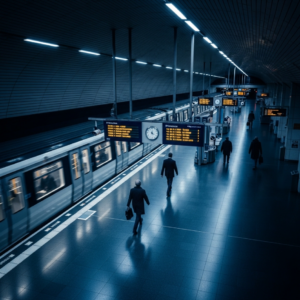
To see the physical scars of this revolution, one only needs to stand at Bank Underground station in the heart of London’s financial district. Before 2020, this was a roaring artery of capitalism. At 8:30 AM, the station was a blur of charcoal suits and expensive leather briefcases, thousands of people moving with the terrifying focus of a shark in a feeding frenzy.
Today, the scene is hauntingly different. Data shows that on a Friday morning, the commuter numbers are roughly half of what they were before the pandemic. The suits are still there, but they are fewer. The frenzy has been replaced by a measured pace. Individual workers are saving thousands on train tickets and fuel; they are reclaiming the two hours a day once lost to the “commuter crush.”
However, this personal gain comes with a hidden cost. Lord Stuart Rose, who formerly led the retail giants Marks & Spencer and Asda, is a vocal critic of this trend. “People who drive trains have to go to work. People in operating theaters have to go to work,” he argues, his voice carrying the weight of traditional management. He sees the empty stations as a sign of a decaying work ethic, a “bad play” for national productivity and economic growth.
Chapter III: The Hybrid Profit Machine
While some CEOs shout for a total return, the data tells a more nuanced story. Nick Bloom points out that 80% of Fortune 500 companies have settled into a “Hybrid” model. They haven’t done this out of the goodness of their hearts; they’ve done it because it is incredibly profitable.
The math is simple: when people work from home two days a week, “quit rates” fall by about a third. In an era where rehiring and retraining is a massive expense, keeping your best talent happy is the ultimate “win-win.” Hybrid work allows for the “Big Three” of modern recruitment: a good pension, a healthcare plan, and the right to work from home.
“If you want your folks in the office five days a week,” Nick Bloom observes with a wry smile, “you basically have to pay them 8% more.” The flexibility has become a shadow currency, a perk that workers are willing to trade literal money for.
Chapter IV: The Great Class Divide
The work-from-home debate has also birthed a new, uncomfortable social hierarchy. On one side, you have the university-educated professionals—the managers, the techies, the accountants—who can perform their duties through a glass screen. On the other, you have the frontline service workers, the delivery drivers, the nurses, and the retail staff.
Billionaire Elon Musk has famously slammed remote work as a symbol of “class division.” He argues that it is morally wrong for the “laptop class” to hide at home while the factory workers toil in person. But Nick Bloom counters this with a powerful human perspective. He speaks of a senior executive who was paralyzed from the neck down in an accident. For this man, coming into the office is a three-hour ordeal involving carers and specialized transport. Working from home takes him twenty minutes.
“The Musk view,” Nick argues, “is going to lose folks like that.” By forcing a “crusade” against remote work, we risk pushing productive, disabled people, parents with young children, and those nearing retirement out of the workforce entirely.
Chapter V: The Political Battlefield
Predictably, the office has become a political battleground. In the United States, your stance on remote work often predicts your voting record. Populist leaders, appealing to a base of frontline and blue-collar workers, tend to view the “laptop class” with suspicion. They use the return-to-office mandate as a way to “poke in the eye” the other half of the population.
Meanwhile, in Europe, the right to work from home is being codified into law. Spain has guaranteed flexible arrangements; Ireland has made the right to request remote work a legal entitlement. In the UK, a new Employment Rights Bill is currently winding its way through Parliament. Yet, Zoe Conway warns that the “implementation” remains a mystery. There is a “nagging feeling” among business owners that remote work is draining the bottom line, and they are lobbying hard to ensure the final law has plenty of “loopholes.”
Chapter VI: The Future—Star Wars or 1950?
So, where do we go from here? Nick Bloom predicts a “Nike Swoosh” trajectory for the remote work revolution. We’ve seen the initial drop from the pandemic peaks, and we are currently in the “flat bit” of the curve. But in the long run, the line only goes up.
As office leases expire over the next decade, companies will realize they don’t need twenty floors of expensive real estate. As younger, tech-native CEOs take the reins, the old-school “eyes on the desk” management style will die out. But the real game-changer is technology.
Nick envisions a 2030 where the “spare bedroom” looks like the Star Wars Jedi Council. We are moving toward an era of holograms, immersive VR headsets, and high-fidelity connectivity that makes a Zoom call look like a stone-age tool.
Deep Reflection: The Soul of the Laborer
The universal lesson of this story isn’t about Wi-Fi speeds or office floor plans. it is about the fundamental human desire for autonomy. For a century, we accepted the “9-to-5” as a natural law, a trade of our time and our geography for a paycheck. The pandemic shattered that illusion. It proved that the world doesn’t stop turning when the cubicles are empty.
True productivity isn’t measured by the hours you spend under a fluorescent light; it is measured by the quality of the work and the health of the worker. The return-to-office push is more than an economic debate—it is a struggle over who owns the worker’s time.
How do you feel as you look at your own workstation today? Are you reading this from a busy office, or from the quiet of your own home? Does your boss trust you to get the job done, or do you feel the “nagging feeling” of a manager who wants you back in the room? Share your thoughts below. The future of work is being written by us, right now.
Disclaimer : This content may be created by AI for entertainment purposes. Any resemblance to real persons, events, or places is coincidental.






