The Beautiful Hands of the Mud: A Mother’s Hidden Sacrifice and the Storm That Healed a Broken Home
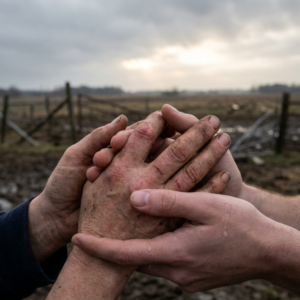
In the quiet, shivering moments before the dawn, Sarah stands alone. The world is a canvas of deep blues and grays, and the air carries a biting chill that settles into the marrow of her bones. She is forty-two years old, but her body carries the history of a much longer life. Beneath her heavy work boots, the ground is frozen and unyielding—a stubborn adversary she faces every single day. Most people passing by would see only a desolate patch of earth, a life of endless toil, and the “dirty” reality of a small-town farmer.
But Sarah sees something else. She sees the promise of life tucked beneath the soil. She sees a legacy she was entrusted to protect. Her hands, once soft and smooth from years of typing in bright, sterile city offices, are now a landscape of hard callouses, deep-set soil stains, and the small, silver scars of sharp tools. Her back often screams in protest, a dull, throbbing ache that follows her from the first light of dawn until the heavy silence of dusk. Since her husband, Mark, passed away, Sarah has been more than a mother; she has been a shield. She works until her muscles fail, just to ensure there is food on the table and a roof over her son’s head. Yet, as she stands in those fields, the silence of her home often feels heavier than any fifty-pound bag of grain she hauls across the yard. She looks at her son, Leo, and sees a stranger—a boy dreaming of neon lights while she is covered in the mud that keeps him fed.
The Promise Written in the Dust
To understand Sarah’s calloused palms, one must look back ten years, to a life that seems like a fading dream. A decade ago, Sarah was a different woman. She lived in the frantic, electric hum of the big city. Her days were spent in a clean, climate-controlled office where the only “dirt” she encountered was the dust on a computer screen. Her evenings were spent walking under the vibrant, artificial glow of neon signs, her hands soft, her silk dresses fluttering in the city breeze. She was comfortable. She was safe.
Then, tragedy struck with the force of an earthquake. Her husband, Mark, the anchor of her life, fell gravely ill. Sarah remembers the sterile smell of the hospital room and the rhythmic, terrifying beep of the monitors. She sat by his side for weeks, holding a hand that was growing colder and weaker each day. In his final moments, Mark looked at her with eyes clouded by pain but filled with a singular, desperate plea. “Sarah,” he whispered, “please take care of our family land. Don’t let it die.”
That promise became Sarah’s North Star. She abandoned the comfort of the city and moved back to the small, quiet village of Mark’s ancestors. The transition was a brutal awakening. She had to teach herself the language of the seasons—how to read the clouds, how to coax life from a stubborn seed, and how to survive on almost nothing. She began to burn the candle at both ends, laboring in the dirt under a blistering sun by day and hammering away at their crumbling farmhouse by night. Slowly, the “city lady” vanished. In her place emerged a woman of the earth, a woman whose every scar was a silent testimony of love for a man who was gone and a son who was growing further away.
The Growing Divide: Neon Dreams vs. Earthly Reality
As the years passed, the gap between Sarah and her son, Leo, became a canyon. Leo did not see the beauty in the sunrise or the miracle of the harvest. He saw only the isolation. He spent his hours hunched over his phone, the blue light reflecting in eyes that were always looking elsewhere. He watched videos of city teenagers in designer clothes, eating in “racy” restaurants and walking through sprawling malls. To Leo, their small house smelled of wet soil and failure.
One evening, the tension finally boiled over. Sarah had prepared a simple meal, the best she could afford. Leo pushed his plate away with a look of pure disdain. “Why do we eat the same simple food every day?” he demanded, his voice sharp with resentment. “My friends in the city have real lives. I want a real life.”
Sarah sat in the shadows of the kitchen, her throat tight. She didn’t tell him about the unpaid bills tucked away in the drawer. She didn’t tell him that her own stomach was often empty so that his could be full. To bridge the gap, she made a desperate sacrifice. For an entire month, she skipped her own breakfast and stopped buying the daily medicine she needed for her aching joints. Every penny was hoarded until she could buy him the expensive, branded jacket he had begged for. She placed it on his bed, her heart racing with the hope that this would be the bridge back to his heart.
Instead, Leo looked at the jacket with a cold, critical eye. “It’s not the latest version, Mom,” he said, tossing it aside. He took her sacrifice as his birthright, never once asking where the money came from or why his mother looked paler and thinner with each passing week.
The Day the Sky Turned Black
The breaking point arrived with the harvest season. The heat was oppressive, and the air was thick with the scent of impending rain. Sarah was at the end of her strength, her body trembling with exhaustion. “Leo, please,” she pleaded, looking at his clean clothes and his defiant posture. “Help me in the field. The rain is coming soon, and we will lose everything.”
Leo stood his ground, looking at her muddy boots with a disgust that felt like a physical blow. “I’m not a farmer and I will never be one!” he shouted. “I want to move to the city and live with Aunt Clara. She has a beautiful life, not a dirty one like this!”
The air between them felt frozen, even in the summer heat. When Sarah reached out to touch his arm, to try and explain the stakes, he pulled away as if her touch were toxic. “I hate this life,” he said coldly, before turning his back on her. Sarah stood alone as the first gray clouds began to swallow the sun. She realized in that moment that Leo didn’t see a home; he saw a prison, and he saw his mother as the guard. She felt smaller than she ever had, a tiny figure against an immense, darkening horizon.
The Wrath of the Storm
On Tuesday, the world ended. The sky didn’t just turn gray; it turned a bruised, terrifying shade of charcoal. The wind began to howl, a sound like a thousand screaming voices tearing through the trees. Sarah stood by the window, her breath fogging the glass, as the rain began to pour with a violence she had never witnessed. It wasn’t a life-giving rain; it was a disaster.
For hours, the storm battered the earth without mercy. When the wind finally died down, Sarah ran to the fields, her heart thumping against her ribs. What she saw destroyed her spirit. The golden crops—the result of months of backbreaking labor and the only source of income for Leo’s school fees—were gone. They were broken, mangled, and buried under a thick, suffocating blanket of mud.
The weight of her failed promise to Mark crushed her. She walked back to the porch, her steps heavy and uncertain. As soon as she reached the shadows, her strength evaporated. She slumped against the cold wood of the house, her head in her hands, gasping for air as the reality of their poverty set in. She was a woman who had traded her soul for this land, and the land had betrayed her. She sat in the dripping silence, wondering if this was the moment Leo would finally leave her forever.
The Shovel and the Revelation
The following morning was unnaturally still. Sarah dragged herself out of bed before the sun, her body feeling like lead. She went to the fields to begin the impossible task of cleaning the debris. Each scoop of mud felt like a mountain. Then, she heard a sound—the heavy, rhythmic thud of a shovel.
She turned and gasped. There was Leo. He was wearing his father’s old, oversized rubber boots, looking small but determined. He didn’t offer an apology; he didn’t give a speech. He simply stood beside her and began to dig. For hours, they worked in a silence that was no longer heavy, but sacred. They were two souls fighting for their survival.
As they moved a pile of wet, matted stalks, Leo stopped. He reached into the muck and pulled out a sodden, filthy rag. It was the expensive jacket Sarah had bought him, now ruined and worthless. He held it in his hands for a long time, the weight of it seemingly pulling his gaze toward his mother’s hands.
For the first time, Leo truly saw them. He saw her fingers—red, swollen, and cracked from the cold. He saw the deep, permanent stains of soil under her nails. He saw the scars from tools and the tremors of a woman who had skipped her medicine so he could wear a brand name. The realization hit him with the force of the storm. He finally understood: his mother had chosen to live in the mud so that he could dream of the lights.
Beautiful Hands: The Healing of a Family
Leo’s breath hitched, and his shoulders began to shake. He dropped the ruined jacket into the mud and walked toward Sarah. He took her rough, scarred hands into his own. His touch was no longer recoiling; it was incredibly gentle. He looked at the callouses that represented every meal he had eaten and every book he had read.
Tears filled his eyes as he looked up at her. In a voice thick with love and a newfound wisdom, he whispered, “Mother, your hands are not dirty. They are beautiful.”
In that moment, the devastation of the lost harvest didn’t matter. The pain of the past ten years vanished. Sarah saw a light in her son’s eyes that was brighter and more enduring than any city neon. They stood together in the ruins of their livelihood, but for the first time, Sarah felt they were standing on solid ground.
In the weeks that followed, they worked side by side. They managed to save a small portion of the harvest—crops that felt like pure gold. Leo stopped staring at his phone. He began to watch the earth. He began to understand that a “real life” isn’t found in a mall or a restaurant; it is found in the people who stand in the mud with you when the storm hits.
Reflection: The Wealth Found in the Storm
Today, the farmhouse is still small. Sarah and Leo still work harder than most people can imagine. But the air inside their home has changed. It is filled with a deep, quiet respect. Sarah no longer hides her scars; she wears them as medals of survival.
This story is a powerful reminder for our modern, digital world. We often hide our struggles, thinking we are protecting those we love. But Sarah’s journey teaches us that sometimes, our silence creates a wall when we need a bridge. Sharing your pain is not a sign of weakness; it is an invitation to be understood.
True wealth is not found in the things we own, but in the hands we hold during the storm. If you are reading this, take a moment to look at the people who have worked quietly for your happiness. Look at the “dirty” hands that built your world. A grateful heart is the richest land you can ever own.
How has someone made a hidden sacrifice for you? Are you proud of the hardworking hands that raised you? Please share your story and comment “GRATEFUL” below to honor the strength of those who stand in the mud for us.
Disclaimer : This content may be created by AI for entertainment purposes. Any resemblance to real persons, events, or places is coincidental.






