The Candle in the Storm: How One Night of Silence Healed an Eight-Year Secret
Every night, the ritual was the same. Daniel would lie in the darkness of his city apartment, the blue light of the streetlamps filtering through thin curtains, waiting for a sleep that refused to come. At twenty-two, his body was heavy with exhaustion, but his mind was a runaway train. He would close his eyes, but instead of rest, he found a theater of anxiety. He saw the mounting stack of bills, the predatory interest on his debts, and the crushing fear that one wrong move at work would send his entire fragile life into a tailspin.
The room was silent, yet his mind was deafening. He would turn to the left, then to the right, hunting for a cool spot on the pillow, a comfortable angle for his limbs, but peace is not found in the position of the body. It is found in the stillness of the soul. As the clock ticked toward morning, the questions would arrive like uninvited guests: What if I lose my job? What if I never get ahead? What if my life is always this heavy? By dawn, he was a ghost of himself—eyes bloodshot, mind sluggish, forgetting the small details of his design work that used to come so easily. He was drowning in his own thoughts, and he was doing it in the middle of a crowded city.
A Call from the Quiet Places
The breaking point arrived on a morning that felt like a thousand others. Daniel sat at his desk, his boss’s voice echoing in his head—“Daniel, you look tired. Are you sleeping?”—and the hollow lie he had told in return—“I’m fine.” But he wasn’t fine. He was desperate. It was then that his phone vibrated with a message that changed the trajectory of his week. It was from his grandmother.
She lived far beyond the city’s steel and glass, in a place where the air moved slower and the horizon wasn’t blocked by skyscrapers. “Come visit me today,” the message read. “I want to show you something.” When he called her, her voice was a cool balm. She didn’t ask if he was okay; she told him he wasn’t. “Come before sunset,” she instructed, her voice steady and knowing, “and bring your worried mind with you.” For the first time in months, Daniel felt something other than dread. He felt a flicker of curiosity. He didn’t know what she had planned, but he knew he couldn’t stay where he was.
The Simple Sanctuary
The bus journey was a slow transition from chaos to clarity. As the urban sprawl gave way to rolling greens and open skies, Daniel felt the physical weight of the city begin to lift, though his mental baggage remained firmly packed. He arrived at a small, weathered house with a garden that breathed life and a wooden chair by the door where his grandmother sat waiting. She didn’t say much; she didn’t need to. Her eyes saw the dark circles under his, the tension in his shoulders, and the frantic energy of a man who had forgotten how to breathe.
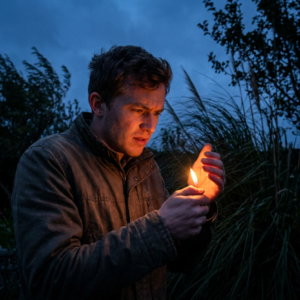
Inside her home, the world narrowed down to the essentials. There was no television, no hum of a refrigerator, just the sound of the wind. She handed him a small, unlit candle and a single match. “Light it,” she said. The flame flickered to life—a tiny, fragile orange glow in the center of the room. “I want you to take this candle,” she whispered, “walk to the end of the yard, and come back.” Daniel looked at her, confused. He expected a lecture, a herbal remedy, or a long talk. Instead, he was given a task that felt like a child’s game. But as he stepped onto the grass, he realized the “test” was anything but simple.
The Battle for the Flame
The yard was open to the evening breeze. As Daniel took his first step, the wind caught the flame, causing it to dance violently. Suddenly, the simplicity vanished. He had to protect this light. He cupped his hand around the wick, his eyes locking onto the fire. He heard a car roar past on the distant road—a sound that usually would have sent his mind spiraling into thoughts of traffic and missed deadlines—but he forced himself to stay. He didn’t turn his head. He couldn’t. If he looked away, the flame would die.
Then, the true test came. His phone vibrated in his pocket. A message. The old Daniel would have reached for it instantly, his mind screaming: Is it work? Is it a crisis? For a split second, his focus shifted. The flame weakened, turning into a tiny, blue ghost of itself. “No,” he whispered to the grass. He ignored the vibration. He chose the candle over the world. In that moment of refusal, something miraculous happened. The noise of the world—the car, the phone, the mental list of debts—became a background hum. The only thing that existed was the warmth of the wax and the steadying light.
The Silence Inside
By the time Daniel reached the edge of the yard and turned back, he was no longer walking; he was flowing. The frantic pace of his thoughts had slowed to match his footsteps. He noticed the bark of a dog and the voices of neighbors, but he didn’t follow them. He acknowledged them and then returned his gaze to the flame. He was practicing the art of presence without even knowing the word for it.
When he finally stepped back into the house, the candle was still burning bright. He stood before his grandmother, his breathing deep and regular for the first time in years. “What did you see?” she asked. Daniel didn’t talk about the yard or the wind. “I saw the flame,” he said. “I had to protect it. If I looked away, it became weak.” His grandmother smiled, a look of profound peace on her face. “Your mind is like this flame,” she said. “When you follow every sound, every worry, your mind becomes weak. But when you stay present, it becomes calm.”
The Architecture of Peace
The lesson was not that the problems had vanished. Daniel’s debts were still there. His job was still demanding. His future was still a mystery. But as he sat in the silence of his grandmother’s home, he realized that peace is not the absence of trouble; it is the presence of focus. You cannot control the wind, but you can cupping your hands. You cannot stop the thoughts from coming, but you can choose not to follow them into the dark.
Daniel returned to the city that night, but he took the candle with him—not in his hand, but in his mind. When the anxiety started to rise, he envisioned that small, steady flame. He took a deep breath. He chose where to put his attention. And that night, in the middle of the noisy, demanding city, Daniel did something he hadn’t done in eight long years. He closed his eyes, let the thoughts drift past like distant cars, and he finally, deeply, slept.
Join the Conversation: We live in a world that tries to blow out our “flame” every single second with notifications, worries, and noise. Have you ever had a “candle moment” where you finally learned to shut out the noise? What is the one thing you focus on to find your inner silence? Share your story below and help someone else find their light.
Disclaimer : This content may be created by AI for entertainment purposes. Any resemblance to real persons, events, or places is coincidental.






