The Ghost in the Tunnel: Why a “Nice Guy” Veteran Carved a Legend of Blood and Silence
New York City—and indeed the world—is full of stories about men who snap. We see them on the news, labeled as monsters or statistics. But rarely do we encounter the anatomy of a tragedy so profound that it blurs the line between a war hero and a vigilante, between a cold-blooded killer and a grieving son. This is the chronicle of a man known to his fellow inmates only as a “really nice guy,” a man serving two life sentences, and a man whose soul remained trapped in the claustrophobic darkness of a Vietnamese tunnel long after the helicopters stopped flying.
It is a story that asks us: What happens when the justice system fails a man trained by his country to be a professional shadow?
The Weight of the “Tunnel Rat”
To meet him in the prison mess hall was to meet a man of quiet, unassuming dignity. He didn’t boast. He didn’t join gangs. He spoke with a soft, neutral tone that suggested a life of disciplined routine. But beneath the sleeves of his prison blues lay the corded muscle of a Vietnam War veteran—specifically, a “tunnel rat.”
To understand his internal state, one must visualize the environment that forged him. Imagine a hole in the earth, barely wider than a man’s shoulders. The air is thick, a humid soup of rot, stale sweat, and the iron tang of damp soil. There is no light. Flashlights were a death sentence, inviting enemy fire. This man spent his youth belly-crawling through these earthen veins, armed only with a .45 caliber pistol (too loud to use) and his boot knife.
He described spiders the size of basketballs rushing at his face in the pitch black. He spoke of sensing the vibration of an enemy’s breath before he saw them. In those moments, he wasn’t a human being; he was a precision instrument of lethality. He learned to slash a throat and drag the corpse forward with him because the tunnel was too narrow to turn around. He lived in blood, literally—once emerging from a hole so saturated in another man’s life force that his commanding officer thought he had been shot.
He came home looking for peace, but the war had already decided he would never sleep soundly again.
The Homecoming That Wasn’t
The veteran’s tour was coming to an end. While his comrades dreamed of burger joints and neon lights, he worried about his sister. He was a man defined by a fierce, silent protectiveness. He knew she was trapped in an abusive relationship, a cycle of violence he couldn’t reach from the jungles of Southeast Asia. He did the only thing a long-distance brother could: he sent a letter, urging her to break it off, hoping his return would provide the shield she needed.
When his plane finally touched American soil, he caught a cab from the airport. He was blocks away from his childhood home, likely smelling the familiar city air, perhaps allowing himself a single moment of hope. But as the taxi turned the corner, the world turned gray.
The street was a sea of flashing blue and red. Yellow tape fluttered in the breeze, sealing off his house like a tomb. He stepped out of the cab, his duffel bag heavy, and walked into a nightmare. He didn’t want to cause trouble; he told the officers he was just back from the war and wanted to go home.
At the station, the detective’s voice was a cold, detached hammer blow: “Your mother and your sister are dead.”
The boyfriend—the coward he had warned his sister about—had not taken the breakup well. He had chosen mass murder over rejection. The police told the veteran to “let the system work.” They told him they had the guy.
Then, the system did the unthinkable. It granted the killer bail.
The Pool Table Bet: A Ritualistic Execution
When the veteran learned that the man who slaughtered his family was walking the streets on bond, the “tunnel rat” took over. The civilized man who buttoned his flannel shirts vanished; the shadow with the boot knife returned.
He didn’t go to the police. He didn’t scream at the courthouse. He went to the bar where the killer felt safe.
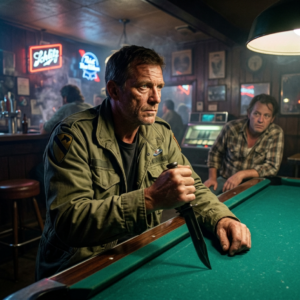
The lighting in the bar was dim, hazy with cigarette smoke, and smelling of cheap beer and desperation. The killer was at the pool table, chalking his cue, laughing as if he hadn’t just erased two lives. The veteran approached him. He didn’t jump him immediately. He sat nearby, chatting him up like a stranger. He told the guy about Vietnam. He pulled out his combat knife—the one that had tasted the humidity of the Mekong Delta—and explained what it was like to crawl in the dark, knowing an enemy was waiting to kill you.
The killer, arrogant and oblivious, asked if the vet wanted to bet on the game.
The veteran looked him in the eye with a gaze that had peered through basketball-sized spiders and said, “I have a bet for you. I bet I can skin you alive in front of everyone here, and not a single person will stop me.”
He won the bet. He dismantled the man methodically. It wasn’t a crime of passion; it was a ritual. He made the murderer feel every second of the darkness he had brought into the veteran’s life. He didn’t stop until the police arrived and asked him to.
The Question That Chilled the Courtroom
The trial was a formality. Vengeance, however justified, is still murder in the eyes of the law. But the veteran didn’t beg for mercy. He sat in the defendant’s chair with an unsettling, stony calmness that sent shivers through the jury.
When the judge asked if he had any final words before sentencing, the veteran didn’t apologize. He didn’t weep for his mother or sister. He leaned forward, locked eyes with the magistrate, and asked one question:
“What is the name of the judge who granted bail to the man who murdered my sister and my mother?”
The courtroom fell into a vacuum of silence. The judge tried to move past the provocation, but the veteran repeated it, firmer this time. He didn’t want a lighter sentence; he wanted a name. He wanted to know who was responsible for the second death of his family.
He was sentenced to two life terms. The system thought they were burying him. They didn’t realize that for a tunnel rat, the darkness of a cell is just another day at the office.
The Vanishing of the Magistrate
Inside the prison walls, the veteran became a living legend. He didn’t seek power, yet gang leaders and ruthless killers gave him a wide berth. He moved through the corridors with the gait of a man still on a battlefield.
But while he was physically contained, his influence was not. He had brothers—men he had bled with in the dirt of Vietnam. Men who owed him their lives.
The judge who had granted that bail started receiving letters with no return addresses. Phone calls that were just the sound of heavy breathing. He grew paranoid. He reinforced his security. But in the world of the shadow-warrior, walls are an illusion.
One night, the judge simply vanished. His car was found abandoned on a deserted road. No struggle, no forced entry. Just an empty seat and a lingering silence. When his body was found days later, the authorities were horrified. He hadn’t been robbed. He had been subjected to precise, methodical cuts—tested to see exactly how much pain a man could endure before succumbing.
Behind bars, when the news reached the veteran, he didn’t cheer. He simply smiled. He hadn’t touched the judge, but the “tunnel” had finally claimed the man who let the wolf out of the cage.
Deep Reflection: The Prison of the Mind
What is the universal lesson here? It is a grim one. It teaches us that the “justice” provided by a set of books and a gavel is often insufficient to heal a heart broken by trauma. It reminds us that when we train men to be monsters in the name of the state, we cannot expect them to forget those lessons when the state fails them at home.
The veteran died in prison years later. He grew old, his hair turning white, his hair thinning until his stare was the only thing that remained sharp. He never showed remorse. He never asked for forgiveness. To him, the world was a series of tunnels. You crawl, you clear the hole, you move to the next one.
His real prison was never the stone walls of the penitentiary. It was the memory of a sister he couldn’t save and a mother whose house he couldn’t protect. He lived in a cell of his own making long before the handcuffs were clicked shut.
Call to Action: This story is a heavy one. It forces us to look at the cracks in our society and the price of vengeance. Have you ever felt that the law wasn’t enough? How do we support the men and women who come home from war carrying these kinds of shadows? Share your thoughts below. Let’s talk about the true cost of “justice.”
Disclaimer : This content may be created by AI for entertainment purposes. Any resemblance to real persons, events, or places is coincidental.






