The Architecture of a Secret: When the Price of Love is Your Best Friend’s Trust
Some feelings do not go away. They aren’t like the weather in Chicago—fickle and prone to shifting with the wind. Instead, they are more like the bedrock of the city itself: cold, heavy, and buried so deep beneath the surface that you forget they are holding everything up. You push them down with the frantic energy of a graphic designer’s deadlines; you cover them with the noise of city traffic; you even try to suffocate them with the presence of other, “safer” people. But the feeling waits. It has nowhere else to be.
My name is Lenora. I am 28 years old, and for eight of those years, I carried a secret that weighed exactly as much as my future. This is not a fairy tale about finding “the one.” This is a story about the devastating arithmetic of the human heart—the realization that sometimes, to gain the love you’ve waited a lifetime for, you have to pay with the only person who truly knew you.
The Thanksgiving That Changed Everything
It was November in Chicago, the kind of cold that bites through your coat and settles in your bones. I was twenty years old, a girl still trying to find her footing in the world. Tamson, my best friend from college—the woman who knew my favorite tea and the exact way my nose crinkled when I was nervous—had invited me to her family’s Thanksgiving dinner.
I remember the house. It was a sanctuary of amber light against the gray Chicago dusk. It smelled of sage, roasting turkey, and the kind of history that only long-standing families possess. Tamson’s mother hugged me at the door with a warmth that made me feel less like a guest and more like a missing piece of the furniture. Her father’s handshake was firm and grounding. I was beginning to relax, to let my guard down, and then the door opened again.
Lyall walked in.
He was Tamson’s older brother, twenty-four at the time, tall with dark hair and an expression that seemed to find the world inherently interesting. When he walked toward me, the room seemed to tilt. He took my hand, shook it, and said my name. He didn’t just utter it; he said it slowly, with a deliberate care that made the syllables feel important. Throughout that dinner, I was a ghost at my own plate. I watched the way he made his mother laugh, the way he helped his father in the kitchen, and the way he listened—truly listened—without ever talking over anyone.
That night, driving home through the silent, dark streets, I told myself it was a “small feeling.” I told myself it would evaporate like steam. It didn’t. It became the background noise of my entire twenties.
The Price of a Placeholder: Corbin and the Silent “No”
Three years passed. I was 23, living in a small apartment, building a career in design. The feeling for Lyall remained, a quiet hum in the back of my mind, even though he had moved away to Seattle. That was when I met Corbin.
Corbin was everything a woman is supposed to want. He was kind, stable, and he adored me. He remembered that I didn’t drink coffee; he remembered my birthday was in March. We went to the cinema; we walked through parks in the humid Chicago summers. For fourteen months, I tried to build a life on top of the secret.
One evening, in the quiet warmth of his living room, Corbin looked at me with a clarity that terrified me. “Do you love me?” he asked.
I wanted to say yes. I searched my throat for the word, but it was blocked by the ghost of a name I couldn’t speak. Corbin didn’t get angry. He didn’t shout. He simply looked at me for a long time, saw the truth I was hiding from myself, and said two words: “I know.”
He put on his jacket and walked out of my life, closing the door with a softness that hurt worse than a slam. Corbin was the first installment of the price I would pay for Lyall. He was a good man who deserved a heart that wasn’t already occupied by a phantom.
The Return of the Ghost
Five more years drifted by. I became a successful designer with a bigger studio. Lyall was a name Tamson mentioned occasionally over our Friday morning tea at the coffee shop where we sat in the same two chairs for six years. He was in Seattle. He was married. He was a memory.
Until he wasn’t.
“Lyall comes back home,” Tamson said one Tuesday. Four words that ended my eight-year peace.
The family dinner was a blurred repetition of that first Thanksgiving, but Lyall was different now. At 32, the easy, funny young man was gone. In his place was a man who looked tired, a man who had survived a divorce and carried the weight of his own mistakes. He was quiet, sitting at the table with his head down, helping his mother with the dishes, saying “thank you” with a gravity that pulled at me.
When I left that night, he followed me to the parking lot. The air was frigid. He looked at me and said, “You seem different. Less nervous. More yourself.” I didn’t have a plan. I just had eight years of accumulated silence.
The next day, a text arrived. Not from Tamson. From Lyall.
Good coffee shop near your studio.
I sent him the address. I told myself it was nothing. I told myself that for eight years. But as we met once, then twice, then five times, the “nothing” began to consume everything else.
The Rain on the Window and the Weight of Truth
One Thursday, the sky opened up. The rain was so heavy it turned the coffee shop windows into a blurred, impressionistic painting. Lyall’s apartment was across the city. “You can sleep on my couch,” I said.
In the 1:00 AM stillness of my apartment, sitting on the floor with tea, the masks fell away. He talked about his marriage. He didn’t blame his ex-wife; he blamed his own obsession with work. He protected her even in the aftermath of their collapse. He was honest in a way that Corbin couldn’t be, because Lyall was broken in the same places I was.
The next Friday, I sat with Tamson. She was glowing, talking about a promotion at work, reaching over to take a bite of my cake, laughing that familiar, warm laugh. I smiled back. I said, “I’m happy for you.”
I felt sick. Every smile I gave her was a counterfeit coin. I knew something she didn’t—that her brother and I were orbiting a sun she couldn’t see. It wasn’t just a secret; it was a betrayal of the Friday morning ritual we had performed for six years.
The Real Line: The Kiss and the Text
Two weeks later, on a quiet evening walk, Lyall stopped. He turned. He kissed me.
I stepped back, the panic rising. “I cannot do this,” I whispered. “I know,” he said.
And then, the words I hadn’t planned to say for the rest of my life spilled out: “I felt this for eight years.”
Lyall went still. “I knew you were twenty when we met,” he said softly. “I chose to do nothing because you were Tamson’s person.”
We walked home in a silence that felt like a funeral for our previous lives. That night, Tamson texted: I did not see you much lately. Is everything okay?
I typed: All good, just busy.
That text was the real line. Not the kiss. Not the eight years of longing. The moment I chose to lie to the woman who loved me most was the moment the debt became due.
The Jacket on the Chair
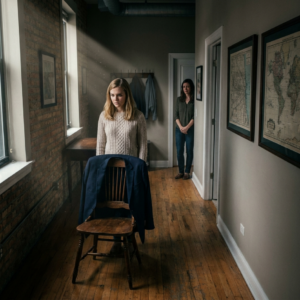
The end of the secret came by accident, as these things always do. Tamson came to my apartment unannounced. The door was unlocked. She walked in and saw his jacket—the dark blue, slightly worn jacket she had seen her brother wear a thousand times—draped over the chair by the door.
I walked out of the kitchen and saw her. She didn’t move. She just looked at the jacket, then at me.
She sat on her usual side of the couch—the left side. “How long?” she asked. “Two months,” I said.
She nodded, her eyes fixed on the floor. She wasn’t surprised that her brother loved me; she had always suspected it. She was angry because for eight weeks, I had looked her in the eye, listened to her life, and kept my own a fortress.
“I am angry because I called you every week,” she said, her voice trembling not with rage, but with the sound of a heart breaking. “You listened to everything I said, and you never said one word to me.”
She left. She didn’t slam the door. She closed it quietly. That quietness was the most terrifying sound I have ever heard.
The Empty Chair and the Five-Page Letter
For three weeks, the world was gray. Lyall was there, but the space where Tamson used to be was a gaping wound. I walked past our coffee shop and saw our two chairs through the window. They were empty. The pain was existential—losing someone who is still alive and only blocks away is a specific kind of mourning.
Lyall told me to choose her. “Choose her over me,” he said. “It’s okay.” But the choice had already been made.
I wrote her a letter. Five pages of ink and honesty. I didn’t ask for forgiveness; I didn’t offer excuses. I told her I was scared. I told her she mattered more than I had the courage to show. I slid it under her door and waited.
Seven days of silence followed. Seven days where I realized that love—the big, romantic kind—is not the whole story. Sometimes the cost of that love is too high to calculate.
On the seventh day, the text arrived: I got it.
The Lessons of Burned Toast
Six months have passed. It is a Sunday morning.
Lyall is in my kitchen, accidentally burning toast until the smoke alarm shrieks. He isn’t the perfect man I imagined for eight years. He’s a man who makes mistakes, who burns breakfast, who carries the scars of a past life. But he is here.
Tamson and I have talked. We’ve sat in parks; we’ve sat in her car. The talks are careful, like walking on thin ice. The easy jokes aren’t back yet. Maybe they never will be. Last week, she sent me a photo of our coffee shop with the empty chairs bathed in morning light.
I remember, the photo said.
I printed that photo and pinned it above my desk. It reminds me that I made a choice. It wasn’t a brave choice or a clean one. It was just an honest one. I stopped carrying a feeling alone, and I stepped into the light, even though the light showed me exactly what I was losing.
I have the man I waited for. I also have the memory of a friendship that may never be the same. I hold both. That is what it means to be a grown woman. You can have the love of your life and the grief of your life at the very same table. And today, with the smell of burned toast in the air, that is enough.
The Question for You: We all carry “small feelings” that we tell ourselves will go away. Have you ever had to choose between a love you couldn’t ignore and a friendship you couldn’t replace? What was the price you paid for your truth? Share your story in the comments. Let’s talk about the choices that define us.
Disclaimer : This content may be created by AI for entertainment purposes. Any resemblance to real persons, events, or places is coincidental.






