A Story of Betrayal, Resilience, and the Long Road Home
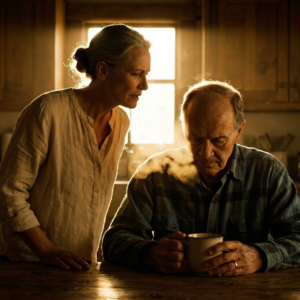
The human heart is not a simple vessel. It is a complex landscape of scars, hidden valleys of grief, and peaks of unexpected strength. For Anna, a woman who spent decades cultivating a life of warmth and family, that landscape was leveled in a single evening of honesty that felt more like a brutal execution. What follows is not just a tale of a broken marriage, but a deeply moving chronicle of how a woman rebuilt her soul from the ashes, only to be faced with the ultimate test: the return of the man who set her world on fire. This is a story for anyone who has ever wondered if the pieces of a broken life can ever truly fit back together.
The Sunset on the Porch: A Life Built on Fragile Promises
Anna’s story began where so many great loves do—in the quiet corner of a neighborhood coffee shop, amidst the aroma of roasted beans and the rustle of turning pages. At twenty-four, Anna was a woman who found solace in books. David was the man who noticed. When he leaned over and asked, “Do you like that book?” he wasn’t just asking about literature; he was opening a door to a shared future. They were a perfect match on paper: they shared a pulse for the same music, a reverence for the outdoors, and a deep-seated hunger for a large, bustling family.
Their wedding was a vision of white lace and iron-clad vows. As David held her hand, his eyes locked onto hers with a sincerity that felt like an anchor. “I will love you forever,” he whispered. In that moment, Anna didn’t just believe him; she built her entire identity on those five words.
For years, they lived a life defined by small, beautiful rhythms. They moved into a modest house—a structure that wasn’t grand in size but was cavernous in its capacity for love. David was a teacher, molding young minds, while Anna found her calling in a flower shop, surrounding herself with the fleeting beauty of blooms. Every morning began with the press of his lips against her cheek; every evening ended on their porch, watching the sky bleed into hues of orange and purple.
When their daughters, Lily and Mia, arrived, David was the quintessential father. He was the voice behind their bedtime stories, the patient hand guiding their homework, and the man who called them his “little stars.” Anna’s days were a blur of cooking, cleaning, and caretaking. She didn’t have poems or grand gestures, but she had a husband who told her to wear a jacket when the air turned crisp and who took over the dishes when her back ached. To Anna, that was the ultimate form of love. It was safe. It was hers.
The Cold Shadow of the Big City
The shift was as subtle as a season changing until it was suddenly winter. As the girls grew older and Anna returned to full-time work, David transitioned into the corporate world of the city. The man who used to be home for the sunset now returned long after the stars had taken their places. He was a shell of his former self—shoulders slumped, eyes distant, and his voice a weary monotone of “I’m just busy.”
But a woman knows the architecture of her husband’s soul. Anna felt the tectonic plates of her marriage shifting. The smiles grew rare. The phone, once left carelessly on the counter, was now a locked vault. The midday check-in calls ceased. Then came the “work trip”—three days of a heavy, intuitive dread sitting in Anna’s chest. When he returned, he was a stranger. No hug, no inquiry about the girls, just a retreat into sleep.
The truth arrived in the form of a friend. Sarah entered the flower shop one afternoon, her face a mask of nervous hesitation. “Anna, I saw David… with another woman. They were holding hands.”
The world didn’t end with a bang. It ended with the shaking of Anna’s hands as she turned the “Closed” sign on the shop door. That night, in the sterile light of their kitchen, she asked the question that had been rotting in her mind. David didn’t even have the mercy to lie. He looked at the floor, a coward in his own home, and admitted it. “Yes. I love her. I’m leaving.”
Anna didn’t give him the satisfaction of her tears. She watched in a frozen silence as he packed a bag and walked out, the sound of the front door clicking shut echoing like a gavel. Her world hadn’t just broken; it had been erased.
The Silence of the Kitchen and the Lessons of Elena
The aftermath was a long, dark tunnel. Anna sat in her kitchen for hours, staring at corners that were saturated with memories. The house felt too big, the silence too loud. She had to break her daughters’ hearts with the news, watching Mia cry and Lily struggle with a “why” that Anna couldn’t answer. “He is still your father,” Anna told them, her voice a fragile bridge. “Respect him. But he hurt me.”
For months, the bed was a cold, empty expanse. Anna was drowning. It was Sarah who pulled her out, dragging her to the children’s hospital where she volunteered. It was there that Anna met Elena.
Elena was a small girl, made fragile by illness and robbed of her hair, but her spirit was an incandescent flame. She showed Anna a drawing—a sun shining over two people holding hands. “That’s me and my mom,” Elena said with a smile that defied her reality. “We go to the park in my dreams.”
Looking at the mothers in that ward—women who slept in chairs, who didn’t know if their children would see tomorrow, yet still found the strength to smile—Anna felt a profound shift. Her pain, though deep, was not the only pain in the world. She began to bring flowers to the ward. Then cookies. Then stories.
Slowly, the act of giving hope to others began to heal Anna’s own spirit. She wasn’t just “the woman who was left.” She was a sponsor for medicine, a storyteller for the sick, a listener for the grieving. Her daughters watched her transform from a victim into a pillar. “Mom, you are strong,” Lily told her one day, and for the first time in years, Anna believed it.
The Mother’s Day Knock: A Ghost Returns
Ten years passed. A decade of growth, of weddings, of new jobs, and the quiet joy of a life reclaimed. Anna still worked at the flower shop; she still walked the halls of the hospital. Her daughters had moved out to start their own lives, leaving Anna in the small house that was now a sanctuary of her own making.
On Mother’s Day, as Anna waited for her daughters, a knock came. It wasn’t the girls. It was David.
He was a ghost of the man who had walked out. His hair was a dull gray, his face a map of exhaustion and regret. “Hi, Anna. Can we talk?” he asked, his voice lacking the projected confidence of his city years. “I made a mistake. Can I come in?”
Anna stepped back, her heart a drum. “This is your old house,” she said, her voice steady. “You can come in.”
As he sat on the couch, David looked small. He confessed the truth: the woman he left her for had lied to him. Her child wasn’t his. He had been discarded just as he had discarded Anna. He had nowhere else to go. He didn’t want her money; he wanted her ears. “Please forgive me,” he pleaded.
Anna looked at him and felt a chaotic symphony of emotions: the old anger, the familiar pain, and a new, startling sense of pity. She didn’t shout. She didn’t cry. She simply pointed toward the hall. “You can stay in the guest room. It’s clean.”
Fixing the Fence: The Labor of Forgiveness
The days that followed were a surreal exercise in cohabitation. David was unsure, a man walking on eggshells. He took his coffee with a whispered “thank you.” He didn’t try to reclaim his place at the head of the table; instead, he took up tools.
Anna watched from the window as he moved through the garden. He fixed the broken fence. He cleaned the windows. He repaired a chair that had been wobbly for years. He worked with a meticulous, quiet care, as if every nail driven was an apology. Anna remained a silent observer, providing simple meals but withholding the intimacy of conversation.
When their daughters visited, the tension was palpable. “Mom, you don’t have to let him stay,” Mia urged, her protectiveness a shield. “We can take care of you.” But Anna realized this wasn’t about being taken care of. It was about the complex, messy business of closure.
The breakthrough came through the eyes of a child. Their granddaughter, Emma, burst into the house and saw David. “Grandpa!” she shrieked, throwing her arms around him. David’s smile in that moment was the first real one Anna had seen in a decade. When Emma begged them both to go to the park, Anna looked at the little girl’s big, expectant eyes and sighed. “Okay. Let’s go.”
Sunset Redux: A New Kind of Honest
At the park, sitting on a bench while Emma played, David finally spoke without the shield of tools. “Thank you for letting me come back, Anna.”
“I haven’t decided yet, David,” she replied, her gaze fixed on the horizon. “I feel angry, but I also feel sorry for you.”
Anna remembered the words of her friend Sarah: “You don’t have to forgive him right away. But maybe this is a chance to heal for both of you.” She realized that healing isn’t a solo journey. Sometimes, it requires the person who broke the world to help pick up the pieces.
The next morning, Anna invited him to the breakfast table. It wasn’t a surrender; it was an invitation to a new reality. “I don’t know if I can forgive you,” she told him, her voice honest and raw. “But I want to try.”
David’s eyes filled with tears—real tears this time, not the tears of a man caught, but of a man redeemed. “I will do everything to make it right,” he promised.
They began to talk—not about the weather, but about the “selfishness” David had lived in, the choice he had made, and the wreckage it left behind. They laughed over old memories and mourned the years lost. One morning, David brought Anna tea in bed. “Be careful, don’t spill it this time,” she joked, and the room was filled with a laughter that didn’t feel hollow.
Anna still doesn’t know what the future holds. The family might never feel “whole” in the way it was before, but perhaps it will become something better: something honest. Forgiveness isn’t a destination; it’s a long, arduous walk. But as Anna watches the sunset from her porch, David sitting a respectful distance away, she knows she is no longer a guest in her own heart. She is the master of it.
Universal Reflection: Anna’s journey reminds us that forgiveness is not a gift we give to the person who hurt us; it is a gift we give to ourselves to stop being a prisoner of the past. It requires the strength to see a person for who they are now, not just for the mistakes they made then.
Join the Conversation: What would you have done in Anna’s shoes? Is some betrayal too deep to ever truly forgive, or is the chance to heal a family worth the risk of a second heartbreak? We want to hear your stories and your heart. Share your thoughts in the comments below.
Disclaimer : This content may be created by AI for entertainment purposes. Any resemblance to real persons, events, or places is coincidental.






