THE LETTER THAT SHATTERED MY SILENCE
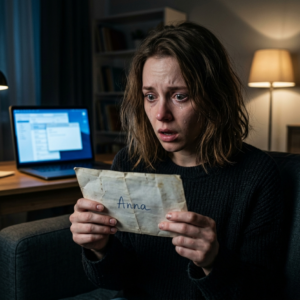
My name is Anna. At twenty-five, my life is a masterpiece of controlled, quiet stability. As a graphic designer, I spend my days creating clean lines and simple social media ads, finding comfort in the predictable pixels on my screen. I live alone in a small apartment where every object has its place, and every hour follows a rigid, safe routine. I wake, I work, I return to the solace of my own company, and I sleep. For years, I believed this solitude was a choice, a fortress I built to keep the world at bay. But the truth is more fragile. This fortress wasn’t built for peace; it was built out of the wreckage of a single morning seventeen years ago—the morning my father walked out of the front door and never looked back.
The memory is etched into my soul with terrifying clarity. I was eight years old, sitting on the hardwood floor of our family home, lost in the world of my doll. The air that day felt thick, heavy with an unspoken tension that a child’s intuition picks up long before their mind understands it. My father stood by the door, his shadow stretching across the room. He didn’t smile. He didn’t offer a playful wink or the usual morning hug. He just stood there, looking serious, his eyes fixed on the exit as if he were already gone. “Daddy, where are you going?” I asked. The question hung in the air, unanswered. In the kitchen, my mother was a statue, her back turned to us, her hands perhaps gripping the counter, her silence as loud as a scream. “Daddy,” I tried again, my voice smaller, more desperate. He opened the door. For one heartbeat, I was certain he would turn around, scoop me up, and tell me it was all a game. Instead, the door clicked shut. That click was the last sound of my childhood. No goodbye. No explanation. Just a sudden, vacuum-like silence that would take seventeen years to break.
The Window Watcher’s Vigil
In the weeks and months that followed, I became a prisoner of hope. Every evening, I would take my post by the window, my forehead pressed against the cool glass, watching the road until the streetlights flickered to life. I learned the rhythm of every car engine that passed, my heart leaping with a painful jolt every time a pair of headlights slowed down near our gate. I was a child convinced that the world worked on a logic of merit—that if I were just a little better, a little quieter, or a little more helpful, the universe would return what it had stolen.
When the months bled into years, the hope began to sour into a quiet, poisonous guilt. I remember asking my mother, “When will dad come back?” She would pause, the grief passing over her face like a cloud, and offer the same hollow refrain: “He had his reasons.” To an eight-year-old, “reasons” are invisible monsters. Without a target for my confusion, I turned it inward. I began to believe that I was the reason. Perhaps I was too loud during his afternoon naps. Perhaps I asked for too many toys. Perhaps I simply wasn’t a good enough daughter to stay for. These thoughts became the foundation of my adult self. I watched other children at school, their fathers lifting them onto shoulders or cheering from the sidelines of a soccer game, and I felt a physical ache in my chest—a silent, hollow throb that I learned to hide behind hard work and academic success.
The Architecture of Independence
By the time I reached my twenties, I had mastered the art of being alone. I told myself I didn’t need anyone. I built a life where I was the only person I depended on, convinced that the only way to avoid the agony of someone leaving was to never let them get close enough to stay. When people tried to enter my inner circle, I felt a cold surge of fear. I waited for the inevitable day they would grow tired of me and walk out that same door. My independence was a shield, but it was also a cage.
Then came the evening that changed everything. I returned home from the studio, the familiar weight of exhaustion settling on my shoulders. As I stepped into my entryway, my eyes snagged on something out of place: a white envelope lying on the floor. In an era of digital noise, a physical letter is an anomaly, a relic. I picked it up, my fingers brushing against the paper, and my breath hitched. My name was written across the front in a handwriting that felt like a half-remembered dream—looping, familiar, and haunting. There was no return address. My hands turned cold. I considered throwing it away, preserving the sterile peace of my apartment, but something ancient and hungry inside me demanded I open it.
“My Dear Anna”: The Truth From the Grave
I sat down, the paper trembling in my grip. My dear Anna, it began. I froze. Those three words were too intimate, too unauthorized after nearly two decades of absence. It’s your father. The air left my lungs. He wasn’t a ghost anymore; he was a voice on a page. The letter was a confession. He spoke of debts, of dangerous people, of a world of “big trouble” that he claimed he had to flee to keep my mother and me safe. He called it “protection.” He said he thought disappearing was the only way to ensure the people looking for him wouldn’t find us.
I stopped reading, the word protect tasting like ash in my mouth. For seventeen years, I had carried the weight of being “not enough,” and now he was telling me he left because he loved us too much? The anger began to simmer, a slow-acting heat that spread through my limbs. He chronicled everything he had missed: birthdays, the first day of school, the milestones that make up a life. And then, the final blow: I am very sick now. I don’t have much time. I am alone, and before I leave this world, I want to see you just once. He provided an address in a small, distant town and a plea: If you can come, I will wait.
The Internal War of a Daughter
The days following the arrival of the letter were a blur of internal conflict. At work, I stared at my computer screen, the designs I was supposed to be creating melting into a meaningless soup of colors. My coworker, Mina, noticed the shadows under my eyes, but I couldn’t find the words to explain that my dead father had just sent me a map to his bedside. At night, the silence of my apartment felt predatory. I paced the floor, back and forth, the letter acting like a magnetic pole I couldn’t escape.
Where was his “protection” when I was crying myself to sleep at ten years old? Where was his “love” when I was navigating the complexities of growing up without a compass? I visited my mother, sitting in the same living room where it all began. When I finally gathered the courage to ask her again why he left, she sighed, the weight of seventeen years of secrets sagging her shoulders. “He was in trouble,” she admitted. “I wanted to protect you.” It seemed everyone was obsessed with my protection, yet no one realized that the greatest danger I faced was the void they left behind. That night, I looked at the letter one last time. I realized that if I didn’t go, I would spend the rest of my life wondering “what if.” I booked a bus ticket, not out of forgiveness, but out of a desperate need for closure.
The House Where Time Stood Still
The journey to the small town was a descent into the past. As the city skyline faded into rolling fields and weathered houses, I felt the layers of my adult self peeling away, leaving only the eight-year-old girl who had been waiting by the window. The house at the address was a reflection of the man who wrote the letter: old, fading, and neglected. The garden was a graveyard of dry weeds, and the paint was peeling like sunburnt skin.
I knocked, my heart hammering against my ribs. When the door finally creaked open, I didn’t see the giant of a man I remembered carrying me on his shoulders. I saw a stranger. He was thin, his hair a shock of gray, his eyes deep-set and exhausted. But when he whispered my name, his voice was the exact frequency of the one I had tried to forget. “You came,” he said, his voice cracking. I stood on the threshold, a lifetime of grievances rising to my throat. “I almost didn’t,” I replied, my voice sharp enough to draw blood.
The Fragile Crack in the Wall
We sat in a room that smelled of dust and medicine, the past standing between us like a physical wall. I let the anger out—years of it. I told him about the nights I waited, the feeling of being “not enough,” and the struggle of building a life on a foundation of abandonment. He listened, his head bowed, his hands shaking with a tremors that weren’t just from his illness. He didn’t make excuses; he admitted his shame. He told me that at first, it was about safety, but then it became about the cowardice of not knowing how to face the damage he had done.
Then, he dropped a final, chilling detail. The trouble hadn’t stayed in the past. “Anna, they found me again,” he whispered. My heart dropped. The danger that had stolen my childhood was still a shadow in the room. But he smiled a tired, sad smile. “I’m not useful to them anymore. I’m just a sick old man.” In that moment, the monster I had imagined for seventeen years shrank into a pathetic, dying human being. We talked for hours, through the setting sun and into the golden hour of evening. I saw the man as he truly was: flawed, broken, and deeply regretful.
The Final Act: Choosing Freedom
As I prepared to leave after staying a few days, I looked at my father. He asked if he would see me again. I didn’t give a definitive answer, but I smiled—a small, genuine spark of connection. I told him I would try to forgive him. I realized then that forgiveness wasn’t a gift I was giving to a man who had failed me; it was a key I was using to unlock my own handcuffs. I was tired of carrying the weight of his “reasons” and my own “faults.”
Stepping out of that old house and into the fresh, morning air, I felt a lightness I hadn’t known since I was seven years old. The little girl who had spent seventeen years waiting by the window was finally allowed to walk away from it. I wasn’t just a designer of ads anymore; I was the architect of my own healing. I realized that people do leave, and the world can be dangerous, but I am no longer defined by the exit of another person. I am whole, not because he returned, but because I chose to face the ghost and move past it.
Have you ever had to face a past you tried to forget? Have you ever found that forgiving someone was more about your own peace than their redemption? Share your journey of healing and second chances in the comments. Let’s support each other in letting go of the weight.
Disclaimer : This content may be created by AI for entertainment purposes. Any resemblance to real persons, events, or places is coincidental.






