The 15-Second Intrusion That Turned a Florida Afternoon Into a Battle for the Living Room
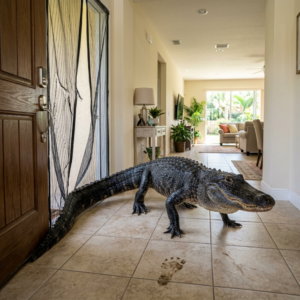
It was 5:00 p.m. on a sleepy afternoon in Venice, Florida. Inside her home in the quiet Grand Palm neighborhood, Mary Hollenbach was doing what millions of people do to unwind: she was curled up on her sofa, the low hum of the television providing a familiar backdrop to the fading daylight. The world outside was typical for Sarasota County—humid, lush, and seemingly still. But in the span of just fifteen seconds, the boundary between the manicured safety of suburban life and the prehistoric wild of the Florida swamplands didn’t just blur—it was violently punctured.
What began as a rhythmic, metallic rattling at her front screen door would lead to a 911 call that sounds more like a Hollywood thriller than a Tuesday afternoon. This is the story of a seven-foot predator, a frantic escape to a lanai, and the terrifying realization that sometimes, the “burglar” breaking into your home has scales, cold blood, and no intention of leaving.
The Sound of the Screen: A 15-Second Countdown to Terror
The first sound Mary heard was a rattle. It was a sharp, insistent banging against the front screen door. In those first few seconds, her mind did what all our minds do—it reached for the most logical explanation. Someone has the wrong house, she thought. Someone is trying the handle. She didn’t feel fear yet, only the slight annoyance of a quiet afternoon interrupted.
She rose from her sofa, the fabric rustling as she moved toward the entryway to investigate. As she rounded the corner, the logic of the modern world disintegrated. From the moment she heard the first rattle to the moment she laid eyes on the intruder, no more than fifteen seconds had elapsed. But in that heartbeat of time, the “someone” at the door had forced their way through. The screen had given way, and standing—immense and ancient—directly inside her foyer was a six-to-seven-foot alligator.
The sensory shock was total. There was no growl, no warning. Just the sight of dark, armored scales against her home’s interior and the heavy, primal scent of the marsh now wafting into her hallway. The gator had not just poked its head in; it was completely inside, its massive tail sweeping against the doorframe, effectively trapping itself—and Mary—within the walls of the house.
The Great Escape: A Sprint to the Lanai
In the presence of an apex predator, the human brain switches to a survival frequency. Mary didn’t scream; she didn’t hesitate. Her eyes locked onto the size of the beast—”He’s a pretty good size one, he’s no baby, that’s for sure,” she would later tell dispatchers. Realizing the front exit was blocked by seven feet of muscle and teeth, she grabbed her only lifeline: her cell phone.
She retreated through the house, her heart hammering against her ribs, fleeing toward the back of the home. She burst through the glass sliders onto the lanai, the screened-in porch that usually served as a place of relaxation. Now, it was her cage and her fortress.
When the 911 operator answered, Mary’s voice was a mixture of adrenaline and disbelief. “An alligator just broke into my house,” she panted. The operator, trained for the bizarre but clearly struck by the gravity of the report, pressed for details. “Is it in the house or just on the porch?” “No, he’s all the way inside,” Mary replied.
The weight of the situation settled in. Mary was stuck outside on the lanai, looking back through the glass sliders into her own home, watching as the massive reptile sat in her entryway, seemingly as confused as she was. “I think he doesn’t know what to do either,” she remarked, a moment of dark irony in the middle of a crisis.
The Standoff: Waiting for Law Enforcement
As the minutes ticked by, the scale of the “burglary” became clearer. The alligator, estimated at over six feet counting the tail, occupied the throat of the house. Mary stood on her lanai, the tropical air thick around her, realizing that she was physically separated from her living room by a single pane of glass.
The dispatcher, realizing the size of the animal, bypassed standard animal services. “Anything over four feet, we’re going to get law enforcement involved,” the operator explained. This wasn’t a job for a net and a pole; this was a high-stakes removal of a dangerous trespasser.
Mary’s concern began to shift from her life to her property. “I don’t want him to decide to get frisky and do damage,” she told the operator. The thought of a seven-foot alligator thrashing through a kitchen or living room—shattering furniture and clawing at walls—was a secondary nightmare. The operator’s response was a blunt reminder of the stakes: “If he does any damage, don’t go in there. Don’t save anything.”
The Professional Rescue and a Neighborhood in Shock
Sarasota County sheriff’s deputies and local conservation officers arrived with a speed and professionalism that Mary later described as “so cool.” To them, a seven-foot gator in a foyer was just another day in Florida, but for the Venice community, it was a wake-up call. The gator had likely crossed two yards and a busy street at 5:00 p.m. without being spotted, a silent ghost moving through suburbia until it found a screen door it could overcome.
The removal was a precision operation. Officers moved in, their faces stoic, treating the prehistoric intruder like a common trespasser. They managed to secure the gator and transfer it to an alligator farm, but the silence that returned to Mary’s home was different than the one that had existed at 4:59 p.m.
The screen door was torn, the foyer was empty, and the television was likely still humming in the background. But the illusion of the “indoors” as a sanctuary had been permanently altered.
Deep Reflection: The Thin Veil of the Wild
Mary Hollenbach’s story is more than just a “Florida Man” style headline. It is a profound reflection on the universal truth that we live in a world that is not entirely our own. We build walls, we install screens, and we set our televisions to a comfortable volume to drown out the wild. But nature doesn’t recognize our property lines or our sense of suburban “safety.”
The gator didn’t break in because of malice; it broke in because it could. It was a reminder that we are often just one unlatched screen door away from a confrontation with the ancient and the unknown. Mary’s quick thinking—grabbing her phone and moving to the lanai—is a testament to human resilience, but the image of that gator in the foyer remains a haunting symbol of the thin veil between civilization and the wild.
Could you stay as calm as Mary if you found a seven-foot intruder in your hallway? How do we balance our love for the Florida landscape with the reality of living alongside its most dangerous residents? Share your thoughts and your own “wild” encounters below.
Disclaimer : This content may be created by AI for entertainment purposes. Any resemblance to real persons, events, or places is coincidental.






