The Tragic Fall of Sterling Alavache and the Miracle at Bank of America
The morning of Tuesday, February 6, 2024, in Fort Myers, Florida, began with the deceptive tranquility of a typical Gulf Coast day. The sun hung high over the palm trees, and the usual mid-morning rush at the Bank of America on Bell Tower Drive was in full swing. Customers were standing in line, pens clicking against deposit slips, while tellers greeted familiar faces with practiced smiles. Nobody could have known that by 11:45 a.m., this sanctuary of commerce would transform into a theater of life and death, defined by a desperate man, a black square box, and a single, silent shot that would echo through the community for years to come.
Inside the bank, the atmosphere was shattered in an instant. A man, later identified as 36-year-old Sterling Ramone Alavache, walked through the heavy glass doors. To a casual observer like 85-year-old Neils Graham, who was nearby, it seemed like a mundane interaction at first. Alavache had been asked to leave earlier, but his return was marked by a sudden, violent shift in energy. He wasn’t just a disgruntled customer; he was a man at the end of his tether, carrying the weight of a troubled past and a mind pushed to the breaking point.
The Frantic Call and the Black Square Device
“What’s your emergency?” The 911 dispatcher’s voice was steady, a stark contrast to the trembling, breathless woman on the other end of the line.
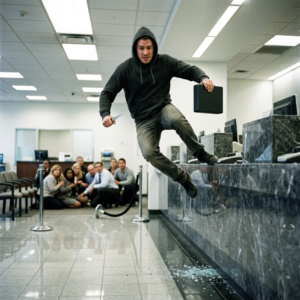
“A guy just entered the Bank of America and made us all get out… he says he has a bomb,” she whispered, her words tripping over each other as she sought cover. She described a terrifying sight: Alavache had vaulted over the high service counter, a feat of adrenaline and desperation. In his hand, he gripped a mysterious “black square thing.” To the terrified hostages pinned to the floor, that small object represented the potential for total annihilation.
“Everybody to the f***ing ground!” Alavache screamed. His voice was a jagged edge of rage and fear. The sensory details of the room became hyper-focused for those trapped inside—the coldness of the tile floor against their foreheads, the smell of floor wax and ozone, and the rhythmic, terrifying sound of Alavache’s heavy breathing as he paced behind the teller line. Outside, the world was still moving, but inside the bank, time had frozen into a singular, agonizing “now.”
A Predator with a Knife: The Escalation
As the Lee County Sheriff’s Office swarmed the perimeter, the situation inside grew increasingly volatile. This was no longer just a robbery; it was a high-stakes hostage crisis. Alavache, wearing a hoodie that shadowed a face etched with conflict, grabbed a knife. The silver of the blade glinted under the sterile fluorescent bank lights.
In a moment that would haunt the survivors, he seized a hostage, the blade pressing into the soft skin of their throat. He attempted to pull another into a headlock, using human lives as a physical shield against the encroaching law enforcement. Outside, the Sheriff’s Office, including the elite SWAT team and precision snipers, were setting up their positions. They were watching through scopes, interpreting every twitch of Alavache’s hand and every shift in his posture.
The emotional stakes were suffocating. Alavache was a man of contradictions. While he held a knife to a throat, he was also heard shouting pleats to the officers outside. “Please don’t make me shoot him! I don’t want to shoot him!” he cried out, his voice cracking with a strange, tragic empathy even as he orchestrated the violence. It was the sound of a man who felt he had lost control of the monster he had created, a man caught in the crosshairs of his own mental collapse.
The Sniper’s Silent Decision
The clock was ticking with brutal efficiency. Only seven minutes had passed since the first deputies arrived on the scene. In those seven minutes, negotiations had been attempted, but Alavache’s behavior remained erratic and lethal. The “black square thing” remained a mystery—was it a detonator? A block of C4? The risk to the hostages was calculated in heartbeats.
Sheriff Carmine Marceno later described the scene as a “successful rescue,” but that success came at a permanent cost. A SWAT team sniper, positioned with a clear line of sight, watched as Alavache moved behind the hostages. In the silent language of tactical operations, the decision was made. A single shot was fired.
The sound within the bank was deafening, followed by a sudden, heavy silence. Alavache fell. Within seconds, the “black square device” was revealed to be a non-explosive, but the threat it posed in the moment had been indistinguishable from the real thing. The hostages were rushed out into the blinding Florida sun, uninjured in body but forever changed in spirit. Following protocol, the sniper was placed on administrative leave, becoming a silent figure in a tragedy that had no easy heroes.
The Ghost of Sterling Alavache: Addiction and Redemption
Who was the man who died on the floor of the Bank of America? To the police, he was a suspect with a criminal record dating back to 2017, including an incident where he had chased cars with a knife. To the public, he was a domestic terrorist. But to those who knew him, Sterling Alavache was a man who had fought a war within himself for years.
Friends and acquaintances expressed a deep, hollow sorrow. They spoke of a man who struggled with drug addiction and severe mental health issues, yet had celebrated one year of being “clean and sober” on September 11, 2023. He was a man who believed in the Bible, who sought refuge in the rooms of AA and NA, and who was described as caring and supportive by those he hadn’t yet pushed away.
This duality—the supportive friend versus the knife-wielding hostage taker—is the true tragedy of the Fort Myers bank heist. It highlights the cultural failure to adequately bridge the gap between addiction recovery and mental health stability. Sterling had fought for a year to be “better,” but in a single morning of crisis, the structures he had built to keep himself sane collapsed, taking him down with them.
A Final Reflection on the Fragility of Peace
The Bank of America has since reopened, the glass replaced and the floors polished, but the memory of those seven minutes remains. It serves as a stark reminder of the universal human lesson: we are all living in a delicate balance. The distance between a “clean and sober” life and a violent ending can be shockingly short when mental health goes unsupported.
The Fort Myers community continues to grieve, not just for the terror visited upon the hostages, but for the loss of a man who was trying—and ultimately failing—to outrun his demons. It was a day where law enforcement did their jobs perfectly, yet the outcome felt like a collective failure of the human safety net.
How do we better support those who have achieved sobriety but still battle the ghosts of mental illness? Can a community ever truly heal from a trauma that unfolds in just seven minutes? Share your thoughts and feelings below as we reflect on this tragic day in Fort Myers. We want to hear your voice.
Disclaimer : This content may be created by AI for entertainment purposes. Any resemblance to real persons, events, or places is coincidental.






