She Signed the Divorce Papers Pregnant and Alone, Never Revealing She Owned the Ground They Stood On
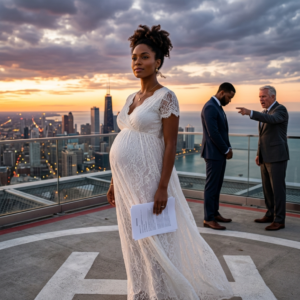
There is a particular kind of silence that comes after dignity has been pushed to its absolute limit. It is not the jagged, frantic silence of defeat, nor the hollow quiet of someone who has nothing left to say. It is the dense, impenetrable silence of a woman who has decided—quietly, completely, and without an ounce of fanfare—that she is done explaining her worth to people who were never truly listening.
Amara had mastered that silence, turning it into an art form and a shield.
The setting was as cold as the hearts of the men standing across from her: the private helipad atop Blackwell Tower in downtown Atlanta. The wind whipped at her white lace dress, the fabric clinging to her eight-month pregnant silhouette. In her hand, she held a stack of divorce papers, the edges fluttering like the wings of a trapped bird.
She looked at the trio across from her with an absolute, terrifying calm that made them shift on their expensive heels. Her husband—soon to be ex-husband—Marcus Blackwell Jr., stood to her left. He was thirty-one, immaculately groomed, and handsome in a way that felt increasingly manufactured. His eyes darted toward the horizon, the skyscrapers, the distant hills—anywhere but her face. He had spent four months rehearsing the lie that his abandonment was “reasonable.”
Directly across from her was the architect of this misery: Senator Roland Blackwell. He stood with a finger pointed in her direction, his voice projected in that booming, practiced register he used for campaign rallies and hostile boardrooms. To his right stood Kezia, Marcus’s personal assistant, clad in a sharp red dress, clutching a notebook with the smug expression of a predator watching a trap snap shut.
“This is the best outcome for everyone,” the Senator declared, his voice cutting through the roar of the city below. “The Blackwell name cannot be attached to this kind of complication. The timing is wrong. The circumstances are wrong. You understand that, don’t you, Amara?”
Amara didn’t blink. She looked at the Senator, then at Marcus, and finally at Kezia. She looked down at the documents, took a pen, and signed. One clean, unhurried, certain signature. She didn’t hand the papers to her husband; she held them out to the Senator. It was a subtle, searing detail that stripped Marcus of his last shred of agency.
“I understand everything perfectly, Senator,” she said. Her voice was barely a whisper, yet it carried over the wind.
Then, she turned and walked toward the waiting car. She did not look back. Nobody on that helipad understood what she meant by “everything.”
They were about to find out.
THE NAME BEYOND THE NARRATIVE
The Blackwells saw a “complication”—a woman of modest means from a foreign background who had somehow snagged their heir. What they didn’t know was that her name was not just Amara. It was Amara Josephina Osmensa. And in the circles that truly run the world, the Osmensa name carried weight that made the Blackwell political empire look like a regional family business.
Her father, Dr. Kwame Osmensa, had built the largest private healthcare network in West Africa before expanding his reach into the United States. Her mother was the founder of an education nonprofit spanning eleven countries. The family’s combined holdings were staggering, yet they operated with a discretion that the Blackwells, with their loud campaigns and shiny towers, could never comprehend.
Amara had never told Marcus. Not because she was hiding, but because when they met two years ago at a charity gala, she was volunteering in the shadows. He had looked at her not as a strategic alliance or a trust fund, but as a person. For the first time in her life, she felt anonymous and loved for it. She had shielded him from her reality to protect the purity of their connection.
It was a mistake she realized only now, as the baby moved gently against her ribs in the back of the car. She pulled out her phone and dialed the one man who had never failed her.
“Baba,” she said, her voice finally cracking. “I need to come home.”
Dr. Kwame Osmensa, a man who had navigated civil wars and economic collapses without losing his cool, heard a specific tone in his daughter’s voice—a sound he hadn’t heard since she was seven years old and had fallen from her bicycle.
“The jet is wheels up in forty minutes,” he replied, his voice like tempered steel. “Tell me where you are.”
“Atlanta. Blackwell Tower helipad.”
“Are you hurt?”
“No, Baba.”
“Is the baby fine?”
“The baby is fine.”
There was a long, heavy pause—the sound of a father assembling a war map in his mind. “Amara,” he said carefully. “What happened?”
“I just signed divorce papers,” she sobbed, the precision of her composure finally shattering. “Eight months pregnant, on a helipad, in front of my husband’s mistress.”
The silence on the other end was absolute. Then, Kwame Osmensa said four words that should have made the Blackwells tremble in their tower: “I see. Come home.”
THE COLLAPSE OF THE BLACKWELL HOUSE
The Blackwells noticed Amara was gone within twenty-four hours, but not for the reasons a family should. They didn’t miss her presence; they missed their money.
The Blackwell Foundation had been in the final stages of securing a $12 million healthcare infrastructure grant—a partnership that was the cornerstone of the Senator’s reelection platform. Suddenly, the phone lines went dead.
The foundation’s director stormed into Marcus’s office, face flushed. “The Osmensa Group has suspended all communications! They won’t return calls. They’ve pulled the grant.”
Marcus looked up, confused. “What does the Osmensa Group have to do with our grant?”
The director stared at him in disbelief. “Mr. Blackwell… the Osmensa Group is the grant. Dr. Kwame Osmensa has been the silent primary funder for eight months. He requested anonymity because…” she paused, looking at Marcus with pity, “because his daughter was involved with your family and he didn’t want it to appear transactional.”
Marcus felt the air leave the room. “His daughter?”
“Amara Osmensa,” the director said. “Your wife.”
Two hours later, Senator Roland Blackwell sat behind his desk, staring at a file his assistant had just compiled. It detailed the Osmensa portfolio: the American holdings, the philanthropic reach, the three decades of operating at the highest levels of global power without needing a single billboard.
The Senator felt a cold, genuine alarm. He had spent forty years building the Blackwell name. He had just personally insulted and discarded the one woman who could have connected that name to a global dynasty. He had looked at Amara and seen a “complication.” He had been a lion tamer who didn’t realize he was standing in the cage of a much larger beast.
He picked up the phone. “Fix this, Marcus. I don’t care how. Fix it.”
THE SITTING ROOM IN ACCRA
Marcus flew to Accra, Ghana, four days later. He knew showing up at the Osmensa compound was a gamble, but he didn’t realize that the stakes were no longer financial.
The compound was not the gaudy palace he expected. It was a sprawling, substantial estate that breathed old-world elegance. Staff moved with the quiet efficiency of people who respected their employers. Dr. Kwame Osmensa received him in a sitting room that was both welcoming and unmistakably a courtroom.
The doctor was a tall man with silvering temples and a stillness that made Marcus feel like a jittery schoolboy.
“My daughter did not tell you who she was,” Kwame said finally. “That was her choice, and I respect it. But understand this: you are not here to fix a business relationship. If that is why you came, leave now.”
Marcus swallowed hard. “I came because I need to tell Amara something. In person.”
“And what is that?”
Marcus looked at this father—a man who had sent a private jet across the Atlantic in forty minutes for his daughter—and felt the full, crushing weight of his own cowardice.
“That I was a coward,” Marcus said, his voice trembling. “That I let other people make a decision that should have been mine. That she deserved better, and I knew it even as I signed those papers. I don’t deserve another chance, but I’ve come to ask for one anyway.”
The silence stretched. Kwame Osmensa read Marcus with the precision of a surgeon. “That,” the doctor said, standing up, “is Amara’s decision. I will tell her you are here.”
THE GARDEN OF RECKONING
Amara made him wait for two hours.
When she finally emerged into the garden, she was in a simple cotton dress, her hair natural, her feet bare on the warm stone path. She was thirty-eight weeks pregnant now, glowing with a strength that Marcus realized he had never truly seen because he hadn’t been looking.
She sat across from him and didn’t offer a greeting. “Say what you came to say.”
Marcus poured it out. No management, no positioning, no Senator-approved talking points. Just the raw truth of a man who had made a catastrophic mistake. When he finished, the garden was heavy with the scent of blooming jasmine.
“Marcus,” she said, her voice firm. “You didn’t leave me because of your father. Your father gave you a reason that made it easier for you to be weak. There’s a difference.”
“I know,” he whispered.
“If you had stood up on that helipad and said ‘no,’ what would have happened?”
“He would have been furious,” Marcus admitted. “And then he would have gotten over it. Because that’s what fathers do.”
“Yes,” Amara said. “It is.” She placed a hand over her stomach. “I am not the person I was four months ago. What happened on that helipad changed me. Whoever you thought you were coming back to… she’s different now. Stronger. Less willing to be someone’s ‘complication.'”
“I’m not asking for the same woman back,” Marcus said, looking her in the eye for the first time. “I’m asking for the chance to be worthy of the woman you actually are.”
The afternoon light of West Africa held them both. Amara looked at this flawed, late, genuinely trying man. She didn’t feel forgiveness—not yet. But she felt the beginning of a path.
“My son,” she said quietly, “is going to need a father he can be proud of.”
Marcus gasped. “My son?”
“Yes,” she said, a small, tired smile finally touching her lips. “So you have a lot of work to do.”
A NEW ARCHITECTURE OF POWER
Marcus stayed in Accra for six weeks. He didn’t go back to the tower or the Senate. He stayed until the baby arrived—a healthy boy with his grandfather’s eyes and his mother’s iron composure. He stayed until he understood what it meant to be present without an agenda.
The healthcare grant was eventually renegotiated, but on Amara’s terms, not the Senator’s. Roland Blackwell eventually made the trip to Accra himself, hat in hand, to meet Dr. Osmensa. He sat in that same sitting room and experienced the humbling reality of being seen by a man who needed nothing from him.
Amara stood on that helipad in silence because she knew something the Blackwells didn’t: she didn’t need their name, their tower, or their approval. She just needed the people who claimed to love her to be brave enough to deserve her.
One of them finally got there. Better late than never.
DEEP REFLECTION: THE DIGNITY OF THE UNSEEN
This story reminds us that the loudest people in the room are rarely the most powerful. True power resides in character, in heritage, and in the quiet strength of those who do not feel the need to advertise their worth. Amara’s journey from “complication” to “empress” is a testament to the fact that you should never mistake a woman’s silence for weakness. She wasn’t hiding her billions; she was testing the hearts of those around her. And in the end, the truth didn’t just set her free—it rebuilt her world.
Call to Action: Have you ever been underestimated or treated like a “complication” by people who didn’t know your true value? How did you find your voice? Share your stories in the comments below. Let’s celebrate the strength of the silent ones. ❤️👇
Disclaimer : This content may be created by AI for entertainment purposes. Any resemblance to real persons, events, or places is coincidental.






