The Blood of the Earth: Unearthing the Gritty, Intoxicating Reality of the Ancient World’s Most Sacred Drink
The sun of the first century beats down upon the cracked, limestone-rich soil of the Mediterranean basin with a relentless, blinding intensity. If you close your eyes and breathe in deeply, you can almost taste the thick, suffocating dust swirling through the ancient air, mingling with the scent of wild olive trees and the sharp, unmistakable tang of fermenting fruit. In this unforgiving landscape, the vine is not merely a plant; it is the vital, pulsating artery of human civilization. Everywhere you look, across vast empires and quiet, forgotten villages, the blood of the grape courses through the daily lives of humanity.
In the grand, marble-columned temples of the Greco-Roman world, this liquid is the center of wild, uninhibited devotion. Men and women, their eyes dilated with the fervor of the Dionysian cults, dance in the flickering, chaotic firelight. They worship the god of the vine, Dionysus, seeking a frantic, intoxicating release from the iron-clad rigidity of Roman order, their skin slick with sweat and the dark, sticky residue of spilled wine.
Yet, hundreds of miles away, in the quiet, sun-baked obscurity of a Galilean village called Cana, a vastly different scene unfolds, setting the stage for a quiet miracle that would fracture history. There are no frenzied orgies here, no wild abandon to the gods of chaos. There is only a humble wedding feast, the joyous, loud clatter of a rural community coming together, and a sudden, quiet crisis. The wine has run dry. In a culture bound by unbreakable laws of hospitality, this is a social catastrophe. It is here that a mother leans in, her voice a desperate, urgent whisper, making a plea to her son. And it is here that Jesus of Nazareth heeds that plea, stepping into the breach to turn ordinary, stagnant water into wine.
But stripped of the theological majesty and the ancient mythologies, a profoundly human, deeply tactile question remains. When the dust settled on the tunics of the common laborers, when the sun dipped below the horizon and the oil lamps were lit, what did the everyday wine of Jesus’s day actually taste like? We are compelled to journey back, past the sterile, climate-controlled cellars of modernity, to taste the raw, unfiltered essence of antiquity.
The Prophets’ Echo: Staring into the Abyss of Antiquity
To understand the wine of this era, we must first sink into the profound spiritual gravity of the people who drank it. We must tune our ears to catch the booming, weeping voice of the prophet Jeremiah, echoing across the desolate, rocky valleys of the ancient Near East. Imagine an old man, burdened to his very core by the terrifying visions of a falling kingdom, standing alone beneath a gnarled olive tree. His voice cracks against the wind, thick with sorrow and an unwavering, desperate faith.
“Great are your purposes and mighty are your deeds. Your eyes are open to all the ways of the children of man, rewarding each one according to his ways, and according to the fruit of his deeds.”
These are not merely poetic words written on dry, lifeless parchment; they are guttural cries torn from the depths of the human chest. The people who cultivated these ancient vineyards lived their entire lives under the unblinking, sovereign eye of a divine Creator. Their faces were constantly turned upward, seeking meaning in the torrential rains, the devastating droughts, and the fleeting joy of the harvest. They believed, with a bone-deep conviction, that every action, every drop of sweat shed over the stubborn vines, was witnessed and weighed by God.
And then, there is the shattering grief of Job. Picture a man sitting in the smoking ashes of his entirely ruined life, scraping his afflicted, diseased skin with a broken, jagged piece of clay pottery. He is engulfed in the absolute, suffocating darkness of human despair, having lost his children, his wealth, and his dignity. Yet, from the lowest, most agonizing conceivable point of human misery, he gasps a declaration of absolute surrender to the divine will: “I know that you can do all things! And that no purpose of yours shall be thwarted!”
This is the intense psychological landscape of the ancient wine drinker. The scriptures of this era mention wine nearly two hundred times, weaving it intimately into the fabric of human existence. But these people did not sip casually from crystal glasses while watching the sunset. They drank the fruit of a chaotic, unpredictable earth, a world where unfathomable suffering was commonplace, and survival was a daily, exhausting negotiation with the divine. Every drop of wine pressed from the soil was a hard-won testament to human endurance.
The Squelch of Survival: Stained Feet and Tainted Waters
It forces us to confront the raw, visceral, intensely physical reality of ancient viticulture. We must violently erase the modern illusions of romance—the guided wine tastings, the eloquent sommeliers swirling Pinot Noir in glass goblets, the luxurious parties lasting into all hours of the night.
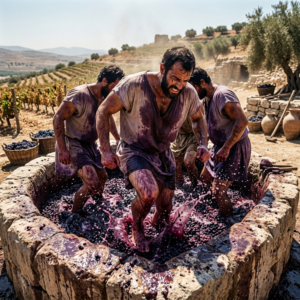
Instead, replace those sanitized images with a massive limestone vat, roughly hewn and carved directly into the bedrock of a sun-scorched hillside. Imagine the sensory explosion of the harvest. Men and women, their rough-spun tunics hiked up to their thighs, stepping barefoot into a basin piled dangerously high with dark, heavy clusters of unwashed grapes. It is almost unfathomable to the modern mind, but they truly smashed the fruit with their bare feet.
Listen to the immediate, wet squelch as calloused heels press forcefully into the taut skins. See the burst of dark purple juice, spraying against ankles and calves, staining their skin a deep, bruised violet. The air around the vat is suddenly thick and heavy with the sharp, intoxicating, almost sickly-sweet perfume of crushed fruit and wild, natural yeast blooming violently in the hot Mediterranean air. They labored intensely, the sweat pouring from their brows, mixing with the juice beneath their feet.
Yet, this grueling labor served a purpose far more urgent than mere celebration. For the vast majority of the ancient world, the primary function of wine was a matter of life and death. Imagine staring down at a heavy clay pitcher of water, recently drawn from a communal well or a slow-moving stream. The water is murky, stagnant, perhaps harboring a faint, foul odor of decay. To drink it straight, unadulterated, was to court absolute disaster. Dysentery, parasites, and mysterious, raging fevers lurked invisibly in those tepid depths.
The human race would not discover the microscopic germs and bacteria responsible for this suffering for another eighteen hundred years. They possessed no microscopes, no understanding of waterborne pathogens. Yet, through brutal, tragic trial and error, through generations of watching neighbors and children wither from corrupted water, the ancients uncovered a profound, life-saving secret. They discovered that adding a measure of the harsh, fermented blood of the grape—with its sharp acidity and hidden alcoholic fire—possessed a mysterious, protective power. It could render the deadly water drinkable.
Therefore, everyday wine was heavily watered down. They would pour a small amount into a vessel and flood it with the dangerous well water, creating a murky, pale liquid that harbored merely two, perhaps three percent alcohol. It was just enough to kill the invisible demons in the water, just enough to ensure they woke up the next morning to toil in the fields once again.
The Shadows of the Upper Room: A Covenant Poured in Clay
Now, the narrative shifts, moving from the blinding heat of the vineyards into the heavy, suffocating shadows of a small, low-ceilinged upper room in Jerusalem. The sun has set, and the air inside the room is thick, redolent with the smell of roasted lamb, sharp, bitter herbs, and the acrid smoke of sputtering oil lamps.
Twelve men recline around a low table, their eyes fixed intently upon their teacher, Jesus. The atmosphere in the room is impossibly tense, heavy with unspoken fears, political danger, and a creeping, terrifying sense of an impending, world-shattering doom. He reaches across the table and takes hold of a heavy clay cup.
This cup does not hold the weak, watered-down daily ration used to sanitize well water. This is the Passover wine. It is thick, dark, and overflowing with centuries of blood-soaked history. Normally, as they looked at the dark liquid swirling in the rough clay, their minds would be transported back to one specific, terrifying night in Egypt. The wine was a visceral mechanism to remember and celebrate the desperate salvation of their ancestors—the frantic, hasty smearing of innocent lamb’s blood on wooden doorposts to ward off the angel of death.
But in the flickering shadows of this room, the ancient narrative violently pivots. The teacher holds the cup, the amber firelight dancing in the dark liquid, reflecting in his sorrowful, fiercely determined eyes.
“But tonight,” he speaks, his voice a low, steady rumble that seems to vibrate through the very floorboards, changing the course of history in a single breath. “Likewise, this is my blood of the New Covenant shed for you and for many for the forgiveness of sins.”
The absolute, paralyzing shock that must have reverberated through the chests of the men at the table is unimaginable. He was taking the ancient, immutable symbol of their national liberation, the very liquid that represented the blood on the doorposts, and mapping it directly onto his own physical body, his own veins, his own impending execution.
The Sour Truth: Tannins, Grit, and the Desperate Alchemy of the Ancients
But if we were to reach across time, take that heavy clay vessel from the table, and bring it to our own lips, what would it actually taste like? We must abandon any lingering notions of refined elegance. To the modern palate, accustomed to centuries of perfected viticulture, ancient wine was an aggressive, uncompromising assault on the senses.
Imagine lifting the cup. The smell hits you first—pungent, overwhelmingly earthy, sharply acidic, with a faint, threatening sour tang of vinegar creeping in around the edges. As the dark red liquid washes over your tongue, it is violent. The majority of these wines were red, and they were brutally simple. The tannins are aggressive, instantly stripping the moisture from the inside of your cheeks, leaving a rough, almost sandpaper-like sensation in your mouth. The acidity is piercing, causing a sharp, stinging reflex at the back of your jaw.
And then, there is the texture. This was not a clarified, beautifully filtered beverage. As you swallow, you feel a distinct, gritty mud coating your teeth and the back of your throat. This is the inescapable sediment—the pulverized remnants of grape skins, crushed seeds, and the literal dust of the vineyard floor, left over from the fermentation process. It is a thick, challenging, abrasive mouthful. Sound delicious? It was not.
What of the delicate, crisp white wines we cherish on a stifling hot summer evening? In the ancient world, such a luxury was an entirely different, nearly mythical beast. These ancient white wines were profoundly different from anything we recognize today. They were heavily oxidized, bearing a deep, golden amber hue, reminiscent of old honey or hardened tree resin. And they were exceptionally rare. Unless you were draped in the silk and absolute power of a rich Roman patrician, you would never lay eyes on it, let alone taste it. The common laborer in Judea would live their entire life without ever savoring that amber luxury.
The winemakers of the ancient world were not merely farmers; they were desperate, frantic alchemists locked in a constant, losing battle against time and the brutal elements. They aged their precarious harvests in massive, porous earthen pots, burying them in the cool earth, hoping to mellow the harsh tannins. But time was a cruel master. They could only age the wine for a few short months, because without modern preservation, the precious liquid was constantly on the verge of spoiling, threatening to turn into undrinkable vinegar.
So, they intervened with startling, bizarre desperation. Imagine a dimly lit cellar, a winemaker frantic to save a turning amphora. He begins tossing in handfuls of pungent herbs and exotic, stinging spices to mask the souring flavor. He pours in thick, golden streams of raw honey, drops in handfuls of sticky, sweet raisins and fleshy dates, desperately trying to artificially balance the biting acidity with heavy sweetness.
But the alchemy grew even darker. To neutralize the violent acids burning the palate, they resorted to the unthinkable. They took chunks of white chalk and heavy marble, grinding them relentlessly into a fine, blindingly white dust, and stirred it directly into the vat. They cracked open eggs, separating the slippery, viscous whites, dropping them into the dark red abyss to drag the bitter sediment to the bottom.
The Miracle of Cana: A Taste of the Divine in a Parched World
Imagine attempting to recreate this desperate, ancient concoction today. You take a modern tasting glass and fill it with a murky, gritty red liquid. It is clouded with pulverized marble dust, aggressively sweetened with dates, and smells intensely of wild herbs and sharp vinegar. You stir the thick mixture, bringing the glass to your lips. You take a hopeful sip.
The reaction is instantaneous and violently visceral. The throat constricts in defense. A harsh, involuntary choke escapes your lungs, accompanied by a genuine gag. The chaotic mixture of cloying honey clashing with the chalky, drying grit and the biting acid creates a horrific, unswallowable dissonance on the tongue. It is a profound shock to the modern senses, a stark, breathtaking reminder of just how far the quiet art of winemaking has evolved from the brutal, unrefined, desperate realities of biblical times.
And this—precisely this gritty, acidic, chalk-filled reality—is the essential crucible in which the ultimate miracle at Cana occurs. We must return our minds to that dusty, panicked wedding feast.
Consider the wedding banquet master, the steward of the feast. This is a man who has spent his entire life tasting the harsh, bitter reality of earthly harvests. He knows intimately the sour taste of failure and the desperate, sweetening tricks of the local winemakers. He is suddenly handed a cup drawn from a massive stone water jar. He braces himself for the mundane, for the diluted, functional beverage of the common folk, perhaps masking the taste of stagnant water.
He brings the cup to his lips. And then—the profound, earth-shattering shock.
It is not the gritty, chalky concoction he expects. It is not the harsh, tannic assault of the local vintage. As the liquid touches his tongue, it is an absolute revelation. It is perfectly balanced, unimaginably deep, bursting with a complex, unearthly perfection that no mortal hand, no desperate alchemy of honey and marble dust, could ever hope to achieve. His eyes widen in the dim light. The chaotic, joyful noise of the wedding feast suddenly fades into a stunned, deafening silence in his own mind.
He pulls the bewildered bridegroom aside, his voice trembling with a potent mixture of awe and profound confusion.
“At every wedding I’ve ever overseen,” he whispers emphatically, his mind racing to comprehend the impossible flavor lingering on his palate. “They serve the best wine first. They bring out the finest they can muster to impress the guests while their senses are sharp. And then, when the people have drunk freely, much later in the feast, when their palates are dulled and the night is waning… they serve the poorer wine. The cheap stuff.”
He stares at the bridegroom, unable to comprehend the gift he has just consumed. He did not know he was drinking something literally divine. He did not know he was tasting the unfiltered, unfathomable perfection of the Creator, breaking vividly through the harsh, bitter reality of human history. Jesus had not just provided wine; he had provided a masterpiece that shattered the boundaries of the ancient world’s desperate reality.
The Vintage of the Human Experience
When we look back at the gritty, harsh reality of the ancient cup, we are looking at a mirror of the human condition itself. We are a people constantly trying to sweeten our own bitter realities, grinding up the marble dust of our own desperate efforts to mask the sourness of life, trying to turn stagnant, dangerous waters into something we can safely swallow. The ancient winemakers stomping in the vats are no different from us today, striving and sweating to extract joy and survival from an unforgiving earth.
Yet, the story of the wine—from the squelch of the grapes to the shocking perfection at Cana, from the shadow of the Passover to the choking reality of the historical recipe—reminds us that sometimes, in the absolute depths of our depletion, when the wine of our own efforts has completely run dry, something miraculous is poured out for us. Something perfectly balanced, unexpectedly given, and vastly superior to anything we could have manufactured on our own.
Disclaimer : This content may be created by AI for entertainment purposes. Any resemblance to real persons, events, or places is coincidental.






