“My grandmother was from Bolaro, sir. She spoke only in Sicilian dialect in our home…” The six words a terrified waitress whispered that made a mafia boss cry.
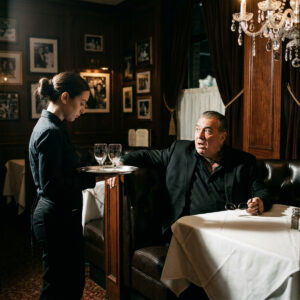
The air inside Castellano’s was engineered to smell like money. It was a heavy, intoxicating blend of white truffles, aged Barolo wine, and the subtle, metallic tang of absolute power. High above, crystal chandeliers cast a fragmented, glittering light across vaulted ceilings, illuminating the crisp, blinding whiteness of the linen draped over every table. This was the Upper East Side of Manhattan, a sanctuary where hedge fund managers bled into old-money socialites, and where, on certain nights, the velvet ropes parted for men whose empires were built in the shadows.
Tonight was one of those nights. The corner booth, a fortress of tufted red leather permanently reserved and strategically positioned with clear sightlines to every entrance and exit, was occupied.
At seventy-three, Victor Castellano Senior did not simply sit at a table; he anchored it. He was a man carved from Sicilian granite, emanating a gravitational pull that commanded the entire dining room. The sleeves of his immaculate, bespoke black suit could not entirely conceal the dark, creeping ink of tattoos that vanished beneath his starched collar. A thick, heavy gold chain rested against his chest, catching the chandelier light. A lion-headed walking cane, polished to a mirror finish, leaned against the booth—a scepter for a king. He wore dark, polarized sunglasses despite the dim, romantic lighting of the restaurant, a barrier between his assessing eyes and a world he trusted exactly zero percent.
To his right sat his son, Victor Castellano Jr., a man in his mid-forties whose suit was sharper, whose ink was hidden, but whose energy was a vibrating, high-frequency echo of his father’s danger. Junior ran the family’s “legitimate” portfolio—real estate, construction firms, and three restaurants, including this one. But everyone in the room, from the busboys to the maître d’, knew that the legitimate businesses were merely the beautiful, manicured skin stretched tightly over the muscle of a criminal empire.
Tonight was a celebration. Senior had flown in from Palermo three days prior for his grandson’s christening. The table was set for twelve: family, capos, and associates whose loyalty was measured in blood. Silent, massive men in tailored suits stood at discrete, tactical positions near the velvet ropes. The energy radiating from Table 9 was warm, filled with the rapid, staccato rhythm of Italian and English, yet it carried an undercurrent of violence so thick it made the air physically heavy to breathe.
And walking directly into the center of this hurricane was twenty-four-year-old Sophia Reyes.
Sophia was the newest addition to Castellano’s waitstaff. She was small, moving with the quiet, ghost-like efficiency of someone whose primary survival mechanism was taking up as little physical and acoustic space as possible. Her dark hair was pulled back into a severe, neat bun, and her wide, doe-like brown eyes made her look infinitely younger and more fragile than her twenty-four years. She was fundamentally, profoundly shy. The loud, demanding arrogance of Manhattan’s elite usually sent her heart racing into a frantic, panicked rhythm.
Before service began, Roberto, the restaurant’s owner and a man who usually operated with a frantic, sweating energy, had pulled her into the shadowy alcove near the kitchen doors. His fingers had dug painfully into her shoulder.
“Table 9 tonight, Sophia,” Roberto had hissed, his eyes wide and terrified. “The Castellano Senior is visiting from Sicily. Be respectful. Be invisible. Be attentive. Do not make eye contact for too long. And for the absolute love of God, do not spill a single drop of anything.”
“Roberto, please,” Sophia had whispered, her voice shaking. “Give it to Marco. Give it to someone with more experience.”
“I can’t,” Roberto said, wiping sweat from his forehead. “You are the only one fluent in Italian. Senior doesn’t speak much English. I need you there. If you mess this up, Sophia… just don’t mess this up.”
Now, holding a silver tray laden with sparkling water, Sophia’s hands trembled so violently the crystal glasses clinked together in a terrifying, high-pitched rhythm. She approached the corner booth. The laughter and the rapid-fire Sicilian died down as she crossed the invisible perimeter of their territory.
Victor Senior noticed her first.
His head tilted a fraction of an inch. Even hidden behind the dark lenses of his sunglasses, Sophia could feel the absolute, paralyzing weight of his assessment. It was the look of a man who had spent fifty years reading micro-expressions for signs of betrayal, weakness, or threat. He was dissecting her down to her very marrow.
Sophia stopped at the edge of the table. Her heart was hammering against her ribs like a trapped bird. She forced her spine to straighten. She gripped the silver tray until her knuckles turned bone-white. She closed her eyes for a microsecond, channeling the only source of strength she had ever known. She bowed her head, just slightly, a gesture of profound, old-world respect.
When she opened her mouth, she did not speak the polished, melodic Italian of the textbooks, or the bastardized American-Italian of New York. She spoke the raw, guttural, ancient dialect of the Sicilian mountains.
“Bonasera, Signor. Benvenuto a New York.”
Her voice, though soft, cut through the ambient noise of the restaurant like a silver wire.
“It is an honor to have such a distinguished guest in our home. I am Sophia. I will be at your service this evening.”
The reaction was instantaneous. The entire table of twelve—men who moved millions of dollars and broke lives without a second thought—went completely, terrifyingly silent. Forks froze in mid-air. Wine glasses were lowered.
Victor Senior reached up with slow, deliberate movements. His thick, tattooed fingers gripped the frames of his sunglasses. He pulled them off, revealing eyes that were sharp, intelligent, and currently burning with an intensity that would have made a seasoned mob boss take a physical step backward. He stared at the terrified, twenty-four-year-old waitress.
“Do I impaustra?” The Sicilian words rolled off his tongue, thick and heavy. Where did you learn this?
Sophia swallowed hard. Her throat was sandpaper. She looked directly into the eyes of the most dangerous man in Manhattan.
“My grandmother was from Palermo, sir,” Sophia said, her voice shaking, but her dialect flawless. “She spoke only in Sicilian dialect in our home.”
Victor Senior studied her. The seconds stretched, agonizing and infinite. The bodyguards near the entrance shifted their weight, sensing the sudden, bizarre tension anchoring the corner booth.
Then, something impossible happened.
The hard, glacial mask that had defined Victor Castellano Senior’s face for half a century—a mask forged in blood, betrayal, and absolute ruthlessness—began to crack. It wasn’t a complete dissolution; this was a man who knew that softness was a fatal disease in his world. But the jagged, violent edges of his expression smoothed out. A warmth, sudden and shockingly genuine, flooded into his dark eyes.
“Which part of Palermo?” Senior asked, his voice losing its interrogative edge.
“The Ballarò district, sir,” Sophia replied, her breath catching in her chest.
Victor Senior slowly turned his heavy head toward his son. “Ballarò,” he repeated.
That single word, spoken in the hushed tones of a prayer, carried a gravitational weight that Sophia could feel pressing against her skin, even if she couldn’t fully comprehend its meaning.
Victor Junior leaned forward over the white linen. The casual, dangerous authority had vanished from his face, replaced by a look of intense, genuine shock. “Your grandmother was from Ballarò? The old neighborhood?”
“Yes, sir,” Sophia said, her knuckles still white on the tray. “She left Sicily in 1962. She came to New York with nothing in her pockets. She worked in a garment factory in Queens for thirty years.”
Victor Senior leaned back against the tufted red leather. He spoke again in rapid, complex Sicilian. This time, the cadence of his voice caused several of the hardened men at the table to exchange wide-eyed, bewildered glances.
“Sit down, Sophia,” Senior commanded. “Just for a moment.”
Sophia’s blood ran cold. The silver tray rattled against her hip. “Signor, please… I have other tables. Roberto will—”
“Roberto!” Victor Senior called out. He did not yell. He did not raise his volume. He simply projected his voice with the terrifying certainty of a man who knew the world would stop spinning if he demanded it.
Roberto materialized from the shadows so fast he seemed to have teleported. His face was slick with a fresh sheen of panic sweat. “Yes, Mr. Castellano Senior? Is there a problem?”
“Your waitress is going to sit with us for five minutes,” Senior said, his eyes never leaving Sophia. “Someone else can cover her tables.”
Roberto looked at Sophia, his eyes wide with a frantic, desperate confusion. He looked at the patriarch. He swallowed hard and nodded rapidly. “Of course. Of course, sir. Marco will take over immediately.”
A heavy, oak dining chair was pulled up to the edge of the table. Sophia, feeling as though she were moving underwater, slowly lowered herself onto the very edge of the seat. She rested her hands in her lap, her fingers twisting together in a knot of absolute terror. Every survival instinct screaming in her brain told her this was wrong. This was dangerous. This violated every rule of hospitality training. You do not sit with the mafia.
But as she looked at Victor Senior, she realized his expression wasn’t threatening. It was an expression of profound, agonizing vulnerability.
“My mother was from Ballarò,” Victor Senior said. He switched to English, heavily accented but clear, ensuring that the younger, American-born associates at the table understood the gravity of the moment. “She died in 1978. I was twenty-eight years old.”
He paused. He looked down at the white tablecloth, tracing an invisible pattern with a scarred finger. For a fleeting, miraculous moment, the seventy-three-year-old apex predator of a criminal syndicate vanished. In his place sat a grieving boy, mourning a mother he had lost half a lifetime ago.
“She spoke to me in that exact dialect every single day of my life until the day she was gone,” Senior continued, his voice dropping to a raspy whisper. “No one has spoken to me in that dialect in forty-six years. Not properly. Not the way she did.”
He slowly raised his head. He looked at Sophia. His dark, ruthless eyes were shining, unmistakably wet with unshed tears.
“You sound exactly like her.”
The table ceased to exist. The twelve people—men who routinely orchestrated violence, women dripping in blood diamonds—sat utterly paralyzed. They were witnessing their untouchable patriarch process an emotional seismic event that none of them possessed the vocabulary to navigate. Victor Junior reached across the crystal glasses and placed a firm, grounding hand over his father’s forearm—a silent, desperate gesture of loyalty and love.
Sophia’s panic evaporated. The terrifying mafia boss dissolved, leaving only an old man drowning in the echo of his mother’s voice. She didn’t know what the corporate protocol was for this situation. So, she abandoned the training. She did exactly what her grandmother had taught her to do when someone was hurting. She spoke from the deepest well of her heart, in the language that felt like home.
“Sua madre era una donna forte, signore,” Sophia whispered, the Sicilian rolling off her tongue like a lullaby. Your mother was a strong woman, sir. “Like my grandmother. Sicilian mothers… they build everything.”
Victor Senior let out a sudden, sharp bark of laughter. It was a real, startled laugh, tearing through the heavy atmosphere of the restaurant. It crinkled the deep, leathery corners of his eyes and revealed teeth that had smiled at very few people in this city.
“Yes,” Senior breathed, the ghost of a smile lingering on his lips. “They do.”
He turned to his son, speaking rapidly in the old dialect. Victor Junior listened intently, nodding his head, before turning his sharp gaze back to Sophia.
“My father wants to know about your family,” Junior translated, his voice softer now. “Your grandmother. Did she have brothers? Sisters?”
“One brother,” Sophia answered, the tension leaving her shoulders. “He stayed in Sicily. My grandmother lost touch with him completely after she came to America. The letters just… stopped.”
Senior and Junior exchanged a look—a fast, complex communication that Sophia could not decode. The patriarch leaned forward, resting his massive forearms on the table.
“What is your full name, Sophia?” Senior asked.
“Sophia Maria Reyes.”
“And your grandmother’s name?”
“Her maiden name was Ferrante.”
Another silent, charged look passed between the two Castellano men. Victor Junior pulled a sleek smartphone from his breast pocket. He typed furiously with one thumb, his eyes scanning the screen. He slid the phone across the tablecloth, turning the screen toward his father. Whatever digital ghost Junior had conjured caused Senior’s thick, gray eyebrows to rise significantly.
“Ferrante,” Senior repeated, tasting the syllables. “From Ballarò.”
“Yes, sir.”
“I knew a Ferrante family in Ballarò when I was a very young boy,” Senior said, choosing his words with agonizing care. “They were… good people. Honest, hardworking people. They had a daughter who left for America in the early sixties.”
Sophia’s breath caught in her throat. The restaurant faded away. “My grandmother’s name was Lucia Ferrante.”
Victor Senior closed his eyes. When he opened them a second later, the last remaining fragments of the mob boss were gone. The armor had completely shattered. What remained was a raw, gaping wound of genuine emotion—a man who had spent decades surrounded by people who either feared him or wanted him dead, suddenly slammed into a visceral connection to the only innocent time in his life.
“Lucia,” Senior whispered softly, as if speaking to an apparition. “I remember Lucia. She used to stand in the square on Sunday evenings. She would sing. She had the most beautiful voice in the entire district.”
Sophia’s eyes flooded. She didn’t try to stop the tears. They spilled over her lashes, tracing hot, salty lines down her cheeks. “She sang to me every single night,” Sophia choked out, her voice breaking. “Until the day she died last year.”
The table held its collective breath. Time stopped.
Victor Senior reached across the white linen. He bypassed the crystal glasses and the silver cutlery. He took Sophia’s small, trembling hand between both of his massive, tattooed palms. These were hands that had ordered executions. Hands that had built empires of blood and concrete. And right now, they were holding the hand of a twenty-four-year-old waitress with a gentleness that defied human comprehension.
“I am so deeply sorry for your loss, Sophia,” Senior said, his voice thick with grief. “Lucia Ferrante was a good woman. I remember her kindness when I was just a hungry boy and my family had absolutely nothing. The Ferrantes… they shared what little bread they had with everyone in the neighborhood.”
He slowly released her hand and leaned back against the leather booth, his expression turning deeply thoughtful, his mind calculating across time and space. He turned to his son and spoke in rapid, hushed Sicilian for a full minute. Junior listened, his brow furrowed, nodding emphatically.
Junior turned back to Sophia. “My father would like to make you an offer, Sophia. Not as a business proposition. As family honors family. Even when the connection is distant and buried in the old country.”
Sophia shook her head frantically, wiping the tears from her face. “No, please. I don’t need anything, sir. Truly. I am just so grateful for the conversation. To hear someone say they remember her… your father’s memories of my grandmother… that means more to me than you could ever know.”
“He anticipated you would say that,” Junior smiled, a genuine, warm expression that changed his entire face. “He says the offer is not charity. It is recognition. You are currently studying to be a nurse, correct?”
Sophia blinked, stunned. “How… how did you know that?”
“Roberto mentioned it when we were discussing the staffing for our table,” Junior explained smoothly. “You work here late nights, you study during the day, and you support yourself completely alone. My father wants to cover your remaining tuition.”
“No,” Sophia gasped.
“Not as a gift,” Junior pressed on. “As payment. As a debt settled for the greatest gift you could have possibly given him tonight: hearing his mother’s language spoken with love.”
“I cannot accept that,” Sophia said firmly, starting to push her chair back. “It’s too much.”
Victor Senior held up one single, thick finger.
Sophia fell instantly silent. She didn’t stop speaking out of fear. She stopped because the gesture carried the absolute, quiet authority of a man who was speaking from the soul.
“Sophia,” Senior said, his English heavily accented, thick with raw emotion. “My mother would want me to help a Ferrante girl become a nurse. She would scream at me from heaven, she would never forgive me, if I didn’t do this.” He leaned forward, his dark eyes locking onto hers. “You honor her memory by speaking our language. You keep her alive. Let me honor your grandmother’s memory by helping you finish your education. This is not a negotiation.”
Sophia looked around the table. She looked at the twelve powerful, dangerous, incredibly complicated people who were watching this exchange. She saw hardened bodyguards whose shoulders had relaxed, their expressions morphing into something resembling awe. She looked at Victor Junior, who was nodding encouragingly.
The crushing, suffocating weight of her student loans, the endless nights of exhaustion, the fear of failing—all of it lifted from her shoulders in a single, miraculous second.
“Thank you, Signor,” she whispered, her voice barely audible over the clinking of glasses in the rest of the restaurant. “Grazie mille.”
Victor Senior gave one firm, definitive nod. He picked up his dark sunglasses, sliding them back onto his face, rebuilding the fortress wall around his eyes. He picked up the heavy leather menu. The emotional vulnerability was boxed away, but the atmosphere at the table was permanently altered.
“Now,” Senior boomed in English, his voice returning to its terrifying, commanding roar. “I believe we ordered our appetizers forty minutes ago. Where is my damn food?”
The entire table erupted into booming laughter. The suffocating tension dissolved instantly, replaced by the chaotic, loud warmth of a genuine family gathering.
Sophia finished her shift in a complete, surreal daze. The plates felt lighter. The air felt clearer.
When the last customer had left and the chairs were being stacked on the tables, Roberto pulled her into the kitchen alcove. He had been briefed by Victor Junior during a bathroom break. Roberto looked at Sophia as if she had just walked on water.
“What the hell did you do?” Roberto asked, half-laughing, half-terrified.
“I greeted him in Sicilian,” Sophia shrugged softly. “That’s all.”
“That’s all?” Roberto shook his head in absolute disbelief. “Sophia, do you have any idea who Victor Castellano Senior actually is?”
“I have some idea.”
“And you just made him cry. In front of his entire inner circle. By speaking like his dead mother.” Roberto let out a long, shaky breath, looking at her with a profound, newfound respect. “Sophia, I have been running this restaurant for twenty years. I have catered to presidents and billionaires. I have never seen anyone affect that man the way you did tonight. Not his wife. Not his children. You, a twenty-four-year-old waitress, walked up to the most dangerous table in Manhattan, and you made the monster at its center feel human.”
“I didn’t mean to make him feel anything,” Sophia said quietly. “I just wanted to be respectful.”
“And that,” Roberto whispered, “is exactly why it worked.”
Two weeks later, a thick, cream-colored envelope arrived at the restaurant with Sophia’s name written in elegant calligraphy.
Inside was a cashier’s check. It was drafted for an amount that covered her entire remaining nursing school tuition, her rent for the year, and her textbooks. There was no corporate letterhead. There was no signature.
There was only the check, and a single, faded black-and-white photograph.
It was a picture of a young, beautiful girl standing in a sun-drenched Sicilian square. She was surrounded by smiling neighbors, her mouth open in mid-song, her eyes closed in pure joy. On the back of the photograph, written in a shaky, elderly hand, were the words: Lucia Ferrante. Ballarò, 1960. Per Sophia.
Sophia stood in the breakroom, clutching the photograph, her hands trembling violently. She wept. She didn’t cry for the money, although the check meant she would no longer have to choose between eating and studying. She wept for the connection. She wept for the beautiful, undeniable proof that her grandmother’s difficult, grueling life had mattered. That her grandmother had been seen. That the joy she brought to a dusty square in Sicily had been remembered by a little boy, sixty years later, half a world away.
Sophia finished nursing school eight months later.
She did not choose pediatrics or surgery. She specialized in geriatric care. She spent her days working in a facility filled with elderly immigrants—people whose bodies were failing, but whose minds were trapped in memories of crossing oceans and building lives from nothing. She brought her grandmother’s Sicilian dialect into the sterile hospital rooms. She spoke to her patients in their mother tongues whenever she could, understanding a profound medical truth: for people who are dying far from where they were born, hearing the language of their childhood is a medicine that no pharmacy can replicate.
Victor Senior visited Castellano’s one last time before returning to Sicily permanently. He specifically requested Sophia’s section. She served his table with the same quiet, invisible grace she had shown on that first terrifying night.
At the end of his meal, as he leaned heavily on his lion-headed cane, he called her over.
“Sophia,” Senior said, his voice a low rumble. “When you finish your nursing… I want you to come to Palermo. I want you to visit Ballarò. Find the square where Lucia used to sing.”
“Yes, sir,” Sophia nodded.
“Stand right in the center of it,” he commanded gently. “And sing something. Anything. It doesn’t matter what.”
“Why?” Sophia asked softly.
“Because the neighborhood remembers,” Senior smiled, a sad, nostalgic curve of his lips. “The stones remember. And Lucia’s spirit will hear her granddaughter’s voice in the exact place where she first learned to sing.” His smile widened into something rare and precious. “And then, you come back to New York, and you take care of stubborn old men like me. We desperately need nurses who speak our language.”
“Yes, Signor,” Sophia promised, tears prickling her eyes. “I promise.”
Years later, Sophia kept her promise.
She stood in the center of a small, worn square in the Ballarò district of Palermo. The ancient stone buildings loomed around her, their facades baked by centuries of Mediterranean sun. It was sunset, and the golden, syrupy light painted the cobblestones in warm, vibrant hues.
She closed her eyes, took a deep breath of the salt-tinged air, and she sang.
She didn’t sing an aria. She sang the simple, rustic lullaby her grandmother had sung to her every single night of her childhood in their cramped Queens apartment. It was the exact same melody Lucia Ferrante had sung in this very square sixty years prior, in a life that felt impossibly distant, yet formed the very foundation of everything Sophia had become.
The locals walking past didn’t stop. Nobody seemed to notice the young American woman singing softly to the empty square at sunset. But as the last note faded into the evening air, Sophia felt something shift. The air felt warmer. The ancient stones beneath her feet felt less cold. And somewhere, in whatever beautiful, quiet place good memories reside, a woman named Lucia smiled.
We spend our lives believing that the most powerful, world-altering moments happen in towering boardrooms, on bloody battlefields, or during grand, cinematic declarations. But true power is infinitely more intimate. True power happens when someone looks past the armor you wear and speaks to the frightened child hiding underneath. It happens when you honor a stranger’s history by simply carrying their language forward. When a shy, terrified waitress walks up to the most dangerous table in Manhattan, and simply by refusing to abandon her roots, reminds a ruthless mob boss that he was once just a hungry boy listening to his mother sing. That is the moment that changes the world. Everything else? Everything else is just dinner.
Do you have a word, a phrase, or a song in your family’s native language that instantly transports you back to your childhood kitchen? Share your linguistic treasures in the comments below. Let’s remember the voices of our grandmothers, because those are the words that truly protect us when the world gets dark.
Disclaimer : This content may be created by AI for entertainment purposes. Any resemblance to real persons, events, or places is coincidental.






