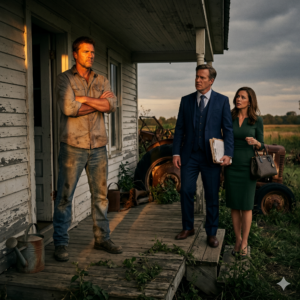
The Abandoned Acres Secretly Held A Fortune Beneath The Barren Soil
The air in the lawyer’s office was thick with the scent of expensive sandalwood and the unspoken scent of victory. Caleb sat in the corner, his calloused hands resting on his knees, feeling like a smudge of grease on a silk sheet. Across from him, his brother, Bennett, leaned back in a mahogany chair, his $3,000 suit perfectly tailored to his smug satisfaction.
“To Bennett,” the lawyer read, his voice a droning monotone of fate, “I bequeath the primary estate in La Jolla, the San Diego beachfront property, and the majority share of the Vance Investment Group.”
Bennett let out a breath he had been holding for thirty years. He didn’t look at Caleb. He looked at the ceiling, as if thanking a God he only acknowledged during quarterly earnings reports.
“And to Caleb,” the lawyer continued, his eyes flicking toward the younger brother with a hint of pity, “I leave the 120-acre ‘Starlight Farm’ in the foothills of the Cumberland Plateau, Kentucky. In its current state, as-is, with no further financial support from the estate.”
The room went silent. The “Starlight Farm” was a family joke. It hadn’t seen a plow in three decades. It was a patch of rocky, acidic earth where even the weeds struggled to survive. It was the place Grandpa Elias had retreated to when the world became too loud, a place of crumbling barns and rusted fences.
Caleb’s wife, Sloane, was sitting next to him. He felt her body go rigid. She had spent the last year talking about the “La Jolla renovation” and the “beachfront lifestyle.” When the lawyer finished, she didn’t cry. She simply stood up.
“Sloane?” Caleb whispered.
“I can’t do this, Caleb,” she said, her voice a flat, terrifying line. “I married a man I thought was going places. I didn’t marry a pauper who inherits a graveyard for old tractors. My bags are already in the car. I’ll send for the rest of my things when you’ve figured out which ditch you’re going to die in.”
She walked out without looking back. Bennett followed a moment later, pausing only to pat Caleb on the shoulder. “Tough break, little brother. But hey, at least you’ll have plenty of fresh air. It’s good for the soul, or whatever it is you have left.”
Caleb sat in the silence of the mahogany room, holding a deed that felt like a death warrant.
The drive to Kentucky took two days. By the time Caleb pulled his battered Ford F-150 into the overgrown driveway of Starlight Farm, the sun was a bleeding orange bruise against the Appalachian horizon. The house was worse than the photos. The porch sagged like a broken jaw, and the barn looked as though a strong sneeze would level it.
He stepped out and breathed in the air. It didn’t smell like success. It smelled of damp earth and rotting cedar.
“Grandpa,” Caleb whispered to the empty fields. “Why me? Why did you give Bennett the gold and me the dust?”
He spent the first week cleaning out the main house. In the cellar, hidden beneath a stack of moth-eaten wool blankets, he found Grandpa Elias’s old surveying equipment. It was outdated but meticulously maintained. Beside it sat a leather-bound journal. Caleb flipped through the pages, but the ink was faded, filled with strange geological notations he didn’t understand—terms like lanthanides, neodymium, and magmatic differentiation.
Curiosity, or perhaps desperation, led him to call a local geological surveyor. He didn’t have much money left, but he needed to know if the land was even worth the taxes he owed.
A man named Silas turned up three days later. He was a mountain of a man with a white beard and eyes that looked like they had seen the birth of the range. He spent hours walking the property, hammering small stakes into the ground and taking core samples. Caleb watched from the porch, nursing a lukewarm cup of coffee.
“You looking to farm this, son?” Silas asked, wiping sweat from his brow.
“I’m looking to see if I can sell it for enough to buy a bus ticket back to a life that doesn’t hate me,” Caleb replied.
Silas didn’t laugh. He looked at the ground, then back at Caleb. “Give me forty-eight hours. I need to run some spectrography on these samples. This dirt… it’s got a strange color to it. Most folks would call it ‘worthless clay,’ but I’ve seen clay like this once before.”
Forty-eight hours later, Silas returned. He didn’t pull into the driveway; he roared into it, his truck kicking up a cloud of red dust. He didn’t even wait for Caleb to stand up before he started shouting.
“Caleb! Get the hell down here!”
Caleb scrambled off the porch. Silas slammed a folder onto the hood of his truck. Inside were chemical analysis sheets that looked like gibberish to Caleb, but Silas was pointing at the bottom line with a trembling finger.
“You know what rare earth elements are?” Silas asked, his voice shaking with a mix of awe and terror.
“Magnets? For phones?” Caleb guessed.
“Not just magnets. High-grade Neodymium and Praseodymium. They are the backbone of the entire green energy revolution. Electric vehicle motors, wind turbines, defense guidance systems. Most of it comes from China because it’s so hard to find in high concentrations.”
Silas leaned in, his voice dropping to a whisper. “Caleb, this isn’t just a farm. It’s a geological anomaly. Usually, these elements are scattered, trace amounts. But beneath your grandfather’s ‘worthless’ fields is a secondary magmatic vein. It’s a concentrated deposit. Based on these core samples, you aren’t sitting on a farm. You’re sitting on the largest un-tapped rare earth deposit in the Western Hemisphere.”
Caleb felt the world tilt. “How much, Silas? What are we talking about?”
Silas looked out over the crumbling barn. “If you sell the mining rights? Hundreds of millions. If you build the processing facility yourself? Billions. Bennett’s La Jolla mansion? That’s a dollhouse compared to what’s under your boots right now.”
News of a geological survey on an abandoned farm travels through small mountain towns like a forest fire. Within a week, the silence of Starlight Farm was replaced by the constant ringing of Caleb’s phone.
First came the mining conglomerates. Men in suits arrived in SUVs that cost more than Caleb’s truck, offering “generous” buyouts that started at ten million and quickly climbed to fifty. Caleb remembered Silas’s warning: They’ll try to lowball you before the federal government realizes what’s here.
Then, the family found out.
The black sedan that pulled into the driveway was unmistakable. Bennett stepped out, followed by their parents. They looked at the sagging porch with a new, hungry kind of reverence.
“Caleb! My boy!” his father shouted, opening his arms as if they hadn’t spent the last decade ignoring him. “We were so worried about you out here in the wilderness. We came as soon as we heard about the… complications with the land.”
“Complications?” Caleb asked, leaning against the doorway.
“We think Grandpa was confused when he wrote that will,” Bennett said, his smile tight and oily. “A farm like this… it’s a lot for one man to handle. Especially the legalities of mineral rights. I’ve talked to the Vance Group lawyers. We can fold Starlight Farm back into the family trust. I’ll manage the mining side, and you can come back to San Diego. I’ll even let you stay in the La Jolla guest house while you get back on your feet.”
“The guest house?” Caleb echoed. “That’s big of you, Bennett.”
“We’re family, Caleb,” his mother added, her eyes darting toward the fields where the survey stakes stood. “We look out for each other. We didn’t realize Grandpa had hidden this from us. It belongs to the Vance name, don’t you see?”
Caleb looked at them. He saw the greed masked as concern. He saw the same people who had handed him a “worthless” deed as a way to discard him.
“The deed says ‘Caleb Vance,'” he said quietly. “Not ‘Vance Investment Group.’ Grandpa knew exactly what he was doing. He knew you’d sell the San Diego house the moment he was gone. He knew you’d spend the money on yachts and vanity projects. But he knew I’d actually come here. He knew I’d walk the land.”
“Daniel, don’t be a fool,” his father snapped, his patience fraying. “You don’t have the capital to develop this. You’ll be tied up in litigation for twenty years if you don’t play ball with us.”
“I’ve already signed an exploratory partnership with the Department of Energy and a private tech consortium,” Caleb lied—though he knew he’d be doing exactly that within the hour. “The land stays mine. Now, please get off my porch. You’re scuffing the wood, and I have a lot of work to do.”
The final blow came two days later. A sleek Tesla pulled into the driveway. Sloane stepped out. She was wearing an outfit that shouted “successful San Diego wife,” but her eyes were red-rimmed.
“Caleb,” she said, her voice trembling. “I was wrong. I was just… I was so scared. The stress of the inheritance, the move… I didn’t mean those things I said.”
Caleb didn’t move. “You said you didn’t marry a broke farmer, Sloane. You were right. You didn’t. You married a man who was willing to work. And now, I’m a man who owns something you can’t put a price on.”
“We can start over,” she pleaded, stepping toward him. “I still love you.”
“No,” Caleb said. “You love the spectrography report. You love the idea of being the ‘Rare Earth Queen.’ But when this was just dirt and a sagging barn, you were gone before the dust settled. You don’t get to enjoy the harvest if you weren’t there for the planting.”
As she drove away, Caleb felt a strange sense of peace. He went back into the cellar and pulled out Grandpa Elias’s journal. He turned to the very last page, one he hadn’t noticed before. The ink was fresh, as if written just days before the old man passed.
To Caleb, the note read. Bennett has the eyes of a hawk—he only sees the prey. But you have the heart of a mountain—you see the layers. I knew they would give you this land because they thought it was a punishment. I knew they would try to take it back once they realized it was a prize. Stay deep, Caleb. The best things are always hidden.
The Sovereignty Of The Soil
Three years later, Starlight Farm was no longer a joke. The processing facility was a marvel of eco-friendly engineering, built into the side of the hills to preserve the skyline. Caleb didn’t live in San Diego. He had rebuilt the farmhouse, keeping the original stone hearth but reinforcing the bones with the very titanium and neodymium his land produced.
He was the CEO of Starlight Strategic Minerals, a company that had single-handedly shifted the global supply chain. He provided jobs for the entire county, built a new school, and funded the restoration of the Appalachian trail.
Bennett’s “beachfront lifestyle” had crumbled. The Vance Investment Group had collapsed under the weight of bad bets and Bennett’s own arrogance. His parents lived in a comfortable apartment in Louisville—paid for by Caleb, but under a strict legal trust they couldn’t touch. He was “responsible,” after all.
One evening, Caleb sat on his reinforced porch, watching the sun dip below the peaks. The rare earth minerals hummed in the batteries of the silent machines in the distance, powering a world that was finally moving toward the light.
He looked at his hands. They were still calloused. He still wore boots that had seen miles of mud. But he no longer felt like a smudge of grease. He felt like a part of the mountain.
Grandpa Elias was right. The world judges by the surface. But the man who is willing to dig—the man who stays when the others run—is the only one who truly inherits the earth.
Disclaimer : This content may be created by AI for entertainment purposes. Any resemblance to real persons, events, or places is coincidental.






