How My “Lucky” Face Became My Boss’s Greatest Mistake
The glass doors of the marketing firm swung open with a hiss that sounded like a warning. I stepped into the lobby, and the atmosphere shifted instantly. It is a peculiar thing, to be the center of a room’s attention yet feel entirely invisible. The hum of productivity—the clicking of keyboards, the low murmur of strategy—stalled. Men looked up from their expensive desks, their eyes traveling a well-worn path from my shoes to my hairline. The women watched too, their gazes cool and analytical, dissecting the curve of my jaw and the depth of my eyes.
“You are so beautiful,” they would whisper, as if beauty were a tangible shield. “You are so lucky.”
Standing there, in a lobby that smelled of expensive wax and ambition, I did not feel lucky. I felt like an artifact behind glass. My name is Aurora. I am twenty-five years old, and for three years, I have lived in the shadows of a “pretty face.” I graduated at the top of my university class. I mastered complex analytics and consumer psychology. I have a mind designed for war-room strategy, yet I have spent my career serving coffee and acting as a living ornament for a man named Mr. Vincent.
This is not a story about luck. This is a story about the precise moment a “pretty doll” decided to develop sharp teeth.
The Gilded Office of Silent Ambition
The office sat high within a gleaming skyscraper, a temple of white walls and spotless surfaces. It was a place where everything looked expensive, but for me, it was a sterile prison. My desk was clean, but it was empty of the reports I was trained to write.
My boss, Mr. Vincent, was a man of fifty who wore his success in the cut of his Italian suits and the practiced sheen of his graying hair. He smiled often, but the expression never reached his eyes. To him, I was not a marketer; I was a brand asset. I was the person who greeted guests at the door because my “smile made money.” I was the person who stood silently at his side during high-stakes parties, a silent signal of the company’s “quality.”
I wanted more. Every night, I went home and studied the accounts I wasn’t allowed to touch. I wrote marketing plans for our biggest clients, pouring my intelligence into blue folders that I would leave on his desk, hoping for a single word of professional recognition.
One afternoon, the call finally came. I walked into his office, my heart hammering against my ribs. I saw my blue folder open on his desk. I thought, Finally, he sees me. But Mr. Vincent didn’t look at the data. He looked at my eyelashes.
“Aura,” he said, leaning back in his leather chair, “you are too pretty to think so much. Thinking makes lines on your face. Just smile. That’s your job.”
I felt a cold, oily sickness settle in my stomach. I wanted to cry, to scream that my brain was a fortress, but I remained silent. I couldn’t leave. Far away, my mother’s small business had collapsed into a mountain of debt. Dangerous men were calling her, threatening her home. I needed this salary to keep her safe. I remembered her voice on the phone, a fragile anchor: “Use your brain, Aura. It is stronger than your beauty.”
The Night of the Blue Folder
The air in the office grew heavy when a massive new project arrived. It was a multi-million-dollar opportunity that could redefine the company. Mr. Vincent was obsessed with it, pacing the floors and talking about the wealth it would bring. I saw my chance—a narrow, flickering window.
I worked until the sun rose, reading every book on the client’s history, analyzing their failures, and crafting a perfect, flawless strategy. I printed it, placed it in a fresh blue folder, and left it on Mr. Vincent’s desk in the pre-dawn silence.
Two days passed in a blur of anxiety. Finally, he summoned me. I sat in the chair across from him, waiting for the words “this is brilliant.” Instead, he leaned forward, inhaling deeply. “Is that a new perfume?” he asked. “You always smell so good.”
The betrayal was total. He didn’t care about the spreadsheets. He didn’t care about the growth projections. He saw me as a sensory experience, nothing more. He touched my hair, his hand moving slowly, a possessive gesture that made me freeze in my chair. I moved away quickly, claiming I had work to do, but his cold smile followed me out the door.
In the hallway, the other women watched. They didn’t see my struggle; they saw a woman they believed was “using her body” to get close to the boss. They stopped talking when I entered the breakroom. They walked away when I sat for lunch. I was a ghost in a red dress, isolated by a beauty I had never asked for.
The Trap and the $50,000 Choice
The breaking point arrived with a late-night phone call from my mother. Her voice was a jagged whisper of terror. The creditors had come to her house. They wanted fifty thousand dollars, or they would take everything. They would hurt her.
The next morning, Mr. Vincent called me into his office. He didn’t look like a boss; he looked like a hunter who had finally cornered his prey. On his desk sat a paper detailing my mother’s private debts. He had been digging into my life, waiting for the moment I was most vulnerable.
“I can help you,” he said, his smile growing wide and terrifying.
He opened his desk drawer and placed two items on the mahogany surface. The first was a check for fifty thousand dollars. The second was a gold key card for The Grand Hotel, the most expensive suite in the city.
“Be mine,” he whispered, standing so close I could smell the heavy musk of his cologne. “Just be mine. You don’t need to work. You don’t need to think. Just be beautiful for me, and your mother will be safe.”
I looked at the check. I looked at the key. My hand twitched with the urge to slap him, but I saw my mother’s face in my mind. I saw the debt collectors. I realized that if I fought him now, I would be fired, and I had no proof of his harassment. Everyone already believed I was his favorite; they would side with him. I was trapped.
But then, a spark of cold, hard logic ignited in my mind. He thought I was a doll. He thought I was stupid. That was his fatal error.
“You will really help my mother?” I asked, making my voice soft, shy, and submissive.
“I always take care of my special girls,” he replied.
I took the key. I took the check. I promised to meet him at Room 512. As I walked out, his laughter followed me, a sound of pure, arrogant victory.
Weapons of Beauty, Bullets of Brains
I didn’t go home to cry. I went to a small, nondescript shop on a side street labeled Security Solutions. Inside, an old man with gray hair looked at me over his glasses.
“I need a camera,” I said. “Small. Invisible.”
I walked out with a gold brooch shaped like a flower. Tucked within its petals was a lens that recorded every sound and every movement in high definition.
Back at the office, I acted the part of the “good girl.” I sat at my desk and listened through the cracked door as Mr. Vincent bragged to a friend on the phone about the “beautiful prize” he had finally won. He talked about me as if I were a car or a painting. I felt the hate burn like acid in my throat, but I kept my face calm.
At 5:00 PM, I went home. I prepared with the precision of an assassin. I wore the red dress he expected. I made my eyes dark and my lips a deep, blood-red. I pinned the gold flower brooch over my heart.
“Tonight,” I told my reflection, “my beauty is the weapon. But my brain is the bullet.”
The taxi ride to The Grand Hotel was a descent into the dark. Rain lashed against the windows, blurring the city lights into streaks of neon. I stepped out into the cold air, my heart beating a frantic rhythm, but my mind was as cold as the marble in the hotel lobby.
Room 512: The Reckoning
The door to the suite opened to a scene of orchestrated romance: red roses, chilled wine, and Mr. Vincent waiting by the window in a dark suit. He stared at me, his mouth hanging open. “Aura,” he breathed. “You look perfect.”
I played the role. I sat on the sofa, acting scared. I asked about his wife. He laughed, calling her “old and stupid.” I asked about my job, and he promised me the Director position—not for my skills, but as a reward for my “goodness” tonight.
Then, he began to brag. He felt so safe, so powerful, that he confessed everything. He told me how he stole small amounts of money from the company to pay for his “girls.” He admitted to bribery and embezzlement, all while his hand moved toward my leg.
“Enough talking,” he said.
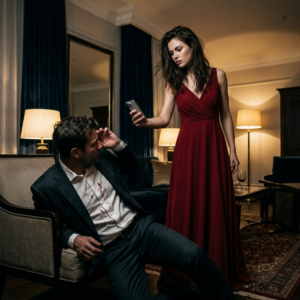
I stood up. The shy girl was gone. I picked up my wine glass and threw the red liquid directly into his face. He screamed, the wine dripping off his expensive suit like blood.
“What are you doing?” he roared.
I pulled out my phone and pressed play. His own voice filled the room, clear and damning. “She is old and stupid… I take money from the company… Just be good tonight.”
His face turned a sickly shade of purple. He lunged for me, but I didn’t flinch. Two years of secret kickboxing classes—taken because I wanted to be strong, not just pretty—guided my movement. I kicked his leg out from under him, and he hit the floor with a heavy thud.
I had called hotel security before I entered the room. Within seconds, the door burst open. I showed them the video on my phone. I showed them the confession. When the police arrived, they didn’t see a “pretty girl.” They saw a witness with an airtight case.
The Queen’s Morning
The fallout was a tidal wave. Mr. Vincent didn’t just lose his job; he lost his life. His wife took everything in a bitter divorce. The company found proof that he had stolen over a hundred thousand dollars. His face, once the image of corporate success, was now the face of a criminal in every newspaper.
I walked into the office on Monday morning. The silence was different this time. It wasn’t the silence of judgment; it was the silence of awe. Stella, the woman who had whispered the loudest, walked up to me and apologized. One by one, the other women followed. They realized that the “pretty girl” had fought a war they didn’t even know was happening.
Two weeks later, the company president called me in. My blue folder was on his desk.
“This plan is the reason we won the client,” he said. “It is the most brilliant strategy I have seen in a decade. We want you to be the new Marketing Director. Not because of your face, Aurora. Because of your brain.”
I accepted.
Now, I sit in my office by the window. I wear less makeup. My hair is pulled back. I look in the mirror and I see a woman who is still beautiful, but that is the least interesting thing about her. I kept the hotel key card in my desk drawer—a reminder of the night I stopped being a doll and became a queen.
People used to say I was beautiful. Now, they say I am brilliant. My face is a gift, but my mind is a fortress. And a queen never bows to anyone.
Call to Action: Have you ever been underestimated because of how you look? Have you ever had to use your inner strength to prove the world wrong? Share your story of resilience and “fighting back” in the comments below. Let’s inspire each other!
Disclaimer : This content may be created by AI for entertainment purposes. Any resemblance to real persons, events, or places is coincidental.






