“I don’t need your pity, Eliza. I need your respect.” The terrifying moment a billionaire CEO realized all her money could not buy the one thing she desperately wanted.
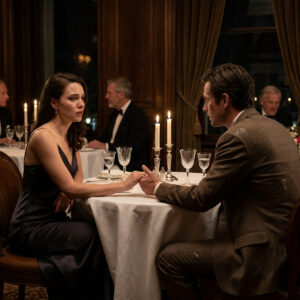
The syllables hung suspended in the heavy, perfumed air of the restaurant, sharper than the jagged edge of a broken crystal champagne flute. Around them, the ambient symphony of the city’s most exclusive dining room—the delicate chime of sterling silver against bone china, the muted, velvety hum of power-brokers negotiating fortunes, the soft jazz weaving through the candlelit shadows—seemed to violently evaporate. There was only the cavernous, suffocating silence radiating from the center of their table. Eliza Harrington, a woman who had spent the last decade commanding boardrooms and dictating terms to the global market, felt the immaculate, porcelain mask of her composure fracture. A physical ache, sharp and entirely unfamiliar, blossomed beneath her sternum. She sat perfectly still, the flickering amber light of the taper candle casting long, trembling shadows across the flawless silk of her designer gown, her breath trapped in her throat. She had laid her entire empire, her heavily guarded heart, and her undeniable power across the pristine white linen of the tablecloth, and the man sitting opposite her had just gently, devastatingly, pushed it back.
Three months before the foundations of her world cracked in that restaurant, Mark Davis had been nothing more than a digital ghost, a string of carefully formatted text floating on the glowing, high-resolution screen of Eliza’s corner office monitor. He was one of hundreds. The applicant pool for Harrington Technologies was a relentless tide of pedigree and ambition: Ivy League graduates with razor-sharp smiles, aggressive young executives eager to sacrifice their personal lives on the altar of her multi-billion-dollar empire. Eliza swiped through them with the cold, practiced efficiency of a machine, her eyes scanning for weaknesses, for hesitations.
But then, the cursor stopped.
It was a small, almost imperceptible anomaly tucked away in the chronological timeline of his employment history. A two-year gap. In the cutthroat arena of software engineering, a two-year gap was professional suicide. It was a glaring, flashing warning light that usually resulted in an immediate rejection. Yet, beneath the dates, written in a plain, unembellished font, was a single sentence: Family medical leave to care for dependent child following divorce.
Eliza leaned back in her ergonomic leather chair, the soft hum of the skyscrapers HVAC system the only sound in her sprawling, glass-walled sanctuary. Her perfectly manicured index finger hovered over the trackpad. She stared at the words until the letters began to blur. Most candidates would have lied. They would have invented a failed startup, a period of independent consulting, a sabbatical to study blockchain in Europe. They would have covered the bleeding wound of their personal lives with corporate bandages. But this man had simply stated the truth, unashamed and unprotected. It was an act of quiet, staggering defiance against the corporate machine she herself had built. It unsettled her. It intrigued her. Instead of forwarding the file to the Human Resources department with a swift dismissal, she picked up her sleek desk phone and instructed her assistant to schedule the interview. She would handle this one personally.
When Mark Davis crossed the threshold of her office a week later, the atmospheric pressure of the room seemed to shift. Eliza sat behind her massive, polished mahogany desk like a monarch on a throne, her posture a weapon designed to intimidate. She expected the usual sequence: the nervous clearing of the throat, the sweaty palms subtly wiped on trousers, the frantic, over-rehearsed elevator pitch.
Mark offered none of this. He moved with a slow, deliberate cadence, the quiet dignity of a man who had already survived the worst the world had to throw at him and had nothing left to prove to a stranger in a suit. His own suit was clean, meticulously pressed, but undeniably dated—the lapels a fraction too wide, the fabric lacking the subtle sheen of bespoke tailoring. When he extended his hand across the expanse of her desk, his grip was firm, yet notably cautious, as if he were careful not to accidentally break the fragile, high-stakes illusion of the interview.
But it was his eyes that caught her completely off guard. They were a deep, oceanic hazel, framed by bruised, purplish shadows of chronic exhaustion. It was a bone-deep weariness that no amount of caffeine could mask, a physical manifestation of a burden his resume could only hint at.
“Tell me about the gap in your employment, Mr. Davis,” Eliza said. Her voice was sharp, a perfectly calibrated instrument of authority that she usually used to cut through pleasantries.
Mark did not flinch. He did not avert his gaze. He simply folded his hands softly in his lap, the knuckles white with tension. “My daughter, Emma, was diagnosed with severe anxiety after my ex-wife and I separated,” he began, his voice a low, steady rumble that seemed to vibrate against the glass walls. “She needed absolute stability. The custody arrangement was… complicated. The legal and emotional toll on her was immense. I chose to take time off to be the constant in her life during the transition.”
“That must have been difficult financially,” Eliza countered, her eyes narrowing slightly, searching for the hidden angle, the plea for sympathy.
“Some things are more important than money, Miss Harrington.”
The words were spoken without malice, without judgment, but they struck Eliza with the force of a physical blow. The absolute, unshakeable conviction in his tone stripped away her corporate armor. In an industry fueled by an insatiable hunger for wealth and status, this man was sitting in the epicenter of power, unapologetically declaring that his child was the center of his universe. It was an integrity so pure, so violently foreign to her reality, that she felt a sudden, inexplicable tightness in her throat. She didn’t ask another question. She hired him before he walked out the door.
At thirty-eight years old, Eliza Harrington possessed everything the modern world had been conditioned to worship. She had turned a failing, inherited real estate portfolio into a tech conglomerate that dictated global market trends. She walked through the world enveloped in a force field of wealth and intimidation. Yet, when the heavy oak doors of her penthouse closed at night, the silence of her luxury was deafening. She was surrounded by people who wanted her connections, her capital, her influence—but she had long ago stopped believing there was anyone left on earth who actually wanted her. The last three men she had tried to love had looked at her and seen only a ladder.
Mark Davis, however, refused to look at the ladder at all.
He was brilliant. His code was elegant, his structural solutions to legacy software problems saving the company millions within his first two months. But unlike the ambitious sycophants who haunted the office until midnight hoping to catch her eye, Mark’s computer powered down precisely at 4:58 PM every single day. He left the building with mechanical regularity to relieve the after-school care program. Eliza found herself inexplicably drawn to his department on the 40th floor. She fabricated transparent excuses—a question about a minor subroutine, a clarification on a weekly report—just to stand near his cubicle, to listen to the steady, calm cadence of his voice.
The gravity of her fascination crystallized on a rainy Tuesday evening. The executive floors were a tomb of shadows and glowing emergency exit signs. Eliza was completing her final rounds when she saw a rectangular patch of harsh blue light spilling from Mark’s doorway. She paused, her heels sinking silently into the plush carpet.
He was hunched over his keyboard, the glare of the monitor washing his exhausted features in a ghostly pallor.
“I thought you always left at five,” she said, her voice softer than she intended, breaking the absolute stillness of the floor.
Mark jumped slightly, his hand flying to his chest. He looked up, his eyes bloodshot, rubbing the bridge of his nose. “Emma’s staying with her mother this week,” he murmured, his voice thick with a profound, aching sadness. “The apartment feels… too quiet. The silence is louder than the servers.”
The raw, unfiltered vulnerability in his admission paralyzed her. She should have nodded, offered a platitude about dedication, and walked away. Instead, she stepped across the threshold, pulled up a mesh office chair, and sat down. “Tell me about her. Your daughter.”
The transformation was instantaneous and breathtaking. The heavy, invisible weight crushing Mark’s shoulders seemed to evaporate. He reached into his breast pocket with a sudden, frantic energy and produced his phone, his thumb swiping across the cracked screen to pull up a photograph. It was a girl with a gap-toothed, luminous smile, her eyes wide and thoughtful—an exact mirror of the man holding the phone.
“She’s brilliant,” Mark whispered, his thumb lightly tracing the edge of the screen as if stroking her cheek. “Loves science and art equally. She can’t decide if she wants to be an astronaut or a veterinarian, so she’s aggressively planning the logistics to be both.”
“Ambitious,” Eliza smiled, the corners of her eyes crinkling in a way they hadn’t in years.
“She gets that from her mother,” Mark said. The words were quiet, entirely devoid of the bitter, acidic resentment Eliza usually heard in the voices of divorced men. “Cynthia always dreamed big. Too big for the small, quiet life we had built, eventually.”
“What happened?” Eliza asked. The question slipped past her lips before her professional filter could catch it. She inhaled sharply, her posture stiffening. “I’m sorry, Mark. That is entirely inappropriate for me to ask.”
“It’s okay,” he said softly, clicking the phone screen dark and laying it face down on the desk. He turned his chair fully toward her. “The simple version is that she found someone whose ambitions matched hers. Someone who wanted to conquer the world, someone who didn’t want to be tied down by the relentless, grinding responsibilities of family. I wanted our family. When that wasn’t possible anymore… I just wanted what was best for Emma.” He paused, his hazel eyes locking onto hers with an intensity that made her breath hitch. “Why are you really here, Miss Harrington?”
No one spoke to her like this. No one demanded the truth from her without flinching. Her mind raced, frantically searching for the corporate shield. “I was wondering if you’d like to join me for dinner. To discuss your structural ideas for the Henderson project.”
It was a lie, paper-thin and utterly transparent. The silence that followed was agonizing.
Mark looked at her, his expression a complex tapestry of gentle understanding and immovable boundary. “I appreciate the offer, Miss Harrington,” he said, his voice a soothing, careful rumble. “But I don’t mix business with pleasure. And I think we both know this wouldn’t just be about the Henderson project.”
The heat rushed to Eliza’s face, a violent, burning flush of embarrassment that she hadn’t experienced since she was a teenager. The rejection was polite, but it was absolute. She stood up too quickly, her chair rolling backward and hitting the metal filing cabinet with a loud clang. “Of course. Good evening, Mr. Davis.”
She fled into the shadows of the hallway, her heart pounding a frantic rhythm against her ribs. Men did not say no to Eliza Harrington. They begged. They pandered. But this man had looked right through the billions, right through the tailored suits and the terrifying reputation, and quietly shut the door.
The following weeks were an agonizing exercise in professional compartmentalization. Eliza promoted him to a special project lead, a thinly veiled excuse to legally mandate his presence in her office every Tuesday and Thursday at 4:30 PM. She learned the exact shade of brown his coffee turned when he added his single packet of sugar. She hoarded the small, trivial details of his life—a scraped knee Emma suffered at recess, a burnt dinner he managed to salvage with extra cheese—like precious, priceless gems.
Then came the Tuesday he simply didn’t appear.
There was no email. No frantic voicemail to the front desk. For a man whose life was dictated by the rigid, unyielding schedule of single fatherhood, this absence was a terrifying alarm bell. By noon, the anxiety clawing at Eliza’s chest was unbearable. Bypassing HR, breaking every protocol she had written into the employee handbook, she pulled his file and dialed his emergency contact number herself.
The line clicked. “Hello?” a small, piping voice answered.
Eliza froze, her fingers gripping the edge of her desk. “Hello… is this Emma?”
“Yes,” the child replied, the syllables clipped with a formal, practiced politeness. “Who is calling, please?”
“This is Eliza Harrington. I am your father’s boss. Is he available?”
A heavy sigh echoed through the phone. “Daddy’s sick. He has a really, really high fever. He keeps trying to put his shoes on to go to work, but he can’t even stand up straight without holding the wall. I made him go back to bed and I hid his phone under my mattress so he would rest.”
The image of the stoic, unbreakable Mark Davis collapsing against a wall sent a spike of pure adrenaline straight into Eliza’s bloodstream. “Emma, is there another adult there with you?”
“No,” the little girl said proudly. “But I’m very responsible. Daddy says I’m eight going on thirty.”
“I am entirely certain that you are,” Eliza said, her mind already moving at lightspeed, rearranging the architecture of her day. “Would it be all right if I came over to help? Your father is very important to our company.”
Forty minutes later, Eliza’s armored town car pulled up to a modest, beige brick apartment complex in a middle-class suburb she had never visited. The air smelled of wet asphalt and cut grass. When the door to unit 3B opened, Emma stood there, a serious, assessing sentry with Mark’s hazel eyes.
The apartment was painfully small, but it was a sanctuary of immaculate love. There were no expensive sculptures, no imported rugs. Instead, the walls were a gallery of construction paper and crayon, framed with the same reverent care Eliza reserved for her original Picassos. Emma pointed a small finger toward a closed door down the narrow hallway.
Eliza pushed the door open. The heat in the bedroom was stifling, smelling faintly of sweat and eucalyptus. Mark was tangled in the sheets, his face flushed a dangerous, mottled crimson, his eyes glassy and unfocused as he tried to push himself up on shaking arms.
“Mr. Davis, get back in bed immediately. That is an executive order,” Eliza commanded, her boardroom voice slicing through his delirium.
He blinked, swaying slightly, trying to focus on the tailored silhouette standing in his bedroom doorway. “Miss Harrington? Am I hallucinating?”
“No. But you might be if this fever spikes any higher. Emma called me.”
“Emma has your number?” he mumbled, his arms giving out as he collapsed heavily back onto the pillows.
“I called your emergency contact. She is incredibly capable.” Eliza walked to the bedside, abandoning every boundary of professional decorum. She placed her cool, manicured palm flat against his burning forehead. The heat radiating from his skin was terrifying. “You need medication and rest. The company will survive.”
“Emma… she has homework. Dinner. The laundry…” he protested, his voice a weak, gravelly rasp.
“I will handle it,” Eliza said. The absolute certainty in her voice was the same tone she used when acquiring a hostile competitor.
And she did. The CEO of Harrington Technologies rolled up the silk sleeves of her thousand-dollar blouse. She called her panicked assistant and cleared a schedule that contained meetings with state senators. She sent her bewildered driver to a local pharmacy and a grocery store. She set up her encrypted laptop on a scratched, circular kitchen table. For three days, she lived a life she had never known. Between multi-million dollar conference calls, she stirred chicken soup. She glued popsicle sticks together for a science project. She wiped a cool, damp cloth across the burning forehead of the man she was rapidly, helplessly falling in love with.
It was the most domestic, mundane, profoundly terrifying thing she had ever done. And it felt like breathing for the very first time.
On the third afternoon, the fever finally broke. Mark emerged from the hallway, leaning heavily against the doorframe, his hair damp with sweat. He found the billionaire CEO of his company sitting cross-legged on his living room floor, groaning in theatrical agony as an eight-year-old girl triumphantly moved a silver thimble across a Monopoly board to bankrupt her.
“You’re still here,” Mark whispered, his voice rough, staring at the scene as if it were a mirage.
Eliza looked up, her cheeks flushing, suddenly acutely aware of her bare feet and wrinkled skirt. “Your daughter is a ruthless capitalist. I demanded a rematch to win back my pride.”
Emma beamed, leaning her small weight comfortably against Eliza’s arm. “Eliza knows all about business strategy, Daddy, but she’s terrible at Monopoly. She buys all the cheap properties.”
The casual, effortless use of her first name. The weight of the child leaning against her. In three days, the terrifying CEO had vanished, replaced simply by Eliza. Mark looked at her, his hazel eyes dark and swimming with an emotion so heavy it threatened to pull them both under.
“Thank you,” he said. Just two words, but they carried the weight of the universe.
The shift was irreversible. The professional boundary had shattered, replaced by a deep, quiet intimacy. Sundays became sacred—dinners at Eliza’s sprawling estate, where the echoing halls were finally filled with the sound of Emma’s laughter. Eliza found herself rearranging international flights just to sit in a folding chair in a gymnasium and watch Emma’s science fair presentation. For the first time in her thirty-eight years, she belonged to something that could not be bought, sold, or traded on a stock exchange.
Six months later, she knew she had to tear down the final wall.
She arranged the dinner at the city’s most exclusive, impenetrable restaurant, fabricating a meeting with a high-level client to ensure Mark’s attendance. When the imaginary client inevitably “canceled,” they were left alone at a secluded corner table, bathed in the soft, romantic glow of candlelight.
Eliza’s heart hammered against her ribs with the violent force of a trapped bird. She had analyzed the variables. She had calculated the risks. The power dynamic of their employment was a massive, looming shadow over their connection. She had to neutralize it. She had to make him her equal before she could make him hers.
“Mark,” she said, her voice remarkably steady as she pushed her untouched plate away. “I have a proposition for you. I am creating a new position. Chief Innovation Officer. You will report directly to the board, completely bypassing my authority. The compensation package includes substantial equity options.”
Mark carefully placed his silver fork on the rim of his plate. He studied her face, his eyes narrowing slightly, reading the micro-expressions she thought she had hidden. “Why?”
“Because your vision is exactly what the company needs to pivot into the next decade,” she recited, leaning forward. Then, she took a shaky, profound breath, abandoning the script. “And because I need to ask you something intensely personal. And when I do, I need you to be standing on the exact same ground as me.”
The slow dawn of realization crept into Mark’s eyes. The air between them thickened, vibrating with unsaid words. “Eliza, you cannot restructure a billion-dollar company and hand me a C-suite title just because you have feelings for me.”
“I am promoting you because you earned it!” she countered, her voice rising slightly, desperately fighting for control. “The timing is because I cannot breathe another day pretending that I only want to be your friend. I want everything.”
Mark sat perfectly still, the flickering candle illuminating the deep, sorrowful lines around his mouth. “What exactly are you asking me, Eliza?”
She leaned across the table, the desperate, uncontainable truth spilling from her lips before logic could restrain it. “Be my husband, Mark.”
It was a reckless, impulsive, terrifying leap into the dark. It was the desperate act of a woman who was used to securing what she wanted through overwhelming force and ironclad contracts. She wanted to lock him in, to protect him, to elevate him. She wanted to fix the struggle she had seen in his small apartment.
The silence that followed was the loudest sound Eliza had ever heard.
Mark looked at her, and the expression that washed over his features was not the joyous relief of a man who had just been handed the keys to the kingdom. It was shock. It was a profound, heavy sadness. And, devastatingly, it was disappointment.
“I don’t need your pity, Eliza,” he said, his voice a low, agonizing whisper that sliced straight through her chest. “I need your respect.”
Eliza recoiled physically, her hand flying to her throat as if she had been slapped. “Pity? Mark, I love you. How could you possibly think—”
“I know what you’re doing,” he interrupted gently, raising a hand to stop her. “You have seen my life. You’ve seen the small apartment, the late-night panic over medical bills, the struggle to balance fatherhood and survival. You look at the modest existence I provide for my daughter, and you look at your empire, and you want to fix me. You want to rescue me with your resources and your titles.”
“That is not true,” she whispered, hot, stinging tears welling in her eyes, blurring the candlelight.
“Let me finish,” he said, his tone softening, reaching across the table. He didn’t take her hand, but his fingers rested inches from hers on the white linen. “You are extraordinary, Eliza. Not because you own the buildings, or because you command the board. You are extraordinary because I watched you sit on my cheap carpet and play Monopoly with my daughter when I was too weak to stand. I watched you strip away the CEO and become a human being. Over these past months, I have fallen completely, irrevocably in love with you.”
Eliza’s breath caught. A violent, desperate spark of hope flared in the dark cavern of her chest. “Then why? Why are you saying no?”
“Because a real marriage, a real partnership, isn’t built on a foundation of rescue,” Mark explained, his hazel eyes shining with his own unshed tears. “It isn’t built on debt or gratitude. It is built on two people standing on their own two feet, seeing each other clearly, and choosing to walk together. I won’t be your charity project. I won’t be the man you saved.”
He finally bridged the gap, his calloused, warm fingers wrapping firmly around her trembling, manicured hand. “I won’t be your husband. Not tonight. Not like this. But… I would be incredibly honored to be your partner. To take a step back. To build a foundation together, slowly, without the pressure of saving each other’s lives.”
A tear finally escaped, cutting a hot track down Eliza’s powdered cheek. It was a vulnerability she had sworn to never show another living soul, yet here she was, weeping in a public restaurant, feeling lighter than she had in decades. A wet, broken laugh bubbled up from her chest.
“I have never, in my entire life, been rejected so beautifully,” she choked out, wiping at her cheek with her free hand.
“It isn’t a rejection, Eliza,” Mark smiled, the bruised exhaustion around his eyes lifting entirely. “It is an invitation. An invitation to something authentic. No power dynamics. No corporate shortcuts. Just a man and a woman, figuring out if they can survive the messiness of a real life together. Furthermore, Emma adores you. But she has survived a broken home. She needs to see a healthy, patient relationship modeled for her, not a rushed fairy tale.”
Eliza squeezed his hand, the frantic panic draining from her body, replaced by a deep, resonant peace. He was right. He was entirely, frustratingly right. She had tried to buy the finish line because she was terrified of running the race.
“So,” she whispered, dabbing her eyes with a linen napkin. “What exactly happens now?”
Mark’s smile widened into a boyish, genuine grin. “Now? You let me ask you on a proper date. As absolute equals.” He paused, his thumb tracing circles on the back of her hand. “Eliza Harrington, would you do me the profound honor of accompanying me to the Natural History Museum this Saturday? Emma informs me there is a new dinosaur exhibit that is, quote, ‘non-negotiable’.”
“I would like that very much, Mr. Davis,” Eliza smiled, the fractured pieces of her mask finally falling away for good.
“And regarding the promotion,” Mark added, his tone shifting back to the quiet, dignified professional she had interviewed months ago. “I appreciate the vote of confidence more than you know. But I am going to decline. I will apply for the Chief Innovation Officer position through the standard HR channels when the time is right. If I am ever going to sit in that seat, I want the entire building to know it is because of the code I write, not the woman I love.”
In that exact moment, staring at the man across the table, Eliza understood the true nature of power. True power wasn’t a bank account. It was the absolute, unshakeable integrity of a father who refused to compromise his soul, even when the world was offered to him on a silver platter.
Exactly three hundred and sixty-five days later, the afternoon sun poured through the floor-to-ceiling windows of the executive office, casting a warm, golden rectangle across the mahogany desk. Eliza Harrington stood gazing out at the sprawling, glittering skyline she had conquered, but her eyes were not focused on the glass towers. She was staring down at her left hand, her thumb gently tracing the cool, heavy platinum band of the diamond engagement ring that caught the sunlight and fractured it into a thousand rainbows across the walls.
Mark had asked her the night before, kneeling on the worn carpet of his living room, with Emma standing proudly beside him holding the velvet box. He had asked her only after he had formally, rigorously interviewed for and won the title of Chief Innovation Officer—securing a revolutionary patent that had skyrocketed the company’s valuation.
The year had not been a cinematic montage of effortless romance. It had been glorious, messy, agonizing, and real. They had fought fiercely over parenting styles and bedtimes. They had navigated the treacherous, whispering minefield of corporate gossip when HR officially announced their relationship. Mark had patiently dismantled Eliza’s terrifying workaholic tendencies, teaching her how to turn off her phone, while Eliza had carefully navigated Mark’s deep-seated insecurities about his ability to provide in the shadow of her massive wealth. They hadn’t rescued each other. They had done the grueling, magnificent work of building a bridge across their two worlds, stone by heavy stone.
A sharp, rhythmic knock on the heavy oak door shattered the quiet hum of the office.
The door swung open, and Mark stood on the threshold. He was wearing a new suit, perfectly tailored, but his tie was slightly askew. Beside him stood Emma, clutching a worn leather satchel, her eyes bright with conspiratorial excitement.
“Are you ready for the 3:00 PM strategy meeting, Miss Harrington?” Mark asked, his voice adopting a tone of rigid professional formality, though his hazel eyes danced with a private, warm amusement.
Eliza turned away from the window, leaning her hip against the edge of her desk. She looked at the man who had dared to reject her billions, and the child who had taught her how to play. The corporate empire sprawling beneath her feet suddenly felt remarkably small, beautifully insignificant.
“Actually, Mr. Davis,” Eliza said, walking slowly toward them, reaching out to gently straighten his silk tie. “I was thinking we might play hooky this afternoon. I have been reliably informed by a highly placed source that an exceptional artisanal ice cream shop has just opened near the botanical gardens.”
Emma’s jaw dropped, her eyes widening in comical shock. “You want to skip work? But Eliza… you never, ever skip work!”
Eliza smiled, reaching down to take the little girl’s small, sticky hand in hers, while her other hand slipped seamlessly into Mark’s. “Some things are infinitely more important than work, Emma,” Eliza whispered, echoing the words a tired, desperate father had spoken in this exact room a lifetime ago. “And I am very lucky to be learning that from the two most important people in my world.”
As the three of them walked out of the corner office, leaving the glowing monitors and ringing phones behind them, Eliza knew the absolute truth. If Mark had accepted her terrified, impulsive proposal in that restaurant, they would have been doomed. They would have skipped the messy, beautiful, essential work of becoming partners. His rejection had not been an ending; it had been the painful, necessary breaking of the soil so that something real could finally grow.
Sometimes, the universe hands you exactly what you ask for. But occasionally, if you are incredibly fortunate, the universe hands you a man brave enough to tell you no.
True partnerships are never forged in the fires of rescue; they are built in the quiet, deliberate light of mutual respect. We are conditioned by fairy tales and silver screens to believe that love is a savior crashing through the ceiling to fix our broken lives. But the deepest, most enduring connections require the terrifying bravery of standing on our own two feet, looking at another human being with all their flaws and baggage, and choosing to walk alongside them—not to carry them, and not to be carried. Have you ever experienced a rejection that turned out to be the greatest invitation of your life? Have you ever had to fight to build an authentic partnership instead of accepting an easy compromise? Share your beautiful, messy, and real stories in the comments below. Let us celebrate the courage it takes to demand respect over pity.
Disclaimer : This content may be created by AI for entertainment purposes. Any resemblance to real persons, events, or places is coincidental.






