The Weight of the Bread, The Shadow of the Vine: A Night of Unthinkable Betrayal and Boundless Love
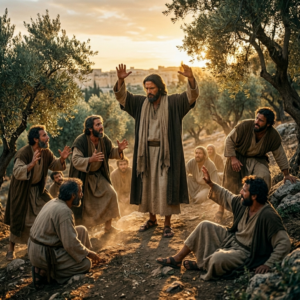
The evening did not begin with the triumphant fanfare of conquering kings, nor with the serene quietude of a traditional holy day. It began with the skittish, furtive energy of hunted men slipping through the shadows of Jerusalem. The air in the city was thick, stifling, laden with the metallic tang of impending violence and the heavy dust kicked up by thousands of pilgrims.
“Are you okay?”
The question hung in the narrow, dimly lit corridor, a fragile tether of brotherhood thrown into a sea of rising, unspoken anxiety.
“Yeah.” The reply was strained, the single word brittle enough to snap. Eyes darted toward the lengthening shadows. Shoulders remained locked in defensive tension.
“What…?”
“Thad, they said, take an ambiguous and evasive route.” The whisper was urgent, slicing through the heavy evening heat. Every footstep on the uneven cobblestones of the city had felt like a drumbeat signaling their approach to an unseen enemy. They hadn’t just walked to a meal; they had navigated a labyrinth, slipping through the closing jaws of a trap they could feel but could not yet comprehend.
“Not the longest one possible,” came the breathless retort, the exhaustion of the winding journey bleeding into the hushed voices.
“I was the last to leave. Seven, eight, nine, ten… There is still one more to come, Mark.” The counting was an anchor, a desperate attempt to impose order on a night that was already spinning out of their control. They were gathering in an upper room, seeking refuge, seeking answers, seeking the familiar warmth of their Rabbi.
Inside, the room was bathed in the warm, flickering amber of oil lamps, casting long, wavering silhouettes against the rough-hewn stone walls. Yet, even in this sanctuary, the petty squabbles of ambitious men flared up, a desperate defense mechanism against the unknown.
“Right. John’s put himself at Jesus’ right hand,” a voice noted, tinged with the weary resignation of long-standing rivalries. “Don’t you want to be at his left?”
“No, I’m good. I’m happy to sit next to you,” came the reply, softer, lacking the sharp edge of political maneuvering.
“We ready for this?”
“Yes.” “No.”
The contradictory answers tumbled out simultaneously, a perfect encapsulation of their collective psyche.
“Ready for what?”
“Whatever is about to happen.”
“Only one way to find out.”
The exchange was rapid, breathless. “Can we define ‘ready’? Does it matter whether we are ready or not?” The philosophical deflection could not hide the trembling undercurrent of genuine fear.
“Matthew. You’ve changed,” a voice observed, cutting through the philosophical fog with a sharp dose of reality. “Who cares if we’re ready? It’d be nice to know what we’re talking about here. What’s the prevailing theory?”
Before the question could spiral into further paranoid speculation, the atmosphere in the room shifted entirely. The heavy wooden door creaked, and the Rabbi entered.
The Humility of the Dust
“Rabbi. Chag Pesach sameach.” The traditional Passover greeting was offered with a mixture of reverence and palpable relief.
“Chag Pesach sameach,” Jesus replied, his voice a steady, grounding force in the turbulent room. “Thank you, Mark.” He looked at the young man who had helped prepare the space, his eyes holding a profound, gentle warmth that seemed to see right through the boy’s nervous energy. “Now go down and enjoy the seder meal with your parents.”
Mark hesitated, his desire to serve battling his obedience. “Are you sure? I’m here to serve. I’ll handle it.”
“Yes, Rabbi. Everybody, welcome,” Jesus affirmed gently, his tone leaving no room for argument, only quiet authority. Mark nodded, slipping away and leaving the core group of men alone with their teacher.
“Tonight will be a night to remember,” Jesus began, his gaze sweeping across the faces of the men he had chosen. Men who were rough, flawed, fiercely loyal, and entirely unprepared. “After we eat together, we will go to Gethsemane, where we will spend some time in prayer and reflection. But… before all that… let us enjoy this beautiful table Peter and John have prepared for us, and begin the remembrance.”
“Rabbi,” one of them interrupted, looking down at his feet, coated in the pale, chalky dust of the treacherous evasion route they had just walked. “That boy Mark said that a servant would be up shortly to help with washing our feet. Yes, some of us are still pretty filthy from the walk.”
But Jesus was already moving. He was not looking toward the door for a servant. He was reaching for the hem of his own outer garment.
“Rabbi, what are you doing?” The question was a collective gasp, a sudden suspension of breath as the men watched their Lord, the man they believed to be the Messiah, unbind his robes.
“Please, sit. Each of you.”
“Sit where?” Panic began to edge into their voices. This was a subversion of every social order, every hierarchy they had ever known.
“At your places at the table.”
“No, sorry, I just…”
“Rabbi, you do not need to do this.” The protests cascaded over one another, a chaotic symphony of discomfort and awe.
Jesus paused, holding the basin of water, the rough linen towel draped over his arm. “My friends, my friends. Tonight is our last meal together.” The words struck the room like a physical blow. The air rushed out of their lungs. “Will you just please do as I say, and not object, for once?”
There was a vulnerability in his plea, a sorrowful weight that silenced them instantly. They moved to the table, their movements stiff, awkward, overwhelmed by the profound intimacy of what was happening. The splashing of water echoed loudly in the stunned silence.
He moved from man to man. “Thank you, James,” he murmured. The rough, calloused hands of the carpenter cradled the tired, dirty feet of his followers. He washed away the grime of the road, the physical manifestation of their grueling journey.
“It’s okay. It’s okay,” he whispered to another, offering comfort to a heart he knew was breaking under the weight of his earlier words.
“Thank you, Rabbi,” Thomas whispered, his voice catching, the characteristic anger and doubt melting away under the warm water and the tender touch.
“It’s all right, Thomas. Please.”
When he reached Little James, he looked up, his eyes meeting the man who bore his physical afflictions with quiet grace. “Are you sure?” James asked, his voice trembling.
“Yes, Little James, I’m sure. Please.” As he washed, Jesus’s voice rose, carrying a poetic, ancient resonance that filled the corners of the upper room. “How beautiful upon the mountains are the feet of him who brings good news, publishes peace, and proclaims salvation.”
Then, he knelt before Judas.
The silence in the room became absolute. The air seemed to freeze. “Judas,” Jesus said softly.
“Rabbi, I…” Judas stammered, a frantic, trapped look flashing across his eyes. The internal war within the man was almost visible—a horrific collision of loyalty, disillusionment, and a dark, spiraling rationalization.
“It’s your turn,” Jesus said, his voice entirely devoid of judgment, holding only an agonizing, unconditional love. He washed the feet that would soon run to betray him. He dried them with the towel.
“Ra– Thank you, Rabbi,” Judas choked out, the words tasting like ash in his mouth.
Finally, Jesus came to Peter. The big fisherman pulled his feet back, his jaw set, his eyes flashing with a fierce, protective pride. “My turn.”
“Please, sit. Peter…”
“Lord, you would wash my feet? No, this doesn’t make any sense.” Peter’s voice was loud, defensive. He could not reconcile the King he worshipped with the servant kneeling before him.
“What I am doing, you don’t understand now. But afterward you will.”
“Master. We should have done this ourselves, and we’re sorry for our pride. But I am telling you, you will never wash my feet.” It was a vow, an absolute refusal born of reverence, yet steeped in a profound misunderstanding of grace.
“Brother, just do what he says,” another disciple hissed, terrified of Peter’s defiance.
“Listen carefully,” Jesus said, his voice dropping to a register of absolute, unbreakable seriousness. “No more of this. Moving forward, you need to trust me more than ever, even if you have no understanding yet. I mean this. If I do not wash you, you have no share with me. You cannot be part of what I am doing.”
The ultimatum struck Peter like a physical strike. The very thought of having “no share” with Jesus, of being separated from him, shattered his stubborn pride instantly. He swung wildly in the opposite direction.
“Well, in that case, Lord, wash not my feet only, but also my hands and my head!” Peter cried out, his desperate, overwhelming love spilling over in characteristic excess.
A fleeting, weary smile touched Jesus’s lips. “Sometimes Peter is still Simon. Peter, did you bathe this morning?”
“Yes.”
“Then only your feet need to be washed now. And that will be enough. Please, sit. Come.” Jesus stood, wiping his hands, letting the profound lesson settle over the silent men. “Besides, you all understand, I’m not talking about literal cleanliness, right? I’m setting you an example. You call me Teacher and Lord. And rightly so. If, then, I, your Lord and Teacher, have washed your feet, then you, also, should wash one another’s feet.”
He looked around the table, burning the mandate into their souls. “When you go out into the world to spread my message, this is how you are to lead. As servants, with humility. You will set aside any pride or ego in order to love and serve others. Friends and enemies alike.”
“Enemies?” The word echoed, sharp and confused.
“Even tonight.”
“What is that supposed to mean? Well, who is, and who isn’t?”
Jesus did not answer the paranoid question directly. Instead, he moved to the head of the table. “I have earnestly desired to eat this meal with you before I suffer. This is our last Passover together on this earth, before we celebrate it again when all is fulfilled in the new Kingdom.”
“I would ask how long that will be…” one whispered, the reality of the impending separation crushing down on them. “…but I know the answer. You will understand.”
“But first…” Jesus turned his attention to the elements on the table, the ancient symbols of a miraculous deliverance that were about to be radically, eternally transformed.
The Bread of Affliction and the True Vine
“Blessed are you, Lord our God, King of the Universe, who brings forth bread from the earth. Amen.”
The ancient Hebrew blessing rolled off his tongue, familiar and comforting, yet charged with a terrifying new electricity. He held up the unleavened bread, the rough, flat disc that generations had eaten to remember the haste of their flight from Egypt.
“Normally this bread is to remember and celebrate our redemption from Egypt into the Promised Land,” Jesus explained, his voice echoing in the cavernous silence of the room. “From slavery into freedom. Tonight we celebrate your redemption from sin because of me.”
He grasped the edge of the bread. With a sharp, echoing snap, he broke it in half. The sound seemed violently loud in the quiet room.
“Take and eat it. This is my body, which is given for you.” He passed the broken pieces to the men on his right and left. “Do this in remembrance of me.”
They took the bread, their fingers trembling. They chewed in silence, the dry, crusty texture scratching their throats, their minds struggling to comprehend the staggering weight of the metaphor. This is my body. Jesus then lifted the heavy clay cup, the dark, rich red wine sloshing against the rim, catching the lamplight like liquid garnet.
“Blessed are you, Lord our God, King of the Universe, who creates the fruit of the vine. Amen.” He looked at the men, his eyes holding a profound sorrow and a fierce, unyielding resolve. “Normally the wine allows us to remember and celebrate the blood of the lamb, spread on the doorposts of our ancestors. But tonight… likewise… this is my blood of the new covenant, shed for you, and for many, for the forgiveness of sins. Drink it, all of you, in remembrance of me.”
The cup was passed. Hand to hand. Lip to lip. The sweet, sharp taste of the wine felt entirely different now. It felt heavy. It felt like a promise sealed in an unimaginable sacrifice.
“I am the true vine,” Jesus continued, his voice dropping into an intimate, urgent cadence. “And my father is the vinedresser. Every branch in me that does not bear fruit, he takes away. And every branch that does bear fruit, he prunes, that it may bear more fruit.”
He looked at each of them, demanding their absolute attention. “Abide in me, and I in you. As the branch cannot bear fruit by itself unless it abides in the vine… neither can you, unless you abide in me. I am the vine. You are the branches.”
He spoke of gathering and burning withered branches, of abiding in love, of asking the Father and receiving. “These things I have spoken to you, that my joy may be in you, and that your joy may be full.”
“Rabbi. What are you smiling at?” a disciple asked, desperate to hold onto the brief flicker of lightness on his face.
The smile faded, replaced by an agonizing shadow. “It’s nothing. It’s just that… Earlier, I may have washed some of your feet. But not all of you are clean.”
The Shadow of the Betrayer
The temperature in the room seemed to plummet. The warmth of the wine evaporated.
“What are you saying?” The voices were hushed, terrified.
“The scripture has now been fulfilled. ‘He who has eaten my bread has lifted his heel against me.'”
“What?”
Jesus took a breath, his chest rising and falling with a heavy, broken rhythm. “Truly, I say to you… one of you will betray me.”
The words detonated in the small room.
“Someone at this very table.”
“Someone in this room? Who?”
Total chaos erupted. The bonds of brotherhood, already strained by the tension of the week, snapped into a frantic, paranoid frenzy. Chairs scraped violently against the stone floor. Men stood, their faces flushed with rage and terror.
“One of you, brothers? Who? Tell us who. We will bind him, gag him, and throw him in a pit, so he can’t do it.”
Jesus remained seated, an island of tragic calm in a sea of hysteria. “The Son of Man goes as it is written of him. But woe to that man by whom the Son of Man is betrayed. It would have been better for him if he had never been born.”
“Just say who it is,” a voice demanded, trembling with aggressive desperation. “And we’ll make sure that man wishes he’d never been born.”
Jesus closed his eyes. “I need a moment.” He turned away, the weight of the betrayal pressing down on him, physically crushing him.
“What’s happening?” “What?” “Andrew.”
The men turned on each other, their insecurities weaponized. “Rabbi, let me get that for you,” James offered blindly, desperate to do something, anything, to restore order.
“Thank you, James.”
“Master, please, I would never betray you,” Thaddeus pleaded, his eyes wide with a frantic, pleading innocence. “But if there’s something you know that I don’t, and it is me, tell me, and I’ll throw myself out this window.”
“Don’t do that, Thaddeus.”
The arguing escalated. Fingers were pointed. Suspicions were voiced with cruel haste. “Could it be Thomas? I mean, he’s been so angry for so long. If it’s him, he hasn’t done a good job hiding it.”
“You haven’t exactly been happy either,” Thomas fired back, his jaw tight. “Careful. I want him to unite our people, and show more of his power. Lazarus’ raising did not upset me the way it did Thomas.”
“Please, we can’t let this tear us apart,” another cried out. “Let’s just take a moment. He needs us now more than ever.”
Even Peter, the Rock, looked inward with a flicker of terror. “Is it me, Rabbi? Because of Ramah? What about Ramah? Is my anger the betrayal?”
“You have been faithful in spite of your anger,” Jesus assured him, but the comfort was a brief respite.
“I’m trying.”
“I know.”
The bickering dissolved into a desperate debate over who was the greatest, who was the most loyal, who was the least likely to fall. They listed their credentials, their proximity to Jesus, their past sacrifices.
“Stop it, all of you,” Jesus finally commanded, his voice ringing with a sorrowful authority. “This questioning of who is the greatest. Foolishness. Return to your places at the table, please.”
He reminded them again of the nature of true leadership—not the lording of authority like pagan kings, but the posture of a servant. He promised them a kingdom, thrones to judge the Twelve Tribes, pulling their vision away from the terrifying present and toward an eternal horizon.
They returned to the Passover liturgy. They poured the ten drops of wine, reciting the plagues: “Blood. Frogs. Gnats. Flies. Disease. Boils. Hail. Locusts. Darkness. The death of the firstborn.”
John led the Dayenu, the beautiful, rhythmic litany of gratitude. “If he had brought us out from Egypt, and not carried out judgments against them… It would have been enough.”
With every line, the men responded: “It would have been enough.” The rhythm was a balm, a momentary return to the sacred history that bound them together. But Jesus interrupted the ancient script.
“Wait. I have something to add.” He looked around the table, his eyes shining with unshed tears. “If he had built for us the holy temple, and not sent the Messiah in our lifetimes… It would have been enough. We would have waited. But you chose us. You chose now. And it is enough.”
Big James broke down, his broad shoulders shaking with silent, uncontrollable sobs. The overwhelming reality of grace, the terror of the impending loss, the sheer magnitude of the moment shattered his stoic exterior.
“James, why are you crying?” a younger disciple asked, uncomprehending.
“If you don’t know by now, then…” someone whispered fiercely.
They moved to the bitter herbs, dipping them in saltwater to remember the tears of their ancestors. But the true bitterness was in the room, sitting at the table.
“Lord, who is it? Is it Thomas?”
Jesus leaned across the table. His eyes locked onto a man sitting quietly in the shifting shadows. The man’s face was pale, his eyes darting like a trapped animal. The silence stretched until it felt like a physical wire pulled taut across the room.
“You do not have to stay anymore.” Jesus’s voice was barely a whisper, yet it sounded like thunder. “Judas.”
Judas flinched.
“He has you now.”
“Who?” Judas breathed out, his voice shaking.
“Not God.” Jesus’s eyes were filled with an unbearable, heartbreaking pity. “It didn’t have to be this way. But you can still stop things from ending badly.” He paused, the final offering of a way out hanging in the air. Judas did not take it. He could not. The machinery in his mind had turned too far.
“What you are going to do…” Jesus said, his voice dropping to a register of absolute finality, “…do it quickly.”
Judas stood abruptly. He did not look back. He fled into the darkness of the Jerusalem night, leaving a hollow, devastating silence in his wake.
The Brittle Vows of Broken Men
“Philip, where did Judas go?” The sheer, naive confusion of the remaining men was agonizing.
“Passover tradition. Give alms to the poor. He is keeper of the purse.” The rationalizations came quickly, desperately trying to plaster over the gaping wound that had just been torn open in their fellowship.
Jesus let them talk for a moment before gathering their attention once more. “My friends. I am with you just a little while longer. And where I am going, you cannot come.”
He gave them the new commandment. The impossible, magnificent mandate. “That you love one another. Just as I have loved you, you also are to love one another. By this, all people will know that you are my disciples, if you have love for one another… it will transform you, and others.”
But they were stuck on his departure. “Lord, where…?”
“Where I’m going, you cannot follow me now. But afterward, you will follow.”
He spoke of many rooms in his Father’s house, of preparing a place for them, of being “the way, and the truth, and the life.” He promised them the Helper, the Holy Spirit, who would dwell within them and bring to memory all he had said. He offered them his peace—a peace entirely alien to the brutal, anxious world they inhabited.
“I have said this before. Why…?” Peter interrupted, the fiercely loyal fisherman unable to contain his frantic devotion any longer. “Belief is not my problem. I just wanna know, why can I not follow you now? I will lay down my life for you.”
Peter’s eyes were blazing. His jaw was set with absolute, unshakable conviction. He meant every single syllable. He felt the love burning in his chest, a roaring fire he believed could consume any threat, any enemy, any trial.
Jesus looked at Peter. He saw the fierce love. But he also saw the brittle, fragile humanity hiding just beneath the surface.
“Will you lay down your life for me?” Jesus asked softly. It was not a rebuke; it was a devastating observation of reality.
He warned them of the hostility to come. He told them that the world would hate them, just as it had hated him. He told them to buy swords, not to start a war, but as a stark symbol of the violent persecution that awaited them.
“Master. We do have two swords,” someone offered, displaying the crude weapons.
“Certainly, it’s not enough to defend 12 men against violent attacks,” another reasoned.
“Eleven,” Jesus corrected, the absence of Judas ringing like a death knell. “It is enough.”
He turned back to Peter, his voice heavy with prophetic sorrow. “You will all fall away because of me tonight.”
“What? No, we won’t.”
Jesus quoted the prophet Zechariah. “I will strike the shepherd, and the sheep of the flock will be scattered.”
“Even if they all fall away from you, I will never fall away,” Peter vowed, his voice rising, thick with wounded pride.
“Simon.” Jesus used his old name, the name of the impulsive, flawed man, not the Rock he was destined to become. “Simon, behold. Satan demanded to have all of you, that he might sift you like wheat. But I have prayed for you specifically that your faith may not fail. And when you have returned, strengthen your brothers.”
“I don’t know what you’re talking about,” Peter cried out, genuinely uncomprehending. “Satan wants to sift us, and all that. But I swear to you, on my eema’s grave, I’m ready to go with you both to prison and to death.”
Jesus stepped closer to Peter, his eyes locked onto the fisherman’s soul. “Peter, I am giving you all these warnings about what’s coming tonight, and moving forward, so that when it all happens, you’ll know it was part of God’s plan. And that I am who I say I am. And I’m telling you. Even you. The rooster will not crow this day until you deny three times that you even know me.”
The words struck Peter like a physical blow, driving the breath from his lungs. “No, no,” he gasped, shaking his head violently, denying the prophecy before the act had even begun. “Even if I must die with you, I will not deny you. No Lord but God to the death.”
The panic infected the room. “I would die with you too,” another shouted. “I won’t leave you.” “I would die for you.” “We would all die for you, master.”
They were broken men making brittle vows they could not possibly keep. And Jesus knew it. Yet, looking at them, his love did not waver. “Greater love has no one than this,” he said quietly. “That someone lay down his life for his friends.”
The Gateway of Righteousness
The night was drawing to a close. The air in the room was suffocatingly thick with unshed tears, terrifying prophecies, and a love too profound for the human heart to contain.
Jesus spoke plainly now, telling them that he came from the Father and was returning to the Father. He assured them they could ask the Father directly in his name.
“Thank you,” a disciple breathed out, feeling a momentary, fragile sense of clarity. “You said it plainly, no longer using figures of speech. I feel less anxious now. Now we know that you know all things, and do not need anyone to question you. This is why we truly believe you came from God.”
“Do you now believe?” Jesus asked, a bittersweet smile touching his lips.
“Always,” they chorused, desperate to reassure him, and themselves.
“Hold on to that belief,” Jesus commanded gently. “Because I tell you, the hour is coming. Indeed, it has come. When you will be scattered, each to his own home, and will leave me alone.”
They began to protest again, but he raised a hand, silencing them. “This is not the time for your declarations of loyalty. I have heard them. And I do not doubt your earnest intentions. Time will reveal all things.”
He gestured to Andrew. “Let’s close with a hymn. But before we do… be assured, all of you. I am not alone, for the Father is with me. I have said these things to you, that in me you may have peace. For in this world… you will have tribulation. But take heart. I have overcome the world.”
The voices, rough and trembling, began to sing the ancient psalm.
Oh, Lord, Open the gates to me Of righteousness I would enter Through them that I will give thanks All to you, my Lord
As the haunting melody filled the upper room, Jesus lifted his eyes. “Father, the hour has come. Glorify your son, that the son may glorify you… I glorified you on Earth, having accomplished the work that you gave me to do.”
The hymn swelled, a desperate, beautiful sound of faith in the face of annihilation.
This is what the Lord has done Marvelous before our eyes
They stood, pulling their cloaks around their shoulders, stepping out of the flickering light of the upper room and descending into the terrifying, absolute darkness of Gethsemane.
Deep Reflection: The Fragility of Man, The Steadfastness of Grace
This final gathering is the ultimate, excruciating portrait of the human condition colliding with the divine. It is a mirror held up to our own frantic, flawed hearts. In Peter, we see our own desperate arrogance—our belief that the sheer force of our willpower can sustain us when the shadows fall. In Judas, we witness the terrifying reality of a mind that becomes trapped in its own dark rationalizations, unable to accept the devastatingly simple grace of turning back. And in the chorus of disciples, arguing over who is the greatest while the world prepares to execute their King, we see our own pathetic obsession with status in the face of eternity.
Yet, against the backdrop of this profound human failure, the love of the Master shines with blinding brilliance. He knows they will scatter. He knows Peter will lie. He knows Judas will trade his life for silver. And knowing all of this, what does he do? He strips off his outer garments, takes a rough towel, and washes the dust from their feet. He breaks his own body and pours out his own blood for them.
He does not demand perfection before he offers peace; he offers peace precisely because he knows they are entirely incapable of perfection. The upper room teaches us that true grace is not given to the unbroken, but to those who are about to shatter, whispering a promise that when the sifting is done, they will be gathered back again.
Disclaimer : This content may be created by AI for entertainment purposes. Any resemblance to real persons, events, or places is coincidental.






