The Shadow Over the Mount of Olives: A Masterclass in Human Fragility and the Weight of Eternity
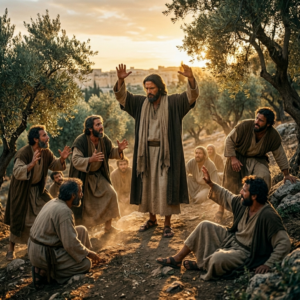
The air resting above the Mount of Olives carried a peculiar, heavy stillness, the kind of quiet that precedes an unearthly storm. It was not a physical tempest that was brewing over the ancient, craggy landscape of Judea, but a spiritual and historical cataclysm. The earth beneath their sandaled feet was dry, a mosaic of hardened clay and ancient dust that seemed to hold the echoes of generations past. Above them, the silver-green canopies of the ancient olive trees swayed ever so slightly, their gnarled trunks standing as silent, twisted witnesses to the unfolding drama. Across the deep ravine, the magnificent stones of the great temple gleamed, a monument of seemingly indestructible permanence. Yet, the atmosphere was saturated with an invisible, suffocating tension. The prophet Zechariah had foretold, in a time long swallowed by the annals of history, that the Messiah would appear on this very mountain at the end of the age. That ancient prophecy, whispered through centuries of oppression and longing, now vibrated in the lungs of the men gathered there. They stood in the presence of their Teacher, their eyes wide with a mixture of profound reverence, desperate hope, and a creeping, icy dread.
The weight of his recent words hung between them like a physical barrier. He had spoken of a coming desolation, a horrifying fracture in their reality where the very stones of their sacred epicenter would be torn down. The silence that followed his revelation was loud, ringing in the ears of his devoted followers. They were men of simple trades and profound passions, suddenly thrust into the epicenter of cosmic upheaval. Every rustle of the olive leaves, every shift of the wind against their coarse garments, seemed amplified, underscoring the monumental gravity of the moment. They were standing on the precipice of eternity, looking down into a terrifying abyss of the unknown, and their human minds were frantically trying to construct a bridge across it. The golden light of the declining sun cast long, dramatic shadows across the mountain, physically mirroring the darkness that was beginning to edge into their understanding of the future.
The Echo of Falling Stones and the Hunger for the Kingdom
The desperate need for comprehension broke the silence. A voice, raw with emotion and trembling with a sudden, overwhelming vulnerability, pierced the quiet air. “Teacher,” the voice pleaded, the single word carrying the weight of a thousand unanswered prayers. “Please help us understand.” The speaker’s eyes, etched with the lines of relentless sun and sudden worry, locked onto the Teacher. The men gathered around were not merely asking for clarification; they were begging for a lifeline. They had abandoned their livelihoods, their families, and the comforting predictability of their pasts for the promise of something greater.
“You said desolate before,” the voice continued, the word ‘desolate’ catching in his throat like a shard of glass. “That the stones will be gone?” The question hung in the air, a terrifying concept for minds built around the eternal permanence of their sacred structures. How could the stones be gone? They were the foundation of their faith, the literal dwelling place of the divine. To imagine their absence was to imagine the sky falling or the oceans drying up into dust. The psychological dissonance was tearing at them.
Yet, intertwined with their terror was a fierce, indestructible hope. “Is this for the new kingdom?” another question tumbled out, rapid and breathless. “Is the time now?” The transition from apocalyptic destruction to glorious renewal was immediate in their minds. They were so eager, so profoundly desperate for the culmination of their struggles. They had endured mockery, poverty, and exhaustion, all fueled by the fire of this promised kingdom. “We’re… we’re ready,” the voice insisted, a heartbreaking assertion of bravery masking a profound lack of understanding. “But you need to give us what sign to look for. You haven’t been telling us.” The frustration in the plea was palpable. It was the universal human cry against the agony of uncertainty. They wanted a map. They wanted a timeline. They wanted the chaotic, terrifying future to be neatly organized into actionable steps so they could prepare their fragile human hearts for the impact.
The Command to Sit and the Geography of Deception
The Teacher looked upon them, his gaze holding a depth of sorrow and profound love that transcended the immediate moment. He did not immediately answer their frantic demands for a timeline. Instead, he offered a single, grounding command.
“Sit.”
The word was not spoken with the harshness of a military commander, but with the quiet, unyielding authority of the earth itself. It was a physical deceleration, forcing their anxious, vibrating bodies to connect with the solid ground. Slowly, deliberately, the men lowered themselves into the dust of the Mount of Olives. The rustling of their robes and the soft thud of their knees hitting the earth were the only sounds. By commanding them to sit, he was forcing them to abandon their frantic, forward-leaning posture of anticipation and enter into a state of receptive stillness.
“You will know soon enough,” the Teacher began, his voice a steady, resonant anchor in the swirling sea of their anxiety. “But in the meantime, see that no one leads you astray.” Here, the narrative shifted from the cosmic to the deeply personal. Before he spoke of falling stars or crumbling empires, he spoke of the vulnerabilities of the human mind. He understood that in times of profound crisis, when the foundations of reality are shaking, the human soul becomes desperate for certainty.
“For many will come in my name, saying, ‘I am the Christ,’ and they will lead many astray.” He was warning them of the insidious nature of deception. The true danger was not just in the physical destruction of the world, but in the internal corruption of their truth. He knew that their desperation for the ‘new kingdom’ would make them easy prey for charlatans and false saviors offering easy answers and painless deliverance. The psychological weight of this warning was immense; they had to guard not just their bodies, but their very perception of reality.
The Symphony of Birth Pains: Wars, Earthquakes, and the Chilling of Human Love
As the disciples sat, anchored to the dust, the Teacher began to paint a terrifying tapestry of the days to come. “And you will hear of wars and rumors of wars,” he said, the words falling like heavy stones into a quiet pool. The air around them seemed to chill. For men living under the iron grip of a foreign empire, the concept of war was not an abstract political theory; it was a visceral nightmare of blood, screaming, and ultimate subjugation. But he immediately countered their rising panic. “See that you’re not alarmed, for this must take place, but the end is not yet.” He was asking them to achieve the impossible: to witness the tearing apart of the human world and maintain absolute internal peace.
The scope of his vision widened, encompassing the very groanings of the earth. “For nation will rise against nation, and kingdom against kingdom, and there will be famines and earthquakes in various places.” The environmental and political chaos he described was absolute. The bedrock of human security—the stability of governments and the predictability of the natural world—would violently fracture. “All these are but the beginning of the birth pains.” This metaphor was devastating in its profound intimacy. The apocalyptic terror they would witness was not the death rattle of the universe, but the agonizing, bloody, necessary trauma of a new world struggling to be born.
But the physical terrors were merely the prelude to the true agony. The Teacher’s voice dropped, carrying an unbearable sorrow. “And then they will deliver you up to tribulation and put you to death. And you will be hated by all nations for my name’s sake.” The men sitting in the dust flinched as if physically struck. This was no longer about distant nations or rumbling ground; this was about their own flesh, their own blood, their own impending executions.
Yet, the darkest revelation was still to come, striking at the very core of their human social fabric. “And then many will fall away and betray one another and hate one another. And many false prophets will arise and lead many astray. And because lawlessness will be increased, the love of many will grow cold.” This was the ultimate tragedy. Not the falling of stones, not the trembling of the earth, but the freezing of the human heart. He was foretelling a societal collapse so absolute that the fundamental human capacity for empathy, loyalty, and affection would simply perish. The psychological horror of looking at a friend, a brother, and seeing nothing but the cold, calculating eyes of a betrayer was a darkness deeper than any physical night.
In the face of this absolute devastation, he offered a single, staggering requirement for salvation. “But the one who endures to the end will be saved. Then this gospel of the kingdom will be proclaimed throughout the whole world as a testimony to all nations. And then the end will come.” Endurance. Not immediate victory, not magical rescue, but the brutal, grinding, relentless act of simply outlasting the darkness, holding onto the truth while the world tore itself apart.
The Unknown Hour and the Unbearable Weight of Not Knowing
The silence that followed this apocalyptic symphony was thick and suffocating. The disciples were mentally battered, trying to reconcile the promise of a kingdom with the guarantee of their own violent deaths and the freezing of human love. They looked to their Teacher, desperate for the timeline they had originally requested. If they had to endure this nightmare, they needed to know when it would end.
“But to answer your question concerning the day or that hour,” the Teacher said, his eyes scanning the horizon, looking past the temple, past the city, into the unfathomable depths of eternity. “No one knows.”
The words hung in the air, a terrifying verdict of ambiguity. “Not even the angels in heaven,” he continued, stripping away any hope of celestial insider knowledge. And then, he delivered a revelation that shook the very foundations of their understanding of him. “Nor the Son.”
The impact of this admission was staggering. The man they followed, the one who healed the sick, commanded the wind, and foresaw the crumbling of the great temple, was suddenly standing before them in a state of profound, self-admitted limitation. He, too, was operating under the veil of an unknown future. He was sharing in the ultimate human vulnerability: moving forward into the dark without a map. “But only the Father,” he concluded, establishing the ultimate, impenetrable boundary of divine sovereignty.
Because the timeline was hidden, the psychological posture required of them was absolute vigilance. “Be on guard. Keep awake. For you do not know when the end will come.” He was demanding a state of perpetual spiritual adrenaline. They could not afford to sleep, to grow comfortable, or to become complacent. Every sunrise could be the dawn of the end; every sunset could be the final twilight. The exhaustion of this calling was unimaginable, requiring a relentless, unyielding focus on the unseen reality behind the crumbling physical world.
The Solitude of the Teacher and the Echo of Unanswered Questions
The physical and emotional toll of the revelation finally broke through the disciples’ shock. “Well, that’s a lot,” one voice muttered, the understatement of the century carrying a profound, relatable human weariness. Another disciple, his face pale and his mind reeling, tried to summarize the devastating paradox they had just been handed. “It is. You’re telling us that everything you just told us, which included our deaths and the end of the age, and not even you know when? Only the father.” The pure, unfiltered shock in his voice was the sound of a human mind fracturing under the weight of divine mystery.
The grief over the physical world they were losing surfaced once more. “Are you really never going back to the temple?” someone asked, the question laced with a profound sense of mourning. It was the final, desperate attempt to hold onto the familiar structures of their past before they plunged into the terrifying future he had just described.
The Teacher did not answer the question about the temple. The emotional weight of what he had just unveiled, the burden of the impending trauma he had just transferred to the minds of his beloved friends, seemed to press heavily upon him. His shoulders, usually set with unshakeable resolve, seemed to carry the crushing weight of the world’s coming agony.
“If you’ll all leave me,” he said softly, his voice carrying an immense, solitary sorrow. “I’d like to be alone as I take it in.”
It was a staggering moment of humanity. He needed space. He needed to sit with the horrifying reality of the path ahead, the violence, the betrayals, the coldness of human hearts that he had just prophesied. “I’ll come back to the house after dark,” he added, providing a small, comforting anchor of practical routine amidst the cosmic chaos. “I just need a moment.”
Slowly, reluctantly, the disciples began to rise from the dust. The sun was dipping lower, casting long, mournful shadows across the Mount of Olives. The air was cooling rapidly. Andrew, unable to bear the unresolved tension, lingered. The human mind demands closure, and Andrew was starving for it. “This is part of a longer conversation, right?” Andrew pleaded, his eyes searching the Teacher’s solemn face in the fading light. “There’s more clarity coming?” It was the ultimate, tragic human plea: Please tell me this makes sense. Please tell me there is a plan I can understand.
But the Teacher remained silent, lost in the heavy communion of his own impending sorrow. From behind Andrew, a gentle hand reached out, firmly grasping his shoulder. It was a gesture of profound solidarity and quiet resignation. “Let’s give him some time, Andrew,” a fellow disciple murmured softly. The words were a gentle reprimand, a recognition of the sacredness of the Teacher’s grief. And then, the ultimate anchor in the shifting sands of their reality was spoken. “I love you.”
In the face of falling stones, roaring earthquakes, and the terrifying promise that human love would grow cold, this single, whispered declaration of affection among terrified friends became an act of profound, defiant rebellion. It was the only armor they had left.
Deep Reflection: The Unyielding Demand of the Unknown
The encounter on the Mount of Olives strips away the comforting illusions we construct to navigate our fragile existence. We are all, in our own ways, standing on a mountain looking at the magnificent, seemingly indestructible temples of our lives—our careers, our societies, our carefully constructed plans—believing they will stand forever. Yet, the brutal, unavoidable truth echoed in this narrative is that the stones will eventually fall. The structures we trust will fracture. The world as we know it is perpetually groaning through the birth pains of change, often agonizing, often terrifying.
The profound psychological challenge presented here is not merely surviving the external chaos—the metaphorical wars and earthquakes of our human experience—but surviving the internal decay. The most terrifying prophecy is not the destruction of cities, but the freezing of the human heart in the face of lawlessness and fear. When our systems fail, when uncertainty reigns, the primal instinct is to close off, to betray, to let our love grow cold for the sake of self-preservation.
Yet, the ultimate victory described is not one of conquering armies or establishing perfect earthly timelines. It is the quiet, grinding, agonizing victory of endurance. It is the choice to remain awake, to stay spiritually and emotionally vigilant when the narcotic of despair begs us to sleep. It is the courage to accept that we do not hold the timeline of our ultimate deliverance, that we, too, must walk into the profound darkness of the unknown hour. In the end, when the grand narratives fail and the future is a terrifying void, all that remains is the defiant choice to reach out in the encroaching dark, grasp the shoulder of a fellow traveler, and whisper, “I love you,” holding the line of human warmth against the freezing of the world.
Disclaimer : This content may be created by AI for entertainment purposes. Any resemblance to real persons, events, or places is coincidental.






