The Echoes of a Shattered Bloodline: How a Single Lie Destroyed My Past and Forged My Unbreakable Future
The veneer of the American Dream is often painted in the muted, comforting colors of the Chicago suburbs. It is a place of manicured lawns that smell of freshly cut grass in the summer and burning leaves in the autumn. It is a geography defined by its quiet predictability, where the architecture of a family’s life is assumed to be as structurally sound as the colonial homes lining the cul-de-sacs. I was born into this curated illusion. My parents were the architects of a reality that looked immaculate on the surface, a masterclass in domestic presentation. My father, a financial adviser at a prestigious downtown firm, wore his authority like a tailored suit. He provided the solid, unspoken foundation of our upper-middle-class existence. My mother, a part-time realtor, was the curator of our family’s image. Her life was an endless campaign of community group participations, PTA meetings, and the orchestration of the perfect, glossy Christmas cards that signaled our flawless existence to the world.
I was the biological son, the golden boy tasked with carrying the weight of their expectations. I existed in a state of frictionless success, securing straight A’s with a casual grace, naturally athletic, and relentlessly courteous to the adults who populated their social circles. I was not a saint, of course. The teenage years brought the requisite rebellions—the quiet clinking of snuck beers with neighborhood friends, the occasional loud party that pushed the boundaries of acceptable adolescent behavior. Yet, these infractions were meticulously managed, kept strictly beneath the threshold of anything that might stain the pristine reputation my mother fought so fiercely to uphold. I was, in every measurable metric, the son they had designed me to be. But the architecture of our family was profoundly altered when I was ten years old. They brought Lily into our home, a three-year-old girl meant to fulfill my mother’s long-held desire for a daughter.
The Quiet Infiltration of Envy
I can still see the precise quality of the light cascading through the front hallway windows on the day they carried Lily across the threshold. She was a fragile, tiny entity anchored by impossibly large, dark brown eyes that possessed a gravitational pull. Within minutes, the entire household was caught in her orbit. Every adult in the room was instantly disarmed, wrapped tightly around her small, delicate fingers. I must confess, the initial shock to my system manifested as resentment. For a decade, I had been the undisputed sun of my parents’ solar system. Suddenly, I was eclipsed. The narrative of our household shifted entirely to chronicle Lily’s milestones: the microscopic dramas of her first day in preschool, the elaborate preparations for her dance recitals, the endless parade of adorable new costumes that required photographic documentation. It was the predictable, bitter taste of sibling envy, the sharp sting of feeling abruptly supplanted in the hearts of the people who had once looked only at me.
Yet, as the years stretched out, the friction softened into a comfortable, average sibling dynamic. The petty squabbles over television remotes and front seats gave way to a quiet, steadfast protectiveness on my part. I remember the visceral surge of protective fury I felt in ninth grade when I discovered a boy on the elementary school playground had been pulling her hair and shoving her into the dirt. The walk to her school the next morning was tense, my jaw set, my mind focused solely on shielding her. The conversation I had with that second-grade bully was brief, cold, and entirely effective. The harassment ceased immediately. I took it upon myself to impart the fundamentals of self-defense to her, adjusting her small stance, showing her the exact mechanics of throwing a proper punch should the world ever turn its fangs toward her. I was her older brother. It was a title I bore with a quiet, unyielding gravity.
By the time I reached my senior year of college, my life was a meticulously drawn roadmap leading directly toward inevitable success. I was operating at the absolute peak of my physical and academic potential. I was the captain of a Division 2 baseball team, my throwing arm generating whispers of minor league possibilities. I maintained a formidable 3.85 GPA in business administration, backed by a minor in finance. I was surrounded by a phalanx of loyal friends, the kind of deeply bonded young men who would materialize at three in the morning to pull a broken-down truck from a muddy ditch without a second thought. My body was a testament to years of grueling discipline; I was bench-pressing 315 pounds for repetitions, squatting over 400, pulling nearly 500 off the floor in deadlifts. I had forged the coveted physical architecture of broad shoulders and a narrow waist, a physical manifestation of my internal drive. My future was perfectly illuminated. My father had already laid the groundwork, utilizing his network at major Chicago investment firms to secure me a coveted spot in an elite management training program post-graduation. The blueprint was flawless: graduate, perhaps chase the fading ghost of professional baseball for a fleeting season, dominate the financial sector, marry the right woman, and inherit the American dream.
Lily, meanwhile, had morphed into a fifteen-year-old sophomore, consumed by the theatrical turbulence of high school drama. She was a theater kid, artistic, prone to wildly exaggerated reactions to the smallest inconveniences. During my brief visits home for holidays, we would share dinners, exchanging the casual, surface-level banter of siblings whose lives were rapidly diverging. I thought we were fine. But memory is a treacherous editor, and looking back through the lens of utter devastation, the overlooked signals glare with blinding intensity. I had missed the tightening of her jaw when our parents boasted about my batting average to dinner guests. I had ignored the acidic undertones in her seemingly innocent remarks about how effortlessly I glided through life. I had dismissed the elaborate, utterly fabricated tales she spun about her daily school life as mere teenage imagination. Hindsight provides a devastating clarity, illuminating the dark, festering roots of a jealousy I never knew was growing.
The Tuesday That Swallowed the Sun
It was a Tuesday in late October, the air already biting with the unmistakable, metallic chill of a Midwestern autumn. My senior year was in full swing, and I had just survived a brutal, lung-burning practice. Our coach, furious over a weekend series loss to our most bitter rivals, had driven us into the dirt. Every fiber of my muscles ached, my legs vibrating like loose strings, my throwing shoulder throbbing with the deep, satisfying ache of a body pushed to the absolute edge of its mechanical limits. I stood under the scalding water of the locker room shower, letting the steam loosen my spine, completely unaware that these were the final moments of the life I had known.
I pulled a heavy hoodie over my damp hair, stepped out into the crisp evening air, and unlocked the door to my F-150, the very truck my parents had proudly helped me purchase for my twentieth birthday. The cabin smelled of cold leather and old pine air freshener. I turned the key, the engine rumbling to life, and casually flipped my phone over.
The screen was a graveyard of panic.
Thirty-seven missed calls. Fifty-four text messages. The notifications cascaded down the glass like blood spatter. The sender names blurred together—aunts, cousins, my closest friends. The fragmented sentences visible on the lock screen formed a jagged, horrifying mosaic: “You sick…” “How could you…” “You’re dead.”
The heavy, rhythmic thud of my heart surged against my ribs. A primal, cold terror flooded my veins. My immediate, desperate rationalization was tragedy—a fatal car crash, a sudden heart attack. Grandma or Grandpa was dead. My fingers, trembling slightly, stabbed at the screen, dialing my father’s number. The line hissed with static for a fraction of a second before he answered.
“What the hell is going on?” I demanded, the panic vibrating in my throat.
The voice that responded did not belong to the man who had raised me. It was a sound stripped of all humanity, an icy, flat void that seemed to suck the oxygen out of the truck’s cabin.
“Get your ass home now. Don’t you dare go anywhere else.”
The line went dead. The silence that followed was louder than a gunshot. I sat paralyzed in the driver’s seat, the engine idling, the stadium lights casting long, unnatural shadows across the asphalt. I dialed my mother. It rang into the void of voicemail. I dialed the number of my oldest high school friend, a man who lived mere miles from my parents. The line rang out. I had suddenly, inexplicably, become a ghost in my own life. I shifted the truck into drive, the transmission clunking heavily, and began the twenty-minute journey home. The radio murmured the calm, measured tones of NPR, but the words dissolved into meaningless static against the roaring in my ears. My stomach tied itself into agonizing, rigid knots.
The Tribunal and the Blood on the Lawn
As the tires of my truck crunched onto the familiar concrete of my childhood driveway, the illusion of my life shattered completely. The driveway was choked with vehicles. I recognized my Uncle Mike’s heavy-duty work truck, parked haphazardly across the curb, alongside a fleet of cars belonging to the extended family. Uncle Mike, a construction contractor whose fifty years were etched into his face in deep, angry lines, had always harbored a quiet, simmering disdain for me. As I pushed the heavy door of my F-150 open, the cold evening air rushed in, carrying the scent of impending violence.
Before my boots could even touch the pavement, Uncle Mike was tearing across the front lawn. He didn’t walk; he charged like a wounded animal. He wrenched the heavy steel door of my truck backward with a terrifying, adrenaline-fueled strength. His thick, calloused hands clamped onto the fabric of my hoodie, violently hauling me out of the cab and slamming my spine against the steel exterior of the truck bed.
“I’m going to kill you,” he roared, the sound tearing from his throat. His face was inches from mine, his eyes wide, feral, utterly devoid of recognition. Drops of his saliva struck my cheek, carrying the sharp, sour stench of hard alcohol. I was a prime athlete, easily capable of breaking his grip, of neutralizing the threat of an out-of-shape man in his fifties. But my muscles refused to fire. My brain was trapped in a state of suspended animation, unable to process the absolute suspension of reality. It was my father and my Uncle Steve who finally descended the porch stairs, their hands gripping Mike’s shoulders, physically dragging him off my chest.
“Inside. Now,” my father commanded. He stared straight through me, his eyes locked onto some invisible point in the distance, refusing to acknowledge my humanity.
I stumbled up the wooden steps, my legs feeling entirely detached from my torso. The moment I crossed the threshold into the living room, the atmosphere suffocated me. The space was claustrophobically packed. My mother sat anchored to the center of the sofa, her face a swollen, ravaged mask of grief, her eyes crimson and wet. Grandparents, aunts, uncles, family friends—they stood shoulder to shoulder, forming a suffocating wall of silent judgment. And there, buried in the crook of my grandmother’s shoulder, was Lily. Her small frame convulsed with theatrical, rhythmic sobs.
The silence in the room was weaponized. Every pair of eyes turned toward me, radiating a thick, palpable aura of absolute dread and pure, unadulterated disgust. It was the look reserved for monsters.
“What the hell is going on?” I shouted, my voice cracking, desperately searching the mosaic of horrified faces for a single tether to reality.
My mother slowly lifted her head. The expression on her face was something entirely alien—a profound, venomous loathing that fundamentally rearranged her features. “How could you? Your own sister.”
“What are you talking about?” I pleaded, taking a step forward, my hands raised in total surrender.
My father stepped out from the wall of bodies. The composed, measured financial consultant had vanished, replaced by a man vibrating with a primal desire to commit murder. “Lily told us everything. About how you’ve been coming into her room at night for years.”
The words hit my chest with the kinetic force of a speeding locomotive. The air was violently expelled from my lungs. The edges of the room began to blur and spin, the floorboards tilting beneath my feet.
“What? That’s insane! I never touched her!”
Lily’s sobbing escalated into a piercing wail. She lifted her face, her eyes wide with a perfectly calibrated terror. “You said no one would believe me! You said you’d hurt me if I told! You said it was our secret!”
“That’s a lie!” I screamed, the sheer absurdity of the nightmare igniting a furious inferno in my chest. “I’ve never said that! I’ve never done anything to her! What the hell is going on?!”
Uncle Mike lunged again, a guttural snarl tearing from his lips, but he was restrained. “My buddy’s a cop,” he spat, his face purple. “You’re going to prison, you piece of filth. They’re going to love you there.”
I opened my mouth to plead, to inject logic into the madness, to explain the impossible physics of her timeline, but I was speaking to a firing squad. Lily’s voice grew steadier, weaving an elaborate, horrifying tapestry of fabricated trauma. She spoke of Christmas vacations when she was ten, of silent threats against our parents’ lives, of a monster that wore my face. Every lie she birthed was met with immediate, unquestioning acceptance by the room. They nodded. They stroked her hair. They looked at me as if I were a demon newly summoned from hell. It was a profound psychological dislocation, a slip into a parallel dimension where the sky was red and gravity pulled upwards.
Then, the final thread of my father’s restraint snapped. He crossed the distance between us in a fraction of a second. The man who had never raised a hand in violence planted his feet and unleashed a devastating right hook. The knuckles connected squarely with my jawbone. The impact reverberated through my skull like a thunderclap. My feet left the floor, and I crashed violently onto the hardwood. The sharp, metallic tang of copper flooded my mouth where my teeth had driven through the soft tissue of my inner cheek.
“Get your things and get out,” he bellowed, standing over my prone body, his chest heaving, his fist unclenching and clenching. “You’re no son of mine.”
Trash bags, bulging with my clothes, were already piled near the front door. They had planned this. My father reached down, viciously yanking my wallet from my back pocket. With methodical cruelty, he stripped it of every credit card, every piece of health insurance bearing his name.
“Dad, please, this isn’t true,” I begged, the blood running down my chin and dripping onto my shirt. “You’ve known me my whole life. You know I would never do something like this.”
He didn’t speak. He reached down, twisted the thick fabric of my hoodie in his fists, and physically dragged my heavy frame across the floorboards. He hurled me out the front door. I tumbled down the concrete steps, my shoulder taking the brunt of the impact. I heard the sickening, wet pop of the joint separating. The trash bags flew out after me, landing in the damp grass with heavy thuds. My beloved baseball gear followed, bats clattering against the pavement.
“If you ever come near this family again, I’ll kill you myself,” he whispered, the absolute certainty in his voice chilling me to the bone. The heavy wooden door slammed shut, the deadbolt sliding into place with a definitive, metallic echo. I sat on the cold grass, tasting my own blood, my shoulder throbbing in agonizing rhythm with my heart, acutely aware of the neighborhood curtains twitching as eyes watched the architect of their demise. In less than sixty minutes, the entire universe I had inhabited was meticulously, brutally eradicated.
The Wilderness of Exile
That night, the cab of my truck became my tomb. Parked in the desolate, unlit corner of the collegiate baseball field parking lot, I sat in the freezing darkness, my mind running on an endless, torturous loop. I could not synthesize the betrayal. I could not understand the mechanical ease with which my parents had severed the bond of blood without a single interrogation of the facts. When the grey, unforgiving light of morning finally broke, my face was a grotesque canvas of swollen purple, and my shoulder was locked in a cage of fiery pain.
The descent was absolute. A reluctant teammate offered a week on a sagging couch, surrounded by the hostile glares of his roommates. My frantic emails, texts, and voicemails to the extended family vanished into a black hole of silence, broken only by a solitary, venomous message from my father promising a restraining order if I dared communicate again. I was dead to them.
The financial strangulation began immediately. Tuition payments bounced. Without a co-signer, the financial aid office became a fortress I could not breach. I was forced to gut my academic schedule, taking grueling, midnight security shifts at dive bars just to eat. My GPA plummeted. The whispers started. The toxic rumors seeped through the porous social structures of the university, transforming me from a respected captain into a social leper. People crossed streets to avoid my path; conversations died instantly when I entered a room.
By deep winter, the final pillar of my old life crumbled. The engine block of my truck cracked, an unfixable death sentence. The eviction notice on my apartment door was a mere formality. The bitter cold of February forced me into the unheated baseball equipment shed. I survived on a single cafeteria meal a day, my body wrapped in three hoodies and a sleeping bag, resting my head on a moldy duffel bag. When my coach found me freezing in the dark, he offered the first sliver of humanity I had seen in months. He didn’t judge; he didn’t demand a confession. He sat on the freezing concrete, listened to the horrific truth, and quietly offered me a lifeline.
That lifeline led to the brutal, unforgiving mountains of Colorado. I traded the collegiate dream for the grueling reality of a wilderness program for troubled youth. The physical labor of carrying fifty-pound packs up oxygen-starved peaks and chopping timber forced my broken body to rebuild itself. I packed on fifteen pounds of dense, hardened muscle, a physical armor against a world that had tried to destroy me. But the internal rot was spreading. The nights were consumed by a desperate, reckless pursuit of oblivion. I drowned the screaming memories in black-out nights of cheap liquor, chased by whatever chemical escapes I could find—cannabis, psychedelics, powders. I was a ghost haunting the woods, desperate to erase my own consciousness. When my negligence nearly cost a child’s life, the program director fired me.
The exile deepened. I became a nomad, living in the cramped, rusted shell of a $1,200 Honda Civic, drifting through towns and taking any labor that required brute strength and asked zero questions about my past. I developed a pathological fear of innocence. The mere sight of a family in a diner would trigger a cold sweat, forcing me to abandon my food and flee. The nightmares were a nightly torture chamber—vivid, hyper-realistic terrors of prison walls, of inmates discovering my supposed crimes, of violence in the dark.
The paranoia culminated in a college pub in Fort Collins. A ghost from my past—a former football player from my university—recognized me beneath the dim neon lights. The whispers began, slithering through the crowd. Predator. Sick. At 2:00 a.m., the whispers manifested into physical violence. Three men ambushed me in the freezing parking lot. I fought like a cornered animal, feeling the satisfying crunch of bone beneath my knuckles as I broke a nose, but the numbers were insurmountable. They left me broken on the asphalt—three fractured ribs, a shattered eye socket, my shoulder violently dislocated once again, my brain swimming in the thick fog of a severe concussion. I woke up in a sterile hospital room, staring at a $17,000 medical bill I could never pay, my body a map of agony.
The Bridge, the Black Lake, and the Marine
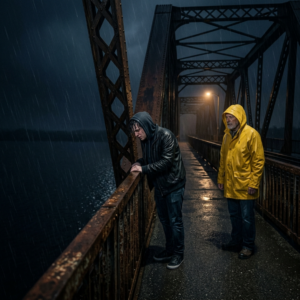
The rain fell in heavy, freezing sheets the night I decided the struggle was over. I drove the rattling Civic to an ancient, rust-eaten bridge suspended high above a pitch-black lake outside of town. The rain plastered my clothes to my skin, the freezing wind cutting through the fabric like razors. Every movement was a symphony of agony radiating from my fractured ribs. I stood on the asphalt, staring into the abyss, the dark water promising an absolute, quiet erasure of the pain. My phone sat dead and heavy in my pocket. Three years. Not a single voice from the bloodline that had created me. No one was coming.
I gripped the freezing steel railing, hauling my battered body over the edge, balancing on the narrow concrete lip above the drop.
“Bit cold for a swim, don’t you think?”
The voice, calm and gravelly, cut through the rushing wind. My heart seized. I turned my head, wincing against the pain in my neck, to see a man in his seventies, wrapped in a heavy yellow raincoat, calmly holding a fishing rod.
“Go away,” I croaked, my voice a broken, pathetic rasp against the storm.
“Can’t do that, son,” he replied, his tone as conversational as if we were discussing the weather over coffee. “See, if I go away and you jump, that makes me responsible in a way. It’s not your problem. It became my problem when I saw you. That’s how life works.”
He didn’t rush me. He stepped closer with a slow, measured, completely unthreatening cadence. “My name’s Frank. Retired Marine Corps. Seen plenty of men at their breaking point. You want to tell me what’s got you standing on the wrong side of this railing?”
“You wouldn’t understand.”
“Try me.”
The dam broke. In the freezing rain, teetering on the edge of oblivion, I vomited the entire, grotesque story into the darkness. I spoke of Lily’s lies, my father’s fist, the freezing shed, the Denver beating, the absolute silence of my family. I spoke because he was a stranger, because the lake was waiting anyway, and because the absolute stillness in his eyes reminded me of a grandfather lost to dementia.
When the torrent of words finally ceased, Frank simply nodded. He looked at my battered face, the rain dripping from the brim of his hat.
“Son,” he said, his voice carrying the immovable weight of a mountain, “you’ve been carrying this alone long enough. Put down the weight for one night. Come have a hot meal, dry clothes, and we’ll talk about it with clear heads tomorrow.”
“Why would you help someone like me? You don’t know if I’m telling the truth.”
Frank’s eyes narrowed, piercing through the darkness, stripping away my defenses. “Been reading men’s faces for fifty years in combat and in peace. You’re either telling the truth or you’re the best damn liar I’ve ever met. Either way, death is permanent. Food isn’t.”
The absolute conviction in his voice, the gravity of a man who had seen the worst of humanity and still chose to extend a hand, broke the spell of the black water. Slowly, agonizingly, I climbed back over the steel railing.
The Art of Reassembly
Frank’s home was a sanctuary of military precision. Books were aligned with mathematical exactness; the air smelled of lemon polish and old paper. He gave me the dry clothes of a son he had buried in the sands of Afghanistan a decade prior. I ate food that tasted like salvation. For the first time in years, I fell into a sleep so deep it felt like a temporary death.
The morning brought strong, bitter coffee and a proposition that would alter the trajectory of my existence. Frank offered me a job in his boutique executive security firm. When I demanded to know why he would trust a broken, suicidal drifter, his answer was a masterclass in human understanding: “Because a man pushed to the edge who chooses to step back has something worth living for, even if he doesn’t know it yet. And because if you screw me over, I know exactly how to find you.”
The rebuilding was a brutal, beautiful process. Frank was a relentless architect of discipline. Five a.m. workouts tore my muscles down and rebuilt them stronger. He funded my medical recovery. He forced me into the office of a Vietnam veteran therapist, breaking down my resistance with sheer stubbornness. Slowly, the therapy began to extract the toxic shrapnel from my psyche. I learned that the trauma was a weapon forged by others, not a reflection of my soul. I learned to dress, to speak, to operate with the quiet, lethal professionalism required to protect the elite. Frank became the father whose ghost I had been mourning. He never urged me to seek revenge or clear my name. Focus on the war, he told me. Building a life they can’t take away from you.
That new life truly began the night Frank assigned me to an art gallery opening, a thinly veiled setup to introduce me to his niece, Sophie. She was a revelation. She possessed an unconventional, striking beauty—tall, fiercely athletic, with an asymmetrical dark haircut framing eyes the color of pale emeralds. We sparred verbally, our assumptions about each other melting away into a profound, electric fascination. We talked until the city slept, discovering a shared rhythm in our scars.
For months, I hid the darkest chapter of my past behind vague lies about deceased parents. But Frank knew the foundation of a real life required absolute truth. When I finally gathered the courage to lay the horrific reality of my past on the dinner table, bracing for the inevitable look of revulsion, Sophie didn’t run. She reached across the wood, laced her fingers through mine, and spoke the words that finally, truly saved my life: “Thank you for trusting me. I believe you.”
Two years later, in the quiet glow of a city evening, I dropped to one knee and asked her to be my forever. Frank walked her down the aisle. I finished my degree, became a full partner in the firm, and bought a home filled with light and warmth. The nightmares retreated. The panic attacks dissolved. The past became a distant, muted film reel of someone else’s life. I had won.
The Coffee Shop Reckoning
Seven years of silence were shattered on a random Tuesday in March. I was in my immaculate office, reviewing threat assessments for a tech billionaire, when the intercom buzzed. A woman claiming a family emergency.
I picked up the receiver, identifying myself by the new name I had built.
The line was dead silent, save for a ragged, choking intake of breath. “Jake… it’s… it’s mom.”
The temperature in the room plummeted. The voice, aged and brittle, triggered a visceral surge of adrenaline. “What do you want?” I demanded, my voice a sheet of freezing ice.
“Lily confessed,” she wept. “She lied about everything. She made it all up.”
The walls of the office seemed to expand and contract. Seven years of absolute hell. The beatings. The freezing nights. The edge of the bridge. The agonizing hours of therapy required to stitch my soul back together. All of it birthed from the mouth of a child, fostered by the cowardice of parents who chose image over truth. I hung up the phone without another word.
It took two weeks of agonizing deliberation, guided by Sophie’s unwavering support and Frank’s silent strength, to orchestrate the confrontation. I chose the battlefield: a crowded, well-lit coffee shop on Main Street. Neutral, public, undeniable.
When they walked through the glass doors precisely at two o’clock, the ghosts of my past materialized into pathetic reality. The passage of time and the weight of their own actions had devoured them. My mother’s hair was a thin, wiry grey, her face deeply trenched with anxiety. The imposing financial titan I called a father was gone, replaced by an emaciated, hollowed-out older man swimming in cheap khakis. Lily, now twenty-two, lacked any trace of the theatrical vibrance of her youth. She looked shrunken, her eyes fixed firmly on the floorboards.
My mother lunged forward, tears spilling freely, her arms open for a maternal embrace that she had forfeited the right to offer nearly a decade ago. I took a hard step backward, bringing Sophie into the space between us, an immovable shield.
“Sit,” I commanded.
The silence that settled over our corner table was heavy, suffocating.
“Son, we—” my father croaked, his voice cracking.
“I’m not your son,” I cut him off, the words striking like a hammer on an anvil. “You made that very clear seven years ago. Now talk.”
Lily was forced to look up. Her eyes were bloodshot pools of regret. Her confession tumbled out in a pathetic, halting whisper. It was the banal, monstrous simplicity of jealousy. I was the golden child; she wanted the spotlight. The lie had spiraled out of control, fueled by the intoxicating rush of attention and victimhood the family eagerly provided. She didn’t know how to stop it, so she simply let it destroy me.
“And you?” I turned the devastating focus of my anger onto the people who had brought me into the world. “You kicked me out without a single question. Without a shred of proof. I wasn’t even in the state when she claimed it happened! Did you even bother to look at a calendar?”
My mother gasped, her hand flying to her mouth in horror. My father’s skin turned the color of old ash. I pulled my phone from my pocket, slamming the device onto the table. I swiped violently through the archived horrors of my exile. The hospital photos—my face a bloated, bruised mass of broken orbital bones and split lips. The gaunt, hollow-eyed selfies taken in the freezing cab of a broken-down Honda.
“You know what happened after you threw me out like trash?” My voice broke, the raw edge of old grief bleeding through the anger. “I almost froze to death. I was beaten half to death by strangers who heard your rumors. I stood on a bridge ready to end my own life because the people who were supposed to protect me assumed I was a monster.”
“We want you to come home,” my father pleaded, the desperation leaking from every pore. “We want our family back together.”
“I already have a family,” I replied, looking at Sophie, who squeezed my hand with the strength of a lioness, and Frank, whose heavy hand rested protectively on my shoulder.
But the true nature of their desperation was yet to be revealed. Lily, her voice shaking, unveiled the final act of their tragedy. Upon her confession, the facade of their perfect life had collapsed. The financial cutoff. The loss of Lily’s luxury car and private tuition. My father’s business failures. The forced downsizing to a cramped apartment. The absolute destruction of my mother’s precious social standing.
“We need your help, Jake,” my mother finally admitted, the shame radiating from her like heat from a radiator. “We’re going to lose the condo. We’ve had to sell everything.”
A laugh, sharp, dark, and utterly devoid of humor, erupted from my chest. It was the punchline to a cosmic joke.
“Let me get this straight. You destroy my life. You disown me, leave me to rot in the streets, and now that I have built an empire without you, you want me to write you a check?”
“We’re family,” my father whispered, a final, pathetic plea to a bond he had personally severed.
“No. We are not.”
I pushed my chair back, the wooden legs scraping loudly against the tile. I stood tall, the physical presence of a man who had survived the worst the world could offer. I looked down at the architect of the initial lie. “I forgive Lily. She was a child who made a monstrous, stupid choice. But you two… you were the adults. You were supposed to protect us both. Instead, you threw one of us into the meat grinder without a second thought.”
I tossed a few crumpled bills onto the table to cover the coffee I hadn’t touched. As I turned to leave, my mother’s desperate fingers clawed at my sleeve. “What do you want from us?” she sobbed.
I looked down at the woman who gave birth to me, feeling absolutely nothing. “I want you to remember how it feels to have everything taken away. To feel completely helpless, knowing no one believes in you. Maybe then, you’ll understand exactly what you did to me.”
We walked out into the bright afternoon sun. Frank’s heavy hand gripped my shoulder, squeezing tightly. “Proud of you, son.” ## The Unbreakable Future
Two years have passed since that coffee shop. The echoes of my past life occasionally reach me through the grapevine. My parents lost their condo. My former financial-titan father now stocks shelves at a big-box retailer. My mother, the queen of the suburban social scene, scrubs the floors of other people’s homes. Lily vanished into another state, dropping out of school entirely.
There are nights when the thought of reaching out flickers in my mind. Sophie, with her boundless capacity for grace, suggests it might be the final stone in the bridge of my healing. Frank reminds me that the power belongs entirely to me. But for now, my energy is fiercely guarded, channeled only into the life that matters. Sophie is pregnant with our first child. The security firm is expanding across three states. I have built an impenetrable fortress of love, respect, and absolute truth. I forged a life out of the ashes they left behind, and it is a life that no one—no lie, no rumor, no blood relative—will ever be able to take away from me again.
If there is a lesson in the fire of my past, it is this: blood does not guarantee loyalty, and family is not always the people who brought you into the world. Family are the ones who stand on the freezing bridge with you in the dead of night and refuse to let you jump.
Have you ever had to walk away from the people who were supposed to love you the most to save yourself? Share your stories below. Let’s remind each other that survival is just the first step—thriving is the ultimate revenge.
Disclaimer : This content may be created by AI for entertainment purposes. Any resemblance to real persons, events, or places is coincidental.






