The Golden Child Wore White to My Wedding: A Decades-in-the-Making Masterclass in Unapologetic Revenge
There is a specific, suffocating kind of silence that permeates a house where one child is worshipped as a deity and the other is treated as a burden. It is an invisible weight that settles into the floorboards, colors the paint on the walls, and dictates the very rhythm of breathing within the family. For an entire lifetime, I existed as the shadow cast by my older sister’s blinding, unearned light. To the world, we were siblings. Behind the closed doors of our childhood home, she was the undisputed monarch, and I was the designated punching bag, the scapegoat, the convenient receptacle for every frustration my parents harbored.
This is not merely a story about a wedding day gone horribly wrong. This is a chronicle of a lifetime of psychological warfare, of enduring the unbearable weight of blatant favoritism, and the glorious, terrifyingly meticulous moment when the scales of justice were finally, forcefully balanced. It is a testament to the fact that while trauma can forge us into quiet, accommodating people, the right partner can unlock a capacity for retribution that burns brighter than a thousand stolen birthdays.
The Taste of Sugar and Ash
To understand the magnitude of the climax, one must understand the foundation of the agony. It started with the small, everyday betrayals that children absorb like sponges. When my sister pointed a finger and accused me of a misdeed, her word was gospel. The gavel fell instantly; punishments were harsh, immediate, and unquestioned. If I dared to present undeniable proof of her transgressions, the atmosphere in the room would shift. My parents would perform Olympic-level mental gymnastics to lighten her sentence, inevitably pivoting the conversation to somehow scold me for my involvement.
Even the days meant to celebrate my existence were hijacked. I remember sitting at the dining room table, staring at the flickering candles of my birthday cake. Every year, without fail, the frosting and the filling were my sister’s absolute favorite flavor. I detested it. My parents would smile, a practiced, hollow expression, pretending they simply forgot my aversions. They would lavish her with spontaneous gifts, taking the family wherever she desired on the very day that was supposed to be mine. Over time, I learned to swallow the bitter taste of that cake, internalizing the lesson that my desires were inconsequential. My youthful frame remained deliberately thin—a physical manifestation of the snacks and treats consistently withheld as punishment—while my sister and parents indulged endlessly.
As children, she mostly ignored me, viewing me as an insignificant object in her kingdom. But as the delicate transition into our teenage years began, the dynamic darkened. My sister, accustomed to receiving everything without earning it, found the real world to be a harsh, unyielding place. She developed no social skills. Her profound sense of entitlement repelled her peers, leaving her isolated and friendless. My parents, desperate to maintain the illusion of her perfection, boasted loudly about her mundane achievements while weaponizing my every flaw as material for familial mockery.
The Teenage Wasteland and the Scent of Sabotage
I was a fairly popular teenager, naturally drawing people toward me because I knew how to listen, a skill honed by years of enforced silence. When my sister noticed that I was surrounded by friends while she sat in a vacuum of her own making, her occasional bullying mutated into a relentless, targeted campaign of sabotage. She began fabricating elaborate lies about my friends, accusing them of theft and misconduct. My parents, eager to validate her isolation, immediately clamped down on my social life. They fed me toxic narratives, asking why I couldn’t just stay home, why I couldn’t be more like my sister, and insisting my friends were terrible influences.
Salvation came briefly in the form of our extended family. During a massive gathering in our hometown, an aunt asked my younger, unfiltered self why I couldn’t attend an upcoming event. With the blunt, unpolished honesty of a child who had nothing left to lose, I stated simply that I wasn’t allowed to have friends because my sister didn’t have any. The silence that swept over the room was deafening. The adults cornered my parents, tearing into their blatantly abusive parenting tactics. I was grounded for a month and berated for “lying,” but the humiliation forced my parents’ hands. They moved my sister to a different, more expensive school further away to save face. She made a few superficial friends there, but her grip on my throat never loosened.
Her cruelty expanded to my romantic life. When I brought my first youthful boyfriend home—a mandate strictly enforced by my parents—she saw an opportunity. While I was in another room, she cornered him. She wore inappropriately skimpy clothing, batting her eyelashes with practiced manipulation, whispering venom about my character while extolling her own fictional virtues. He was utterly repulsed and immediately sought me out to expose her. Naturally, she beat him to the punch, running to our parents with a fabricated tale of him making aggressive passes at her, which she valiantly rejected out of loyalty to me. My parents swallowed her lies without chewing. They banned him from the house, deciding I was fundamentally incapable of making good choices. This pattern repeated with the next boy. I was suffocated under a blanket of unearned mistrust, my curfews infinitely stricter than hers, my freedom non-existent.
The Scholarship Rebellion
The horizon of high school graduation felt like the edge of a prison wall. My sister, despite her abysmal grades—where a simple ‘B’ warranted a household parade—was accepted into a mediocre college. My parents proudly announced they would finance her entire higher education, complete with generous spending money.
Shortly after, my mother sat me down at the kitchen table. The lighting was dim, casting long, oppressive shadows. She delivered the blow with a practiced coolness: because they were funding my sister’s education, there was simply no money left for mine. I was instructed to enter the workforce immediately, wait for my sister to graduate, and perhaps, years down the line, they might consider helping me. Furthermore, if I chose to live at home, I would be charged rent and utilities. When I suggested taking out student loans, my mother wept crocodile tears, claiming their profound love for me meant they couldn’t allow my “bad judgment” to ruin my financial future by taking on debt.
I did not scream. I did not cry. I simply looked at her and said, “Okay.”
My mother was visibly stunned. She had wanted a tantrum, a hysterical reaction she could weaponize to prove my emotional instability. Instead, I gave her nothing. Behind my blank expression, a fire was roaring. I had anticipated this exact betrayal for years. Because I was forbidden from socializing, I had weaponized my isolation. I studied with a ferocious, desperate intensity. I viewed academic excellence as my solitary escape hatch.
When the time came, I secured a full-ride scholarship to a highly respected university. Knowing my family would try to sabotage the opportunity, I bypassed them entirely. I posted the victory on social media for the entire extended family to see, tagging my parents and offering a sickly-sweet public “thank you” for their support. They were trapped in their own public image. My sister, failing her own classes, was furious. My parents subtly tried to plant seeds of doubt, whispering that if my “smarter” sister was struggling, I would surely fail. I ignored them. I packed my bags, left that house, and finally allowed myself to breathe.
Enter the Architect of Retribution
Years passed. My sister ultimately dropped out of college, returning home to live rent-free while my mother pulled strings to secure her a nepotism job. Meanwhile, I found my footing, found my peace, and eventually, I found him.
My husband is the antithesis of everything I was conditioned to be. Where my upbringing molded me into a meek, non-confrontational doormat who cried silently into her pillow after an injustice, he is a force of nature. He is a man who thrives on holding people accountable. He possesses a razor-sharp wit, an unshakable sense of self-worth, and an absolute intolerance for bullies. When someone slights him, he doesn’t just demand an apology; he meticulously dismantles their audacity. People were often baffled by our pairing, but his fierce protective energy was the sanctuary I had searched for my entire life.
When we decided to marry, we planned an intimate, budget-friendly ceremony in my hometown to save money for a luxurious European honeymoon. Naturally, my parents demanded to meet him. I was terrified, my old traumas rising like bile in my throat. I warned him, begging him not to let them corner him alone.
He looked at me, a dangerous, brilliant spark in his eyes. He purchased a high-fidelity, covert audio recorder, slipping it into his tailored jacket pocket. He walked into the lion’s den utterly alone, practically vibrating with the anticipation of shutting down my sister’s inevitable flirtations and verbally destroying my parents.
Hours later, he returned to our apartment. He was not angry; he was euphoric. He paced the floor, his hands gesturing wildly, a massive grin splitting his face. He told me to sit down. He didn’t play the recording immediately; he wanted to set the stage.
My parents and sister had not tried to flirt with him. Instead, they sat him down and presented a proposition so profoundly twisted, so deeply insulting, that my husband’s brain had momentarily short-circuited. They told him they were willing to pay for our entire wedding on one non-negotiable condition: my sister had to walk down the aisle before me, wearing a full, traditional white wedding dress. Their deranged justification was that because she was the older sister, it was deeply unfair that I was experiencing the joy of marriage first. Therefore, she deserved the “experience” of walking down a decorated aisle, taking professional photographs in a bridal gown, and cutting a cake.
When my husband relayed this, the sheer audacity of it hit me like a physical blow. The distance of adulthood had softened my memories, making me believe they couldn’t possibly be that cruel. But here it was. The ultimate attempt to erase me on the one day that was supposed to be mine.
The Trojan Horse and the Illusion of Control
My husband, however, saw something I didn’t. Where I saw heartbreak, he saw the ultimate canvas for nuclear retaliation. His initial urge had been to scorch the earth and hurl insults, but a quieter, more devious voice in his head had whispered: String them along.
We spent the night drinking wine and plotting, our minds weaving through possibilities ranging from the chaotic to the illegal. After consulting his incredibly level-headed brother to ensure we wouldn’t end up in a courtroom, we settled on a plan that was elegantly brutal in its simplicity. We would act as though we agreed. We would bleed them dry for the finest wedding money could buy, and on the final hour, we would slam the iron gates shut.
The execution required a sociopathic level of acting, and my husband delivered an Oscar-worthy performance. He returned to my parents’ house alone. He put on a face of reluctant compromise. He told them that I was deeply neurotic, controlling, and suspicious—using their exact historical insults against me—and that if they sprung this on me, I might cause a public scene. However, he told them, he understood their perspective. To keep the peace, he would agree to the plan behind my back, provided they paid for the wedding, which would guilt me into staying quiet when the surprise happened. My parents were thrilled. My sister practically skipped around the room like a toddler.
Crucially, my husband insisted that because I constantly “snooped” through his phone due to my inherent untrustworthiness, they could never, under any circumstances, put a single word of this arrangement in writing. No texts. No emails. No voicemails. Every discussion about the sister’s bridal moment had to happen in person or over an untraceable phone call. They bought the lie completely, thrilled to have found a conspirator who saw my “true” awful nature.
For months, the con was on. My parents believed they were the puppeteers, while my husband gracefully pulled every single string. We didn’t care about the napkins or the floral arrangements, but we cared about the financial damage. When picking a caterer, my husband would take my sister to the tasting, pretend to love the cheapest option, and dramatically sigh, saying we couldn’t possibly ask my parents to pay for the premium steak and lobster. My sister, driven by a need for the best, would throw a fit, demanding the most expensive tier. My parents immediately paid for it. We repeated this psychological trick for the top-tier photographer, the imported floral centerpieces, and the premium open bar.
When my mother tried to force me into a deeply unflattering, cheap wedding dress, my husband intervened. He secured a scrap of the fabric during alterations, drove to their house, and claimed he had accidentally destroyed my dress in an argument. He played the panicked groom, manipulating them into buying the gorgeous, wildly expensive gown I had actually wanted, just to keep the peace.
Through it all, I played my part. When my sister texted my husband to flirt, I replied from his phone, cementing their belief that I was a psychotic, controlling bride. My husband practically floated through those months, deriving more pure joy from his weekly trips to manipulate my abusers than from the actual wedding planning.
The Walk of Shattered Illusions
The day of the wedding arrived, wrapped in an atmosphere of thick, buzzing anticipation. The venue was breathtakingly beautiful, draped in the expensive imported flowers my parents had unknowingly funded for my joy.
Their master plan was agonizingly simple: they would wait until every guest was seated. Because the bride is traditionally hidden, they would cue the music, and my sister would emerge from the entrance in her wedding dress. By the time I realized what was happening from my holding room, it would be too late to stop the photographs and the public spectacle.
What they didn’t know was that the woman checking names at the front door was a decoy. Hidden out of sight was a massive, imposing private security guard. We had paid him an exorbitant fee with one strict instruction: under no circumstances was the sister allowed inside, and total discretion was required until the trap was sprung.
The moment approached. My father, standing at the entrance of the aisle to walk me down, received a text that my sister was five minutes away. Smirking, he signaled the string quartet to begin playing. My bridesmaids, completely clued into our plan, marched down the aisle perfectly on cue. My father stood at the threshold, waiting for his golden child to appear in white.
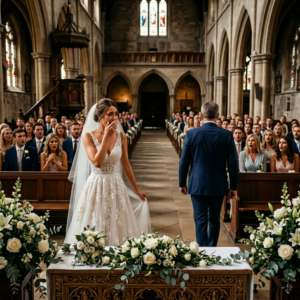
Instead, the heavy wooden doors swung open, and there I was.
The blood drained from my father’s face so rapidly I thought he might faint. He craned his neck frantically, trying to look past my voluminous veil into the parking lot, but the angles of the architecture blocked his view. He had no idea where my sister was. Suddenly, his cell phone began to vibrate violently in his pocket. He pulled it out, looked at the caller ID, and panic set in. With a breathless, incoherent mumble about “something coming up,” he dropped my arm. He abandoned me at the literal altar and sprinted back down the hallway.
A collective gasp echoed through the vaulted ceilings of the venue. Confusion rippled through the pews. On cue, a close friend sitting in the second row—a woman who lived for theatrical drama—stood up and loudly demanded, “What just happened?!”
I looked at the crowd. I let the years of suppressed pain rise to the surface, and genuine, hot tears spilled over my eyelashes. With a voice trembling with perfect, authentic sorrow, I cried out, “He told me it wasn’t supposed to be me walking down the aisle!”
The friend amplified the chaos, shouting, “What does he mean it shouldn’t be you?!” ensuring every single aunt, uncle, and extended family member heard the horrifying phrase. She then dramatically hiked up her dress and ran toward the exit to “investigate,” effectively blocking my father from returning. My mother, sensing the catastrophic collapse of their plan, scrambled out of her seat and ran after him.
In the vacuum of their absence, my husband’s father—a kind, steadfast man who had been briefed on the situation—stepped out of his pew, walked firmly to my side, and offered his arm. A genuine, radiant smile broke through my tears. I walked down the beautifully decorated aisle to the whispers of a hundred bewildered guests. When I reached the altar, my husband squeezed my hands, his eyes sparkling with a mixture of profound love and triumphant mischief. “Oscar-worthy,” he whispered.
The Tarmac Tantrum and the Gaslighter’s Masterpiece
We spoke our vows and sealed our marriage in perfect peace. My parents never returned to the sanctuary. Throughout the reception, I noticed clusters of guests stepping outside and returning with expressions of absolute, unadulterated horror. They were fiercely protective of me, showering me with forced positivity and aggressive joy, trying to shield me from the carnage outside.
Later, piecing together the accounts from the security guard, my rogue friend, and my husband—who had excused himself briefly to witness the massacre—the full picture emerged.
My sister had arrived at the front doors wearing a full, elaborate white wedding gown. The towering security guard immediately blocked her path. When she demanded entry, he looked at her with feigned confusion and stated that she must be at the wrong venue, as the bride was already inside.
My father rushed out, screaming at the guard, threatening to call the police because he had never hired him. The guard, cool as ice, offered to call the police himself, confirming he was hired by the groom and the venue. Realizing police intervention would only magnify the humiliation, my father desperately tried to bribe and threaten his way past the door. It was useless.
By then, my dramatic friend had arrived, acting as a human megaphone. She began verbally eviscerating my sister, screaming about how psychotic it was to wear a wedding dress to her sister’s venue. Other family members, drawn by the commotion, spilled into the parking lot. The sight of my sister, fully dressed as a bride, standing next to my panicked parents outside my wedding, was an image that shattered their carefully crafted reputation forever.
Surrounded by disgusted aunts, uncles, and cousins, my parents panicked. They pointed fingers at the venue doors, screaming that my husband had orchestrated the whole thing, that he had promised my sister this moment.
My husband stepped out into the cool evening air. He looked at the screaming, red-faced trio. He tilted his head, adopting an expression of profound, innocent bewilderment.
“What are you talking about?” he asked softly, perfectly projecting his voice for the crowd.
They shrieked that they had a deal. My husband calmly asked for proof. He asked to see a single text message, a single email, a single signed document corroborating this deeply disturbed fantasy. My father, vibrating with rage, screamed that they had no proof because my husband had explicitly forbidden text messages.
My husband let out a short, disbelieving laugh. He looked at the gathered crowd of horrified relatives, shaking his head. “Wow. How incredibly convenient,” he said, his voice dripping with condescension. “Why on earth would I ever agree to let another woman wear a wedding dress to my wife’s wedding? Are you people insane?”
He then delivered the final blow, publicly condemning them as terrible, toxic parents who were trying to ruin the happiest day of his wife’s life. He turned on his heel and walked back into the party, leaving them to the wolves.
My sister, the golden child who had never been told ‘no’ in her entire life, suffered a total psychological collapse. She threw herself onto the filthy asphalt of the parking lot. In her pristine white wedding gown, she kicked her legs, pounded her fists into the ground, and wailed like an unhinged toddler. My father’s face shifted from purple to a sickly, defeated white. He eventually had to physically drag my sister off the pavement, her white dress stained with dirt and grease, and force her into the car under the disgusted glares of our entire extended family.
The Epilogue of Peace
We danced the night away, drinking top-shelf champagne paid for by the very people banished to the parking lot. We left for our European honeymoon the next day, refusing their desperate attempts to pay for our flights, knowing they would try to cancel them out of spite.
The fallout was spectacular. My sister eventually bypassed the blocks and sent me an unhinged manifesto, blaming me for her public humiliation and accusing my husband of being a two-faced snake who led her on. My husband, ever the meticulous architect, took screenshots of her raving lunacy, combined them with the threatening voicemails my parents had left him, and dumped the entire dossier into the massive extended family group chat. He played the victim one last time, begging the family to protect us from their harassment so we could enjoy our honeymoon in peace, adding a final, lethal joke begging them not to share our location lest my parents force my sister to show up in our honeymoon suite.
The family handled it. The silence from my parents has been absolute, enforced by the collective disgust of our entire bloodline.
People often ask me why they treated me the way they did. After years of therapy and late-night conversations with my husband, I have settled on a theory. My sister was a long-awaited miracle child. I was an immediate, accidental pregnancy. They were not wealthy, and the unexpected financial and emotional burden of a second baby mere months after the first bred a deep, unspoken resentment that festered over decades. Furthermore, we suspect they never actually intended to let my sister walk down the aisle. We think she threw a tantrum about me getting married, and they made the outlandish offer assuming my husband would refuse in disgust. That way, they could play the heroes to my sister while securing the perfect excuse to deny me financial help. But my husband called their bluff, and they were too terrified of my sister’s wrath to back down.
Whatever the truth is, it no longer matters. They tried to bury me in their shadows, but they forgot that under enough pressure, even the quietest doormat can step aside and let you fall on your own sword.
Disclaimer : This content may be created by AI for entertainment purposes. Any resemblance to real persons, events, or places is coincidental.






