How a Single Mispronounced Word Sent Me on a Journey of Self-Discovery
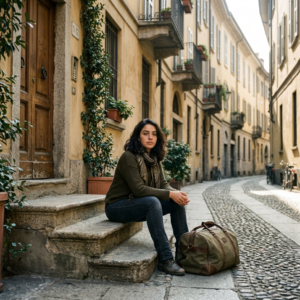
They say the beauty of travel lies in the unexpected, but nobody tells you what to do when the “unexpected” is a taxi driver laughing at your face while you’re stranded in a foreign city. It was a morning in Milan that began with a soft glow of European sunlight and the heavy weight of a suitcase, but it quickly transformed into a labyrinth of linguistic confusion. For a twenty-six-year-old traveler like me, Milan was supposed to be the dream—a city of high fashion, ancient stone, and perfect pasta. Instead, it became the place where I learned that the distance between “resting” and “wrestling” is much farther than it sounds on paper.
This is more than a story about a wrong turn; it is a chronicle of the vulnerability we feel when our tools for connection—our words—fail us. It is about the physical toll of a thirty-thousand-foot journey, the adrenaline of being lost, and the quiet triumph of finding one’s way back home.
The Sky Above and the Silence Within
The journey began in the pre-dawn hush of England. At 26, I had spent my life dreaming of the European continent, fueled by textbook English and a restless spirit. The morning of my flight was a blur of zippers and nervous energy. I hadn’t slept; the anticipation of the unknown acted like a caffeine shot to my system. The taxi ride to the airport was a quiet affair, the English countryside passing by in shades of gray as I mentally rehearsed my travel plans.
The airport was a cathedral of movement—lines of weary travelers, the mechanical rhythm of passport stamps, and the constant hum of announcements. I remember the feel of the cold plastic seat at the gate and the immense size of the plane waiting on the tarmac. When I finally found my window seat, I felt a surge of pure, unadulterated joy. I watched the clouds transform from solid white floors into wisps of smoke, and eventually, I drifted into a shallow sleep, my mind dancing between the English I knew and the Italian world I was about to enter.
When the wheels touched down in Milan, the air changed. The signs shifted from the comfort of my native tongue to the melodic, sharp angles of Italian. I followed the flow of the crowd, my bag feeling heavier with every step, my body beginning to acknowledge the lack of sleep. I was a stranger in a beautiful, ancient land, armed with a phone at five percent battery and a vocabulary that was about to be put to a humiliating test.
A Language of Laughter and Mirrors
Outside the terminal, the Milanese sun was high and unforgiving. I found a bench, my eyes darting between the bustling taxi stand and the rapidly dying screen of my phone. I had booked a small room near a vibrant shopping street—not a grand hotel, but a place that promised authenticity. When a man finally approached me and said “Taxi,” I felt a wave of relief. I showed him the address on my flickering screen, he nodded with a confident “Okay, let’s go,” and we merged into the heavy Italian traffic.
Inside the car, the atmosphere was warm and smelled of old leather and espresso. The driver, a friendly man who watched me through the rearview mirror, began the ritual of small talk. “First time in Milan?” he asked. I smiled, my pride in my English-speaking roots fueling my response. I told him I was from England. He welcomed me with a warmth that felt like a hug.
But then, the fatigue hit me like a physical wall. I leaned my head back against the seat and said the words that would change the trajectory of my day: “I want to rest.”
The silence that followed was brief, replaced quickly by a look of profound confusion in the mirror. He laughed—a deep, belly laugh that filled the small space of the car. “You want to wrestle?” he asked, his eyes wide with amusement. I felt a hot flush of shyness creep up my neck. “No,” I insisted, my voice smaller now. “I want to rest. I want to sleep.” He laughed even louder, the misunderstanding hanging in the air like a fog. “Ah, rest! Not wrestle!” he chuckled. To him, it was a “funny mistake.” To me, it was the first crack in my confidence. Was my English really that bad? I had studied for years, yet here I was, accidentally challenging a taxi driver to a match in the middle of Milan.
The Black Screen of Panic
As the taxi sped past sun-drenched parks and ancient stone buildings where people cycled with an effortless grace, my phone finally gave up the ghost. The screen turned black—a digital death that left me blind. We were on the right street, or so I thought, but the driver was suddenly unsure. The narrow, winding roads of Milan began to look like a repetitive dream.
The driver stopped the car and rolled down his window, calling out to a passerby in rapid-fire Italian. There was gesturing, a pointing of fingers, and a realization: we had gone the wrong way. “Go back and turn left,” the stranger directed. My heart began to drum a nervous rhythm against my ribs. We drove for another five minutes through streets that grew increasingly quiet until we stopped in front of a nameless building. “This is it,” he said.
I stepped out onto the cobblestones, the taxi pulling away before I could even find a house number. I stood there, a lone figure with a heavy bag and a dead phone. I asked a woman with a baby if she recognized the address; she shook her head and walked on. I was truly, completely alone in a city where I had just “offered to wrestle” the only person who knew where I was going.
I sat on a cold stone step and forced myself to breathe. “Stay calm,” I whispered. Ten minutes felt like ten hours. Finally, a man emerged from the building. He told me the address I sought was actually on the next street. I hauled my bag, walking slowly, counting the numbers on the doors until I saw it: a brown door that matched the mental image I had burned into my brain before my phone died. When the host, a man named Leila, opened the door and said, “Welcome, you are here now,” the weight of the world finally lifted.
The Education of a Traveler
That evening, safe in my small room with my phone plugged into the wall, I did something I hadn’t expected to do: I researched my own language. I sat on the bed and listened to the digital voices repeat “rest” and “wrestle” over and over again. I realized how close they were—how a slight slip of the tongue could turn a request for peace into a call for combat. I said “rest” five times to the empty room, then “wrestle,” and suddenly, I was laughing too.
The shyness of the afternoon had evaporated, replaced by a sense of hard-won bravery. I had traveled alone, survived a linguistic trap, and navigated a city without a map. I went out again as the sky turned a bruised orange and pink. I sat in a square, watching a man play guitar while a little girl danced, and I realized that the mistake wasn’t a failure—it was the story.
The next day, Milan opened up to me. I visited the Great Cathedral—a massive, white marble ghost of history—and bought a hat from a market seller who used his fingers to tell me the price. I even had a moment of tension when a stranger tried to lead me “somewhere nice,” but I used my English—clear, firm, and practiced—to say “No, thank you” and walked away. I was no longer the girl who was afraid of a mispronounced word. I was a woman who knew that a mistake is just the beginning of a lesson.
Deep Reflection: The Grace of Being Wrong
Leila’s journey through Milan serves as a profound reminder that perfection is the enemy of experience. We often wait until we are “ready” or until our skills are “perfect” before we venture into the world, but the most vibrant memories are often born from our stumbles. The taxi driver’s laughter wasn’t a mockery of Leila’s ability; it was an invitation to see the humor in the human struggle to be understood.
Language is a bridge, but sometimes the bridge has holes. Falling through those holes doesn’t mean you can’t swim. By the end of her trip, the words “rest” and “wrestle” weren’t just vocabulary points—they were milestones of her own resilience. We learn that it is okay to be shy, it is okay to be lost, and it is most certainly okay to laugh at yourself. In a world that demands constant competence, there is a quiet, radical power in being a student.
Call to Action: We have all had that “lost in translation” moment—whether it was in a foreign country or a difficult conversation at home. What is one mistake you made that eventually turned into your favorite story? How did you find your way back to the “brown door” of your own confidence? Share your travel blunders and linguistic lessons in the comments below. Let’s celebrate the beauty of getting it wrong together!
Disclaimer : This content may be created by AI for entertainment purposes. Any resemblance to real persons, events, or places is coincidental.






