When a City of Millions Looked Away, and One Man Refused to Move
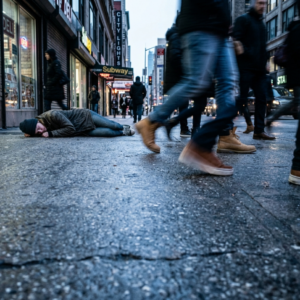
There is a specific kind of silence that exists only in the middle of a screaming crowd. It is the silence of being seen but not acknowledged; the chilling realization that you have become part of the pavement, a mere obstacle for the thousands of shoes marching toward their own destinations. In our modern, high-speed world, we often pride ourselves on our progress, but we rarely discuss the invisible wall we build between ourselves and the strangers we pass every day.
This is the story of Lena Kareem, a woman who came to a new land with nothing but hope, only to find herself dying in plain sight of a city too busy to notice. It is a cinematic journey through the cold mechanics of human indifference and the warmth of a single, stubborn soul named Albert. It is a narrative that forces us to look into the mirror and ask the most uncomfortable question of all: If I were walking down that street, would I have stopped?
Chapter 1: The Weight of an Invisible Life
Lena Kareem is a name that sounds like a whisper in a thunderstorm. At twenty-six, her life is a repetitive cycle of labor and exhaustion. Having moved to this towering, metallic city three years ago from Syria, she carried with her the heavy baggage of a migrant’s hope—the dream that if she worked hard enough, she would eventually belong. But belonging is a luxury that requires time, and time is something Lena sells every day for the price of survival.
Every morning at 5:00 AM, the world is a blur of blue shadows and cold air. Lena’s day begins before the sun has the courage to rise. She boards a bus so crowded that the air feels recycled, standing for an hour as the vehicle jolts through the awakening streets. At the hotel where she works as a cleaner, she is a ghost in a uniform. She scrubs floors that people walk on without looking down; she changes sheets for guests who never see her face; she carries bags for travelers who never learn her name.
“Keep going, Lena,” she whispers to herself, a mantra against the crushing weight of the heavy hotel linens. “This is your chance.” But that chance feels far away when her “home” is a single room with a window facing a brick wall—a literal barrier between her and the beauty of the world. On the nights when the loneliness is too loud, she remembers her mother’s voice. The world can be hard, but there are always kind people. It was a beautiful thought, but in the gray light of the city, that belief was starting to fade like an old photograph left in the sun.
Chapter 2: The Morning the World Went Dark
The day of the incident began with a warning from her own body. Lena woke up late, her head throbbing with a rhythmic pain that felt like a hammer against her temples. Her limbs felt as though they were made of lead. Any other person might have called in sick, but for Lena, a day without work was a day without food. She pushed herself into the chaos of the morning.
The bus was a nightmare of elbows and indifference. People were packed tightly together, yet the emotional distance between them was miles wide. No one made eye contact; everyone was hunched over their phones, retreating into digital sanctuaries. Lena gripped the metal rail, her knuckles white, feeling the world begin to tilt. At work, her manager didn’t ask if she was okay; he only saw a clock. “You’re late again, Lena,” he said, his voice a cold blade. He didn’t wait for her soft apology.
By noon, the hotel hallways began to spin. The white light of the corridors became blinding. Lena sat on the floor for a moment, her forehead against the cool wall, whispering, “Just a minute. You can do this.” But she couldn’t. When her shift finally ended, she stepped out into the bustling city street. The air was thick with exhaust and the sound of a thousand conversations. People were laughing, checking their watches, rushing to dinners and meetings. Lena took one step, then two, and then the sky simply vanished.
Chapter 3: The Forest of Moving Shoes
When Lena regained a sliver of consciousness, the perspective of her world had shifted. She was no longer walking among the people; she was beneath them. She was lying on the cold, hard pavement, her cheek pressed against the grit of the sidewalk. The sky looked impossibly far away, a distant ceiling over a world that no longer included her.
She tried to speak, to cry out for the help she so desperately needed, but her voice was a dry rattle. “Help,” she whispered. She waited for a hand. She waited for a voice. Instead, she saw shoes.
A forest of shoes marched past her head. Polished black leather, scuffed white sneakers, high heels clicking with rhythmic precision. One man paused for a fraction of a second, his eyes meeting hers, before he adjusted his tie and walked away. A woman swerved around Lena’s prone body as if she were a puddle of spilled water. Lena watched the feet move—fast steps, slow steps, but none that stopped. The city was alive, but she was disappearing inside its heart. The terror began to settle in her chest: Is this how I end? Lying on the ground like a piece of trash while the world goes to lunch?
Chapter 4: The Man with Shaking Hands
Just as Lena felt the darkness pulling her back under, a different sound broke the rhythm of the sidewalk. The steps were slower, heavier, and more deliberate. They stopped.
“Hey, can you hear me?”
The voice was old, like parchment, but it carried an urgency that the city lacked. Lena opened her eyes to see a man with gray hair and a face etched with the deep lines of a long life. His hands were shaking slightly—not from fear, but from age. This was Albert.
“I’m here,” he said, his voice a solid anchor in the sea of her panic. “Don’t worry.”
Albert looked up at the sea of people and shouted, “Can someone help? She needs help!” But the forest of shoes continued to move. A young man in a sharp suit walked past as if Albert were invisible. A woman with headphones shook her head, her lips forming the words, “I’m late.” Albert’s worry turned to a righteous, burning anger. “What is wrong with you people?” he screamed at the rushing crowd. “She’s a human being! She’s not okay!”
Still, the city did not care. Seeing that he was alone, Albert did something that looked painful for his aged body. He slowly, carefully knelt down on the hard concrete next to her. “My name is Albert,” he said softly, ignoring the dirt on his trousers. “I’m not going anywhere. Stay with me, Lena. You’re not alone.”
Chapter 5: The Ghost of a Daughter
The minutes that followed were a surreal bubble of humanity in a desert of indifference. Albert tried to call for an ambulance, but his old phone had no signal. He stood up again and again, his knees trembling, pleading with passersby to just make one phone call. A woman finally stopped, checked her watch, and said, “I really can’t be late,” before disappearing into the crowd.
Albert sat back down, letting out a laugh that sounded more like a sob. “People,” he muttered. “Always in a hurry.” To keep Lena awake, to keep her anchored to the world, he began to talk. He told her about his daughter. He spoke of a girl who used to warn him that the world was too busy to care. Albert had always told her she was wrong, but the bitterness in his voice suggested he had learned a hard lesson.
“What happened to her?” Lena whispered.
The pain on Albert’s face was more intense than any physical wound. He explained that years ago, his daughter had fallen in the rain. She had hit her head and stayed conscious for a long time, calling for help. People saw her. They walked around her. Albert arrived too late. “So now,” he said, his eyes locking onto Lena’s with a fierce, protective light, “now I don’t walk away. I won’t make the same mistake twice.”
In that moment, Lena realized that Albert wasn’t just saving her; he was fighting a battle against his own past. He was the one person who understood that “not my problem” is a lie we tell ourselves to stay comfortable.
Chapter 6: The Choice That Remains
The arrival of a young boy who had heard Albert’s shouts finally brought the sound of a siren. A distant echo grew into a piercing scream as the ambulance cut through the city’s noise. The paramedics arrived, their movements clinical and fast. As they lifted Lena onto the stretcher, she felt the first real wave of relief. She looked at Albert, who was standing back, looking exhausted.
“Will you come?” she pleaded. Albert hesitated, feeling like an intruder in this professional medical scene, but then he nodded. He sat in the ambulance, holding the side of the door, his presence a silent promise. At the hospital, when the nurse asked for a relative, Lena pointed to the stranger in the hallway. “Him,” she said.
Two days later, Lena sat by her hospital window. The doctors said her collapse was the result of stress and exhaustion—a physical manifestation of a life lived on the edge. As she watched the people outside, she saw the world differently. She saw a man drop a bag and no one help. She saw a child struggling with a box and people walking past.
The city hadn’t changed, but Lena had. She returned to work, and when a fellow worker dropped a heavy box in the hallway, the voice in her head whispered, Not my problem. But she silenced it. She put down her tools. She walked over. She helped.
Deep Reflection: The Power of One
The story of Lena and Albert is not just a story about a medical emergency; it is a story about the soul of a society. We live in a world where we are more “connected” than ever through technology, yet more “disconnected” from the person standing three feet away. We have outsourced our compassion to “someone else”—the police, the paramedics, the government—forgetting that the first line of defense for any human being is the person standing next to them.
Albert was not a hero with special powers. He was an old man with shaking hands and a broken heart. He stayed because he knew what it felt like to be left behind. Kindness is often inconvenient. It makes us late for meetings; it gets our clothes dirty; it forces us to get involved. But as Lena learned, that one small choice to stop can be the difference between a life saved and a life lost.
Call to Action: Lena felt invisible until one man looked her in the eye. Have you ever been in a situation where you needed help and no one stopped? Or have you ever been the one to stop when everyone else walked away? The world needs more Alberts. We invite you to share your stories of kindness or your thoughts on how we can break down the “invisible walls” in our own cities. Tell us in the comments: What would you do?
Disclaimer : This content may be created by AI for entertainment purposes. Any resemblance to real persons, events, or places is coincidental.






