The Hidden Cost of a Nurse’s Silence
Every war is fought on two fronts. There is the front line where steel meets flesh, and there is the silent front—the one that exists inside the hearts of those who wait and those who serve. We often speak of the visible scars, the medals, and the maps, but we rarely discuss the weight of the words that are never spoken. What happens to a soul when it becomes a container for too much reality? What is the price of a love maintained by a gentle, protective lie?
This is the narrative of Clara Whitmore, a woman whose hands saved lives while her heart slowly broke under the pressure of a secret. It is a cinematic exploration of sacrifice, the heavy burden of duty, and the moment a hidden truth finally demands to be heard.
Chapter 1: The Mud and the Medicine
France, during the Great War, was a world of gray. Gray skies, gray mud, and the gray faces of men who had seen too much. For Clara Whitmore, a twenty-six-year-old nurse, the environment was a sensory assault that never relented. Every morning began with the biting intrusion of cold air through the canvas of the field hospital tents—a chill that seemed to settle in the very marrow of her bones.
The atmosphere was permanently thick with the sharp, clinical smell of antiseptic and the metallic tang of blood. Beneath the rhythmic shaking of the tents in the wind, there was a symphony of human suffering: the low, guttural moans of the wounded, the sharp barking of military orders, and the devastating, sudden silences that often followed a struggle for breath. Clara had arrived three months prior, bolstered by a youthful belief in her own strength. She quickly learned that strength in a field hospital isn’t about not feeling; it’s about continuing to move when your feelings tell you to stop.
She moved between cots with a ghostly efficiency, her apron stained and her eyes weary. In this place, the boundary between life and death was as thin as the fabric of the tents. She saw young men, barely out of childhood, reaching for a hand to hold in the dark. She saw doctors who had forgotten what it felt like to sleep. Every day was a cycle of trauma, yet to the world outside, she had to remain the Clara they remembered—the woman who left England with a smile.
Chapter 2: A Promise Made at the Station
The memory of the train station in England was Clara’s only sanctuary. She could still feel the phantom pressure of her husband Daniel’s hands as he squeezed hers, his knuckles white with the fear of letting go. “Write to me,” he had pleaded, his voice cracking over the hiss of the steam engine. “I will,” she had promised. “And come back safe,” he added, searching her eyes for a guarantee she couldn’t truly give. “I will try,” she had whispered.
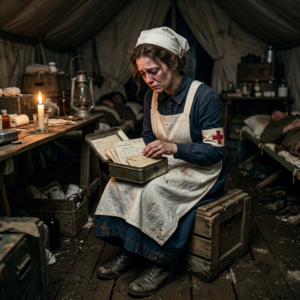
That promise became her secondary job. Every week, no matter how many hours she had been on her feet, Clara would find a quiet moment. She would sit on a small, splintered wooden box beside her cot, the flickering light of a single candle casting long, dancing shadows against the tent wall. She would take out a precious sheet of paper and begin with the same two words: Dear Daniel.
In those moments, the pen became an extension of her soul. She wrote about the cold that turned fingers blue. She wrote about the teenage soldiers who sobbed for their mothers in the middle of the night, their voices sounding like lost children. She wrote about the boy whose hand she held until the warmth left it. She wrote the raw, unvarnished truth of the war—the things she saw, the things she smelled, and the things that kept her awake. But she never sent those letters.
Chapter 3: The Tin Box and the Half-Truth
Instead of placing these letters in the mail, Clara would fold them with a precision that bordered on ritualistic. She would reach under her cot, lift a loose piece of the wooden flooring, and place the paper inside a small, battered tin box.
Why the secrecy? Because the truth felt like a weapon. Daniel was at home, safe in the quiet countryside of England. He was waiting for his wife to return as the person he knew. Clara believed with every fiber of her being that if she told him about the piles of blood-soaked bandages or the way she had to choose which soldier to treat first, it would destroy the peace he had left. She felt it was her duty to protect his mind from the horrors her eyes could not unsee.
To Daniel, she sent a different version of reality. She sent short, sanitized notes. I am fine. The work is hard, but I am strong. These were the “sent” letters—polished shells of a life, containing none of the meat. But as the weeks turned into months, the tin box grew heavy. It became a graveyard of her honest thoughts. Sometimes, in the deepest part of the night when the hospital was momentarily still, she would speak to him in her mind. Daniel, today was so hard, she would whisper. And in her imagination, his voice would return, steady and kind: I know, Clara. You are strong. It was a haunting, imaginary dialogue that allowed her to breathe for one more day.
Chapter 4: The Night the Silence Broke
The turning point came on an evening that felt like a thousand others. A nineteen-year-old soldier had died in her arms just as the sun went down. His final request—”Don’t let me be alone”—echoed in her ears like a bell. Clara sat on her cot, the ink still wet on a new letter, her tears blurring the words.
She reached under the floorboards to deposit the latest confession, but as she opened the tin box, she paused. The box was nearly full. The sheer volume of hidden pain startled her. She wasn’t just surviving; she was building a monument to her own trauma. As her fingers brushed the stacked paper, the weight of the silence felt physical, like a hand pressing down on her chest.
Outside, a fresh transport of wounded arrived. The chaos resumed. Clara stood up, her instincts taking over. She cleaned wounds, she whispered comforts, and she lied to a terrified boy who asked if he would go home. “You are safe now,” she told him, a phrase that was technically true in the moment but hollow in the grand scheme of the war. After the rush subsided, she sat in the cold night air, looking at the stars that refused to shine through the clouds. She realized that by “protecting” Daniel, she had moved herself into a world where she was completely alone.
Chapter 5: The Mirror of the Senior Nurse
The next day, Clara was called to the senior nurse’s desk. As the older woman spoke about moving supplies, Clara’s eyes drifted to a drawer that had been left slightly ajar. Inside sat a small, empty tin box, identical to her own.
The sight hit her like a physical blow. The senior nurse caught her look and slammed the drawer shut with a speed that spoke of deep, practiced shame. “It’s nothing important,” she said, her voice tight and defensive.
In that instant, the isolation Clara felt began to crack. She realized she wasn’t a solitary martyr; the hospital was likely filled with hidden boxes and unspoken words. They were all carrying invisible rucksacks filled with the truths they couldn’t tell their loved ones. That evening, Clara did something she had never dared to do: she opened her tin box and read her own words. She saw her soul laid bare on the page—the fear, the guilt, the exhaustion. She realized that these letters weren’t just reports; they were her. And by hiding them, she was hiding herself from the one person who mattered most.
Chapter 6: The Final Decision and the Medical Truck
The news of a transfer came suddenly. The unit was moving, and anything left behind would be lost or discovered by strangers. Clara knelt by her cot one last time, staring at the floorboards. The thought of leaving her truth in the mud of France was unbearable, but the thought of carrying it forever was impossible.
She made a choice that felt like a leap into a dark canyon. She took every single letter out of the tin box. She placed them in a cloth bag, her hands trembling so violently she could barely tie the knot. On top, she placed one final note: Please forgive me for not telling you sooner. Clara.
She walked through the encampment toward a medical supply truck bound for England. The driver was a man she didn’t know, a face lost in the machinery of war. “Deliveries?” he asked. “Yes,” she replied, her voice steady despite the pounding of her heart. She placed the bag inside the truck. For a heartbeat, she wanted to snatch it back, to return to the safety of her silence. But she let go. She watched the truck pull away, disappearing into the mist of the French countryside.
Deep Reflection: The Freedom of the Truth
Clara Whitmore survived the war, returning to England months later. She never spoke of the bag, and she never knew for certain if Daniel had read the contents. But the change in her was profound. The heavy, invisible rucksack she had carried for months had been left behind in that supply truck.
The moral of Clara’s journey is a universal one. We often believe that silence is a shield—that by hiding our pain, we are protecting those we love. But silence is not a shield; it is a weight. It creates a distance that love cannot easily cross. Clara learned that while the truth can be painful, it is the only thing that allows us to be truly known. Sacrifice is noble, but honesty is what brings us home.
Call to Action: Clara’s story challenges us to look at our own “tin boxes.” Have you ever kept a secret to protect someone, only to find it was hurting you both? Do you believe Clara was right to send the letters, or should some things stay hidden forever? We invite you to share your thoughts and feelings in the comments. Let us honor the strength it takes to be honest in a world that often demands silence.
Disclaimer : This content may be created by AI for entertainment purposes. Any resemblance to real persons, events, or places is coincidental.






