“That Ink On My Arm Wasn’t For You.” He Ripped The Old Man’s Shirt—Then The Black SUVs Arrived.
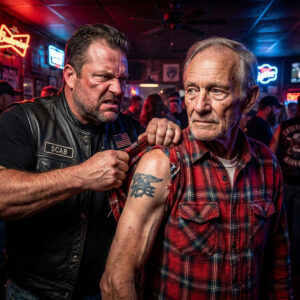
The air in the Salty Dog Tavern didn’t just smell like stale lager and industrial-grade disinfectant; it smelled like the slow, agonizing evaporation of hope. It was a cocktail of spilled whiskey and ancient regret, a place where the neon beer signs in the window cast a jaundiced, flickering glow on the patrons, making them look like wax figures in a forgotten museum. It was a sanctuary for ghosts, and Terry Harmon was just another one, sitting in the corner booth, hoping to commune with his memories in a peace the world rarely afforded him.
Terry was seventy-eight years old. His hands were a map of his history, covered in a constellation of liver spots and thin, translucent skin that looked like parchment. He held a glass of water with a steadiness that defied his age. The slight tremor that usually plagued his fingers had, for a fleeting moment, retreated. He was transfixed by the condensation trailing down the glass—a tiny, cold river cutting through the humid, stagnant air of the bar.
Then, the light vanished.
A mountain of a man stepped into Terry’s peripheral vision, his shadow stretching across the table like a dark tide. The newcomer wore a leather vest stitched with the snarling wolf emblem of the Road Vultures. He smelled of exhaust fumes and unearned arrogance.
“What’s a fossil like you doing in a place like this?”
The voice was a low growl, thick with the gravel of cheap beer and a lifetime of bullying those who couldn’t fight back. Terry didn’t look up. He remained focused on his water, his spine slightly bent but not broken.
“Hey, I’m talking to you, Grandpa.” The biker—a man whose patch identified him as ‘Scab’—leaned forward, planting two meaty, grease-stained fists on the scarred wooden table. The wood groaned in a sharp, splintering protest. “This is our place. We don’t like strangers, especially not broken-down old ones.”
Scab gestured with a sharp jerk of his chin toward the cane leaning against Terry’s chair. It was a simple thing, made of worn, dark wood, polished by decades of Terry’s palm. To Scab, it was a white flag. To Terry, it was a receipt for a life paid in full.
Terry finished his water, the cool liquid a sharp contrast to the heat rising in the room. He set the glass down with a soft, deliberate click that seemed to echo in the suddenly quiet tavern. Only then did he raise his eyes.
They were a pale, washed-out blue, like a winter sky after a storm. But they held a depth that made Scab’s breath hitch for a microsecond. They weren’t clouded with the fear the biker expected, nor were they burning with the impotent rage of the weak. They were merely observant. They took in the three-to-one odds, the layout of the room, and the tactical posture of the men flanking him.
“I’m not a stranger here,” Terry said, his voice a quiet rasp that carried better than a shout. “I’ve been coming here longer than that vest of yours has been on your back.”
Scab chuckled—a dry, ugly sound that rattled in his chest. “Oh, a real comedian. You got a lot of mouth for a guy who looks one strong breeze away from turning to dust.”
With a casual, cruel flick of his wrist, Scab knocked Terry’s cane. It clattered to the floor, the sound of wood hitting the sticky tile ringing out like a gunshot. “You going to pick that up, or do you need one of your nurses to help you?”
The bar went dead. The jukebox, which had been mid-way through a mournful country ballad about a lonesome highway, seemed to go mute. Patrons hunched over their drinks, their gazes fixed on the scuffed tops of their tables, wanting no part of the impending violence. The only person who seemed to be truly watching was Maria, the bartender. She stood behind the mahogany rail, polishing a glass with a frantic, white-knuckled force, her eyes darting toward a small drawer beneath the register.
Terry Harmon began to move. It was a slow, pained descent. A testament to old injuries that never truly healed, only went dormant. As he reached for the floor, his hip protested with a dull, grinding ache, and his right knee—a road map of surgical scars—sent a sharp, electric signal of agony up his thigh. He ignored it. Pain was an old companion, a shadow he’d lived with since 1968. He gripped the smooth wood of the cane, his fingers finding the familiar grooves worn by time.
As he straightened back up, a fine sheen of sweat appeared on his brow, glistening in the neon light. Scab saw the struggle and his grin widened, revealing a row of stained, uneven teeth. This was the confirmation he needed—the proof of his own distorted superiority. He saw a frail, disabled old man. He couldn’t see the tempered steel underneath the parchment skin. He couldn’t see the discipline forged in crucibles he couldn’t possibly imagine.
“Pathetic,” Scab sneered, his voice booming for the benefit of his cronies. “You should be at home in your rocking chair, not taking up space in a real man’s bar.”
“This bar is for anyone who wants a quiet drink,” Terry stated, his voice as level as a horizon line. He placed the cane back in its spot. He wasn’t engaging in the theater of the ego; he was enduring.
He had endured far worse than the posturing of a barroom bully. He had endured the suffocating, chlorophyll-heavy heat of the Mekong Delta. He had endured the biting, bone-deep cold of high-altitude nights where the stars were the only things that didn’t want him dead. He had endured the profound, aching silence that follows the loss of brothers. To Terry, Scab was a gnat—unpleasant, but ultimately insignificant.
But Scab wasn’t used to being ignored. His frustration began to curdle into a dangerous, volatile anger. He needed a reaction. He needed to see Terry break. His gaze fell on Terry’s simple, worn red flannel shirt.
“What are you hiding under that thing, old-timer?” he growled, reaching out with a predatory hand. “A bag? A colostomy bag?”
Terry’s eyes hardened. Just a fraction. A flicker of something cold, dark, and lethal sparked in their blue depths—a ghost of the man he used to be—before the embers were suppressed.
“Don’t,” Terry said.
The word was not a plea. It was a command spoken with an authority that felt utterly alien coming from the man in the corner. It was the voice of a man who had led giants into the mouth of hell.
The quiet command only enraged Scab further. In a swift, violent motion, he lunged across the table, grabbing the front of Terry’s shirt with both hands. “I’ll do what I want!”
With a harsh, rhythmic tearing sound, the cheap cotton fabric ripped down the middle. Buttons popped and scattered across the sticky linoleum like discarded teeth. The shirt fell open, exposing the thin, pale chest of an old man—and something else.
On Terry’s right bicep, faded by decades of sun and age but still unmistakably clear, was a tattoo. It wasn’t a skull, or a pin-up girl, or a wolf. It was an eagle, its wings spread wide in a defiant arc, clutching an anchor, a trident, and a flintlock pistol.
The Navy SEAL Trident.
The bar plunged into a silence so absolute it felt physical. Scab stared at the ink, his brows furrowed in a confused, drunken haze. He didn’t recognize the specific heraldry, but he recognized the aura of the symbol. It felt official. It felt heavy. It didn’t fit the narrative of the “weak old man” he had constructed.
As Scab’s grimy fingers brushed against the faded tattoo, the stale air of the tavern dissolved for Terry. The smell of cheap beer and cigarette smoke was replaced by the visceral scent of salt air, jet fuel, and gun oil.
He wasn’t in the tavern anymore. He was twenty years old, sitting on an overturned ammo crate in a sweltering tent somewhere in Southeast Asia. A wiry man with a cigarette dangling from his lips was hunched over his arm, a homemade tattoo gun buzzing like an angry hornet. The needle felt like a thousand tiny stings—a fire tracing a sacred pattern into his skin. He hadn’t flinched then, and he didn’t flinch now.
Around him in the tent were his teammates. All of them young, hard, and convinced they were immortal. They were all getting the same mark. It was more than just ink; it was a covenant. A silent promise that they were part of something bigger, something the outside world—men like Scab—would never understand. It was the price of admission to a club paid for in blood, sweat, and a piece of their collective soul.
The memory vanished as quickly as a muzzle flash, leaving an ache of nostalgia in its wake. Terry was back in the Salty Dog, the torn halves of his shirt hanging loose.
Scab recovered his bravado, though it rang hollower now. He laughed—a forced, dismissive sound. “What’s that? You get that out of a Cracker Jack box? Trying to pretend you were some kind of big-shot old man?” He poked the tattoo with a dirty finger. “You’re no soldier. You’re just a sad old man playing make-believe.”
The public humiliation was complete. Terry’s history, his identity, and the memory of his fallen brothers were being mocked by a man who couldn’t comprehend the weight of the ink he was touching.
Behind the bar, Maria had seen enough. The line hadn’t just been crossed; it had been obliterated. Her loyalty to Terry—her quiet, dignified regular who always remembered her son’s birthday—solidified into a cold, hard resolve.
She remembered a promise made ten years ago. Terry had given her a small, laminated card with a single phone number on it. “If I’m ever in here and it looks like real trouble,” he had said, his voice low, “the kind you can’t call the local police for… you call this number. You tell them my name. Terry Harmon.”
She had tucked it away, thinking it was the harmless eccentricity of an old vet. Tonight, she knew better.
She slipped into the cluttered back office, closing the door until only a sliver of light remained. Her hands were shaking, not with fear, but with a righteous fury. She dialed the number. It didn’t even finish its first ring before a man answered.
His voice was like ice—calm, professional, and entirely devoid of emotion. “Operations.”
“Hello, my name is Maria,” she whispered, her voice tight. “I’m at the Salty Dog Tavern on Route 4. I’m calling about Terry Harmon.”
The silence on the other end was fractional, but the atmosphere changed instantly. “Is he okay?” the voice asked, a new, lethal edge to its tone.
“No,” Maria said, tears welling as she heard Scab’s booming laugh from the other room. “There’s a group of bikers. They ripped his shirt. They’re… they’re mocking him. Please. He told me to call if there was real trouble.”
“Understood, Maria,” the voice said. “We have your location. Help is on the way. Just stay on the line and keep your head down.”
Maria could hear muffled but distinct commands being issued in the background. Phrases that meant nothing to a civilian. “Initiate Code Trident. Active asset is under duress. I repeat, active asset under duress. Scramble the QRF.”
Miles away, in the sterile, blue-lit quiet of a Naval Special Warfare command center, Master Chief Petty Officer Ryan Thompson stood up from his desk so fast his chair hit the wall.
The name Terry Harmon was an electric shock. Harmon wasn’t just a veteran. He was a plank-owner of the modern SEAL teams. He was a ghost whose file was mostly black ink.
“Sir,” Thompson said, turning to the watch commander, Lieutenant Commander Evans. “We have a Code Trident. It’s Master Chief Harmon.”
Evans was on his feet in a second. The low hum of servers was replaced by a tense, focused silence. Every operator in that room knew the name. They had studied his missions at BUD/S; his tactics were the DNA of their training manuals. To them, Terry Harmon was King Arthur.
“Location?” Evans asked, his voice clipped.
“The Salty Dog Tavern, Route 4. Biker gang is harassing him.”
Evans’ jaw tightened. The thought of Terry Harmon being manhandled by thugs was an insult to the entire Navy. “Get the Quick Reaction Force. Full deployment. Wheels turning in five minutes.”
“Already on their way to the vehicles, sir,” Thompson replied with a grim smile.
Back at the tavern, Scab was losing his patience. Terry’s refusal to react was infuriating. The old man just stood there, his torn shirt a silent indictment of Scab’s cowardice.
“All right, that’s it. You’re done,” Scab snarled. He grabbed Terry firmly by his tattooed bicep. Terry winced—not from the pressure, but from the sheer indignity of the touch. “You’re coming with us. We’re going to take you for a little ride. Teach you some respect.”
This was the final escalation. Scab began to haul Terry toward the door. Terry didn’t fight back; he allowed himself to be pulled, his limp more pronounced, his cane left behind on the dusty floor. He just kept his eyes locked on Scab’s—a look of profound, soul-weary disappointment.
Just as they reached the swinging doors, a low, powerful rumble began to permeate the walls. It wasn’t the ragged, uneven sound of a Harley. It was the synchronized, high-performance hum of multiple engines.
The tavern doors swung open.
Three black, immaculate SUVs, the kind used by federal agencies, were parked in a perfect semi-circle, blocking the exit. The doors opened in perfect unison. Twelve men emerged. They were dressed in crisp, navy blue operational uniforms, gear strapped to their chests with an intimidating, functional neatness. They moved with a chilling economy of motion, scanning the room with eyes like lasers.
The last to enter was Lieutenant Commander Evans. He walked forward, his boots making no sound on the floor. He stopped directly in front of Scab and Terry.
Scab, confronted with a reality he couldn’t comprehend, froze. His hand was still clamped on Terry’s arm.
Evans ignored the biker. He brought his heels together with a sharp crack. His back was ramrod straight. He raised his hand to his brow in a salute so sharp it seemed to cut the air.
“Master Chief Harmon,” Evans said, his voice ringing with reverence. “Lieutenant Commander Evans, sir. We received a call. Are you all right?”
The bar was so quiet you could hear a bead of sweat drop from Scab’s forehead. His hand fell away from Terry’s arm as if it had been burned.
Terry raised a weary hand and gave a slow, tired version of a return salute. “I’m fine, Commander. Just a slight… misunderstanding.”
Evans kept his eyes on Terry, but his next words were aimed like a weapon at the bikers. “Master Chief Petty Officer Terrence Harmon,” he began, his voice dropping to a low, cold monotone. “Enlisted 1961. Recipient of the Navy Cross. Two Silver Stars. Four Bronze Stars with Valor. Three Purple Hearts. This man taught the tactics that keep soldiers alive today. He has bled more for this country than your entire club has drank beer.”
With each word, the bikers seemed to physically shrink. Their arrogant smirks had melted into slack-jawed horror.
“The tattoo you were mocking is the SEAL Trident,” Evans continued. “He earned it in places you will never see, doing things you could never do. You put your hands on a living legend.”
Terry looked at Scab. He didn’t look for revenge. He looked at him with a deep, profound pity.
“The uniform, the medals… they’re just things,” Terry said, his voice a low rasp. “What matters is what you do when no one is looking. That ink on my arm wasn’t for you. It was for them—the ones who didn’t come home.”
As the local deputies arrived to a scene they couldn’t possibly process—a dive bar surrounded by elite naval operators—Terry Harmon turned his gaze inward one last time. He remembered the mud of the Delta. He remembered the white-hot pain when his leg was shattered by shrapnel, and the sheer force of will that allowed him to lay down suppressive fire while dragging his wounded teammates to the extraction point.
The limp wasn’t a disability. It was a receipt. Proof of purchase for another man’s life.
Months later, the tavern was quieter. Terry still came in for his water, a new flannel shirt buttoned to his chin. As he left one afternoon, he saw a man sweeping the parking lot of the grocery store next door. It was Scab. The arrogant swagger was gone, replaced by the stoop of a man who had been thoroughly and publicly humbled.
Their eyes met. Scab froze, the broom trembling. He gave a short, jerky nod—a silent, pathetic apology. Terry Harmon looked at him for a long moment, then gave a slow, deliberate nod in return. A nod of forgiveness. Then, he got into his old pickup truck and drove away, leaving the man to his sweeping and his ghosts.
True heroism doesn’t need to shout to be heard. It lives in the quiet actions of unassuming giants who walk among us every day. Have you ever encountered someone whose quiet strength changed your perspective? Share your thoughts and your gratitude for our veterans in the comments below. Let’s remind the world that still waters run deep.
Disclaimer : This content may be created by AI for entertainment purposes. Any resemblance to real persons, events, or places is coincidental.






