“I have lived in this town longer than you’ve worn that badge…” Three sentences later, the Sheriff’s reign of terror collapsed.
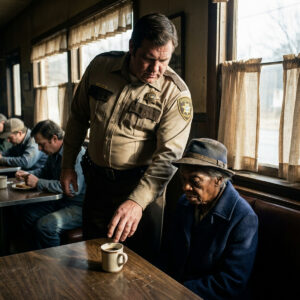
The slap didn’t just vibrate the air; it shattered the very soul of the Morning Star Diner. It cracked through the room with the bone-chilling finality of a gunshot, a sharp, wet sound that sent a shockwave across the grease-stained counters and worn-out linoleum. Plates froze in midair, gripped by hands that had suddenly lost their strength. Forks clattered onto porcelain. The low hum of the ceiling fan and the sizzle of bacon on the flat-top were the only sounds left, amplified by a silence so heavy it felt like it could crush a man’s lungs.
Evelyn Carter didn’t scream. She staggered, her frail, seventy-year-old frame yielding to the brute force of the blow. Her hip caught the sharp, metal-edged corner of the booth with a dull thud before she collapsed onto the floor. Her glasses—the ones she had worn for five years, with the gold frames she’d saved up for—skittered across the tiles like a frightened animal.
She lay there, the taste of copper blooming in her mouth, her ears ringing with a high-pitched whine that drowned out the world. Through a blurred haze, she saw the scuffed toes of a pair of black, high-gloss duty boots. They were planted firmly, arrogantly, just inches from her face.
Sheriff Clayton Hargrieve didn’t move to help her. He stood over her like a conqueror in a conquered land, his broad chest heaving slightly, his hand still stinging from the impact. He leaned down, his face a mask of cold, unchecked malice, staring into the eyes of a woman whose only crime was existing with dignity. He was daring someone—anyone—to speak. He was breathing in the fear that saturated the room, using it as fuel for a fire that had been burning in this town for decades.
The Morning Star Diner usually smelled of comfort—burnt coffee, fried bacon, and the sweet, lingering scent of maple syrup. It was a place where time didn’t so much march forward as it did lounge around in the booths. Regulars like Evelyn Carter didn’t need menus; they needed a familiar corner and a moment of peace before the world got too loud.
Evelyn was a fixture of the town. She was a woman of silver-gray hair and thin, veined hands that had spent fifty years working the soil, raising children, and stirring pots for church fundraisers. She wore a modest hat and her best navy coat, not out of vanity, but out of a deep-seated belief that how you presented yourself to the world was a reflection of how you respected God’s creation.
She had lived in this forgotten little town her entire life. She had watched the trees grow and the buildings crumble. She had buried friends and celebrated births. To most, she was invisible—a part of the landscape. And to a man like Hargrieve, that made her an easy target.
The bell above the door hadn’t just rung when the Sheriff entered; it had shrieked under the force of his entry. Hargrieve was a man who armored himself in his authority. His uniform was a weapon, his badge a shield against consequence, and his sidearm a constant reminder of who held the literal power of life and death in these zip codes. He didn’t come for the blue-plate special. He came to remind the town that the law didn’t just live in books; it lived in his fists.
He had walked straight to the back booth. Tap, tap, tap. His nightstick drummed against his thigh in a rhythmic, predatory countdown.
“You’re sitting in my seat,” he had said. His voice wasn’t a shout; it was a low, gravelly rasp that carried the weight of a threat.
Evelyn had looked up, her steady gaze a direct challenge to his intimidation. “I’m sorry, Sheriff. I didn’t see a sign. I’ve always sat here.”
The air in the diner had turned to ice. Hargrieve leaned forward, his massive hands splayed on the table, invading her personal space until she could smell the tobacco on his breath. “I don’t like the way you people get too comfortable,” he whispered. “Start thinking places belong to you.”
It wasn’t about the seat. It was about the hierarchy. It was about a man who felt his grip on the world slipping and needed to break something smaller to feel whole again. When he flicked her coffee cup, sending the scalding liquid onto her lap, he didn’t just cause pain; he attempted to erase her humanity.
“Careful,” he had smirked as she gasped from the heat. “You’re making a mess.”
The silence that followed her refusal to apologize was a vacuum. Every regular, every traveler, even the waitress with the trembling hands, looked away. They were good people, but they were practiced in the art of survival. They knew that in this town, the Sheriff didn’t just enforce the law; he was the law.
Until the slap. Until Evelyn Carter, lying on the floor with a purple bruise blooming on her cheek, realized that no one was coming to save her.
What Hargrieve didn’t notice—what no one noticed—was the man at the far end of the counter. He sat in a worn leather jacket, his eyes hidden beneath the brim of a dark hat. He hadn’t flinched when the cup fell. He hadn’t gasped when the hand struck. He had simply watched, his eyes cold and calculating, assessing the Sheriff like a hunter evaluating a wounded animal.
As Hargrieve stormed out, barking a final threat about towing Evelyn’s “junk car,” the man in the leather jacket didn’t rush to her side. He didn’t join the chorus of “Are you okay?” that broke out only after the danger had passed. He simply placed a ten-dollar bill on the counter, glanced once more at the woman picking up her cracked glasses, and walked out into the crisp morning air.
He found Hargrieve by his patrol car. The Sheriff was already smirking, a man satisfied with a lesson taught.
“Sheriff,” the voice said. It wasn’t loud. It carried a terrifying certainty that bypassed the need for volume.
Hargrieve turned, his hand instinctively drifting toward his belt. “You lost, son?”
“You don’t have the right to humiliate people,” the man said calmly. “That woman in there is old enough to be your mother.”
The Sheriff’s laugh was a sharp, jagged thing. “And who the hell are you?”
“I’m giving you advice,” the man replied, stepping into the Sheriff’s light. “The last good advice you’re going to get. Walk back inside. Apologize. Right now.”
Hargrieve’s ego flared like a match in a dry forest. “I run this town! I’ll put you on the ground so—”
Crack.
The sound echoed across the asphalt, identical to the one in the diner. The Sheriff’s head snapped sideways. He staggered, his balance stripped away by a blow he never saw coming. Before his mind could register the pain, the man in the leather jacket had him by the collar, dragging him toward the diner door.
“This is where your authority ends,” the man said, his voice as cold as a November rain.
The diner bell shrieked again as the door burst open. The Sheriff was thrown forward, stumbling until he collapsed at the feet of the woman he had just assaulted. The regulars gasped, a collective intake of breath that sounded like a sigh of relief.
“Apologize,” the man in the leather jacket commanded. “Now.”
Hargrieve looked up. For the first time in his life, there was no armor. There was only the raw, naked face of a coward who had been found out. He looked at Evelyn, and for the first time, he saw her—not as a target, but as a witness.
Evelyn didn’t gloat. She didn’t look for revenge. Her eyes were filled with a quiet, devastating sadness. “Son,” she said softly to the stranger. “That’s enough.”
Those three words carried more power than the slap ever could. They were the words of someone who knew that vengeance is a hollow victory, but truth is a permanent one. The Sheriff fled, his badge rattling uselessly against his chest, a broken man heading toward a future he could no longer control.
The man in the leather jacket didn’t stay for thanks. He stepped outside, pulled out a phone, and dialed a number with no name attached.
“He crossed the line,” he said. “Publicly.”
“Then it’s time he learns what happens after that,” a voice responded.
The Sheriff believed the humiliation was the end. He didn’t understand that he had just become the star of a tragedy he couldn’t stop.
By 9:17 AM, the video was everywhere. It wasn’t a rumor; it was a record. Clear, unedited, and impossible to deny. The footage from the diner’s security system, and a secondary recording from a phone that had never been seen, flooded the county. People watched as the coffee spilled. They watched as the slap landed. They watched the pattern of abuse that stretched back years—audio recordings of threats made in the dark, patterns of racist remarks, and complaints that had been buried by a system designed to protect itself.
The silence that had kept the town obedient for forty years didn’t just break; it dissolved.
State officials arrived. Unmarked vehicles filled the station parking lot. By the sixth day, the Sheriff sat in a house that no longer felt like a fortress. His badge lay on the table beside a cold cup of coffee, a piece of tin that no longer granted him the right to be a monster.
In a courtroom filled with the people he had spent years intimidating, the verdict was read. It wasn’t a storm; it was a quiet correction of an error that had persisted too long. Guilty. Abuse of authority. Violation of civil rights. Obstruction of justice.
Justice is rarely as loud as the crimes that necessitate it. It is often a quiet, methodical process of setting things right.
Evelyn Carter returned to the Morning Star Diner a week after the sentencing. She sat in the same back booth, the sunlight touching the surface of her new coffee cup. The waitress didn’t shake when she poured the cream. The regulars didn’t lower their voices when a patrol car passed the window.
The man in the leather jacket was gone. He was never a hero; he was a catalyst. He understood what the Sheriff did not: that power does not come from volume, and authority is not earned through fear.
Evelyn took a sip of her coffee and watched the street. “Justice isn’t bitter,” she said softly to herself. “It’s just honest.”
And honesty, once spoken in a room where everyone is listening, has the power to change the world.
Has there ever been a time when you saw someone stand up to a bully, or have you had to find that courage yourself? We often think we are alone in our struggles, but as Evelyn found, sometimes the world is just waiting for one person to break the silence. Share your feelings in the comments below—we read every story.
Disclaimer : This content may be created by AI for entertainment purposes. Any resemblance to real persons, events, or places is coincidental.






