“You only see the dirt on my boots—not the power in my fists.” They laughed until I stepped into the ring.
The concrete under Maris Hail’s feet felt like ice, even through the worn soles of her leather boots. It was 7:45 AM, that brittle, unforgiving hour when the morning sun is a pale, heatless disc and the shadows of the school flagpole stretch across the dusty yard like a pointing finger. She stood at the center of the gravel lot, her shoulders hunched slightly—not in defeat, but to keep the biting wind from slipping beneath the collar of her faded flannel shirt.
The laughter started as a low, bubbling hum near the lockers before it erupted, sharp and sudden, slicing through the quiet morning air like a serrated blade. It was a sound Maris knew the way a sailor knows the sound of an approaching storm. It was cruel, rhythmic, and relentless, echoing off the brick walls of the high school as if it had been waiting in the rafters all night just to find its target.
Standing at the epicenter of that cacophony, Maris remained a statue of flesh and bone. She was unflinching, her jaw set so tightly that a tiny muscle pulsed rhythmically at the corner of her mouth. Her eyes were lowered, fixed on a specific, jagged pebble near her toe. She had learned long ago that meeting their gaze was like throwing gasoline on a fire; it only gave them the reaction they hungered for.
Behind her lowered lids, Maris’s mind was a fortress of silent, complex calculations. She wasn’t thinking about the insults. She was counting the seconds until the first bell, analyzing the distance between herself and the nearest exit, and suppressing the white-hot roar of energy that hummed in her fingertips—a strength they couldn’t possibly imagine.
Maris Hail had always been “The Quiet Farm Girl.” In a town where everyone was defined by a label, that was the one they had pinned to her chest like a warning sign. To her classmates, the label explained everything they needed to know. It explained her faded, mismatched clothes that smelled faintly of cedar and woodsmoke. It explained the deep, permanent callouses on her palms and the dirt beneath her fingernails. Most of all, it explained her habit of speaking only when absolutely necessary—a silence they mistook for stupidity.
Her reality was miles outside the town limits, on a patch of land where the mornings began long before the sun dared to crest the horizon. While other teenagers slept through their third snooze alarm, dreaming of trends and weekend parties, Maris was already chest-deep in the cold mist of the north pasture. Her internal clock was synchronized with the heavy thrum of the tractor and the rhythmic lowing of the cattle.
She didn’t worry about homecoming royalty or the social hierarchy of the lunchroom. Her anxieties were visceral and heavy: a broken fence line that could let the herd escape into the highway, a sick calf that needed bottle-feeding every four hours, and the looming, suffocating question of whether the harvest would be enough to pay the bank and keep the family land for another season.
School was a different kind of battlefield—one where she felt like a ghost haunting a world that spoke a language she had forgotten. The polished, linoleum hallways felt alien under her work boots. The high-pitched chatter and the artificial lights weighed on her quietly, like a storm she carried deep inside her chest but never permitted to break. She moved through the corridors with a deliberate, ghost-like efficiency, trying to be as invisible as possible in a place designed to highlight every flaw.
But visibility is not always a choice. Kellen Royce, a boy whose charisma was a thin veil over a deep-seated cruelty, had long since decided that Maris was his favorite punchline. To Kellen and his circle, she wasn’t a person; she was a convenient target for their boredom. They mocked her silence as if it were a defect. They laughed at her background as if poverty were a character flaw. They saw a quiet girl from the dirt, never realizing that the dirt is where things grow strong.
What Kellen Royce didn’t see—what no one in that town saw—was what happened after the yellow school bus dropped Maris at the end of her long, gravel driveway.
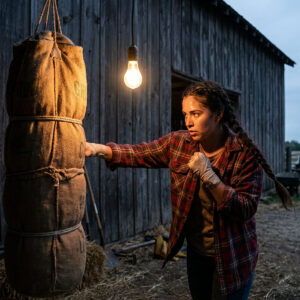
As the bus pulled away, Maris would let out a breath she felt she’d been holding since homeroom. She would walk past the farmhouse, straight to the weathered, gray-timbered barn that sat at the edge of the woods. Behind that barn, shielded from the road and the prying eyes of neighbors, stood her sanctuary.
It was a makeshift training space, born from grief and grit. It wasn’t much to look at: a heavy bag patched together from old grain sacks and duct tape, a few worn wrestling mats she’d salvaged from a garage sale, and a pair of leather gloves that had seen so many miles they were practically held together by sweat and memory.
Years ago, after her older brother, Elias, had left for the city and never returned, Maris had found his old training journals tucked away in a cedar chest. Elias had been a fighter—not the kind who looked for trouble, but the kind who understood that life is a series of rounds you have to survive. His handwriting was disciplined and passionate, filled with diagrams of footwork, the physics of a hook, and the philosophy of the “Silent Warrior.”
Those yellowed pages became Maris’s gospel. Without a coach to correct her stance, without an audience to cheer her progress, she trained herself. She became a student of the micro-moment. She analyzed the way her hip needed to rotate to generate power from the ground. She felt the way her breath needed to be exhaled in sharp, controlled bursts to keep her muscles from tightening.
Every strike against the grain sacks, every drop of sweat that hissed against the cold barn floor, was a step toward something she couldn’t quite name. It was a shedding of the day’s humiliations. It was where her voice truly lived. She trained at dawn while the dew was still silver on the grass. She trained at dusk when the world grew quiet and the only sound was the rhythmic thud-thud-thud of her fists against the bag—a heartbeat for a girl the world thought was hollow.
The air in the schoolyard was thick with the scent of dry dust and hot asphalt. The sun hung high and unforgiving, casting short, dark shadows that looked like ink spills on the ground. Maris was walking toward the edge of the athletic field, her mind already miles away on the farm, when a shadow blocked her path.
It was Kellen Royce. He was flanked by three others, their faces twisted into that familiar, predatory grin. The laughter they shared carried that same sharp, jagged edge, but today, there was a new vibration in the air. An expectation. They weren’t just looking for a laugh; they were looking for a breaking point.
“Hey, Farm Girl,” Kellen sneered, his voice dropping into a mock-intimate whisper. He stepped into her personal space, the smell of his expensive cologne clashing with the natural world around them. “I’m talking to you. Or did you forget how to use your mouth along with how to wash your clothes?”
He reached out, his hand moving to shove her shoulder—a move intended to make her stumble, to make her look clumsy and small.
Maris stood there. Her heart was a steady, rhythmic drum, not the frantic fluttering of a cornered animal. Her breathing remained deep and calm, drawn from the diaphragm, just as Elias’s journals had instructed. For a micro-second, the world seemed to slow into a series of still frames. She saw the sweat on Kellen’s brow, the way his weight was unevenly distributed on his heels, the arrogant flare of his nostrils.
For a moment, it looked like she would do what she always did: say nothing, endure the shove, and walk away. But something in the atmosphere had shifted irrevocably. Maybe it was the months of training in the freezing barn. Maybe it was the sheer exhaustion of carrying years of silence like a lead weight in her lungs.
Without a single word, Maris stepped back. It wasn’t a retreat; it was a repositioning. The movement was subtle, almost invisible to the untrained eye, but she was now perfectly balanced, her center of gravity anchored.
What followed wasn’t the loud, chaotic brawl the bullies expected. It was a display of geometric precision. Every motion carried a singular, devastating purpose. When Kellen lunged again, Maris moved like water—fluid, effortless, and impossible to grip.
The laughter stopped as if a throat had been gripped. It was replaced by a stunned, vacuum-like silence as the reality of who Maris Hail actually was unfolded before them. She didn’t fight out of anger; anger is messy. She fought with the discipline of a craftsman. She used his own momentum against him, her movements a blur of controlled power.
It was over in seconds. Kellen was on the ground, not badly hurt, but completely dismantled, his breath coming in ragged gasps of shock. Maris didn’t loom over him. She didn’t gloat. She simply adjusted the strap of her bag and walked away, her face as unreadable as a mountain.
The impact of those few seconds lingered long after the dust had settled. Word spread through the school like a wildfire in a dry forest. “The Quiet Farm Girl” wasn’t just quiet anymore. The label was being rewritten in the whispers of the hallway.
Soon, people began to look at Maris differently. The mockery was gone, replaced by a cautious curiosity that bordered on respect. Teachers who had once treated her like a piece of furniture began to call on her, their voices carrying a new note of attention. Students who had laughed now avoided her gaze, not out of malice, but because they realized they didn’t know the person standing in front of them.
But for Maris, the internal world remained the same. She still woke before the birds. She still felt the sting of the morning frost on her cheeks as she moved the hay. She still trained behind the barn, her movements becoming even more focused, more lethal. The difference was a weight she no longer carried. She had found her voice, and it didn’t need words to be heard.
One afternoon, a bright red flyer appeared on the school’s cluttered notice board, fluttering in the draft from the main doors. THE REGIONAL AMATEUR CHAMPIONSHIP. It was coming to the county seat in three weeks—a chance for unknown fighters to step into a regulated ring.
Most students saw it as a Friday night distraction. Maris saw it as a door.
The decision to enter wasn’t an easy one. Entering the competition meant stepping directly into the blinding spotlight she had avoided her entire life. It meant being seen, being judged, and being tested in a way that Elias’s heavy bag could never simulate. But she realized that to truly honor the work she had done in the dark, she had to be willing to stand in the light.
The weeks leading up to the championship were a blur of fire and iron. Maris pushed her body past the limits of what she thought was possible. She ran the perimeter of the farm until her lungs felt like they were filled with broken glass. She hit the bag until her knuckles were bruised purple. There were nights when she sat on the barn floor, her head in her hands, wondering if she was a fool to think a farm girl could compete with “real” athletes.
But the memory of the schoolyard—the memory of how it felt to finally stand her ground—pushed her back to her feet every time.
The day of the event arrived bright and terrifyingly clear. The local arena buzzed with an electric energy that Maris found suffocating. It was filled with the smell of popcorn, cheap floor wax, and the metallic tang of adrenaline. The noise was a physical weight—shouting fans, thumping music, the erratic crack of gloves hitting pads.
As she stepped onto the mat for her first match, the world narrowed. The lights were so bright they washed out the faces in the crowd. The noise faded into a dull, underwater hum. For the first time in her life, Maris felt completely and utterly at home. There was no need for small talk here. No need for trendy clothes. There was only the truth of the movement.
Her matches were not the cinematic victories people expected. They were grueling tests of endurance. Her opponents were bigger, faster, and had expensive coaches in their corners. But Maris had something they didn’t: a patience forged in the slow seasons of the earth. She met every strike with a quiet determination that unsettled them. She didn’t fight to impress the judges; she fought with a clarity that came from years of being overlooked.
Round after round, she advanced. She became the “Dark Horse” of the tournament—the girl with no team jacket and no highlight reel who was dismantling everyone in her path.
The final match was a collision of worlds. Across from Maris stood a seasoned amateur fighter from the city—confident, powerful, and wearing gear that cost more than Maris’s tractor. The crowd expected a quick knockout. They saw a quiet girl with a plain braid and thought they knew the ending.
The fight was a symphony of violence and grace. Every movement was a test of Maris’s skill and the resilience she had built while tending the fields. Time seemed to stretch into eternity, each second carrying the weight of the early mornings, the broken fences, and the years of being called “worthless.”
In the final minute of the last round, when her vision was blurring and her muscles were screaming for surrender, Maris saw an opening—a tiny, microscopic flaw in her opponent’s guard. It was the same opening Elias had sketched in his journal on page forty-two.
She didn’t hesitate. She didn’t think. She simply became the strike.
The arena erupted. The sound was deafening, a wall of noise that should have felt overwhelming. But as the referee raised Maris Hail’s hand, she didn’t feel triumph in the way the crowd did. What she felt was a profound sense of arrival. Not at a destination, but at a realization. She was Maris Hail, and she was enough.
Back at school on Monday, the world had changed in ways no one could have predicted. The laughter was gone, buried under a new, uneasy respect. Kellen Royce and his group kept their distance, their arrogance shattered by a truth they had been too blind to see. Maris didn’t seek revenge. She didn’t need to see them fail to feel her own success. Her strength wasn’t about proving them wrong; it was about knowing herself.
She returned to the farm, to the life she had always known. The fields still needed tending, and the harvest was still a gamble. The barn still stood weathered and gray against the wind. But as the sun rose over the horizon, painting the fields in shades of gold and amber, there was something different in the air.
It wasn’t just resilience. It wasn’t just survival. It was the quiet, unshakable power of a girl who had found her voice in the silence.
True power doesn’t always roar. Sometimes, it grows in the quietest corners of the world, fueled by the people we choose to overlook. Have you ever discovered hidden strength in a moment of silence? Do you believe that the people the world underestimates are often the ones carrying the most power? Share your story with our community below. Let’s remind the world that still waters run deep.
Disclaimer : This content may be created by AI for entertainment purposes. Any resemblance to real persons, events, or places is coincidental.






