“My father did not send me to a punishment; he sent me to a kingdom.” — The unwanted daughter who crashed a locomotive to save the man she loved.
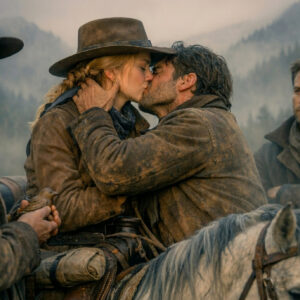
The Italian marble floors of the Whitfield mansion on Lindell Boulevard were so polished they looked like standing water, cold and deep enough to drown in. On the evening of October 23, 1878, Clara Whitfield stood in the shadow of a towering potted fern, a silent ghost in her own home. She was twenty-four years old, and she was a living mistake. Her father, Theodore, had built a fortune on railroad contracts and whiskey-soaked handshakes, and he viewed Clara’s existence as a smudge on his newly minted pedigree.
Clara’s mother had been a seamstress, a woman who smelled of starch and cotton, who died with red, rough hands while washing the linen of a husband who had already moved on. Theodore’s new wife, Lucille, and her three “impeccable” daughters orbited the parlor like exotic, high-pitched birds, preparing for a ball Clara was not invited to attend.
Clara watched them through the fronds of the fern, her cornflower blue eyes—too vivid for a girl meant to be invisible—tracking the high-society laughter she would never share. She wore a dress re-hemmed by her own hand, the silk three seasons old, a garment Margaret had discarded as “tired.” Clara knew she was beautiful; she had seen it in the terrified wonder of the stable boys. But in the Whitfield house, beauty was not value. Value was measured in bloodlines, and hers was deemed “wrong.”
The summons to her father’s study came later that night, after the champagne had ceased to flow. The air in Theodore’s office was thick with the suffocating scent of expensive cigars and the metallic tang of a final decision. Theodore didn’t look up from his ledger. Lucille stood by the window, her handkerchief pressed to her nose as if Clara’s presence were an odor.
“We have found a match for you, Clara,” Theodore rumbled, his voice like sliding gravel. “A family named Callaway. Three brothers in the Wyoming Territory. Trappers. They need a woman of sturdy constitution to manage their homestead.”
“Sturdy constitution,” Clara repeated, the words tasting like ash.
“I sent them your daguerreotype—the one where you aren’t smiling,” Theodore continued with a thin, clinical smile. “The eldest wrote back. He said you looked capable. It is time you earned your keep, Clara. Your ticket is bought. One way.”
The journey was seven days of soot, coal smoke, and a slow-motion transformation. As the green hills of Missouri flattened into the grey immensity of the Great Plains, Clara felt the lace and silk girl dying inside her. By the time she reached Jackson’s Crossing, she was wrapped in wool and carrying a stolen ledger—her father’s secret record of bribes and fraud—hidden at the bottom of her trunk.
Old Walt, a toothless mule-cart driver, eyed her with weary suspicion as they climbed Callaway Ridge. “Haven’t had a visitor in five years,” he spat. “They say the eldest killed a grizzly with his bare hands. Hope you’re tougher than you look, miss. The wind up there don’t like strangers, and neither do the Callaways.”
The homestead was not a shack; it was a fortress of Douglas fir, nestled against a granite cliff. When Clara pushed open the heavy door, she found a cabin that smelled of pine resin and cured leather. On the mantle sat delicate wood carvings—a fox, a bird, a bear—whispers of tenderness in a world of stone.
Then the door crashed open.
Three giants filled the frame, frosted with ice and draped in buckskin. The eldest, Eli, had to duck to enter his own home. He had amber eyes that stripped away every defense Clara had spent twenty-four years building.
“Your father said you were prone to fits,” Eli’s voice was a deep rumble, unused to the weight of words. “He said you were mentally unfit. He said you were a housekeeper, not a bride. Now I want to hear your words.”
Clara set her jaw. The girl behind the fern was gone. “My father is a liar,” she said, her voice small but iron-hard. “I am not mad. I am the daughter he tried to make disappear. I am not going back. If you need a housekeeper, I can learn. If you need a wife… I can learn that, too.”
Eli studied the calluses on her hands—the ones she’d earned washing blood from her mother’s handkerchiefs. “Can you skin a rabbit?” he asked, a ghost of a smile twitching in his beard.
“No,” Clara replied. “But I can learn.”
“Good,” Eli said. “Because winter is coming, Clara, and up here, it doesn’t forgive.”
The first month was a war of attrition. Eli taught her the axe—lift with the shoulders, let gravity do the work. Levi, the youngest and tallest, taught her with laughter and songs for the milk cow. Jonah, the middle brother, taught her through the challenge of broken fences and frozen ruts.
Clara didn’t just survive; she optimized. When the water pump snapped, she didn’t wait for a replacement from town. She opened Jonah’s workshop, used her secret engineering books, and fabricated a replacement crank arm from an iron bar and leather.
The moment the brothers saw the water flowing, the dynamic shifted. She wasn’t a guest anymore. She was a Callaway.
But the mountain held secrets. One evening, Eli confessed the truth. He had been a lawyer in Philadelphia once, but the world of suits and polish had broken his heart when his first wife died in childbed, unable to survive the altitude he had dragged her to.
“Your father sent you here thinking you’d fail,” Eli whispered, the firelight painting his face in Chiaroscuro shadows. “He wants this land for his railroad. He put a competency clause in your dowry contract. If the marriage fails, if you’re declared ‘unfit,’ he claims Callaway Ridge. You aren’t a daughter to him, Clara. You’re a flag planted on territory he intends to conquer.”
Clara felt the cold fist of the Whitfield machine closing around her once more. “Then we don’t let him win,” she said.
The storm didn’t creep; it attacked. For three days, they were trapped in the cabin. The intimacy was suffocating and beautiful. Clara learned the rhythm of Eli’s breathing, the way Levi carved wood into life, the way Jonah kept watch so his brothers could sleep.
When the storm broke, Eli went to check the horses. Minutes stretched into an agonizing silence. Clara grabbed the shotgun and the buffalo coat and plunged into the waist-deep drifts.
She found him pinned beneath a massive pine limb, the snow around him staining a deep, terrifying crimson. For two seconds, the “useless daughter” voice screamed in her head. Then, she remembered leverage. She remembered the multiplication of force.
Clara wedged a rock, found a fulcrum, and roared. It was a primal sound that echoed off the granite peaks. She heaved the torso-thick branch just enough to drag 250 pounds of dead weight through the sucking snow. She was no longer a decorative flower; she was the wall against the cold.
She set the splint. She packed the wound on his ribs. She fought the infection with vinegar, lye, and a terrifyingly efficient will. When the fever broke on the eleventh day, Eli reached for her hand, tracing the new calluses on her palms.
“My wife,” he said. It wasn’t a question. It was a covenant.
The peace was short-lived. Theodore Whitfield’s machine arrived in the form of Harlon Cobb and twelve mercenaries. They came for the deed. They came to burn the “unfit” girl out of the mountain.
“I’ll ride for the law,” Clara said, her voice flat and final.
Eli’s refusal was instinctive, the protective fury of a man who’d already lost one wife to the wilderness. But Clara was already saddling the grey mare. “I’m small, I’m fast, and I speak the language of the marshals. You hold the ridge.”
The ride was a nightmare of granite walls and 300-foot drops. Clara didn’t go to Cheyenne; she went to the Granite Creek mining spur. She walked into the foreman’s shack with a shotgun and a lie about blasting powder. She sent the Morse code herself—the skill her father taught her for dictation, now the weapon of his destruction.
Marshall’s dispatch: received. Estimated arrival 14 hours.
But 14 hours was too long. The cabin was already burning. Clara looked at the switching engine sitting on the tracks—fifty tons of iron and steam.
“Can you drive that?” she asked the foreman.
“The tracks end three miles from the ridge,” he stammered.
“Then we’ll make our own road,” Clara said.
The locomotive exploded out of the forest like the voice of a god having a bad day. It plowed through the valley floor, wheels turning up dirt and pine needles, cow-catcher smashing through saplings. The sight of a train where no train should be dissolved the mercenaries into chaos. In the confusion, the Marshals poured over the hill.
Clara climbed down from the cab, her face soot-stained, her cornflower eyes bluer than the Wyoming sky. She walked to the cellar doors where the brothers had retreated and tore them open.
Eli climbed out, coughing and singed, and fell to his knees. Not out of weakness, but out of something that doesn’t have a name in the vocabulary of mountain men.
“You crashed a train,” he rasped.
“I told you,” Clara whispered, pulling his massive frame into her arms. “I am not a delicate flower.”
The federal investigation into the “Whitfield Rot” took fourteen months. The ledger Clara carried buried her father’s empire in a landslide of fraud and bribery charges. Theodore Whitfield died three days after a massive stroke, disgraced and penniless, in the very dining room where he had once banished his daughter.
Twenty-five years later, a journalist came to Callaway Ridge. He saw a two-story house with a wraparound porch and climbing ivy. He saw a silver-haired woman with a quiet authority that radiated like heat from a stove.
“They say you were sent here as a punishment,” the journalist said, scribbling in his notebook.
Clara looked at Eli, whose arms were settled around her waist. She looked at the grandchildren chasing wildflowers in the meadow. She smiled—the smile that had transformed the wilderness into a home.
“You can tell them,” Clara said, her voice clear as mountain water, “that the beast didn’t need a beauty. He needed a queen.”
Have you ever been told you were “unfit” for a world that was simply too small for you? Have you ever had to crash a train—figuratively or literally—to save what you loved? Share your story of triumph in the comments below. Let’s celebrate the queens of the mountain together.
Disclaimer : This content may be created by AI for entertainment purposes. Any resemblance to real persons, events, or places is coincidental.






