The Legacy in the Envelope: Why I Walked Away from My Father’s $4 Million Shadow
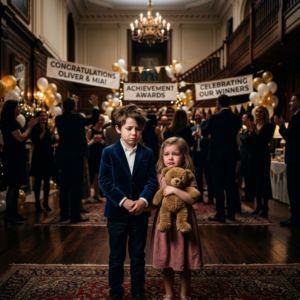
The air in the country club ballroom was heavy with the scent of expensive bourbon and the suffocating weight of a lie. It was my father’s retirement party—a “celebration of legacy.” Across the room, a massive projector screen flickered to life, casting a cold, blue glow over the faces of my family. I stood in the back, my hand gripping my wife Natalie’s, watching thirty years of our family history being rewritten in real-time.
There was Logan, my older brother, shaking hands with partners at age twenty-four. There were Logan’s children, grinning from soccer fields and ballet stages. Frame after frame, the “Carter Family Legacy” played out like a high-budget commercial. And then it hit me, a physical blow to the stomach: I wasn’t in it.
Not a single photo of my children, Liam or Ava. Not a mention of my fifteen years as a software consultant. Not a glimpse of the life I had built. My father, the man of the hour, sat in the front row, glowing with pride as Logan took the stage to announce himself as the “next chapter.”
I didn’t make a scene. I didn’t yell. I simply reached into my blazer, pulled out a heavy white envelope with a navy wax seal, and placed it on the gift table. Then, I walked out into the cool December night, leaving behind the ghost of a son I was no longer willing to be.
My father assessed love the way a banker assesses a portfolio: in terms of milestones, ROI, and public achievements. Growing up, I was the “expected” child. When Logan brought home a “B,” my father would beam, “At least you’re trying!” When he took third place in a science fair, he was hailed as a future titan of industry.
Meanwhile, I came home with straight A’s, and my father would squint at my report card, his face a mask of frigid indifference. “Well,” he would mutter, “that’s what’s expected.”
I became an expert at being invisible. I learned to find warmth elsewhere—in the quiet logic of computer code and eventually in the radiant, constant love of Natalie. We built a life of presence. I work from home because I want to be the father mine never was. I want to walk my kids to school and hear about their day, not just their trophies.
I thought I had made peace with it. I told myself I didn’t need his approval. But the past has a way of finding the cracks. It started with a group chat message on December 18th. My father was establishing a “new tradition”—a New Year’s Eve gathering. He promised something “extremely unforgettable” for the grandchildren.
I allowed myself to hope. I watched my eleven-year-old son, Liam, carefully iron his blue “gentleman’s blazer.” I watched eight-year-old Ava practice counting backward from ten. I thought, Maybe this is it. Maybe he’s finally trying to balance the scales.
We arrived at my father’s apartment at 6:45 p.m. on New Year’s Eve. Natalie had baked her trademark cranberry tart, and I was wearing a paper crown from a cracker, desperate to keep the mood light.
The apartment was bustling, but the decorations were… specific. Banners read “Carter’s Big Year” and “A Star Is Born: Chloe’s Ballet Journey.” The bookshelves were stripped of their usual ornaments, replaced by framed photos of Logan’s kids. A small monitor on the side table looped a slideshow of Logan’s family vacations.
Natalie’s smile froze. She looked at me with a plea in her eyes: Please tell me this isn’t what it looks like.
Then came the toasts. My father stood, tapping his glass with a fork. “A tribute to the next generation,” he announced. My heart raced. I waited for the mention of Liam’s math league victory or Ava’s incredible drawings.
“Carter has had a tremendous year,” my father beamed, gesturing to Logan’s son. “Student of the month twice! And Chloe, your poise in ballet blew us all away.” He proceeded down the line, lavishing every one of Logan’s children with specific, glowing praise.
Then, silence.
He didn’t even look at Liam or Ava. He simply raised his glass. “Let us all be inspired by their hard work. Cheers!”
I felt Liam move behind me, trying to hide. Ava’s small hand clamped onto mine, her fingers cold. I smiled through clenched teeth, the sound of clinking crystal sounding like breaking glass. I murmured to Natalie, “Let’s get their coats.”
We left before the countdown. We were home by 11:15 p.m. As I tucked Liam in, he asked the question that broke my heart: “Dad, did I do something wrong?”
The next morning, the “unforgettable” surprise arrived via text. “Leaving early was disrespectful, Ethan,” my father wrote. “You made it about you again.”
That was the moment the last thread of my patience snapped. I wasn’t the villain for protecting my children from his neglect; I was the only one standing in the way of their spirits being crushed.
For weeks, the exile deepened. Logan renamed the family group chat, excluding the cousins and my mother, turning it into a private echo chamber for his achievements. My mother called, her voice a “creaking rope bridge across lava,” pleading with me to “understand” him.
“He feels like you’re punishing him, Ethan,” she whispered. “I’ll talk to him when he treats all his grandkids like they exist,” I replied, and hung up.
Then came the “Family Unity” Facebook album posted by Logan’s wife. Polished photos of winter hikes and board games. The caption: “So grateful for a father-in-law who sees and nurtures the best in our children.” #Legacy #FamilyFirst.
We were officially being written out of the script. But while they were busy curating a fake history, I was in my home office, fueled by the “silent nothingness” of their rejection, building something real.
In June, Natalie’s mother passed away unexpectedly. We were gutted. While I was managing the household and supporting a grieving wife, my father sent a text: “I saw Liam didn’t attend Carter’s birthday. I hope this isn’t about New Year’s yet.”
Our pain had an expiration date in his mind. That night, I went into the garage to find “Dad’s boxes”—a bucket of old photos. I wanted to see if I had imagined the favoritism. I hadn’t. In every beach photo and birthday shot, I was the one cropped to the side, half-shadowed, an afterthought in my own life.
But at the bottom of the bucket, I found a yellowed envelope. It was from my mother, dated 2006, my sophomore year of college.
“Ethan,” it began. “I am sorry your father did not say it, but I am proud of you. You ask questions. You don’t just follow. That’s your strength. Someday you’ll build something no one else in this family has ever done. Own it.”
I didn’t weep. I just sat on the cold concrete floor as the hum of the freezer filled the silence. I had been begging for crumbs from people who had no intention of feeding me.
I went to my office and opened a blank document. I began to code. I didn’t build for them. I built for us. I called the app Hearth—a digital sanctuary for families to organize their lives with intention, chore charts that felt like games, and shared calendars that prioritized presence over performance.
By October, Hearth had moved from a beta test among friends to a viral sensation. We hit 12,000 users. Parent blogs were calling it the “Anti-Achievement App.” It was built in the early morning hours, in the silence of my father’s “exile.”
Then came the call from my cousin Brooke. “Ethan, Logan is planning a ‘surprise’ retirement party for your dad at the country club. There’s a slideshow. Logan refers to himself as the ‘only next chapter.’ You’re being erased, Ethan.”
I looked at the Hearth dashboard on my screen—the growth charts, the testimonials from parents who were finally connecting with their kids. I realized I didn’t need to fight for a seat at their table. I had built my own.
I printed twelve copies of a “Founder’s Note” on heavy cardstock.
“Hearth was built quietly in the shadows of a family who never believed in me. This is what legacy looks like when you choose to build your own instead of waiting for permission.”
I sealed them in those navy-waxed envelopes. I sent them to the country club manager, the videographer, and the local tech council. I kept one for the party.
The night of the party, I dressed in an understated gray blazer. I walked into that ballroom—a place that smelled of champagne and old money. I saw the “Legacy Wall”—a gallery of photos where I didn’t exist.
Logan was holding court. He saw me, and his smile faltered. “Didn’t expect to see you here,” he said. “I figured I’d witness the coronation,” I replied.
The lights dimmed. The slideshow played—the one that erased me, Natalie, Liam, and Ava. Logan took the stage and spoke about the “roots” of the family business. The applause was thunderous.
I stood up, placed my envelope on the gift table, and walked out.
The ripples began three days later. My father opened the envelope alone. Inside was the card that read: “Some legacies are built on inheritance. Others are built on silence, pain, and perseverance. Guess which one lasts longer?”
A week later, Family Focus Weekly ran a front-page feature on me. “How One Father Turned Family Chaos into a 55,000-User Legacy.” The photo showed me, Natalie, and our kids—happy, present, and whole.
Logan emailed me, sounding corporate and desperate, asking to “collaborate” and “cross-promote.” I didn’t delete it. I replied: “Logan, I’m currently focused on building something independent of the family brand. I hope the party was everything you wanted it to be.”
My father never apologized. He isn’t capable of it. But he did start clipping my articles out of the newspaper. He started calling Liam to ask about his science projects. He realized, too late, that he had bet his entire legacy on a son who only cared about the business, while the son he ignored was the one actually changing the world.
Legacy isn’t a name on a building or a slideshow at a country club. It isn’t something you wait to be given. It is the work you do in the dark when no one is watching. It is the choice to be present for your children when your own father was a ghost.
I carry my mother’s 2006 letter in my wallet. I carry the 55,000 families who use Hearth in my heart. But most of all, I carry the image of my kids at the dinner table, knowing—without a shadow of a doubt—that they are the most important investment I will ever make.
Disclaimer : This content may be created by AI for entertainment purposes. Any resemblance to real persons, events, or places is coincidental.






