When the Man I Loved Became a Stranger
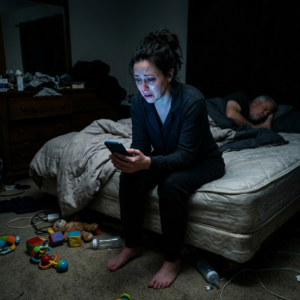
There is a specific kind of silence that haunts a home when trust has been shattered. It is not a peaceful quiet, but a heavy, suffocating pressure that rings in the ears. For Anna, a 37-year-old woman whose life was once defined by the rhythmic safety of domesticity, that silence has become her constant companion. In the small apartment she calls home—an apartment that bears her name on the deed but feels increasingly like a prison—she sits in the dim light of a flickering television, watching the minutes tick by. Beside her, a one-year-old baby sleeps, blissfully unaware that the foundation of her world is cracking.
Anna’s story is a harrowing journey through betrayal, financial entrapment, and the agonizing choice between a broken heart and a broken home. It is a narrative that spans nearly two decades, beginning with a whirlwind romance and ending in a dark place where love and hate are indistinguishable. For anyone who has ever felt “stuck,” for every woman who has looked at her partner and realized she is living with a stranger, Anna’s testimony is a powerful, gut-wrenching mirror.
Chapter 1: The Illusion of the Perfect Protector
Nineteen years ago, Anna believed she had found her anchor. John was 40 at the time—tall, handsome, and possessing a quiet maturity that made the 18-year-old Anna feel safe. At a friend’s wedding, amidst the swirl of white lace and the scent of lilies, John had watched her from across the room. He didn’t dance; he didn’t join the loud laughter of the other guests. He simply observed her with an intensity that felt like a promise.
Two days later, a message appeared on her phone that would change the trajectory of her life: “I saw you at the wedding. You looked beautiful. I want to get to know you.” Within forty-eight hours of texting, John dropped a bombshell that should have been a warning sign, but to a young woman in love, felt like destiny. “I want to marry you. I see you as my wife and the mother of my children.”
Anna said yes. She stepped into a white dress and walked into a life she thought was a fairy tale. In those early years, the age gap—twenty-two years—seemed like a benefit. John was established, kind, and generous. He brought gifts, he whispered sweet things, and when their first daughter was born eighteen years ago, Anna felt their bond was unbreakable. But even then, the first hairline fractures began to appear. John had cheated during that first pregnancy, a “mistake” Anna had buried deep in the shadows of her mind for the sake of her child. She chose to believe it was a one-time lapse, a temporary fog in an otherwise clear sky.
Chapter 2: The Midnight Phone Bill and the Cold Truth
For nearly two decades, Anna lived a “simple life.” John worked, and she stayed home, pouring her soul into the upbringing of their daughters. But as the years passed, the man she married began to recede. The kindness was replaced by a sharp, defensive edge. He became a man of locked doors and hidden screens. He smiled at his phone in a way he no longer smiled at her.
The turning point came with the birth of their second daughter. While Anna was immersed in the exhausting, beautiful fog of caring for a newborn, John was drifting further away. One night, driven by a primal instinct she could no longer ignore, Anna reached for his phone. The explosion that followed was volcanic. John didn’t offer comfort; he offered rage. “You have no right!” he shouted, his face contorted in a way that made the apartment feel small and dangerous.
Determined to find the truth, Anna scrutinized the phone bill. One number appeared like a recurring nightmare—called every day, sometimes multiple times. When Anna finally dialed that number, the voice on the other end was a cold splash of water. It was a woman, a contemporary of Anna’s, also married, also a mother. Her response was chilling in its indifference: “It is not my problem if my husband finds out.” The betrayal was total. Anna confronted John with the evidence, expecting remorse or perhaps a plea for forgiveness. Instead, she met the wall of his arrogance. “I will end it when I want,” he told her, his voice devoid of the warmth he once used to woo her. “You cannot tell me what to do.”
Chapter 3: The Power of the Purse and the Loan
What makes Anna’s situation particularly tragic is the mechanical nature of her entrapment. This is not just a story of a broken heart; it is a story of economic chains. Anna is currently on maternity leave, her days filled with diapers and the soft babble of a one-year-old. She has no independent income. The apartment is in her name, but the mortgage—the loan that keeps a roof over their children’s heads—is paid with John’s salary.
John knows this. He wears his financial contribution like a crown of thorns, using it to silence Anna’s protests. He feels powerful. He has looked his wife in the eye and told her he could have another girlfriend if he wanted, because he holds the keys to their survival. He spends money at fancy restaurants and buys expensive gifts for another woman while Anna checks the bank account and watches their family’s security dwindle.
Even their 18-year-old daughter has tried to intervene. She has looked at her father and begged him to stop, to remember the family he helped build. But John’s response to his own child is as bitter as his response to his wife. He hurls bad words at her, wounding the very person he once stood alone at a wedding to “protect.” The household is a battlefield where the only casualties are the innocent.
Chapter 4: The Echoes of a Second Chance
As Anna struggles with her current reality, she is haunted by the memories of a previous life. In the transcript, she reflects on a moment when she actually did leave. She took her children and sought refuge with her parents. For a month, she lived in a state of suspended animation, her heart full of hate for the man who had lied to her.
But the cultural pressure to “keep the family together” was immense. Her parents, seeing only the surface of the marriage, urged her to forgive. John, ever the master of the “second chance,” came to her with words that tasted like honey. “You are my angel. You are the best wife.” For the sake of the children, Anna returned. She gave him a second chance, hoping against hope that the man from the wedding would return.
He didn’t. Within two months, the texts started again. The late nights returned. Anna eventually saw them together—John in his car with the other woman. The cycle of apology and betrayal had become a merry-go-round that Anna could no longer stand to ride. She realized that John’s apologies were not signs of change, but tools of manipulation. He didn’t want to be a better husband; he just wanted to be a comfortable one.
Chapter 5: The Darkness and the Decision
Today, Anna feels like she is in a dark place with no visible exit. The stress has manifested physically; she cannot eat, she cannot sleep. Her doctor tells her she needs “rest,” a word that feels like a cruel joke to a woman whose husband is spending their mortgage money on a mistress.
Her older daughter has stopped smiling. She has withdrawn from her friends, carrying the heavy weight of her father’s shame like a physical burden. The baby, though young, exists in an environment of vibrating tension. Anna looks at her children and feels a soul-crushing guilt. She wants them to have a “happy family,” but she realizes that a family held together by lies is not happy—it is merely a hollow shell.
Anna admits, with a vulnerability that is painful to witness, that she still loves the man John used to be. She wants him to remember them. She wants him to choose them. But the silence of the apartment tells her a different story. She is stuck between the need for his money and the need for her own dignity.
The Universal Lesson: The Price of a Stolen Identity
Anna’s story is a profound reminder that we cannot build our identities entirely on another person. When she married John at 18, she handed him the blueprint of her life. Because she had no job, no independent standing, and a heart full of unvetted trust, he was able to rewrite her story into one of subservience. The lesson for the global community is clear: Love must be a partnership of equals, and trust, once broken, requires more than words to repair. It requires a fundamental shift in character, something John has proven he is unwilling to undergo.
Call to Action: Anna feels lost, weak, and alone. But her story is being told, and in the telling, there is power. Have you ever felt trapped in a situation where your heart and your head were at war? What gave you the strength to find your way out of the dark? Share your words of encouragement for Anna and for women like her in the comments below. Your story might be the light someone else needs to find their way home.
Disclaimer : This content may be created by AI for entertainment purposes. Any resemblance to real persons, events, or places is coincidental.






