The Day the Temple Trembled: When Divine Love Ignited a Holy Rebellion in a Den of Thieves
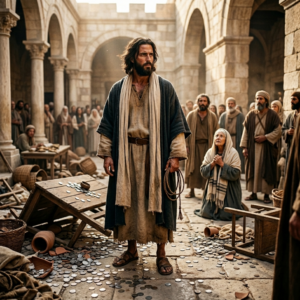
There is a profound, tragic alchemy that occurs when the sacred intersects with the deeply cynical nature of human greed. Throughout the sprawling, complicated history of humanity, nothing possesses the terrifying power to turn holy things profane more quickly, more efficiently, and more devastatingly than money. It is a creeping, silent corruption. It does not arrive with the blare of enemy trumpets or the clash of foreign swords. Instead, it slips quietly through the heavy cedar doors of the sacred, disguised as convenience, dressed up as a necessary transaction, until the very atmosphere of devotion is choked out by the cold, metallic clinking of coins. This is the story of a singular, explosive moment when the creeping rot of exploitation met the unstoppable, blazing force of divine love. It is the story of a house meant for eternal communion, reduced to a marketplace of extortion, and the man who simply refused to let the beauty of faith be bought and sold.
To understand the sheer magnitude of the betrayal taking place within the ancient walls of Jerusalem, one must first feel the grit and the exhaustion of the road. It was the season of the Passover, a time of profound, deeply ingrained spiritual significance. This was a feast so monumentally important, so central to the identity of the children of Israel, that thousands upon thousands of Jewish faithful would leave behind their homes, their livelihoods, and their relative safety. They traveled from the furthest, dustiest fringes of the sprawling Roman Empire. They walked for days. Some walked for agonizing weeks. They endured the blistering, merciless sun of the desert days and the bone-chilling cold of the Judean nights.
Imagine the physical toll of this pilgrimage. Imagine the heavily blistered feet wrapped in worn leather sandals, the muscles screaming in protest with every step up the rocky inclines toward the Holy City. Yet, pushing them forward was a fire in the soul, a desperate, beautiful yearning to stand in the presence of the Almighty. They envisioned the grand temple courtyards as a place of ultimate peace, a sanctuary where the heavy burdens of their earthly existence could be temporarily lifted, where they could offer their humble sacrifices and feel the reassuring embrace of their Creator.
But reality is rarely as pure as a pilgrim’s prayer. We all know, even in our modern era, exactly what happens when thousands of hopeful, desperate tourists come flowing into a city. The fundamental laws of supply and demand are weaponized. All the prices go up. The locals see the incoming tide not as a gathering of faithful souls, but as a massive, walking reservoir of profit waiting to be drained. And in Jerusalem, this exploitation was not happening in the dark alleyways or the secular markets; it was happening directly on the doorstep of the divine.
The betrayal was systemic, sanctioned by the very men who were supposed to be the guardians of the holy. The Sanhedrin, the elite religious council draped in fine robes and possessing the ultimate authority over temple affairs, had made a devastating compromise. They had willingly, purposefully allowed all the greedy, sharp-eyed merchants right into the sacred temple courts. The vast, sun-drenched courtyards, intended to be a quiet space of prayer and preparation for the Gentiles and the faithful, had been entirely transformed.
It was deafening. The air was thick, heavy, and suffocating with the smell of unwashed bodies, the pungent musk of confined livestock, and the sharp, acidic scent of animal waste. But the most overwhelming sensory detail was the noise. The frantic bleating of sheep, the low, distressedinging moans of cattle, the fluttering panic of caged doves, all drowning beneath the aggressive, shouting voices of the merchants haggling over the price of piety.
It was obscenely profitable. The road-weary pilgrims, carrying the dust of a dozen provinces on their cloaks, were completely trapped. They had nowhere else to turn. They could not drag their own pristine livestock across hundreds of miles of hostile terrain, so they had absolutely no choice but to procure their sacrificial offerings upon arrival. So, they bought their terrified goats. They bought their trembling lambs. They bought their massive cattle. They bought their fragile, cooing doves right there at the massive temple doors.
But they did not buy them fairly. The merchants, operating with the full blessing of the religious elite, applied a crippling surcharge to every single animal. Furthermore, because the pilgrims carried the foreign currencies of the Roman Empire—coins stamped with the blasphemous faces of pagan emperors—they were forced to exchange their money for acceptable temple half-shekels. This allowed the money changers to impose an exorbitant exchange tax on top of the already astronomical, artificially inflated prices. The pilgrims, desperate to fulfill their religious duties, emptied their meager leather pouches, watching their hard-earned survival money vanish into the overflowing chests of the corrupt.
There was plenty of money to flow endlessly upward. It cascaded from the calloused hands of the poor directly into the silk-lined pockets of the Sanhedrin, with a heavy, appeasing cut flowing smoothly upward to the occupying forces of Rome. The entire holy ecosystem had been hollowed out, replaced by a ruthless syndicate of religious racketeering. When you truly look at the mechanics of it, when you feel the desperation of a father unable to afford a flawless lamb for his family’s atonement, it feels profoundly, deeply icky, doesn’t it? It is the sickening feeling of watching the purest human intentions being harvested for cold, hard cash.
Into this chaotic, deafening, utterly corrupted environment stepped Jesus. Imagine the sudden, jarring contrast. Amidst the frantic, sweating merchants and the bewildered, exploited pilgrims, he stood as a singular pillar of absolute, terrifying stillness. He did not immediately scream. He looked. He absorbed the agonizing reality of the courtyard. He saw the scales being tipped in favor of the rich. He saw the distressed animals. He saw the pious poor being financially bled dry in the name of the God he knew so intimately.
When Jesus entered the temple and saw the undeniable truth—to find his Father’s house, the very epicenter of divine connection on earth, completely and utterly transformed into a literal den of robbers—a profound physical and emotional shift occurred. The text does not say he was merely annoyed. It implies a total, consuming, physiological reaction. It was enough to, well, boil his blood.
Try to fathom the internal emotional state of the Son standing in the house of the Father. This was not a detached, philosophical disagreement about economic theory. This was a visceral, deeply personal violation. The stones beneath his feet were supposed to echo with the whispers of the broken seeking healing, yet they vibrated with the shouting of men trading silver for salvation. The heat of a righteous, terrifying indignation rose within him, a heat born not of hatred, but of a fierce, unyielding protectiveness.
The stillness shattered. The boiling blood demanded action, a physical manifestation of divine rejection.
Whip sound. Crowd shouts.
It happened with blinding, terrifying speed. Jesus grabs a whip. The sudden, violent crack of leather tearing through the thick, incense-laced air cut through the cacophony of the marketplace like a bolt of lightning. The sheer shock of the moment paralyzed the courtyard for a fraction of a second before the absolute chaos erupted.
“Move!”
His voice, usually known for delivering profound, gentle truths on the grassy hillsides of Galilee, now boomed with the terrifying, resonant authority of a king reclaiming his stolen throne. He did not ask politely. He did not submit a formal grievance to the Sanhedrin. He became a one-man tempest of holy fury.
He lunged toward the tables of the money changers. With a surge of raw, physical power, he upended the heavy wooden structures. Imagine the sound—the deafening clatter of hundreds of silver coins hitting the stone pavement, rolling wildly into the gutters, the sheer panic of the greedy men dropping to their knees, desperately scraping the dirt to reclaim their ill-gotten wealth.
“Take these away!” he commanded, his eyes blazing with an uncompromising light.
He drove them out. He moved through the throngs of cattle and sheep, scattering the livestock, dismantling the machinery of extortion piece by piece. He looked directly into the terrified, wide eyes of the merchants who had spent years turning a profit on the backs of the faithful.
“Stop making my Father’s house a place of business. No!”
That single word—”No!”—echoed off the ancient limestone walls. It was a cosmic rejection of the profanity of greed. He was cleansing his Father’s house, sweeping away the filth of exploitation with the terrifying, majestic power of his own two hands.
Needless to say, in a world entirely governed by the flow of wealth and the maintenance of political power, this breathtaking display of defiance did not go over well. The immediate aftermath in the courtyard was a stunned, breathless silence, followed rapidly by the frantic, panicked whispering of the powerful.
Jesus had crossed an invisible, deadly line. I mean, calling the religious leaders hypocrites in the countryside was one thing. Debating their complex theology and healing the sick on the Sabbath was certainly controversial, a thorn in their collective side. But this? You start directly messing with Sanhedrin money, you start overturning their heavily taxed tables, and yelling with absolute, undeniable authority in their own fiercely guarded courts? You might as well just go ahead and tape a massive, glowing target directly to your own back. He had struck at the very heart of their financial and political security.
And it was not just the Jewish religious elite who were suddenly watching him with murderous intent. Rome, the great, paranoid occupier, wasn’t too happy either. From the heavily fortified towers overlooking the temple complex, Roman guards gripped the hilts of their swords, their eyes narrowed. To the cold, calculating minds of the imperial forces, Jesus’s sudden, violent outburst had all the terrifying markings of a revolutionary about to incite a massive, bloody revolt. To disrupt the economy of the temple was to disrupt the peace of Jerusalem, and Rome dealt with disruptors using the brutal, unforgiving language of the cross. Jesus knew this. He knew the cost of the whip in his hand. He knew that overturning those tables was effectively signing his own death warrant. And yet, he swung the leather anyway.
As the dust settled on the stone courtyard, as the last of the scattered coins were desperately scooped up and the bleating of the driven animals faded into the narrow streets of Jerusalem, a profound, world-altering truth remained hovering in the air.
The most striking, deeply psychological thing about this entire explosive event was the absolute purity of its source. Jesus’s terrifying anger wasn’t provoked by the things that make most of us angry. When human beings lash out, when we scream and overturn the proverbial tables in our own lives, it is almost entirely driven by an injured ego. We explode because we were insulted, because our pride was wounded, or simply because of not getting our way. Human anger is inherently selfish; it is a defensive posture designed to protect our own fragile significance.
But the wrath displayed in the temple courtyard was entirely alien to the human ego. It was brought on by love. It was a fierce, protective, uncompromising love for what is good, for what is true, and for what is beautiful. Jesus looked at the broken, weary pilgrims seeking God, and he loved them too much to watch them be financially and spiritually abused. He looked at the concept of communion with his Father, and he loved it too much to allow it to be reduced to a miserable, earthly transaction. His anger was simply the terrifying, necessary manifestation of a complete refusal to let the sacred be corrupted or stolen by a den of robbers. It is a powerful reminder that true love is not merely passive and gentle; when that which is cherished is threatened by the creeping shadows of greed and exploitation, true love possesses the courage to stand up, overturn the tables, and shout a definitive, earth-shaking “No.
Disclaimer : This content may be created by AI for entertainment purposes. Any resemblance to real persons, events, or places is coincidental.






