A Masterpiece of Shattered Dreams and Self-Discovery
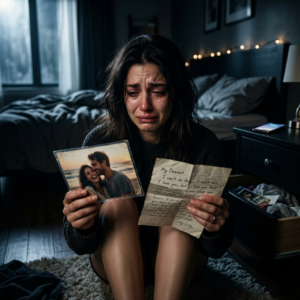
For Leila, love was once a simple, luminous thing—as clear as the view from her childhood bedroom window. At fifteen, love looked like a boy named Mason playing football across the street, his laughter echoing in the summer air. It was a secret kept in the quiet of a young girl’s heart, a smile shared only with the glass of her windowpane. But as the years turned the girl into a woman, that luminous thing became a shadow, and Leila learned the most painful lesson of the human heart: that being chosen is not the same as being loved.
In a sweeping narrative of betrayal, resilience, and the quiet dawn of a new life, Leila’s story serves as a testament to the strength found in the debris of a broken promise. This is not just a tale of a failed marriage; it is an epic of the soul’s return to itself.
Part I: The Garden of White Flowers and False Promises
The wedding was a portrait of perfection. Set in her parents’ garden, the air was thick with the scent of white flowers, and the world was bathed in the soft, golden light of a promise kept. Leila, at twenty-five, felt the culmination of a decade-long devotion. She had waited for Mason through his college years, through long-distance messages, and through the quiet anticipation of a life together. When her father walked her down the path to a smiling Mason, she believed she was walking toward her “forever.”
They moved to the city, leaving behind the safety of their small town. Leila traded her familiar world for a small flat, driven by the singular desire to be the perfect wife—to create a sanctuary for the man who had been her first kiss, her first boyfriend, and her first love. She cooked, she cleaned, and she waited for him to return from work, content to live in the orbit of his exhaustion. But the city light is colder than the sun in a small-town garden, and soon, the silence in their flat began to grow teeth.
Part II: The Message and the Woman in the Red Dress
The unraveling began with a flicker of light on a phone screen. While Mason showered, a notification appeared—a digital ghost from a life Leila didn’t know he was still living. “I still think of you every night.” The words were a physical blow. The heat in Leila’s face and the trembling of her hands were the first physical signs of a house beginning to crumble.
Suspicion led her to the dark corners of their home. In a hidden drawer, she discovered the evidence of her own displacement: a photograph of Mason with a girl in a red dress, her long hair blowing in a wind from his past. On the back, a note signed “Forever yours, Nora” served as a brutal map of Mason’s true geography. He had married Leila, but his heart was still anchored to a woman named Nora.
The confrontation was quiet but devastating. When asked if he married Leila because he loved her, Mason’s answer was a jagged truth: “I wanted to try. I wanted to forget her.” In that moment, Leila realized she wasn’t a partner; she was a tool. She was a human bandage meant to cover a wound that refused to heal.
Part III: The Long Train Ride Home
Leaving is rarely a loud event; it is a series of heavy breaths and the sound of a zipper closing on a suitcase. Mason did not stop her. He watched her pack, his silence a final confirmation of his indifference. Leila walked out of their city life, carrying a heart that felt like it had been turned to lead.
The train ride back to her parents’ house was a transit between worlds. She watched people through the glass—smiling, talking, living—and felt like a ghost among the living. Her return was met not with questions, but with the fierce, wordless embrace of her mother. In her old room, surrounded by the books and furniture of her childhood, Leila had to confront the reality that she was no longer the girl who had watched Mason from the window. She was a woman who had been used as a replacement for a memory.
Part IV: The Quiet Light of a New Morning
Healing began in the most mundane places: a garden walk, the steam from a cup of tea, and the familiar rhythm of the local cafe. Reclaiming her old job at the cafe was Leila’s first act of reclamation. It was a space that was hers alone. There, amidst the smell of ground beans and the clinking of porcelain, she met Levi.
Levi was the antithesis of the storm that had broken her. He was a man of soft eyes and gentle silences, a regular who saw the “quiet light” inside her. Unlike Mason, who used her to fill a void, Levi simply sat with her in the space she occupied. Their connection grew not out of a need to forget the past, but a willingness to be present in the now. When he told her, “You smile like someone who knows pain,” he wasn’t judging her; he was recognizing her.
Part V: The Final Reckoning and the Stars Above
A chance encounter with Mason by his car provided the final closure Leila needed. He was tired, his eyes softer, apologizing for trying to “heal his heart” at her expense. He admitted he loved the idea of love, not the person beside him. Standing there, Leila realized her own worth. She didn’t need to be his “healer” or his “replacement.” She walked away from him, and as she did, a “big cloud” moved away from her heart.
The story ends not with a grand wedding or a dramatic romance, but with a quiet epiphany under a starlit sky. Leila sat in her room, the wedding ring hidden away, and whispered the most important truth of her life: “He was my first love, but I was never his. And that is okay now, because I am mine.”
Deep Reflection: Leila’s journey teaches us that the greatest betrayal isn’t necessarily a lie told by another, but the loss of oneself in the service of someone else’s healing. We often think our “worth” is tied to being someone’s first choice, but Leila proves that our true worth is found in our ability to stand alone and still feel whole.
Call to Action: Have you ever felt like you were living in someone else’s shadow? How did you find the strength to reclaim your own “quiet light”? Share your journey of self-love in the comments below. Let’s celebrate the bravery of belonging to ourselves.
Disclaimer : This content may be created by AI for entertainment purposes. Any resemblance to real persons, events, or places is coincidental.






