Audrey’s Twenty-Year Journey from Devotion to Defiance
The silence of a long-term marriage is rarely empty. For Audrey, a forty-two-year-old woman living in the hushed corridors of a small-town house, that silence was a heavy, suffocating fabric woven over two decades. It was the sound of a television humming in the background, the rhythmic crunch of chips, and the sharp hiss of a soda tab being pulled—a symphony of domestic stagnation. Audrey’s life was not defined by what happened, but by what failed to happen. For twenty years, she had been the invisible architect of a home that housed four people but felt inhabited by only one spirit. Her husband, Caleb, had become a fixture of the architecture, as immovable and unresponsive as the sofa he claimed as his kingdom. This is a story of how twenty years of invisible labor met a single moment of devastating clarity, and how a woman rediscovered her voice in the ruins of a broken vow.
The Architecture of Apathy
Audrey’s daily existence was a marathon of unacknowledged service. Every morning, while the world outside their quiet town began to stir, Audrey was already deep into the mechanics of motherhood and housewifery. She moved through the kitchen like a ghost, preparing meals for two teenagers who were increasingly absent, drawn away by the magnetic pull of their own lives. But while the children were moving forward, Caleb was perfectly still. At forty-two, Caleb had retreated into a shell of profound laziness. The sofa was his sanctuary and his prison. He did not cook; he did not clean; he did not shop. He existed in a state of perpetual consumption, watching the flickering screen of the TV while Audrey performed the manual labor of their shared life.
The emotional toll of this imbalance was a slow-burning fire. Audrey would look at him—the man she had pledged her life to—and see a stranger. When she reached out for help, she was met with a wall of indifference. “I’m tired,” he would say, despite having done nothing to earn that exhaustion. “Leave me alone,” was the mantra that guarded his comfort. In those moments, Audrey felt a coldness that no heater could warm. She remembered a version of Caleb that existed in the sunlight of their youth—a man who laughed, who held her hand, and who promised a partnership. But that man had been replaced by a shadow who only knew how to take. She stayed for the children and she stayed out of habit, but inside, the foundation was crumbling.
The DARLING in the Dark
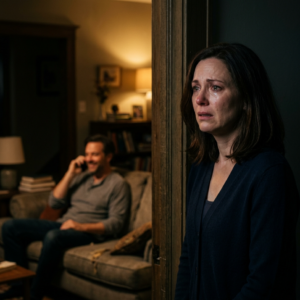
The fracture in Audrey’s reality occurred on an ordinary Sunday morning. The lighting in the house was soft, the kind of quiet weekend glow that usually suggests peace. Audrey had dressed for a routine shopping trip, her coat buttoned against the morning chill, when a small oversight changed the trajectory of her life. Realizing her bank card was in a different coat, she retreated to the bedroom. It was there, through the thin veil of the doorway, that she heard a sound that didn’t belong in her house: the sound of Caleb’s voice, but not the voice she knew.
It was a voice dipped in honey. It was warm, sweet, and vibrantly alive. “Darling,” he said into the phone. The word hit Audrey like a physical blow. In twenty years, that word had never crossed his lips in her direction. “I will see you tomorrow… I miss you, too.” Standing frozen in the shadows of her own bedroom, Audrey felt her heart accelerate into a frantic, painful rhythm. Her hands began to shake, a physical manifestation of the world shifting off its axis. The man who was “too tired” to walk to the grocery store was suddenly full of romantic energy for a voice on the other end of a line. The betrayal was not just in the infidelity; it was in the realization that he was capable of being the man she wanted—he just chose not to be that man for her.
The Confrontation and the Choice
When Audrey stepped into the living room, the mask of the lazy husband shattered instantly. Caleb’s face went white, the blood draining away to leave a mask of pure, childish guilt. There was no grand denial, no elaborate lie. When pushed, he simply admitted it: “She is my woman.” The honesty was perhaps the most brutal part of the encounter. He claimed this mistress made him “feel alive,” a statement that effectively erased the twenty years Audrey had spent keeping him comfortable, raising his children, and tending to the hearth of a home he had long since abandoned.
The brokenness Audrey felt in that moment was profound, but it was quickly cauterized by a rising heat of indignation. She realized that she had been a participant in her own erasure by allowing his laziness to dictate her happiness. In a moment of sharp, decisive power, she didn’t beg him to stay or ask for an explanation. She commanded him to leave. “Run. Walk. I do not care. Just go.” Watching him walk out the door was like watching twenty years of wasted hope leave the building. The house felt empty, cold, and strange, but as Audrey sat at her kitchen table and wept, a small, resilient light began to flicker in the darkness of her grief. She was alone with the betrayal, but she was also finally alone with herself.
The Strength of the Legacy
The healing did not happen in a vacuum. The following days were a delicate dance of vulnerability and strength. When Audrey finally broke the news to her children, she expected collapse, but she found a different kind of architecture: the strength she had built into them. Her daughter’s voice, steady and certain, became her first anchor. “Mom, you are strong. You can leave him.” These words were the return on twenty years of mothering. She had taught her children to be brave, and now they were reflecting that bravery back to her when she needed it most.
Even a brief, tense encounter with the mistress—a young woman with a smile that didn’t yet know the weight of Caleb’s apathy—served to clarify Audrey’s resolve. She saw the girl not as a rival, but as a warning. When Caleb tried to return, dragging his messy hair and unwashed clothes back to the door like a stray dog, Audrey saw him clearly for the first time. He wasn’t sorry for the pain he caused; he was sorry that his life had become inconvenient. He missed the service, not the woman. By locking the door against him, Audrey wasn’t just keeping a cheater out; she was reclaiming the sanctity of her space.
The Sunrise of a New Self
The road to the courthouse was paved with quiet, intentional acts of self-care. Audrey began to move through her house with a different energy. The sofa, once a symbol of his neglect, was now just a piece of furniture. She signed the divorce papers with trembling hands, but each stroke of the pen was a stitch in the repair of her soul. The lawyer spoke of “signing her freedom,” and as she walked out of that office into the fresh, sunlit air, Audrey felt her lungs expand in a way they hadn’t in decades.
Her new life was built on a foundation of small, beautiful moments. Lunch with her neighbor Sadie, a woman who had walked the path of solitude and found it to be a place of self-discovery, showed Audrey that a woman’s life does not end when a marriage does. She began to see the world again—the red and yellow flowers in her garden, the laughter of children in the park, the taste of tea enjoyed in a quiet house. She realized that she was no longer a servant to a stranger’s whims. She was Audrey, a woman who had suffered, survived, and stood up. As she tucked herself into a bed that no longer felt empty, but merely peaceful, she finally understood the ultimate truth of her journey: she was not alone because she finally had herself.
Reflective Conclusion: Audrey’s story serves as a powerful reminder to the global community that “habit” is not a reason to stay in a house without a heartbeat. We often fear the silence of being alone, forgetting that the loudest pain comes from being ignored by the person sitting right next to us. Audrey chose the uncertainty of freedom over the certainty of neglect, proving that it is never too late to start a new chapter.
Call to Action: Have you ever felt like a stranger in your own home? Or have you found the courage to walk away from a life that no longer served your soul? Share your story of resilience and new beginnings in the comments below. Let us support one another in the journey toward freedom and self-love.
Disclaimer : This content may be created by AI for entertainment purposes. Any resemblance to real persons, events, or places is coincidental.






