The Bloodstained Dagger and the Healer’s Hands: How a Secret Assassin Discovered the True Revolution
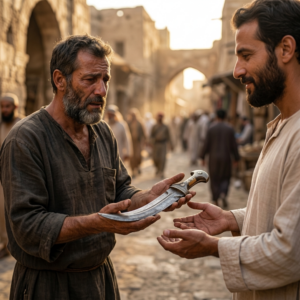
The heavy, suffocating scent of dust and crushed stone hung over the ancient, holy streets. It was an atmosphere thick with a profound, generational grief, a sorrow that seemed to seep directly from the bedrock of Judea itself. Six long, agonizing decades before the miraculous, quiet birth of a child named Jesus in a Bethlehem barn, the very foundations of the Jewish world had been violently, irreparably shaken. The Roman general Pompey, a man whose name would forever be synonymous with the shattering of sacred peace, had marched his iron-clad legions into the heart of Jerusalem. The capture of the city was not merely a military defeat; it was a profound spiritual trauma, a terrifying tear in the fabric of their divine covenant. The thundering rhythm of Roman boots marching across the cobblestones echoed like a relentless, mocking heartbeat, signaling the definitive end of sovereignty and the devastating beginning of the Roman occupation of Judea.
The air in the city changed on that day. It tasted of foreign bronze and imperial ambition. The once-proud banners of the Jewish people were suddenly cast into the long, suffocating shadow of the Roman eagle. Every corner of the city, every bustling marketplace, and every quiet, sun-baked alleyway became a constant, humiliating reminder of their subjugated status. The foreign conquerors brought with them not just swords and shields, but a heavy, bureaucratic machinery of oppression that sought to control not just the land, but the very soul of the people who inhabited it. The children of Israel, a people whose entire identity was deeply intertwined with the promises of divine liberation and sovereign rule, now found themselves forced to navigate a humiliating, daily existence beneath the watchful, unforgiving eyes of pagan overlords. The psychological weight of this occupation pressed down upon the populace, creating a fractured society desperately trying to find a way to endure the unendurable.
The Quiet Halls of Compromise and the Heavy Robes of the Sanhedrin
Within the grand, meticulously carved stone halls of religious authority, a tense and fragile game of survival began to unfold. The Sanhedrin, the supreme council and tribunal of the Jews, faced an impossible, agonizing dilemma. These were men deeply learned in the ancient laws, men who wore the heavy, ornate robes of spiritual leadership and carried the profound responsibility of guiding their people. Yet, the brutal reality of the Roman occupation forced them into a painful posture of accommodation. They had to learn, through gritted teeth and deeply conflicted hearts, how to carry out their sacred, divinely mandated duties even under the suffocating grip of Roman rule.
Imagine the whispered conversations in the dim, echoing corridors of power. The subtle shifts in language, the careful framing of edicts, the agonizing compromises made in the name of preserving what little peace they could. The Sanhedrin believed, or perhaps desperately rationalized, that maintaining the rhythm of the sacrifices, preserving the sanctity of the temple rituals, and keeping the structural framework of their faith intact required a delicate, diplomatic dance with the Roman authorities. They bent their necks so that their faith might not be entirely broken. But this flexibility, this willingness to negotiate the boundaries of their holy existence with a pagan empire, came at a steep, psychological cost. To many outside those quiet halls of power, the Sanhedrin’s diplomatic maneuvering did not look like survival; it looked, tragically, like a slow, creeping treason.
The Gathering Shadows and the Deeply Held Conviction
While the religious elite learned to bend, a drastically different response was taking root in the hidden, shadowy corners of the nation. Away from the sunlit courts of the temple and the watchful patrols of Roman centurions, a secret society of rebels was forming. These were men whose hearts were entirely inflexible, men whose spirits had hardened into a furious, unyielding stone. They looked at the compromises of the Sanhedrin with a visceral, burning disgust. For them, the very idea of accommodating the Roman presence was not a strategy for survival; it was an abominable blasphemy against the Almighty.
This underground movement organized itself around one singular, deeply held, and dangerously absolute conviction: Only God could be the true, legitimate ruler of Israel. It was a theological premise taken to its most extreme, uncompromising logical conclusion. If God alone was the sovereign king of their people, then absolutely anyone else attempting to occupy, govern, or tax this sacred land was an affront to the divine order. The presence of the Roman eagle was not merely a political reality to be navigated; it was an infectious, spiritual disease that had to be eradicated. And if the invaders would not leave willingly, if the oppressor refused to recognize the exclusive sovereignty of the God of Israel, then they must be pushed out. With force, if necessary. With blood, if demanded. The air in their secret meetings was thick with a terrifying, righteous intensity, a collective heartbeat thumping with the rhythm of impending war.
The Oath in the Dark and the Theology of the Blade
In the flickering, unstable light of hidden caves and locked cellars, the initiation into this secret society was a matter of absolute, life-or-death gravity. The men who joined this cause were not looking for a political platform; they were seeking a holy war. The atmosphere of their gatherings was charged with a dangerous, intoxicating electricity. A voice would ring out from the shadows, piercing the silence, asking the fundamental, defining question of their existence:
“For what were you born?”
The response was not a mere recitation of words, but a heavy, binding vow, spoken with the absolute certainty of religious fanaticism.
“To cleanse Israel of her enemies. To expel all non-Jews from Jerusalem.”
They called themselves Zealots. The name itself was a declaration of their burning, consuming passion for the purity of their land and the honor of their God. For these men, the lines between faith and warfare had been completely, irreversibly erased. They did not view violence as a necessary evil, nor did they view it as a tragic last resort born of desperate political circumstances. In their minds, the theology of liberation had become intrinsically linked to the shedding of blood. For the Zealots, violence was not only justified by God; He actively, undeniably required it. To strike down an enemy of Israel was, in their eyes, an act of supreme, holy devotion. It was a terrifying worldview, one that transformed ordinary men into instruments of divine wrath, their hands firmly gripping the hilts of concealed weapons, waiting for the perfect moment to execute the will of the Almighty.
The Shadow War and the Chilling Reality of the Complicit
The Zealots, despite their burning fervor, were keenly aware of the cold, mathematical reality of their situation. They were wildly outnumbered, unable to compete in sheer numbers or organized military might with the sprawling, disciplined, and heavily armored Roman forces. A direct confrontation on an open battlefield would have been a rapid, suicidal slaughter. Therefore, they embraced the dark, terrifying art of guerrilla tactics. They became phantoms in the crowded streets, moving unseen through the bustling markets, their eyes constantly tracking the movements of the occupying forces. They meticulously planned assassinations, turning the vibrant, noisy life of the city into a deadly, unpredictable theater of shadow war.
They targeted Roman rulers, striking swiftly and vanishing back into the labyrinthine alleys before the alarm could even be sounded. But the true, deeply chilling horror of the Zealot cause lay in their secondary targets. Wait for it. The whispered rumors that sent shockwaves of terror through the upper echelons of Jewish society were entirely true. They meticulously planned assassinations of Jewish leaders. Yeah, you heard me right.
The Zealots were so incredibly, dangerously zealous, so entirely uncompromising in their radical cause, that they drew no distinction between the foreign invader and the domestic collaborator. In their rigid, black-and-white worldview, any Jewish elites who were friendly with the Roman oppressors, any members of the Sanhedrin who engaged in the delicate dance of political compromise, were viewed as traitors to the covenant. The Zealots believed, with a terrifying, cold certainty, that these complicit Jews were just as culpable, just as guilty of blasphemy, as the Romans themselves. To tolerate the oppressor was to become the oppressor. Thus, the secret blades of the Zealots were turned inward, creating an atmosphere of profound, suffocating paranoia where a fellow countryman could be as deadly as a foreign soldier.
The Mastery of the Sica and the Singular Focus of Zee
Within this dark, uncompromising brotherhood of assassins, one man stood out for his absolute, chilling dedication to the cause. And Zee was a Zealot’s Zealot. If the movement required an unyielding stone, Zee was a diamond—hard, sharp, and entirely focused on the singular goal of violent liberation. To understand Zee is to understand a mind entirely consumed by a holy, burning wrath. There was no room in his heart for doubt, no space in his psyche for the gray areas of political compromise. He was a weapon, forged in the fires of righteous indignation and sharpened by the daily humiliations of the Roman occupation.
He carried a specific, deeply symbolic tool of his trade: a dagger called a sica. This was not a weapon designed for the open battlefield. It was a short, curved blade, perfectly crafted to be concealed beneath the folds of a cloak, drawn in a fraction of a second, and thrust into the ribs of an unsuspecting target in a crowded marketplace. The sica was the weapon used exclusively by the assassin class, an instrument of intimate, terrifying violence designed to silence Romans and complicit Jews alike. When Zee gripped the handle of his sica, he felt the heavy, undeniable weight of divine justice in his hands. Every strike was a prayer, every drop of spilled blood a sacrifice on the altar of national purity. Zee believed, with every fiber of his being, that getting the invaders out of the Holy Land was job number one. Everything else—family, comfort, even his own life—was entirely secondary to this grand, violent mission.
The Rumor that Shook the Foundation and the Cracking of Stone
But the rigid, unyielding stone of Zee’s worldview was about to encounter a force far more powerful than Roman steel or Zealot fury. The universe has a profound, deeply unsettling way of interrupting our most absolute certainties. For Zee, this interruption did not come in the form of a grand military victory or a massive political uprising. It came in the form of a quiet, astonishing rumor. When Zee heard the news, it struck him not with the force of a physical blow, but with the disorienting, world-altering impact of a psychological earthquake.
He heard about his brother’s healing.
His brother, broken and beyond the reach of any earthly medicine, had been completely, miraculously restored. And this restoration did not come at the hands of a skilled physician or a powerful political leader. It came at the hand of a wandering rabbi named Jesus. The news fundamentally short-circuited Zee’s entire theological framework. How could a man wield such profound, life-altering power without a sword? How could the divine presence manifest itself so clearly, so undeniably, not in the violent shedding of blood, but in the gentle, restorative mending of broken flesh? As the reality of his brother’s healing washed over him, a terrifying, beautiful crack formed in the armor of Zee’s militant ideology. He realized, in a moment of profound, dizzying clarity, that there may be another way to change the world. A way that did not require the sica. A way that did not require the endless, brutal cycle of murder and retribution.
The Dismantling of the Assassin and the Gaze of the God-Man
The inevitable meeting between the hardened assassin and the miraculous healer was a collision of two entirely different universes. Imagine the physical and emotional tension of that space. Zee, a man whose entire identity was wrapped around the concealed blade at his side, standing before a rabbi who spoke of loving one’s enemies. The air must have been thick with unspoken questions, vibrating with the silent clash of violence and peace.
Jesus looked at the man who had dedicated his life to holy murder. He didn’t scream at him. He didn’t condemn him with righteous fury. Instead, with a calm, penetrating authority that pierced straight through Zee’s hardened exterior, Jesus made a request that demanded the surrender of Zee’s very identity.
“Show me your weapon.”
The words hung in the air, heavy with profound psychological significance. Slowly, perhaps with a trembling hand, Zee reached beneath his cloak and produced the sica. He held out the curved blade, the instrument of death that had defined his existence, exposing his violent truth to the light.
Jesus looked at the deadly steel. “Impressive,” he might have acknowledged, recognizing the sheer, terrifying dedication required to wield such a thing. “But there’s something…”
In that incomplete sentence lay the entire, magnificent mystery of the Gospel. Jesus was looking past the weapon, past the political fanaticism, and peering directly into the wounded, desperate soul of the man holding it. He was gently, deliberately dismantling the assassin, preparing to replace the theology of the blade with the revolution of the heart.
The Ashes of the Temple and the Endless Kingdom
History, in its relentless march, would soon reveal the tragic, devastating culmination of the Zealot philosophy. In the decades following the resurrection of Jesus, the rigid, violent worldview that Zee had once championed reached its horrifying climax. The Zealots’ murderous, uncompromising purge of Roman sympathizers did not bring about the divine liberation they had so fiercely expected. Instead, their escalating violence only fueled the Empire’s brutal, overwhelming crackdown. The Roman legions returned, not merely to occupy, but to annihilate. The resulting war was a catastrophe of unimaginable proportions, ultimately leading to the utter, heartbreaking destruction of the second temple. The very heart of their religious world was reduced to smoldering ash and blood-soaked rubble. The Zealot way ended in a horrific, devastating failure.
So although the Zealots’ movement—their secret oaths, their hidden daggers, their terrifying assassinations—eventually faded into a dark, tragic footnote of history, another movement was quietly conquering the globe. The revolution that Zee eventually embraced, the entirely different way of changing the world led by the God-man named Jesus, did not end in the ashes of a ruined city. It continues to grow stronger, deeper, and more profoundly transformative with each passing millennium. It is a revolution not of spilled blood, but of sacrificial love; not of political domination, but of spiritual liberation.
The Ultimate Invitation and the Surrender of the Sica
The profound depth of this transformation is encapsulated in the staggering, deeply emotional final exchange between the former assassin and his new master. Stripped of his weapon, stripped of his violent purpose, Zee faced a terrifying crisis of identity. If he was no longer a killer for God, who was he? He looked at Jesus, his voice likely thick with vulnerability and profound confusion.
“Without my sica dagger, why do you need someone like me?”
It is the cry of a man who believes his only value lies in his utility, in his ability to execute violence for a cause. He believed he had to earn his place in the revolution through bloodshed.
Jesus looked deeply into the eyes of the man who had once been defined by death. His response was a masterpiece of divine grace, a statement that entirely shattered the human understanding of worth and belonging.
“I have everything I need. But I wanted you.”
In those deeply moving words, the true nature of the kingdom was revealed. Jesus did not need Zee’s blade. He did not need his political zeal or his capacity for violence. He simply wanted the man himself. He wanted Zee’s heart, his soul, his surrendered life. It was an invitation to lay down the weapons of earthly rebellion and step into the profound, enduring peace of a love that conquers not by killing, but by endlessly giving itself away.
Disclaimer : This content may be created by AI for entertainment purposes. Any resemblance to real persons, events, or places is coincidental.






