The Invisible Fracture: Four Tales of Severed Trust, Stolen Sanctuary, and the Tipping Point of the Human Spirit
We walk through the world under the illusion that the ground beneath our feet is solid, that the social contracts we sign with our families, our peers, and our communities are etched in an unbreakable stone. We believe that the dinner table is a place of sanctuary, that a workshop is a space of shared vigilance, that handing over our beloved companions to a professional is a transaction of safety, and that the scales of familial love are balanced with an unwavering sense of justice. Yet, reality is far more precarious. The invisible threads that bind us to one another are fragile, fraying under the weight of unsolicited judgments, reckless indifference, profound oversteps of authority, and the quiet, crushing sting of unequal expectations.
The human experience is not defined solely by grand, sweeping tragedies. It is shaped, molded, and often scarred by the micro-moments of betrayal that occur in the banality of our everyday lives. It is the sudden, chilling silence that follows a cruel remark dropped casually over a birthday meal. It is the searing, blinding pain of an avoidable accident in a space where vigilance is the only barrier between life and death. It is the sheer, paralyzing terror of a stranger weaponizing their brief authority to hold a piece of your heart hostage. It is the slow, quiet realization that your lifelong sacrifices are being penalized to subsidize the recklessness of the blood sitting beside you.
Tonight, we pull back the heavy curtain on four distinct lives, each standing at the precipice of their own breaking point. These are not stories of cinematic villains or fictional monsters. These are the intimate, harrowing, and deeply human accounts of ordinary individuals forced to navigate the treacherous waters where the actions of others collide violently with their own boundaries. We will step into their shoes, breathe the heavy air of their environments, and dissect the profound psychological significance of the moments when they were forced to look across the divide and ask themselves: who is truly at fault?
The atmosphere in the room is supposed to be one of celebration. It is a mother’s birthday, a day traditionally marked by the gathering of family, the clinking of glasses, and the warm, golden hum of shared history. The dinner table is set, the plates are filled, and the conversation flows with the practiced rhythm of relatives who, despite not seeing each other frequently, fall back into the familiar cadence of familial updates. Sitting at this table is a twenty-eight-year-old woman, observing the dynamic between her mother and her thirty-five-year-old cousin, Lauren. Lauren sits beside her husband, their shoulders carrying a heavy, invisible burden that precedes them into every room they enter.
Lauren and her husband are navigating the harrowing, emotionally bankrupting labyrinth of infertility. It is a deeply private agony, compounded by the physiological toll of underlying health issues and the relentless, crushing disappointment of several failed rounds of In Vitro Fertilization. The financial hemorrhage of the treatments is immense, but it is nothing compared to the quiet, desperate longing that shadows their every waking moment. During the course of the dinner, the topic of their journey surfaces. The air in the room shifts, growing tender and delicate. Lauren, with a vulnerability that demands the utmost care, shares that they are preparing to brace themselves for yet another round of IVF.
The response from the table is immediate and rooted in empathy. Heads bow slightly, a collective breath is taken, and a prayer is offered into the space above the half-empty plates. Good luck is wished. It is a moment of communal support, a fragile net cast beneath a couple walking a tightrope of hope and despair.
And then, the twenty-eight-year-old woman speaks.
She does not offer comfort. She does not offer silence, which would have been an infinitely kinder alternative. Instead, she looks across the table at a woman bruised by medical trauma and delivers an unsolicited, clinical verdict. Her voice slices through the warmth of the room as she states that, given the exorbitant amount of money already spent, the numerous failed attempts, and the contributing health factors, Lauren and her husband should seriously consider stopping the treatments. She suggests they take a break. She suggests they save their money.
The sheer audacity of the statement hangs in the air, but the speaker is not finished. As Lauren and her husband’s faces freeze in a portrait of profound shock and deep offense, Lauren attempts to defend her autonomy. She quietly states that they are not struggling with money, hoping to gently close the door on the intrusion. But the twenty-eight-year-old woman pushes the door wide open. She presses forward, doubling down on her intrusion, explaining to the grieving couple that while they may not be struggling now, the future is uncertain. She tells them they have wasted thousands of dollars for absolutely no benefit. She then delivers the final, devastating blow: she suggests that the money spent attempting to build their own family should have been given to a struggling family who already has children.
The silence that follows is not peaceful; it is a vacuum. It is the sound of oxygen being sucked from the room. Lauren shrinks inward, falling completely quiet, the light extinguishing from her eyes as the cruel arithmetic of her cousin’s logic washes over her. The speaker attempts to soften the blow with the ultimate, hollow shield of the aggressor, stating it was “just her opinion.”
Lauren’s husband, however, does not shrink. His eyes lock onto the speaker, burning with a grudging, protective fury. He looks at the woman who has just reduced his wife’s deepest pain to a mismanaged financial portfolio and tells her, with a chilling calmness, to mind her own business and keep her opinions to herself. The speaker, blinded by her own self-righteousness, takes offense. She accuses the defending husband of being disrespectful, sparking a heated argument that shatters the remaining illusion of the birthday celebration.
When the couple finally flees the toxic environment, the fallout begins. The mother, horrified by the scene, demands to know why her daughter chose this moment to detonate a bomb of cruelty. The daughter deflects, minimizing the devastation, claiming the couple blew a simple conversation out of proportion. The mother demands an apology, a desperate attempt to bandage the severed artery of the family dynamic. The lines are drawn, sides are taken by sisters and husbands, but the psychological core of the incident remains undeniable: the speaker lacked the fundamental empathy to understand that another woman’s womb, another family’s grief, and another couple’s financial choices are sacred grounds where uninvited opinions are not just rude, but deeply destructive.
The environment of a blacksmith’s workshop is one of primal, unforgiving elements. It is not a place for the absent-minded. The air is thick with the metallic tang of heated iron and the sharp, acrid scent of coal smoke. The ambient noise is a cacophony of roaring fires, the mechanical rhythm of automatic hammers, and the sharp, ringing percussions of metal striking anvil. It is a space that demands absolute, unwavering presence of mind, because the margin for error is measured in degrees of permanent disfigurement.
In this school-like environment, an older apprentice works meticulously, treating the craft as a passionate hobby, moving with the deliberate caution the trade demands. But sharing this dangerous space is a seventeen-year-old boy who moves through the workshop like a walking, ticking time bomb of a safety hazard.
The boy lacks the fundamental anchor of focus. He is easily distracted, his attention slipping off the heavy responsibilities of the room like water off oil. Boredom sets in quickly, and when it does, his hands seek desperate occupation. Every object he encounters is reduced to a toy, a makeshift fidget spinner to soothe his restless mind. He twirls his keys. He tosses his water bottle. He spins heavy leather gloves. Most terrifyingly, he casually flips heavy hammers and the long, iron tongs used to grip searing metal.
The older apprentice watches this behavior with a mounting, cold dread. The boy is clumsy. The makeshift toys frequently slip from his grasp, crashing to the concrete floor or, occasionally, striking another person in the vicinity. Every attempt to correct him, to gently but firmly explain the catastrophic risks of horseplay in a room filled with fire and heavy machinery, evaporates. The boy will cause a minor incident, crumble into extreme apologies, behave for a fleeting window of time, and then inevitably regress into his dangerous compulsions. The older apprentice attempts to extend grace, aware of whispered rumors regarding the boy’s mental health issues and therapy sessions, choosing not to pry, hoping the situation will stabilize.
But the laws of probability in a blacksmith’s shop are merciless.
On this particular day, the boy is tasked with forging a bell. He stands before the intense, roaring heat of the forge, gripping the heavy tongs. Clasped securely in the jaws of the tongs is a piece of raw metal, glowing with a terrifying, radiant orange heat. It is a staggering eight hundred degrees Celsius, over fifteen hundred degrees Fahrenheit. It is a temperature that does not merely burn flesh; it vaporizes it.
The boredom creeps into the boy’s mind. The deadly compulsion takes over. He begins to play with the tongs, swinging the handles, spinning the tool despite the liquid fire clamped at its end.
The grip slips. The physics of the swing take control.
The heavy tongs plummet, hitting the ground with a harsh clang, and the impact acts as a catapult. The piece of orange-hot metal launches through the air like a localized meteor, hurtling directly toward the older apprentice. There is no time to dodge. The searing iron strikes the apprentice’s forearm. The pain is instantaneous, blinding, and visceral—a white-hot agony that overrides every other sensory input in the room. The smell of singed hair and burning skin briefly cuts through the scent of the coal.
The boy freezes, panic washing over his face as the reality of his recklessness manifests in the agonizing hiss of the victim. He scrambles, desperately rushing to the first aid kit, returning with a tube of panthenol, his eyes wide with the familiar, frantic apologies.
But the older apprentice has reached the absolute limit of their empathy. The physical pain is the final catalyst, burning away the polite tolerance they had harbored for the boy’s mental health struggles. The older apprentice looks at the teenager, gripping their burned arm, and unleashes a furious, hissing rant. They do not accept the apology. They scold the boy fiercely, telling him to shove his hollow apologies until he learns to stop treating a deadly environment like a playground, until he stops endangering the lives of everyone around him.
The boy, utterly shattered by the unvarnished reality of his actions, retreats. He hides in the bathroom for half an hour, hovering on the verge of tears, before returning to act completely invisible until the end of the day. Meanwhile, a toxic complication arises. The other men in the workshop, individuals who frequently mistreat the boy even when he is behaving, approach the burned apprentice. They cheer. They celebrate that someone finally put their foot down, leaving the older apprentice awash in a complex, sickening wave of guilt. They stand by the necessity of the harsh reprimand—an apology is meaningless if the behavior never changes—but the heavy, moral weight of publicly breaking a troubled youth in a hostile environment settles deep into their bones.
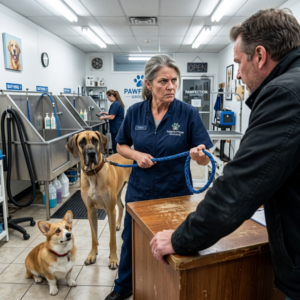
The final weeks of pregnancy are a time of intense physical limitation and psychological vulnerability. The body is heavy, exhausted, and fiercely protective of the impending life within. For one expecting mother, standing at eight and a half months pregnant, the simple, routine tasks of life have become monumental hurdles. Bathing and trimming the nails of her two dogs—a massive Great Dane and a smaller Corgi—is no longer physically possible.
These are not simple pets; they are purebred rescues carrying the invisible scars of their pasts. The mother has poured endless hours and resources into professional training to manage their behavioral quirks. The Great Dane is a gentle giant with humans, perfectly safe around small children, but harbors a deep, reactive terror of strange dogs. When approached by an unknown animal, his fear manifests in loud, intimidating barking—a terrifying display for anyone who does not understand the anxiety beneath the massive frame. The Corgi, conversely, loves the world but suffers from severe, crippling separation anxiety, plunging into panic when removed from the mother’s side.
When their usual groomer closes its doors due to the pandemic, the family is forced to seek a new professional. The mother is meticulous. Over the phone, she painstakingly details the intricate psychological profiles of both dogs to the new groomer. She explicitly outlines the Great Dane’s fear reactivity toward other dogs. She goes so far as to pay for an extra half-hour of the groomer’s time, creating a buffer to ensure her massive dog can enter and exit the facility without ever crossing paths with another client’s animal. The groomer issues verbal assurances, promising she understands and can handle the situation.
Because the mother is not allowed inside the new facility, and because leaving her causes the Corgi immense distress, the husband takes on the responsibility of the drop-off. He delivers the dogs, casually mentioning to the groomer that his wife is heavily pregnant. The groomer’s face contorts into an unreadable expression, a micro-reaction that goes unspoken but hangs ominously in the air.
Hours later, the husband returns to collect his family members. The groomer steps forward and hands over the leash of the anxious Corgi.
But the Great Dane is absent.
The groomer looks at the husband and delivers a statement that shifts the ground beneath his feet. She announces that she is seizing the Great Dane. She claims that during the appointment, the massive dog exhibited aggression toward one of her own dogs—a direct violation of the isolated environment the mother had explicitly paid to guarantee. The groomer then weaponizes the husband’s earlier casual comment. She states that, because they are expecting a baby, she cannot, in good conscience, return a “reactive” dog to their home.
It is an act of staggering, illegal audacity. A service provider, armed with zero behavioral credentials, zero authority, and zero understanding of the family’s meticulous management protocols, has decided to play god. She has effectively kidnapped a family member, holding the animal ransom under the guise of unsolicited, self-righteous protection of an unborn child she has never met.
When the husband calls the heavily pregnant mother to relay the hostage situation, a primal, terrifying panic sets in. The next seven hours become a waking nightmare. The mother, heavily pregnant and physically compromised, is plunged into an intense psychological warfare to retrieve her stolen property. The groomer stubbornly refuses to relinquish the animal, forcing the family to escalate the nightmare to its absolute peak: calling the police.
It requires the presence of armed law enforcement to finally break the groomer’s illegal siege and force the return of the terrified Great Dane to his rightful owners. The trauma of the event is so profound, the adrenaline crash so severe, that the mother takes to social media in the immediate, white-hot aftermath, detailing the horrific experience and blasting the business. By the following dawn, the groomer’s digital footprint vanishes, the pages pulled down, the business seemingly shuttered overnight.
Yet, the victim is left questioning her own sanity. Friends whisper that she acted like a “mega Karen,” a cruel dismissal of a mother fiercely defending her family against an attempted theft. Even her own mother suggests the groomer was genuinely looking out for the baby, suggesting the pregnant woman went too far. But the truth remains stark and chilling: good intentions do not grant a stranger the right to steal your dog, and trauma is not mitigated just because the perpetrator believed they were righteous.
In the quiet, familiar space of a family home, a conversation is unfolding that will quietly dismantle a lifetime of unseen sacrifices. A twenty-eight-year-old woman sits across from her parents, listening to the logistics of an upcoming family vacation abroad. It is meant to be a bonding experience, a rare opportunity for the parents and their two adult daughters to share time and geography.
But a financial caveat is introduced, and it drops onto the table like a lead weight.
The parents announce their plan: they will fully fund the vacation for the twenty-eight-year-old’s sister. They will cover the flights, the accommodations, the experiences. But they turn to the twenty-eight-year-old and state that she will have to pay her own way entirely. Their reasoning is presented as a matter of simple, pragmatic arithmetic. They state that they cannot afford to pay for both daughters. Furthermore, they observe that the twenty-eight-year-old is in a remarkably stable financial position, easily capable of affording the trip, while her sister is struggling and absolutely cannot. Therefore, funding the sister is the only mechanical way all four of them can exist in the same tropical location. They assure the older daughter that if her fortunes were ever reversed, they would extend the same safety net to her.
On the surface, it is a socialist utopia of familial resources—from each according to their ability, to each according to their need. But beneath the surface, the twenty-eight-year-old feels the cold, sharp sting of a profound injustice.
She looks at her parents, and then she looks at her sister, and the invisible ledger of their entire adult lives balances out in her mind. She is not financially stable by accident, nor by the whims of a benevolent universe. Her bank account is the direct result of years of brutal, unglamorous discipline. She chose to build her life in a cheaper, less desirable geographical area, accepting the isolation of living far away from her core group of friends. She strategically selected a career path where financial security was guaranteed, perhaps sacrificing more creative or passionate pursuits. She lives meticulously, tracking her spending, denying herself daily luxuries, and existing strictly within her means.
Her sister, conversely, walked an entirely different path. The sister pursued a passion-driven career that she fully knew was underpaid. She absolutely insisted on living in a high-rent district to remain physically close to her social circle. She lives vibrantly in the moment, spending heavily on her lifestyle, dining out, and enjoying the fruits of her daily labor without a second thought for the morrow.
The parents do not see the discipline; they only see the balance sheet. They frame the narrative as one of “luck.” They tell the frugal daughter she is lucky her passions aligned with a lucrative market, and lucky she found a partner willing to move to a cheaper city. They frame the spending sister as a victim of bad luck—unlucky in love, unlucky in her industry. They coddle the consequences of the sister’s choices, dressing them up as tragedy.
The frugal daughter makes her decision. She looks at the vacation itinerary, a trip she easily could afford, and she refuses to go. She informs them she will take a vacation with her friends instead.
She does not want her parents to pay for her. She does not want her sister to go into debt. But she refuses to participate in an economic system where her years of intense, quiet sacrifice are fundamentally punished to subsidize the lavish, day-to-day spending of her sibling. The parents are devastated, the sister is offended, and the frugal daughter is branded as money-hungry and uncompassionate. The vacation falls apart. The frugal daughter is left sitting alone in her affordable apartment, realizing that in her family, responsibility is not rewarded; it is simply taxed.
These four narratives, seemingly disconnected by geography and circumstance, are bound together by a singular, universal truth: the profound difficulty of enforcing boundaries in a world that constantly asks us to shrink ourselves for the comfort of others.
The infertile couple was asked to swallow the agonizing judgment of a relative who valued her own opinion over their fragile sanity. The burned apprentice was asked to continually tolerate the physical danger of a colleague whose apologies were utterly detached from changed behavior. The pregnant mother was asked by society to quietly accept the illegal seizure of her dog because the perpetrator hid behind the shield of “good intentions.” And the frugal daughter was asked to invalidate years of personal sacrifice so her family could enjoy a vacation free from the discomfort of financial reality.
In every instance, the victim was pressured to capitulate. They were told to mind the awkwardness, to show more compassion, to not be a “Karen,” or to stop being so stubborn. But true peace is never achieved through submission. True harmony in a family, a workshop, or a business transaction requires the fierce, unapologetic enforcement of respect. It requires the understanding that an apology without changed behavior is manipulation. It requires the knowledge that another person’s grief is not a public forum for debate. And it requires the courage to stand up, even when your own family calls you the villain, and declare that your safety, your property, and your lifetime of hard work are not up for negotiation.
Disclaimer : This content may be created by AI for entertainment purposes. Any resemblance to real persons, events, or places is coincidental.






