The Boy Who Watched the Stars and the Man Who Broke a Kingdom
Imagine a young boy standing alone on a windswept hill in Spain. The air is dry, smelling of dusty earth and wild rosemary. The sun is sinking toward the edge of the world, painting the sky in violent streaks of orange and pink. He is small, perhaps unnoticed by the world, but his eyes are fixed on the horizon. He dreams of something more than the struggle of his daily life. At this micro-moment, he has no way of knowing that his name will be etched into history books with both blood and gold. He does not know he will one day command an empire, or that his life will become a haunting lesson on the price of human ambition. This is the saga of Francisco Pizarro.
CHAPTER 1: THE HUNGRY HEART OF TRUJILLO
The story begins in 1478, in the small Spanish town of Trujillo. To understand the man, we must first understand the dust from which he was born. Trujillo was a place of simple stone houses and hard lives. In one of these humble dwellings, Francisco was born to a soldier father and a mother from a poor family. They were not married—a detail that carried a heavy social weight in the 15th century.
From his first breath, Francisco was an outsider. People in the town looked at him with a mix of pity and shame. He did not grow up in a grand villa; he did not have the luxury of school. He could not read the letters of the alphabet, nor could he write his own name. His world was physically small, bounded by the chores of a poor child.
But notice the “silent moments” of his youth. While other children played, Francisco watched the horizon. He spent his days working with animals, often tending to pigs in the sun-drenched fields. The work was grueling and repetitive, the kind of labor that numbs the spirit of most. Yet, as he watched the swine, his mind traveled. He imagined the vast, salt-sprayed oceans he heard sailors speak of in the taverns. He heard whispers of “new lands”—places where the dirt might hide gold instead of just grit. His grandparents loved him, but their warmth could not satisfy the hunger in his heart. He wanted a life that was entirely his own.
CHAPTER 2: THE OCEAN’S COLD EMBRACE AND THE JUNGLE’S HEAT
In 1502, the young man made a choice that would echo through time: he decided to leave. Picture the scene at the harbor—the creaking of wooden ships, the smell of tar and old ropes, the shouting of sailors. Francisco stepped onto a small vessel, leaving behind everything he knew. The journey across the Atlantic was terrifying. The waves were mountains of dark water, and the ship felt like a mere splinter in the hand of God.
He arrived in Hispaniola, a land of vibrant greens and unknown dangers. He didn’t just survive; he studied the world around him. But survival was a low bar for a man with a heart like Pizarro’s. He joined Vasco Núñez de Balboa on a legendary trek across the Isthmus of Panama.
Close your eyes and feel the environment: the air is thick and humid, clinging to the skin like a wet blanket. The insects are a constant, deafening roar. Every step through the tangled vines is a battle against nature itself. Then, the foliage breaks. There, shimmering under a brutal sun, was the Pacific Ocean. Francisco stood on the shore, his heart pounding against his ribs. He was one of the first Europeans to ever behold this vast blue expanse from the Americas. In that moment, the word “hope” wasn’t just a concept; it was as real as the sand beneath his boots.
CHAPTER 3: THE LINE IN THE SAND
By the time Francisco reached his late 40s, he was settled in Panama, but his eyes were still turned South. He heard whispers of a golden king, an empire of unimaginable wealth tucked away in the clouds of the Andes. To find it, he partnered with Diego de Almagro and a priest named Hernando de Luque.
The first attempts were disastrous. In 1524, the sea turned angry. Food ran so low that men chewed on leather. They were attacked by local tribes; Francisco himself felt the bite of steel and wood, seven deep cuts marking his body, his blood soaking into the foreign sand. Most men of fifty would have retired to a quiet life, but Pizarro’s ambition was a fire that required more fuel.
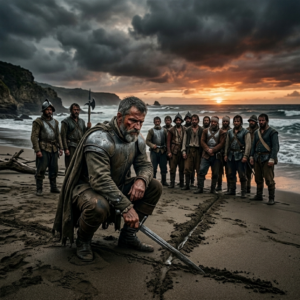
The turning point came in 1526 on a desolate island. The Governor of Panama, fearing the loss of more lives, ordered the expedition to return. Francisco stood before his tired, hungry men. He drew his sword, the metal catching the glint of the sun. With a slow, deliberate motion, he drew a line in the sand.
“On this side,” he pointed back toward the ships, “is safety and poverty. On that side,” he pointed South, “is danger, death, but also glory and gold.” He stepped over the line. Only thirteen men followed him—the “Famous Thirteen.” It was a micro-moment of pure, unadulterated willpower. They sailed on, eventually reaching the coast of Peru, where they saw enough gold to know the legends were true. Francisco returned to Spain, showed the King his proof, and was granted the title of Governor. He was no longer a boy watching stars; he was a man authorized to take the world.
CHAPTER 4: THE GOLDEN TRAP AT CAJAMARCA
In 1532, Pizarro ascended into the highlands of Peru with fewer than 200 men. He learned that the Inca Empire was fractured, reeling from a bloody civil war between two brothers, Huáscar and Atahualpa. Atahualpa had emerged victorious but ruled a divided people.
Francisco sent a message, inviting the Inca King to meet in the city of Cajamarca. Atahualpa, confident in his thousands of warriors, agreed. November 15, 1532—the air in the square was cold and tense. Atahualpa arrived on a golden litter, carried by nobles who treated the ground he walked on as holy.
The micro-moment of the clash: A Spanish priest approached the King and handed him a Bible. Atahualpa held the object, perhaps smelling the old parchment, looking at the strange ink markings. He did not understand its significance and threw it to the ground. That was the signal.
The silence was shattered by the roar of cannons. Horses, beasts the Inca had never seen, charged into the crowd. Steel swords flashed in the light, cutting through cotton armor. In just nine minutes, the square was a graveyard. Atahualpa was captured. The King offered a desperate bargain: he would fill a room with gold, as high as his hand could reach, in exchange for his life. For months, the gold flowed—statues, plates, jewelry—shimmering under the torchlight of his cell. But Pizarro, gripped by the fear of an uprising, broke his word. Atahualpa was executed. It was a victory that stained the soul.
CHAPTER 5: THE PALACE OF SHADOWS
Francisco founded Lima, the “City of the Kings,” and ruled over a vast, broken land. But the gold could not buy peace. His old partner, Diego de Almagro, felt cheated and forgotten. The bond of friendship snapped under the weight of greed. Civil war broke out among the Spanish themselves. Almagro was eventually executed by Pizarro’s brother, a death Francisco did not stop.
The final micro-moment occurred on June 26, 1541. Pizarro was an old man now, eating lunch in his palace in Lima. He felt the sea breeze through the windows, perhaps thinking of the hills of Trujillo. Suddenly, the doors burst open. The followers of Almagro’s son rushed in with swords drawn.
Francisco had no armor, but the soldier’s spirit remained. He grabbed a sword and fought with the strength of his youth until he was overwhelmed. As he lay dying on the cold floor, he did something deeply symbolic: he drew a cross on the stones using his own blood. He kissed it, whispered the name “Jesus,” and breathed his last. The boy who watched the stars died in a pool of his own ambition.
DEEP REFLECTION: THE COST OF THE HORIZON
Francisco Pizarro’s life is a mirror for all of us. He proves that our beginnings do not define our endings—a poor, illiterate boy can indeed change the world. He shows us the power of courage and the “line in the sand” moments that define a legacy.
However, his story also warns us of a darker truth. Courage without compassion is merely cruelty. Ambition without wisdom is a path to loneliness. He won an empire of gold but lived in a palace of enemies, dying by the very steel he used to conquer others. As we journey through our own lives, seeking our own “gold,” we must ask ourselves: what are we willing to sacrifice? Is the view from the top worth the blood on the stairs?
CALL TO ACTION: Francisco Pizarro never gave up on his dream, even when the world told him it was impossible. But his dream came with a heavy price. What is one dream in your heart right now that you will never give up on? And how will you ensure you keep your heart whole as you chase it? Share your thoughts in the comments below.
Disclaimer : This content may be created by AI for entertainment purposes. Any resemblance to real persons, events, or places is coincidental.






