A Betrayed CEO Meets A Master Craftsman On The Cliffs — What She Finds In His Code Rewrites Her Future
In the vertical kingdom of Manhattan, power is often perceived as a loud, blunt instrument—measured in the roar of private jets and the heavy slam of a mahogany gavel. But for Rowan Vance, the “Iron Architect” of the tech world, power had become a hollow cage. At thirty-two, she had built Vance Biostructures from a single patent into a global empire, only to watch her husband, Cillian Thorne, attempt to dismantle it from the inside using a shadow corporation and a mountain of lies. Desperate to find the evidence that would save her legacy, Rowan retreated to her family’s ancestral villa on the jagged cliffs of the Oregon coast. She went there to find silence, but instead, she found a man with hands of cedar and a mind of silicon. She expected a simple carpenter; she found the “Ghost of the Ledger”—a man who had been erased by the very industry she commanded. This is a story of how a chance encounter in a salt-misted cove revealed a betrayal that went deeper than corporate greed, proving that the most resilient structures are not built of steel, but of the secrets we hide in the grain.
The salt air tasted like copper on Rowan Vance’s tongue. Or perhaps that was blood from where she’d bitten the inside of her cheek for the third time in an hour, hunched over a mahogany desk that had belonged to her grandmother. Before her, the spreadsheets on her laptop rearranged themselves into the exact shape of ruin.
Rowan pressed her fingertips into her temples and stared at the column marked AB Share Distribution: Hostile Reallocation Scenario. Her husband, Cillian, was accelerating his timeline. A dummy corporation, Pinnacle Ventures, had acquired enough proxy votes to force an emergency board session within two weeks. If Rowan couldn’t prove that Cillian’s seat on the board was secured through fraudulent credentials, she would be voted out of the company she had built from a single patent and a maxed-out credit card at twenty-four.
She pushed back from the desk, the leather chair groaning. She needed air. The Crescent Bay House had always been her sanctuary—a sprawling coastal estate perched on the granite bluffs of the Pacific. She changed into a simple linen dress, the color of sea-glass, and headed toward the boardwalk that led down to the private cove.
The boardwalk had been damaged in a late spring storm, and she had hired a local craftsman to repair it. She hadn’t expected him to be working today, but as she descended the sun-bleached wood, she heard the rhythmic bite of a hand plane—a sound so steady it almost resembled breathing.
Elias Reed was not what she had pictured. Her property manager had called him a carpenter, and she had imagined someone older, perhaps weary. The man crouched on the observation platform was tall and broad-shouldered, with the kind of build that came from carrying timber, not gym vanity. He wore heavy canvas pants and a faded gray Henley with the sleeves pushed past his elbows. His forearms were cabled with muscle and mapped with fine white scars.
He looked up as she approached, gave her a brief, professional nod, and returned to his work. There was no lingering scan of her, no flicker of appraisal. He looked at her the way you look at a colleague—with full, undistracted attention to the matter at hand.
Rowan stepped past him onto the sand, holding a folder of documents she needed to study. But the wind was treacherous in the cove. A sudden gust hit like a slap, and the most critical sheet—Page 17 of the ABS Share Appendix—ripped free from her fingers, tumbling toward the surf.
Rowan lunged, but Elias was already in motion. He didn’t run after the paper; he cut across the beach at an angle, moving with an explosive precision that was startling for a man his size. His hand shot out, closing around the sheet just as a wave broke behind him.
He walked toward her, extending the page. His eyes were a pale gray-green, the color of winter sage.
“The cove funnels wind from the northwest,” he said, his voice a low, unhurried rasp. “Creates a Venturi effect. Accelerates and redirects at about thirty degrees east of what you’d expect. If you’re going to work with loose paper down here, weight the corners.”
He was explaining fluid dynamics. He had just performed an acrobatic rescue of her future, and he was calmly explaining physics.
“Thank you,” she said, her voice slightly breathless.
By late afternoon, Rowan brought two cups of pour-over coffee down to the platform. Elias was packing his tools. She noticed his laptop sitting on a makeshift workbench. It wasn’t running a woodworking app.
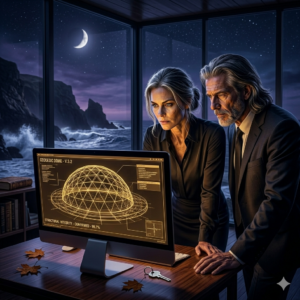
The screen was running a massively complex Building Information Modeling (BIM) suite—a custom interface with a level of sophistication that went far beyond anything commercially available. The display was a three-dimensional wireframe rendering of an architectural structure Rowan knew intimately: The Apex Biodome.
The Biodome was the masterwork that had made Cillian Thorne a visionary. It was the primary credential he had used to secure his power at Vance Biostructures.
Rowan set her coffee down carefully. “Elias. What is that?”
He looked up, and for the first time, a wall went up behind his eyes. He reached over and closed the laptop. “Old project,” he said.
“That’s the Apex Biodome,” Rowan countered. “I know it because my husband claims he designed it. You know it because… why?”
The silence that followed had teeth. Elias stood very still, looking at her with an expression between resignation and relief.
“Five years ago,” Elias began, his voice flat. “I was the founder of a small firm called Lattice Structural. The Biodome was my obsession. My life’s work. Then my wife, Clara, got sick. A rare degenerative condition. The only treatment was an experimental protocol that cost nine hundred thousand dollars—not covered by insurance.”
He looked out at the ocean. “Cillian Thorne’s firm had been circling me for months. He knew I was desperate. He approached me in the hospital parking lot while Clara was having a seizure. He offered me 1.2 million for the intellectual property, provided I signed an ironclad NDA and a full transfer of rights that attributed the design to him.”
“You signed,” Rowan whispered.
“I signed. Clara lived for another year. I got to hold her hand until the end. I’d make the same trade again. But I couldn’t stay in that world, watching him wear my brain like a borrowed suit.”
“He’s trying to take my company, Elias,” Rowan said, stepping closer. “He’s using your genius to legitimize a coup. Help me stop him.”
Elias shook his head. “The NDA is ironclad, Rowan. I can’t claim authorship.”
“I’m not asking you to claim it publicly,” Rowan said, her eyes flashing. “I’m hiring you as a Special Compliance Auditor. You aren’t a claimant; you’re a technical consultant auditing public domain filings for Hayes Meridian.”
They worked through the night in the villa’s sunroom. Rowan converted the space into a war room, monitors glowing against the darkness. Elias brought out encrypted drives Marcus thought had been destroyed.
The breakthrough came at 2:00 AM. Elias pointed at a single variable in the load-bearing struts algorithm.
“Look,” he said. “The offset value. 071483.”
“What is it?”
“Clara’s birthday,” Elias said, his hand trembling slightly. “July 14th, 1983. I embedded it in the code as a digital watermark. It affects the structural output by 0.003 degrees—invisible in renders, but load-critical. If you remove it, the simulation shows a catastrophic collapse under high wind. Cillian’s team never changed it because they never understood the math deeply enough to know it wasn’t a random coefficient.”
“It’s a love letter hidden in the physics,” Rowan whispered. “And it’s timestamped to your personal server six months before the acquisition.”
The emergency board meeting was a cathedral of brushed steel and airless tension. Cillian Thorne sat at the head of the table, wearing a charcoal suit and a magnanimous smile.
“The motion is to restructure,” Cillian announced. “Rowan has done well, but the industry demands the kind of vision that created the Apex Biodome.”
“I agree, Cillian,” Rowan said, standing up. “Which is why we’ve conducted a technical audit of that very vision.”
She signaled the door. Elias Reed entered. He wore a dark blue suit, his rugged shoulders filling the frame. Cillian’s smile vanished. The color drained from his face until he looked like old wax.
Elias didn’t perform. He simply connected a drive and showed the board the “Clara Variable.” He demonstrated, in real-time, that Cillian’s “genius” was a stolen love letter. He showed the metadata. He showed the fraud.
“The Apex Biodome isn’t a credential, Cillian,” Rowan said, her voice cutting through the silence. “It’s a crime. And as of ten minutes ago, the Federal Bureau of Commercial Integrity has received a full report on your systematic IP theft.”
Cillian left the building in a silence so profound it felt like a vacuum.
A year later, the Thorne-Vance divorce was a footnote in the financial pages. Rowan Vance remained the CEO, but she was a different kind of leader now—one who prioritized the “bones” of a company over the “skin.”
She drove down to the Oregon coast on a Saturday. She found the workshop by the sound of it—the whisper of a hand plane.
Elias had used his settlement to build Lattice Woodworks on a windswept bluff. The building was a marvel of reclaimed timber and hand-fitted stone. In the center, on a massive table, sat a piece of gnarled driftwood.
Lily, Elias’s six-year-old daughter, was sanding a section of the wood. She looked up at Rowan and smiled. “We’re revealing what’s underneath,” the girl said.
Elias walked over, holding a piece of fine-grit sandpaper. He looked at Rowan with those steady gray-green eyes. “Want to help? Sand away the rot, and what’s left will never collapse.”
Rowan took the paper. Her fingers brushed his—warm, dry, and certain. She realized then that she hadn’t come back to be rescued. She had come back because she had finally found a structure designed to hold.
I realized then that the strongest things in the world aren’t the ones that resist the storm, but the ones that know how to incorporate the damage into their design until it becomes an unbreakable strength.
Disclaimer : This content may be created by AI for entertainment purposes. Any resemblance to real persons, events, or places is coincidental.






