He Celebrated Winning the Divorce — Until His Wife’s Father Walked Into the Courtroom
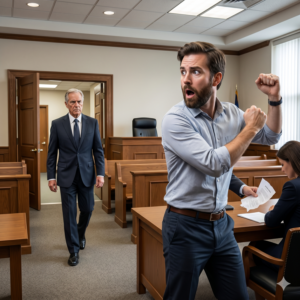
For all his meticulous planning, the ruthless attorney, the concealed offshore funds, and the savage prenup meant to leave Audrey destitute, Russell Sterling had overlooked a single catastrophic variable, his father-in-law.
While Russell had spent the previous evening toasting his own brilliance with Dom Perinol, convinced he could easily discard the woman who had stood by him for a decade, he had dismissed the old man as a simple retired mechanic from Ohio. That assumption crumbled at 900 a.m. When the courtroom doors opened, Russell wasn’t facing a pensioner. He was staring down his worst nightmare. A man clutching the one document capable of destroying his entire world.
The air inside the Golden Rail, one of Boston’s most exclusive private clubs, smelled of aged mahogany, cigar smoke, and the distinct crisp scent of arrogance. Russell Sterling held his crystal tumbler of scotch up to the light, admiring the amber liquid. He was 42, handsome in a predatory sort of way, with a jawline that looked like it had been chiseled out of granite and a suit that cost more than most people’s cars.
“To freedom,” Russell said, a smirk playing on his lips. Across the table, Harrison Cole, his attorney, clinkedked his glass against Russell’s, Harrison was a man who resembled a ferret in a bespoke suit. Sharp-nosed, beady eyed, and utterly ruthless. He was the kind of lawyer you hired when you didn’t care about justice, only winning.
To total and complete exoneration, Harrison corrected, taking a sip. and to the obsidian trust remaining. Strictly hypothetical. Russell laughed, a loud barking sound that caused a few heads to turn. She has no idea, Harrison. Audrey thinks I’m worth maybe 5 million on paper. She doesn’t know about the holdings in the Cayman’s.
She doesn’t know about the Shell Company in Delaware. And she certainly doesn’t know that the house she’s sleeping in tonight is already sold to a private LLC controlled by well me. It’s a masterclass, Russell, Harrison said, leaning back. Honestly, usually the wives have a sense. They hire a PI. They dig through the trash. But Audrey, she’s been dosile as a lamb.
She signed the prenup back in 2014 without even reading the rider clauses. Tomorrow is just a formality. We go in, Judge Dalvo stamps the decree, and you walk out a single man with your fortune intact. We give her the Volvo and maybe 10 grand for relocation assistance. It’s brutal, but hey, that’s business.
Russell checked his watch. It was a PC Philippe, another asset he’d conveniently lost in a poker game to his brother last month, only to have his brother hold it for him until the divorce finalized. “She’s weak,” Russell muttered, his eyes narrowing. “That’s her problem.
She’s always been weak, just like that old man of hers.” “What was he? A shift manager at a tire plant in Akran. pathetic. Russell pulled out his phone. A text message from Jessica, his assistant, and the woman waiting for him in a condo downtown lit up the screen. Is it done yet? I have the champagne on ice. Russell typed back, “12 hours, baby. Then we own the city.
” He thought back to the last conversation he’d had with Audrey 3 days ago in the kitchen of their sprawling estate in Brookline. She had looked tired. Her blonde hair, usually kept neat, was pulled back in a fraying, messy bun. She was wearing sweatpants. She looked defeated. “Russell, please,” she had whispered, holding a coffee mug with both hands to stop them from shaking. I don’t care about the money.
I just want the house. It’s the only stable thing the kids have known. [clears throat] The kids are going to boarding school in Switzerland, Audrey, he had snapped, grabbing his keys. And the house is too big for you. You can’t afford the heating bill, let alone the property tax. Do yourself a favor.
Don’t fight me on Tuesday. If you fight, I will bury you in legal fees until you’re living in a cardboard box. She hadn’t said a word after that. She just looked down at her coffee. That was the moment Russell knew he had won. She had no fight left. She had no allies. Her mother had passed away 5 years ago. And her father, Arthur, was a ghost.
Some old guy who sent a card with a $20 bill in it every Christmas and barely spoke two words at the wedding. “One more round,” Russell yelled to the waiter. and bring the bottle. They drank until 2:00 a.m. Russell went home to the condo, not the estate.
He slept the sleep of the just, or at least the sleep of the incredibly wealthy and morally bankrupt. He didn’t dream of his wife of 10 years. He didn’t dream of the tears she’d cried when he missed their anniversary for the third year in a row. He dreamed of the yacht he was going to buy on Wednesday. He was going to name it the alimony, a final private joke. Little did he know, across town, in a small, [clears throat] dimly lit hotel room at the Holiday in Express, a light was still burning. Audrey sat at a small desk, her hands folded. Sitting on the bed behind her, cleaning a pair of wire
rimmed spectacles with a microfiber cloth, was a man in a flannel shirt and worn out jeans. Arthur Holloway didn’t look like much, but then again, neither did a loaded gun until the trigger was pulled. “Go to sleep, Katie,” Arthur said gently.
His voice was gravel, rough from years of breathing in factory dust, or so Russell assumed. “I’m scared, Dad,” Audrey whispered. “Harrison Cole is a monster. He destroyed his last three opponents. Russell says he has Judge Dalvo in his pocket. Arthur put his glasses on. His eyes were a startling icy blue. Intelligent eyes, dangerous eyes. Let Mr. Cole be a monster, Arthur said, standing up and walking over to his daughter. He placed a heavy, calloused hand on her shoulder.
And let Russell think he’s a king. Kings get careless. They forget to look down at the grass to see where the snakes are hiding. Russell thinks you’re a mechanic, Audrey said, a small, nervous smile touching her lips. Arthur chuckled. It was a dry, humilous sound. I was a mechanic, Katie. I fixed broken things. Tomorrow we’re going to fix something very big and very broken. He looked at the cheap digital clock on the nightstand. Get some rest.
Tomorrow is going to be a very long day for your husband. The Suffach County Courthouse was an imposing building, all gray stone and misery. To Russell Sterling, it looked like a bank, where he was about to make a massive withdrawal. He stroed into courtroom 4B at 8:55 a.m., flanked by Harrison Cole and two junior associates carrying boxes of files. The intent was clear.
Intimidation. They wanted to physically dominate the space with paperwork, suits, and confidence. Russell smoothed his tie. He looked over at the defendant’s table. Audrey was there. She wore a simple navy blue dress, one she’d had for years. She looked small against the heavy oak furniture.
Beside her sat her attorney, a woman named Sarah Jenkins. Russell almost laughed out loud. Jenkins was a solo practitioner who mostly handled traffic violations and minor custody disputes. She looked frizzy, disorganized, and completely out of her depth. Jenkins, Harrison whispered to Russell, covering his mouth to hide a sneer. This is going to be a blood bath. I almost feel bad. Don’t, Russell said coldly.
Just finish it. All rise, the baiff bellowed. Judge Anthony Dalvo entered. He was a heavy set man with a face like a bulldog and a reputation for hating long drawn out proceedings. He wanted efficiency. Russell liked that. Efficiency favored the one with the best paperwork. And Russell’s paperwork was immaculate.
Docket number 492 serway 1. The cler announced Sterling v. Sterling. Good morning, your honor. Harrison Cole boomed, standing up and buttoning his jacket. Harrison Cole for the plaintiff, Mr. Russell Sterling. We are ready to proceed with the summary judgment based on the prenuptual agreement signed August 14th, 2014.
“Miss Jenkins,” Judge Dalvo looked over his reading glasses. “Good morning, your honor,” Sarah Jenkins said. Her voice was steady but quiet. Sarah Jenkins for the defendant. Mrs. Audrey Sterling. All right. Dalvo sighed, shuffling papers. I’ve reviewed the motions. Mr. Cole, you’re asserting that the assets in question, specifically the Brookline estate, the portfolio with Vanguard, and the collection of vintage automobiles are sole property of Mr. Sterling, pre-protected by the prenup.
That is correct, your honor, Harrison said, pacing slightly. The agreement is explicit. Any assets acquired through Sterling Industries or its subsidiaries remain the sole property of my client. Mrs. Sterling waved her rights to equitable distribution in exchange for a lumpsum payment of $50,000 upon dissolution of the marriage.
A ripple of murmurss went through the few people in the gallery. $50,000. It was an insult. It wouldn’t even cover rent in Boston for a year. And Harrison continued, pressing his advantage. We have evidence that Mrs. Sterling has been fiscally irresponsible during the marriage, necessitating this strict separation.
My client has been the sole provider. Russell sat back, crossing his legs. He watched Audrey. She wasn’t looking at him. She was looking at the double doors at the back of the courtroom. Who is she waiting for? Russell thought. Her boyfriend. Some loser she met at the gym. Miss Jenkins, the judge said.
Do you have any counterarguments regarding the validity of the prenup? Sarah Jenkins stood up. She shuffled her papers nervously. Your honor, we are not contesting the signature on the prenup. Russell smirked. Game over. However, Jenkins continued, we are contesting the completeness of the financial disclosure provided by Mr. Sterling at the time of signing, and indeed the financial disclosure provided to this court today.
” Harrison Cole laughed. A short dismissive sound. Objection, your honor. This is a fishing expedition. We have provided over 4,000 pages of financial documents. Mr. Sterling’s life is an open book. Your honor, Jenkins said, “We believe there are significant assets totaling in the mid8 figures that have been deliberately concealed through a network of shell companies in the Cayman Islands and Nevice.
” “That is a lie,” Russell blurted out, standing up. Sit down, Mr. Sterling. Judge Dalvo barked. He looked at Jenkins. That is a serious accusation, counselor. Do you have proof? Because if you are just stalling, I will hold you in contempt and grant the plaintiff’s motion immediately. We do have proof, your honor, Jenkins said, but it involves a complex web of corporate entities.
I would like to call a witness who can explain the structure of Obsidian Holdings LLC. Russell froze. Obsidian. He [clears throat] felt a cold drop of sweat slide down his spine. He had never spoken that name to Audrey. He hadn’t even written it down in his home office. It existed only on a secure server in Zurich and in the mind of his offshore banker. Harrison Cole stiffened.
Your honor, this is preposterous. There is no witness list. They cannot just surprise us with Actually, your honor, Jenkins interrupted. We filed an amended witness list this morning at 8:00 a.m. adhering to the 60-minute emergency disclosure rule for rebuttals. Dalvo checked his computer screen.
She’s right, Mr. Cole. It’s here. The judge squinted at the screen. Arthur Holay. Russell blinked. He let out a breath of relief. Arthur, her dad. Russell leaned over to Harrison. It’s fine, he whispered aggressively. It’s her father. He’s a nobody. He’s a retired factory worker. He doesn’t know what an LLC is.
They’re desperate. Let him testify. I’ll tear him apart on cross-examination myself. Harrison looked doubtful, but he nodded. Very well, your honor. We have nothing to hide. Let’s hear from the father. Baleiff, call Arthur Holloway, the judge said. The heavy double doors at the back of the courtroom groaned open.
Russell turned around in his swivel chair, a smug grin plastered on his face, ready to intimidate the old man with a stare. He expected to see a man in a cheap polyester suit, maybe a stained tie, looking confused and frightened. Instead, the man who walked through the doors moved with the silence and precision of a predator entering a clearing. Arthur Holay was wearing a suit, but it wasn’t cheap polyester.
It was a charcoal three-piece suit that fit him perfectly. He carried a leather briefcase that looked battered but expensive, the kind used by men who traveled to places where business was done in whispered tones. But it wasn’t the clothes that made Russell’s smile vanish. It was the way Arthur walked. He didn’t shuffle. He marched.
His head was high. His eyes locked directly on Russell. There was no fear in those eyes. There was only a cold, hard promise of violence. As Arthur passed the bar and approached the witness stand, he paused for a brief second near Russell’s table. He didn’t look at his daughter. He looked at Harrison Cole. Mr. Cole, Arthur said, his voice deep and resonant, carrying to the back of the room without a microphone. I believe we met in 1998.
The Enron hearings. You were a junior associate then. I see you haven’t changed your ethics, only your billing rate. Harrison Cole’s face went white, the blood drained from it so fast he looked like a corpse. You, Harrison stammered. He looked at Russell, panic flaring in his eyes. Russell, you said he was a mechanic.
He is, Russell hissed. He worked at Goodyear. Arthur took the stand. He placed his briefcase on the ledge. He sat down and adjusted the microphone. “State your name for the record,” the cler said. “Arthur James Holay,” he said. “And your occupation.” Arthur looked at Russell. A small terrifying smile appeared.
“Currently?” “Retired?” Arthur said. “Formerly? senior forensic auditor for the Internal Revenue Service, Special Crimes Division, specializing in offshore tax evasion and high-n networth asset recovery. The silence that fell over the courtroom was absolute. It was the silence of a bomb having been armed with the timer ticking down to zero. Russell felt his stomach drop through the floor.
He looked at Harrison. Harrison was trembling. You said he was a mechanic,” Harrison whispered, his voice cracking. “He told me he fixed things,” Russell cried out too loud. “I did,” Arthur said into the microphone, answering the whisper Russell thought was private. “I fixed people who thought they were above the law, Mr. Sterling. And today, I’m going to fix you.
” Judge Dalvo leaned forward, the leather of his chair creaking loudly in the stunned silence. He took off his reading glasses, polished them on his robe, and put them back on, staring at the man in the witness box. “Mr. Holay,” Dalvo said, his voice carrying a mix of curiosity and warning. “Did you just say Special Crimes Division?” “I did, your honor,” Arthur replied smoothly. Badge number 4992.
I spent 30 years tracking money that didn’t want to be found. I retired 5 years ago to spend time with my daughter and grandchildren. I told people I was a mechanic because frankly it kills the conversation at dinner parties. Nobody wants to talk to the tax man. [clears throat] Everyone wants to talk to the guy who can fix their transmission.
Russell felt the blood rushing to his head. A high-pitched ringing started in his ears. He grabbed Harrison Cole’s arm, his grip tight enough to bruise. Do something, Russell hissed. Object. Get him out of here. He’s lying. He’s a scenile old man. [clears throat] Harrison Cole pulled his arm away, his eyes darting around the room like a trapped animal.
I can’t object to his occupation, Russell. If he’s perjurying himself, he goes to jail. But if he’s telling the truth, Harrison swallowed hard. If that’s really Arthur, the artichoke Holloway, the what? It was a nickname, Harrison whispered, looking nauseous. Because when you peel back the layers of a company, he always gets to the heart.
He took down the Mallister Syndicate in ‘ 04. I thought he was dead. Mr. Cole, Judge Dalvo barked. Are you done consulting with your client? Because I am very interested to hear what Mr. Holay has to say about Obsidian Holdings. Harrison stood up, his knees shaking slightly. Your honor, we we object to this witness on the grounds of relevance.
This is a divorce hearing, not a tax audit. Mr. Sterling’s financials have been certified by a CPA. and Enron’s financials were certified by Arthur Anderson. Arthur cut in, his voice calm, but slicing through the air like a razor. Certification only works if you show the accountant everything, Mr. Cole. You know that you taught a seminar on creative asset shielding at Harvard Law in 2011.
I have the syllabus in my briefcase if you’d like a refresher. Harrison sat down abruptly. He didn’t say another word. He knew when he was outgunned. “Proceed, Ms. Jenkins,” the judge said, a faint smile playing on his lips. Sarah Jenkins, who had been looked down upon by Russell and Harrison all morning, stood up. She looked taller now, confident.
“Mr. Holay,” she said, “Please tell the court how you became aware of the entity known as Obsidian Holdings LLC.” Arthur turned his gaze to Russell. For the first time, Russell saw the depth of the intelligence behind those eyes. It wasn’t the look of a father-in-law.
It was the look of a hunter who had been watching his prey graze for months, waiting for the perfect wind. Russell has always considered me a simpleton, Arthur began. For 10 years, I’ve sat at his Thanksgiving table. I’ve listened to him explain basic economics to me as if I were a child. I’ve watched him buy cars worth more than my pension. And I never said a word. I played the part. The bluecollar dad from Ohio.
Arthur paused, opening his briefcase. The click of the latches echoed like gunshots. But Russell made a mistake. He assumed that because I was quiet, I wasn’t listening. and he assumed that because I lived in a small house, I didn’t have resources. Arthur pulled out a thick stack of documents bound with a red clip. 6 months ago, Audrey called me crying.
Arthur continued. She said Russell was going to leave her. She said he had been threatening her, telling her she would end up with nothing. That triggered an instinct in me, your honor. So I made a few calls to old colleagues in Zurich and the Caymans. I didn’t break any laws. I simply followed the digital exhaust.
Digital exhaust? Judge Dalvo asked. Rich men like Russell are arrogant, Arthur said, pulling a single sheet of paper from the stack. They think the internet is anonymous. It isn’t. On January 14th of this year, Russell accessed a secure server in Nevice. He did it from the IP address of his home in Brookline. He used a VPN, of course.
GhostVPN, very popular, but he made one critical error. Arthur held up the paper. He paid for the VPN subscription using his corporate credit card, the one registered to Sterling Industries, and he used his personal email [email protected] as the recovery address for the offshore account. Russell felt like he couldn’t breathe. The room was spinning.
The recovery email, he had set it up late one night, drunk on scotch, thinking, “I’ll never need this.” But just in case I forget the password, once I had the email linkage, Arthur said it was a matter of public record requests in Nevice regarding the registered agent. The agent is a man named Lars Vunderhar. Mr. Vddahar is a known facilitator for Shell Companies.
And guess who is the sole beneficiary of the trust managed by Mr. Vandar? Arthur looked directly at Russell. Russell Sterling. Lies. Russell screamed. He couldn’t help it. The walls were closing in. He jumped up, knocking his expensive chair over. This is illegal. You hacked me. You hacked my computer. Sit down, Mr. Sterling. Or I will have you shackled.
Judge Dalvo roared. The gavl banged down, shaking the bench. Mr. Holay, do you have physical proof of the assets within this Obsidian holdings? I do, Arthur said. Miss Jenkins, if you would. Sarah Jenkins walked to the center of the room and set up a projector. She plugged in a laptop. Part four begins now, Arthur said softly to himself. A spreadsheet appeared on the white projection screen.
It was complex, filled with routing numbers, swift codes, and transaction IDs. To the layman, it looked like gibberish. To a financial judge and a tax lawyer, it looked like a confession. “What are we looking at?” Judge Dalvo asked, leaning forward, squinting. Arthur pointed a laser pointer at the screen. The red dot danced over a column of numbers.
“This, your honor, is a transaction log from Sterling Industries main operating account in Boston. Note the dates: November 3rd, December 12th, January 4th. large withdrawals $250,000, $500,000 tulles, $1.2 million. They are labeled in the corporate ledger as consulting fees paid to a vendor called Global Strategic Solutions.
I have consultants, Russell yelled, though his voice was weaker now. We were expanding into Asia. Global Strategic Solutions, Arthur continued, ignoring Russell, is a shell company registered in Delaware. Its address is a P.O. box at a UPS store in Wilmington. I had a colleague drive by and take a picture. Sarah Jenkins clicked a button. A photo appeared on the screen. It was a sad, lonely mailbox in a strip mall next to a dry cleaner.
There is no office. There are no employees, Arthur said. But look where the money goes after it hits Delaware. The slide changed. Now it showed a flow chart. From Delaware the funds are wire transferred within 24 hours to a bank in Likenstein.
The account holder is Obsidian Holdings and from there it sits acrewing interest waiting for the divorce to be finalized. Arthur turned to the judge. Your honor, the total amount transferred into Obsidian Holdings over the last 18 months is 14 million $300,000. This money was siphoned directly from the marital assets. It is community property. Russell stole it from his wife and he tried to hide it from this court.
Harrison Cole had his face in his hands. He was no longer taking notes. He was likely calculating how much malpractice insurance he had. Mr. Cole, Judge Dalvo said, his voice dangerously quiet. Did you know about this? Harrison shot up. No, your honor, absolutely not. My client assured me that the financial disclosures were complete.
I relied on his sworn affidavit. If these allegations are true, I have been defrauded by my own client. You coward, Russell shouted at his lawyer. You told me how to do it. You said, “Get it out of the country before she files.” The courtroom gasped. Russell clamped his hand over his mouth instantly, his eyes widening in horror.
He realized what he had just done. In his anger, in his panic, he had just confessed. Judge Dalvo stared at Russell. The judge didn’t look angry anymore. He looked disappointed, and that was worse. “Let the record show,” the judge said, speaking slowly into his microphone that the plaintiff has just admitted to transferring assets to avoid equitable distribution.
“I I didn’t mean,” Russell stammered. But we aren’t done, your honor, Arthur interrupted. Because the money isn’t just about the divorce. This is where it gets interesting. Arthur picked up another document from his briefcase. This one looked older. It was yellowed at the edges. Mr. Sterling, Arthur said, addressing Russell directly.
You remember the prenup, don’t you? The one you waved in my daughter’s face. The prenup is ironclad. Russell muttered, trying to regain some ground. She gets nothing. Ms. Jenkins, Arthur said. Page 14, clause 7B. Sarah Jenkins handed a copy of the prenup to the judge. Clause 7B, Sarah read aloud. Material breach and penalty.
In the event that either party is found to have willfully concealed assets exceeding the value of $1,000,000 with the intent to defraud the other party, the entirety of this pre-nuptual agreement shall be rendered null and void. Russell froze. He didn’t remember that clause. Harrison, Russell whispered. Harrison Cole looked at him with dead eyes. It’s a standard fraud protection clause, Russell.
I put it in all my contracts. I assumed I assumed you wouldn’t be stupid enough to actually get caught. Since you have just admitted to the concealment, Arthur said, “And the amount is clearly over $1 million, the prenup is dead, which means Arthur took off his glasses and folded them. [clears throat] Audrey is entitled to 50% of everything, including Obsidian Holdings, including the house, including the company.
No, Russell whispered. No, you can’t take the company. It’s my legacy. There is one more thing, Arthur said. He turned back to the judge. Your honor, as a former federal officer, I have a duty to report crimes. The $14 million in Obsidian Holdings wasn’t taxed. It was written off as business expenses, consulting fees. That represents approximately $5 million in tax evasion.
Arthur pulled a small sealed envelope from his jacket pocket. I took the liberty of compiling a formal whistleblower report for the IRS Criminal Investigation Division. I haven’t mailed it yet. I wanted to see how today went. Russell stared at the envelope. It was white, unassuming, and it contained the end of his life.
“If that envelope gets mailed,” Harrison Cole whispered to Russell. “You aren’t just losing your house, you’re going to federal prison for 5 to 7 years,” Russell looked at Audrey. She was still sitting quietly, but she was looking at him now. She wasn’t smiling. She looked sad. She looked at him with the pity one might feel for a dog that had run into traffic.
Audrey, Russell choked out. Honey, baby, we can talk about this. We don’t need the courts. We can work this out. Arthur stepped down from the witness stand. He walked over to Audrey and stood behind her, his hands on the back of her chair, a shield of steel and flannel. Mr. Sterling, the judge said, I am going to call a recess. I suggest you and Mr.
Cole have a very, very serious conversation about a settlement offer. And when I say serious, I mean you better offer Mrs. Sterling the moon, the stars, and the sky. Because if you come back in here and make me rule on this, I will strip you of every dime you have. And then I will personally hand that envelope to the district attorney. Recess for 1 hour. The gavl banged.
Russell collapsed into his chair. He watched Arthur lean down and whisper something to Audrey. She nodded and took her father’s hand. They walked out of the courtroom together, heads held high. As they passed the defense table, Arthur paused. He didn’t look at Russell.
He looked at the Rolex on Russell’s wrist, the one Russell was hiding. “Nice watch,” Arthur said. “You might want to sell it. You’re going to need the bail money.” The conference room attached to courtroom 4B was a stark contrast to the opulence Russell Sterling was accustomed to.
It was a windowless box with scuffed beige walls, a water cooler that hummed aggressively, and a laminate table that wobbled if you leaned on it too hard. Russell sat on one side, his head in his hands. His expensive suit jacket was draped over the back of the chair, now wrinkled.
The tie he had chosen so carefully that morning, a silk Hermes print meant to project power, felt like a noose around his neck. Harrison Cole was pacing the small room, frantically thumbming through messages on his Blackberry. The lawyer’s veneer of invincibility had completely shattered. He wasn’t thinking about Russell anymore. He was thinking about his own license to practice. “They have us, Russell,” Harrison hissed, stopping to glare at his client. “They have us cold.
The forensic trail is undeniable. You use the corporate card for the VPN.” God, how could you be so sloppy? That’s rookie mistake 101. I didn’t hire you to critique my IT skills, Harrison. Russell snapped, looking up. His eyes were bloodshot. I hired you to fix this. Make it go away. I can’t fix fraud, Russell.
Harrison kept his voice low but intense. This isn’t a parking ticket. You admitted in open court that you moved the money. Arthur Holay is sitting out there with a sealed indictment in his pocket. If that envelope hits the mail, the IRS freezes everything. The company accounts, your personal accounts, even the cash in your wallet.
You won’t be able to buy a pack of gum, let alone pay me. The door opened. Russell flinched. He expected the baiff. Instead, Sarah Jenkins walked in, followed by Audrey and Arthur. Audrey looked different. The fear that had defined her posture for the last year was gone. She didn’t look triumphant exactly. She looked resolved. She sat down opposite Russell, folding her hands on the table.
Arthur didn’t sit. He stood by the door, leaning against the frame, arms crossed. The white envelope was visible in his breast pocket, a silent, terrifying sentinel. Here is the offer,” Sarah Jenkins said, sliding a single sheet of paper across the table. Harrison picked it up.
His eyes scanned the document, widening with every line. “This is insane,” Harrison muttered. “You want everything?” “Not everything,” Sarah corrected calmly. “We are leaving Mr. Sterling with his personal vehicle, the 2022 Mercedes, and his fortun, which is legally protected. “You want the house?” Harrison read aloud, his voice rising. “The Cayman accounts, the NeAs trust, and 60% of Sterling Industries stock.
” “That’s my company,” Russell slammed his hand on the table. “My father started that company. You can’t take my majority share. That means I lose control of the board. You lost control when you used the company to launder money, Russell. Arthur spoke up from the doorway. His voice was calm, contrasting with the hysteria in the room.
If the IRS investigates, they will seize the company assets to pay the back taxes and penalties. The company will be bankrupt within 6 months. Your employees will lose their jobs. The stock will go to zero. Arthur walked over and tapped the paper in front of Harrison. This is a mercy kill, Russell.
If Audrey takes the 60%, she becomes the majority shareholder. She can fire you, yes, but she won’t liquidate the company. She wants to preserve it for the children’s inheritance. She saves the business. You get to walk away without handcuffs. Russell looked at Audrey. Cat, please. You don’t know how to run a manufacturing firm. You’ll run it into the ground.
I won’t run it, Audrey said softly. I’m hiring a new CEO. Dad knows some people. Russell felt a vain throb in his temple. So that’s it. I build it and you hand it over to some stranger. You didn’t build it alone, Russell? Audrey said, her voice gaining strength. I hosted every dinner party. I managed the renovation so you could riff an ants. I raised our children while you were working late with Jessica.
The mention of Jessica’s name sucked the air out of the room. Russell went pale. I know about her, Audrey said, tears welling in her eyes, but she didn’t let them fall. I’ve known for 6 months. I found the receipts for the bracelet you bought her. The Cartier love bracelet. You told me business was tight that month, so we couldn’t go on vacation, but you spent $12,000 on a bracelet for your assistant.
Russell looked down, unable to meet her gaze. The shame was a physical weight, pressing him into the cheap plastic chair. The offer is non-negotiable, Sarah Jenkins said. You signed the settlement agreement admitting to the financial discrepancies as clerical errors which we will accept for the civil case and you transfer the assets immediately. In exchange, Mr. Holay destroys the whistleblower report.
And if I don’t sign, Russell asked weakly. Arthur reached into his pocket and pulled out the envelope. He held it up. Then we go back into the courtroom. Judge Dalvo issues a ruling that gives Audrey everything anyway because you committed perjury. And then I walk this down the street to the federal building.
The choice is yours, Russell. Poverty or prison. Harrison Cole leaned in close to Russell. Sign it, he whispered. Sign it right now. If you go to prison, I can’t help you. And frankly, with what you owe me in legal fees, I’m not sure I’d want to. Russell looked at the pen. It was a cheap big ballpoint sitting on the table. It looked so insignificant.
He thought about his condo downtown. He thought about the yacht he was going to buy. He thought about the reputation he had built as a titan of industry. It was all dissolving like sugar in hot water. I need time, Russell croked. You have 5 minutes, Arthur said, checking his watch. The judge is back at 11:0.
Russell looked at Audrey one last time. [clears throat] He was looking for a trace of the woman who used to forgive him for everything. The woman who would apologize when he yelled at her. That woman was gone. With a trembling hand, Russell picked up the pen. He signed his name at the bottom of the page. The signature was shaky, barely recognizable. Russell Sterling.
He pushed the paper away. Are you happy now? He spat at Audrey. Audrey stood up. She picked up the document and handed it to Sarah. No, Russell, she said sadly. I’m not happy. My marriage is over. My family is broken. But for the first time in a long time, I’m safe. She turned and walked out.
Arthur lingered for a moment. He looked at the envelope in his hand, then at Russell. He ripped the envelope in half, then in quarters. He dropped the pieces on the table. “A deal is a deal,” Arthur said. “You’re a lucky man, Russell. Try not to waste your second chance.” Arthur left the room. Russell stared at the torn pieces of paper. He reached out and picked one up. He unfolded it. It was blank.
There was no report inside, no whistleblower form, just blank sheets of printer paper. “He bluffed,” Russell whispered, his eyes widening in disbelief. “The old man bluffed.” “Harrison Cole was packing his briefcase, eager to flee.” He looked at the blank paper. “He played you, Russell,” Harrison said, shaking his head. He played poker with a pair of twos, and you folded a full house. I’d be impressed if I wasn’t so disgusted.
” Russell let out a scream of rage that echoed off the beige walls, but there was no one left to hear it. The reality of the settlement didn’t hit Russell immediately. It was a slow, agonizing bleed. It started 10 minutes after he left the courthouse. He walked out the side exit to avoid any potential press, though in reality no one cared enough to be there.
He pulled out his phone to call Jessica. He needed comfort. He needed to hear someone tell him that he was still a king, even if his kingdom had been harved. “Hey, baby,” he said, when she answered, trying to force a casual tone into his voice. “Caught is over.” Finally, Jessica’s voice was bright, expectant.
Did you crush her? Is the house ours? Russell paused, standing on the sidewalk as a cold wind whipped through the streets of Boston. Not exactly. There were some complications. The judge was biased. We had to settle. Settle? The brightness in her voice dimmed. What does that mean, Russell? What did you give her? She got the house, Russell admitted, wincing. And the investment accounts, silence on the other end. A cold, calculating silence.
And the offshore money? Jessica asked sharply. The obsidian thing you told me about. She got that, too. Russell rubbed his temples. Look, Jess, it’s complicated. Her father is some kind of exf. They had me cornered. But I still have my salary. I’m still the CEO. Well, technically I’m a minority shareholder now, but I can rebuild. We can rebuild.
Wait, Jessica said. Her voice was unrecognizable. It wasn’t the voice of the loving girlfriend. It was the voice of a transaction failing. You lost the house, the savings, and the hidden cash. So, what do you have? I have you, Russell said, hating how pathetic he sounded.
And the condo? The condo is leased in the company name, Russell, Jessica pointed out. If you lost control of the company, how long until they cut the lease? Russell hadn’t thought of that. I can’t do this, Jessica said abruptly. I’m not doing the rebuilding phase. I signed up for the enjoying the spoils phase. I’m sorry, Russell. Don’t come to the condo tonight. I’ll have my things moved out by 500 wars. Jessica. Jess.
Click. She hung up. Just like that. Two years of love gone the moment the balance sheet turned red. Russell stood on the corner of Tmont Street holding a phone that felt like a brick. He walked to his car. At least he still had the Mercedes. He unlocked the door and sank into the leather seat. It smelled of new car and stale cologne.
He started the engine, but before he could put it in drive, his phone pinged. An email notification from HR DepP Sterling Industries. Subject: Notice of special board meeting. Dear Mr. Sterling. Per the request of the new majority shareholder, a mandatory board of directors meeting has been scheduled for tomorrow at 9 a.m. Marett.
The sole agenda item is executive leadership restructuring. Your attendance is required. Restructuring. Russell muttered. That was corporate speak for you’re fired. He drove. He didn’t know where he was going. He couldn’t go to the estate in Brookline. That was Audrey’s now. He couldn’t go to the condo. Jessica was packing.
He instinctively drove toward the Golden Rail. He needed a drink. He needed to be around men who respected him. Men who didn’t know he was a failure. He pulled up to the valet. The young attendant, a kid named Leo, who Russell usually tipped well, opened the door. “Good afternoon, Mr. Sterling. Rough day.
” You have no idea, Leo, Russell grunted, tossing him the keys. Keep it close. He walked into the club. The mahogany, the smoke, the scent of money. It was all there. He sat at the bar. Mallen 25, Russell ordered. The bartender, a man named Thomas, who had served Russell for a decade, hesitated. He looked uncomfortable. “Mr. Sterling, Thomas said quietly.
I’m afraid your membership has been flagged. Flagged? Russell laughed incredulously. I pay my dues annually, $50,000 a year. What are you talking about? It’s not the dues, sir. Thomas leaned in, lowering his voice to a whisper. The bylaws committee met an hour ago. Apparently, news of the court proceedings leaked, specifically the admission of fraud.
Russell’s blood ran cold. Harrison. It had to be Harrison. That snake was distancing himself by spreading the news first, painting himself as the victim of a lying client. “The club has a strict morality clause regarding financial crimes,” Thomas said apologetically. They’ve suspended your privileges pending a formal review. I I can’t serve you, sir. Heads were turning.
Men Russell had played golf with, men he had done deals with, were looking at him. [clears throat] They weren’t looking with admiration anymore. They were looking with that specific mix of curiosity and disgust reserved for the contagious. Russell stood up. His legs felt weak. Fine,” he snarled, trying to salvage a shred of dignity. This place has gone downhill anyway. He stormed out.
He waited for his car, tapping his foot, feeling the eyes of the valet on him. [clears throat] When the Mercedes pulled up, Russell ripped the door open. He drove aimlessly for hours. As the sun set, turning the Boston skyline into a silhouette of jagged teeth, Russell realized he had nowhere to go. He checked his bank account on his phone.
The joint accounts had been frozen by the court order pending transfer. His personal account had four out of 200 saw laws in it. That was it. That was the sum total of Russell Sterling’s life. He pulled into the parking lot of a motel off I 93. It wasn’t the Holiday Inn Express where Audrey had stayed. It was worse.
The neon sign buzzed with a dying e. He paid cash for a room. The room smelled of cigarettes and mildew. Russell sat on the edge of the sagging mattress. He loosened his tie, the Hermes tie that cost more than a week’s stay at this motel. He put his head in his hands.
And for the first time in 30 years, Russell Sterling cried. He didn’t cry for Audrey. He didn’t cry for his children. He cried for himself. He cried for the yacht he would never own. He cried for the reflection in the mirror that he could no longer stand to look at. But the night wasn’t over. At 11:30 p.m., a knock came at the door.
Russell wiped his eyes. Room service? No, this place didn’t have room service. He walked to the door and opened it. Standing there were two men in cheap suits. They weren’t police. They weren’t IRS agents. “Russell Sterling?” the taller one asked. “Yes, my name is Mr. Gate,” the man said.
“We represent the investors from the Nevice Trust, the Obsidian account.” Russell’s heart stopped. The investors, he had told them their money was safe. He had told them he was the master of the shell game. We heard there was a transfer of ownership, Mr. Gain said, stepping into the room without being invited. Our clients are very private people, Mr.
Sterling. They don’t like their funds being part of a Boston divorce settlement. They certainly don’t like their names being on a spreadsheet in a public courtroom. I I can explain, Russell stammered, backing up until his legs hit the bed. No need to explain, the man said, closing the door behind him.
We’re just here to discuss the repayment schedule because you owe our clients $4 million, and unlike the bank, we don’t charge interest.” The man smiled, but it didn’t reach his eyes. We charge in other ways.” One year had passed since the night the handcuffs clicked shut on Beatrice Harrington’s wrists. The autumn wind swept across the Hamptons, but it no longer whistled through the iron bars of a locked gate.
The intimidating 10-ft perimeter fence of the Harrington estate was gone. In its place stood a welcoming wooden archway, and the gravel driveway, once reserved for limousines and silence, was now filled with the bright yellow of school buses. Sarah Blackwood stepped out of her town car. She paused, taking a deep breath of the crisp air.
She had spent the morning in a glasswalled boardroom in Manhattan, staring down Preston Clyde until he finally signed the acquisition papers. The shark had folded. Sarah had secured the shipping routes, not by shouting, but by quietly leveraging the environmental data she had acquired. She was a billionaire now, a titan of industry. But here on this lawn, she was just Sarah.
They’re louder than the old garden parties, a raspy voice noted. Arthur Sterling sat on the ver in his wheelchair, a tartan blanket over his knees. And significantly less boring. Sarah smiled, walking up the steps to join him. The Marianne Blackwood Center for the Arts is officially at capacity, Arthur.
We have 200 kids from the city here today, painting, music, coding. They’re breathing fresh air for the first time in their lives. You could have sold this land for a fortune, Arthur reminded her, though his eyes twinkled with pride. I have a fortune, Sarah said simply. I wanted a home. Above the front door, the Harrington Crest had been chiseled away.
In its place was a simple plaque dedicated to Sarah’s mother. The house that had been a monument to greed was now a sanctuary. Suddenly, a commotion near the fountain caught Sarah’s eye. A young boy, maybe 7 years old, was running with a violin case. He tripped over his own shoelaces and went sprawling onto the pavement. The case clattered loudly.
The boy froze. He curled into himself, flinching, waiting for the shouting to start. It was a reaction Sarah knew too well. It was the same way she had flinched when the vase shattered a year ago. Sarah didn’t hesitate. She walked over and knelt on the pavement, ruining the knees of her tailored trousers.
“Hey,” she whispered. “Are you okay?” The boy looked up, terrifying tears in his eyes. I fell. I’m sorry. I’m sorry. It’s okay, Sarah said, her voice steady and warm. In this house, we don’t get in trouble for accidents. We just pick ourselves up. She tied his shoelaces for him. Go on, make some music. The boy beamed, the fear vanishing, and ran off.
Arthur watched her return to the porch. You know, I received a letter from Bedford Hills Correctional Facility today. Sarah’s expression hardened slightly. Beatrice. She claims she’s a political prisoner. Arthur sighed. She’s still writing letters to the governor, demanding a pardon. She refuses to work in the laundry room because the detergent ruins her hands.
Let her write, Sarah said. She has 3 years to think about it. And Russell, he’s in Jersey City, Arthur reported. He lost the car wash job. He’s delivering food for Door Dash on a bicycle now. Apparently, he got a bad review yesterday for eating a customer’s fries. Sarah let out a short, sharp laugh. Reality is a tough teacher. You conquered them, Sarah. You took their castle.
No, Sarah corrected him, looking at her grandmother, Martha, who was sitting on a bench reading to a group of toddlers. I didn’t take their castle. I just opened the doors. Martha looked up and waved. She looked 10 years younger, her heart condition managed by the best doctors money could buy.
She had told Sarah once that the Blackwood name was a fire. But Sarah hadn’t been burned. She had used the fire to keep others warm. Sarah looked at the house. It wasn’t scary anymore. It wasn’t a symbol of her oppression. It was just a building filled with noise and life and messy, beautiful potential. The maid who had been thrown out into the rain had returned as the owner, but she hadn’t become a Harrington. She had remained a Bennett.
Come on, Arthur, Sarah said, grabbing the handles of his wheelchair. Let’s go inside. I think the kids are putting on a concert, and I don’t want to miss the opening act. And that is the story of Sarah Blackwood. It serves as a powerful reminder that true nobility isn’t defined by your lineage or your bank account, but by how you treat people when you think you have nothing to lose.
The Harringtons had everything, money, status, power, and they lost it all because they lacked basic humanity. Sarah had nothing but her dignity. And it turned out to be the most valuable asset of all. She proved that you can walk through the fire of revenge without getting burned as long as you remember who you are.
The Harringtons built walls to keep people out. Sarah built tables to invite people in. That is the only legacy that matters. What an incredible journey. From the service entrance to the boardroom. What do you think? Did Russell deserve a harsher punishment? Or is delivering lukewarm fries in the rain the ultimate justice for a man who used to mock the working class? Let me know your thoughts in the comments below. I love reading your theories.
If you enjoyed this story of justice served cold, please smash that like button. It really helps the channel grow. And if you haven’t already, hit subscribe and turn on notifications. We have a massive story coming next week about a groom who exposed his bride’s secrets at the altar. You do not want to miss the drama. Thanks for watching. Stay kind and remember, be careful who you step on today. They might be your boss tomorrow.
Disclaimer : This content may be created by AI for entertainment purposes. Any resemblance to real persons, events, or places is coincidental.






