The Unsuitable Wife: The Night the Invisible Woman Reclaimed Her Name
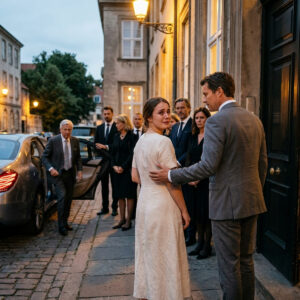
The golden glow of the chandelier in the Maple Street mansion didn’t feel like warmth to Maria; it felt like a spotlight on a crime scene. It was a Saturday evening, their fifth anniversary, and the house was packed with fifty guests—mergers, acquisitions, and high-society ghosts dressed in designer silk. Maria stood in her own kitchen, smoothing the fabric of a cream-colored dress she’d found on a clearance rack three months ago. She had spent five years learning the art of the “slow-motion” disappearance, gradually shrinking her voice, her needs, and her presence until she was little more than a whisper in the halls of her own life.
Liam, her husband, moved through the crowd with the practiced grace of a shark. He was a tech executive, a man who viewed relationships as assets to be leveraged or liquidated. He had insisted on this party, not to celebrate five years of partnership, but to maintain a reputation. To Liam, Maria wasn’t a wife; she was an accessory that had gone out of style. As she watched the caterers arrange silver trays, Maria didn’t know that the cold calculation in her husband’s eyes was about to manifest into a public execution of her dignity. She didn’t know that a dark silver car was currently navigating the quiet streets toward her driveway, carrying a man who held the missing pages of her history.
The party was a sea of bold reds and shimmering golds. Maria, in her modest cream dress, felt like a smudge of pencil lead on a vibrant canvas. She had tried to suggest a quiet dinner at the Italian place where they had their first date—a place that smelled of oregano and old-world comfort—but Liam had laughed. “We’re not college kids anymore, Maria,” he’d said, his voice carrying that sharp, condescending edge that had become the soundtrack of her marriage.
Earlier in the evening, Scarlet, Liam’s mother, had cornered her by the bookshelf. Scarlet was a woman who wore judgment like a designer fragrance—expensive and impossible to ignore. She had looked Maria up and down with a resigned disappointment that cut deeper than any insult. “You look like the help, dear,” Scarlet had whispered, her voice a low, lethal hum. “But I suppose you are what you are. Liam knew what he was getting when he married you.”
The psychological toll of those words settled into Maria’s bones. She had spent years believing that if she just became “suitable” enough, the coldness in the house would thaw. But as Liam found her twenty minutes later and asked her to help pass drinks because the professional servers were “overwhelmed,” the truth began to crystallize. He didn’t want a partner; he wanted an invisible laborer who could be trotted out when convenient and ignored when not. “Don’t embarrass me, okay?” he’d said, his smile tightening into a warning. “These people are important.”
Maria picked up a tray of champagne, moving through the rooms of her own home like a ghost haunting a gala. Most guests took glasses without looking at her, their eyes fixed on the next “important” person in the room. Near the back window, she caught the low murmur of voices. It was Liam and his friend Roger, a sharp-featured lawyer who handled Liam’s most private affairs.
“Once the papers are signed, everything transfers to you,” Roger said, his voice professional and detached. “Clean and simple. She won’t have any claim.”
Maria’s hand trembled, the champagne glasses clinking softly on the tray. She froze, the air in the room suddenly feeling thin and metallic.
“And she won’t suspect anything?” Liam asked.
“Why would she? You’ve been careful. She trusts you,” Roger replied, sipping his wine with a smirk. “By the time she realizes what’s happened, it’ll be too late to contest anything.”
The coldness that had been growing in Maria’s chest for years finally turned to ice. She told herself she was overreacting, that they were talking about a client, a merger, a business deal. But the way Liam looked over his shoulder toward the kitchen made her stomach turn. She retreated to the shadows, a server in a cream dress, watching her life being liquidated in real-time.
An hour later, the sharp ring of a spoon against a glass silenced the room. Liam stood in the center of the living room, bathed in the warm light of the chandelier. The guests turned, expecting a romantic toast, perhaps a story about how they met at a bookstore five years ago.
“I need to say something important,” Liam began. He looked at Maria, and for the first time, she saw the “Man with No Heart” clearly. There was no love, no regret, just the cold satisfaction of a hunter closing a trap. “I’ve been pretending for a long time, and I can’t do it anymore. Maria… I want a divorce.”
The silence that followed was visceral. It was a physical weight that pressed Maria against the kitchen doorway.
“I married you thinking you’d grow into this life,” Liam continued, his voice echoing through the silent mansion. “But you’re still the same girl who worked at that bookstore, content with small dreams and smaller ambitions. You’re comfortable being invisible, and I need someone who can stand beside me, not behind me, serving drinks.”
The humiliation was a fire that flooded Maria’s face. Guests shifted uncomfortably, looking at their shoes, their phones, anywhere but at the woman being dismantled in front of them. Roger stepped forward, pulling a folder from his jacket. “The house, the cars, the savings—everything is in Liam’s name alone,” he announced.
“I signed papers…” Maria whispered, her voice finally breaking the silence. “We bought this house together.”
“You signed what I put in front of you, Maria,” Liam interrupted, walking toward her with a terrifying calm. “Did you ever actually read any of those documents? Or did you just trust me and sign wherever I pointed?”
Liam’s hand gripped Maria’s arm, leading her toward the front door as if she were a trespasser. “I think it’s time for you to leave,” he said. The guests parted like the Red Sea, their faces a blur of pity and detached curiosity. Maria felt the tears break free—hot, angry tears that she hated herself for shedding. She was being put out of her own home while her mother-in-law sipped wine and watched.
But as Liam opened the front door to the cool evening air, headlights cut through the darkness. A dark silver car, polished and imposing, pulled up the driveway.
An elderly man stepped out. He carried himself with a quiet, massive authority—distinguished gray hair, sharp eyes, and a suit that spoke of old, unshakable wealth. Two others followed him: a woman with a leather folder and a man with a briefcase.
“Can I help you?” Liam asked, his voice losing its edge for the first time.
The old man ignored him. His eyes were fixed solely on Maria. He walked toward her with measured steps, studying her face as if searching for a ghost.
“Granddaughter,” he said.
Maria blinked, her mind spinning. “I… I don’t understand. I don’t have any family.”
“Your mother’s name was Catherine Whitmore,” the man said. “She left home thirty years ago after an argument. I was stubborn. I let her go. I’ve been looking for her ever since.” He pulled an old, creased photograph from his pocket and handed it to Maria.
The woman in the photo had Maria’s dark hair, Maria’s eyes, Maria’s slight frame. “My name is Edward Whitmore,” the man continued. “I found you three months ago. I’ve been watching from a distance, wanting to understand your life before I approached.”
The atmosphere changed instantly. The guests, who had been watching Maria’s eviction with bored fascination, now leaned in, their eyes wide.
“We wanted to know your character,” Edward said, his gaze shifting to Liam. The warmth in his eyes vanished, replaced by a cold, surgical hardness. “And we learned about tonight. About the systematic theft and fraud. About the property transfer documents with forged signatures.”
Liam’s face went gray. “I don’t know what you’re talking about.”
The man with the briefcase stepped forward, opening it to reveal a mountain of evidence. “We’ve had investigators tracking your transactions for fourteen days,” the attorney said. “Bank account manipulations, forged refinancing papers—we have it all.”
Edward looked at the sharp-featured Roger, who was trying to slip back into the crowd. “I wouldn’t leave, Mr. Roger. The authorities are on their way.”
As the blue and red lights of police cars appeared at the end of the street, the “Golden Moment” of Liam’s life turned into a nightmare. Handcuffs clicked around his wrists in the middle of his own living room. Roger was led out beside him. The guests fled like roaches in a sudden light, suddenly remembering early morning meetings. Within twenty minutes, the house was empty of Liam’s “important” people.
Edward sat beside Maria on the couch. “I have a guest house on my estate,” he said gently. “You can stay there as long as you need. No expectations.”
Maria looked around the living room. She saw the expensive furniture Liam had chosen, the art she’d never liked but never dared to criticize. For five years, she had accepted crumbs and called it a feast.
“I don’t want to stay here,” she said. She picked up her purse—nothing else. She didn’t want the designer life Liam had stolen for her; she wanted the life she had almost forgotten she possessed.
Three months later, Maria sat in Edward’s study, but she wasn’t passing drinks. She was reviewing property investment proposals. She had started taking business courses, learning to read the fine print so she would never again sign her life away to a man who didn’t value her soul.
“What do you think of the commercial development proposal?” Edward asked.
Maria studied the clause, her finger tracing the text. “The environmental impact assessment seems incomplete,” she said firmly. “We should request more detailed studies before committing.”
Edward smiled. 3 months ago, Maria would have said “whatever you think is best.” Now, she was learning that taking up space wasn’t selfish—it was necessary.
Maria’s story is a reminder that the quietest pain often speaks the loudest truth. She had to lose a house she never really owned to discover a dignity she had never truly lost. Liam’s “unsuitable” wife was actually a woman of immense depth and character, hidden under layers of forced silence.
The lesson of Maria and Edward is that karma isn’t just a punishment for the cruel; it is a restoration for the kind. Some bridges don’t need rebuilding, and some versions of ourselves are better left in the past. Maria is no longer shrinking. She is painting again—small watercolors of the garden at sunset. And when Edward asks to buy one, she says no. “Not yet,” she tells him. “This is mine. I need something that’s just mine for a while.”
Call to Action: Have you ever felt like you were making yourself “small” for someone else? Have you ever had a moment where you realized your worth was far greater than the life you were living? Share your story of rebuilding and reclaiming your voice in the comments below. We read every single one. Don’t forget to subscribe for more stories about the power of resilience and the inevitable reach of karma.
Disclaimer : This content may be created by AI for entertainment purposes. Any resemblance to real persons, events, or places is coincidental.






