The Duke of the Yellow Cab: When Karma Parked at the Golden Mansion
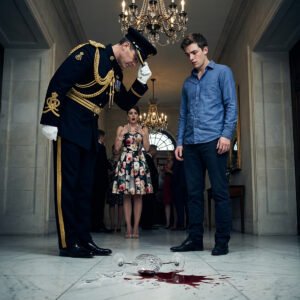
The air inside the Aster Street mansion was thick with the scent of gardenias and the suffocating weight of generational expectations. Sunday dinner at the Waywrights’ was never merely a meal; it was a staged performance of wealth, a choreographed display of “old money” elegance designed to remind every participant exactly where they stood in the social hierarchy. But on this particular evening, the script was about to be shredded by a man who had spent the last six months navigating the gritty, neon-lit streets of Chicago behind the wheel of a yellow cab.
Maya Waywright stood in the foyer, her heart a fluttering bird against her ribs. She was the “black sheep”—the artist who preferred paint-stained denim to silk, the woman who saw value in people rather than portfolios. Beside her stood Oliver. To Maya, he was the man who made her laugh until her sides ached, the one who listened to her dreams about art schools for underserved children with a quiet, intense sincerity. To the rest of her family, he was a nameless intruder from the “lower rungs” of society.
The tragedy of the Waywrights was that they were blind to everything but the polish on a shoe or the title on a business card. They didn’t know that the man they were about to mock was the living embodiment of the very prestige they were desperately clinging to. As the heavy oak doors swung open, the collision of two worlds began—a collision that would leave one sister crowned in love and the other drowning in the wreckage of her own cruelty.
The limestone walls of the sitting room seemed to shrink as Felicia Waywright appeared in the doorway. Felicia, thirty-two and calcified by bitterness, carried her wine glass like a scepter. She was the family’s “prize,” a beautiful socialite currently tasked with marrying a wealthy, albeit odious, Lord to save the family from the silent rot of bankruptcy.
The moment her eyes landed on Oliver, the poise she had spent decades perfecting vanished. Her face went rigid, draining of color until she looked like one of the marble statues lining the hall. She didn’t see a boyfriend; she saw a “ghost” from her morning commute.
“You cannot be serious,” Felicia whispered, her voice cracking with a jagged edge of disgust. “Maya, you’re dating my cab driver.”
The silence that followed was visceral. Margaret Waywright, the family matriarch, froze. Ronald, clutching his third scotch, looked up with a confused, watery gaze. The air grew cold, sterilized by a judgment so sudden and sharp it felt physical. Felicia took a step forward, her heels clicking like a countdown on the marble floor. She didn’t see the man who loved her sister; she saw the person she had spent months belittling for a five-dollar tip. For the next five minutes, the room became a theater of cruelty.
Felicia didn’t just insult Oliver; she dissected him. She called him a “parasite,” a “social climber” who had surely done his research on the Waywright address to “play the long game” with a naive rich girl. She mocked his clothes, his profession, and his very presence in their home.
“I paid this man to drive me around the city,” she spat, gesturing to Oliver as if he were a piece of faulty furniture. “He’s a servant, Maya. You’re parading a servant through our home like he belongs here.”
Maya stood her ground, her voice shaking with a mixture of grief and fury. She spoke of Oliver’s kindness, his respect, and the way he treated her like a human being—concepts she noted were clearly foreign to her sister. But Felicia was relentless. She painted a picture of a man sizing up the silverware, calculating what he could steal.
Oliver remained unnervingly still. He didn’t shout. He didn’t defend himself. He watched Felicia with a gaze that wasn’t filled with anger, but with a profound, clinical sadness. He was seeing the exact thing he had flown across the Atlantic to escape: a heart so consumed by status that it had lost the capacity for empathy. Margaret Waywright finally spoke, her voice like a sheet of ice, requesting that the “young man” leave their home immediately.
Oliver’s hand was on the heavy brass handle of the front door, ready to retreat into the anonymity of the Chicago night, when the doorbell rang. It was an insistent, rhythmic sound that cut through the tension like a blade.
Margaret opened the door, her face a mask of irritation, only to be met by three men who seemed to have stepped out of another century. They wore dark uniforms with crisp lines, their postures military-straight, and on their chests gleamed the unmistakable insignia of the British Royal House.
Chief Royal Guard Thomas Brennan didn’t wait for an invitation. He stepped past Margaret, his eyes scanning the room with the precision of a hawk until they locked onto the man in the button-down shirt and slacks. Brennan crossed the foyer, the heavy thud of his boots echoing against the marble, and stopped directly in front of Oliver.
In a movement that made Felicia’s wine glass slip from her hand and shatter into a thousand glittering shards, Brennan bowed low—a deep, ancient gesture of absolute fealty.
“Your Grace,” Brennan said, his crisp British accent ringing through the vaulted room. “The Duke of Harrington.”
The world stopped spinning for the Waywrights. The “cab driver” was the 12th in line to the British throne, the owner of the Harrington Estate, a man whose ancestral manor had stood for twelve generations. Oliver Hail was not a social climber; he was the social peak.
The psychological shift in the room was nauseating. Margaret’s face drained of color as she realized she had just kicked a multi-millionaire duke out of her house—the very salvation she had been praying for. Felicia leaned against a chair, her breath coming in strangled gasps. They hadn’t just made a mistake; they had revealed their souls to the one person who had the power to change their lives.
Oliver turned to face them, his voice now carrying the natural authority of his station. He didn’t gloat. He didn’t yell. He spoke with the devastating clarity of a man who had seen behind the curtain. “If you had known,” he said, glancing at the shattered wine glass, “you would have treated me like royalty. And that is precisely the problem.”
He explained his journey—the suitcase, the taxi license, the desperate need to find someone who loved Oliver, not the Duke. He looked at Maya, the only person in the room who hadn’t changed her expression based on his title, though her eyes were brimming with tears of betrayal.
In the wreckage of the Waywright sitting room, Oliver offered Maya a choice. He didn’t offer her jewelry or a title; he offered her the realization of her dream—an empty building on his estate where she could finally build the art school she had talked about during those long, rainy cab rides.
“They mock your dreams,” Oliver said gently, taking Maya’s shaking hands. “They call your kindness a weakness. Come with me to London. Leave these people who only measure human worth by job descriptions.”
Felicia lurched forward, her voice a pathetic whimper, begging for a forgiveness that she hadn’t earned. Margaret tried to negotiate, her mind already calculating how to spin a “Duke in the family” to the bank. But it was too late. The “Golden Source” of their salvation was walking out the door.
Maya looked back at her sister one last time. “You were right about one thing, Felicia,” she said quietly. “I do have a thing for strays. But I choose people who have good hearts underneath, not just good breeding on top.”
The convoy of black SUVs, British flags fluttering on the hoods, pulled away from the curb, leaving the Aster Street mansion to fall into the silence of its own looming foreclosure.
The story of the Duke and the artist is a modern parable of the “Golden Rule” in reverse. It reminds us that our true character is not revealed in how we treat our equals or our superiors, but in how we treat those we perceive to possess nothing.
Felicia saw a cab driver and chose cruelty, unknowingly burning the bridge to her own survival. Maya saw a human being and chose kindness, unknowingly walking into a fairy tale. The universe, in its occasional moments of poetic justice, proved that while status can be faked and fortunes can be lost, the quality of one’s soul is a permanent currency.
As the private jet leveled out over the Atlantic, heading toward a new life in London, Maya leaned back and asked one last question: “What do you call a duke who pretends to be a cab driver?”
Oliver groaned, a smile tugging at his lips. “Please, don’t.”
“A royal pain in the back seat.”
They laughed together, the sound echoing through the cabin—a sound of genuine joy that no title could buy and no cruelty could ever silence.
Call to Action: Have you ever seen someone’s true colors revealed by how they treated a stranger? Or have you ever been underestimated because of your job or status? We want to hear your stories of karma, kindness, and standing up for the “black sheep.” Drop your thoughts in the comments below—and tell us, what city are you reading this from?
Disclaimer : This content may be created by AI for entertainment purposes. Any resemblance to real persons, events, or places is coincidental.






