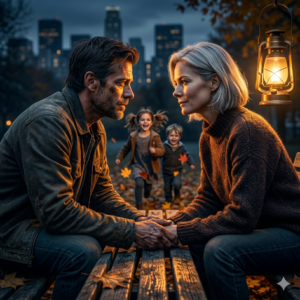
Their First Date Was Magic—Until She Whispered, “You Can Go… I’m Raising A Child Alone”
In the rhythmic hum of a city that never stops to ask how you’re doing, most people are merely curators of their own facades. We present the versions of ourselves that are easiest to digest—the polished, the unburdened, the free. But for Julian Varga and Carys Thorne, the facade had become a heavy suit of armor. They were both residents of the “invisible demographic,” those who navigate the world with one eye on the clock and a heart perpetually divided between their own needs and the breathing, laughing, crying responsibilities waiting for them at home. Their meeting was a statistical anomaly, a collision of two tired souls in a sea of superficiality. They didn’t realize that their evening together wasn’t just a reprieve from their domestic marathons, but a laboratory of the human spirit. This is the story of a night where a single confession was meant to be an ending, only to reveal that the most profound connections are found not in what we have in common, but in the scars we’ve spent years trying to hide.
Julian Varga wiped the grease from his knuckles with a rag that had seen better decades. It was 5:00 PM on a Friday, and the air in the garage was thick with the scent of burnt oil and cooling steel. Julian was thirty-four, but his hands—mapped with the callouses of fifteen years under chassis and engines—suggested a man who had lived twice that.
“Going somewhere, Jules?” his boss, a silver-haired veteran named Silas, asked with a knowing smirk.
“Just a dinner, Silas. A dinner.”
“You’ve been saying ‘just a dinner’ for three weeks. Go. Change your shirt. The world won’t stop spinning if a transmission has to wait until Monday.”
Julian nodded, but his mind was already miles away. Specifically, it was at his sister’s apartment, where his six-year-old daughter, Leo, was currently being “bribed” with extra cartoons to stay quiet. Julian had been a widower for four years. His life was a tactical loop: wake up at 5:30 AM, make Leo’s oatmeal, pack a lunch with a hand-drawn dinosaur on the napkin, work ten hours, come home, play “space explorer,” and fall asleep during the third page of a bedtime story.
Dating wasn’t just a foreign concept; it felt like a betrayal of the efficiency he’d built to survive. But then there was Carys. They had met on a digital platform for “Old Souls,” and her profile hadn’t been a parade of filtered vacation shots. It had been a photo of a rainy window and a quote about the dignity of silence.
He arrived at The Hearth, a small, dimly lit bistro, twenty minutes early. He adjusted his collar in the rearview mirror, feeling like an impostor in a clean button-down. He wasn’t looking for a spark; he was looking for a witness.
Carys Thorne walked into the bistro with a grace that felt hard-won. She was a restorer of antique books, a woman who spent her days breathing life into crumbling vellum and frayed leather. She understood that anything of value required patience and a gentle touch.
When she sat across from Julian, the awkwardness that usually defines first dates was absent. There was an immediate, gravitational pull. They talked about the smell of old paper and the physics of a well-tuned engine. They laughed about their shared disdain for the “hustle culture” of the city. For two hours, Julian forgot the weight of the mortgage and the looming parent-teacher conference. For two hours, he was just Julian.
But as the dessert menu arrived, the invisible clock began to chime. Julian saw the flicker in Carys’s eyes—the sudden intrusion of the “real world.” Her posture shifted. She pulled her hands back from the table.
“Julian,” she said, her voice dropping into a register that made the candle flame between them shiver. “This has been… more than I expected. Which is why I need to do this now.”
She took a breath, the kind people take before jumping into cold water. “You’re a good man. You’re honest and you’re kind. But you can leave now. I won’t be offended. I’m a single mother. I have a four-year-old son who is my entire world, and I know that’s not what people sign up for when they’re looking for a ‘fresh start.'”
She looked at the exit, her jaw set, bracing for the polite excuse, the “check please,” and the silent walk to the car.
Julian didn’t reach for his coat. He didn’t even blink. He let the silence settle, a heavy, velvet curtain over the bistro. He watched Carys, seeing the way she clutched her napkin—a mirror of every time he had been the one to deliver the “bad news” to a potential partner.
“Is that the part where I’m supposed to run?” Julian asked softly.
Carys blinked, her defenses faltering. “Most people do. It’s a lot of ‘baggage,’ Julian. It’s a life that’s already full. I’m not looking for a hero, I’m just being fair to you.”
Julian reached into his back pocket and pulled out his wallet. It was worn leather, bursting with receipts. He fished out a small, laminated photograph—one he hadn’t shown anyone outside his family in years. He slid it across the table.
It was Leo, covered in flour, holding a wooden spoon like a scepter.
“That’s Leo,” Julian said. “She’s six. She thinks she can talk to cats, and she’s the reason I have grease under my fingernails and holes in my favorite socks. I’m a single dad, Carys. I’ve been making pigtails and reading The Very Hungry Caterpillar for four years.”
Carys picked up the photo. Her eyes welled with a mixture of shock and a relief so profound it looked like pain. “You… you have a daughter?”
“I have a world,” Julian corrected. “And I wasn’t going to tell you until I knew if you liked the man I am when I’m not ‘Dad.’ But it turns out, I can’t separate the two. I don’t see your son as baggage, Carys. I see him as the reason you have that depth in your eyes.”
The date didn’t end. It evolved. The conversation shifted from movies and books to the beautiful, exhausting reality of their “hidden worlds.” They talked about the guilt of leaving their children for an evening, the strange loneliness of being the only adult in a room at 3:00 AM during a fever, and the sheer, unadulterated joy of a first tooth.
But as the night drew to a close, a different kind of truth emerged.
“My son’s name is Arlo,” Carys whispered as they walked toward the parking lot. “His father… he was an architect. A brilliant one. But he couldn’t handle the ‘structure’ of a family. He left before Arlo could even crawl.”
Julian stopped in his tracks. “What was his name? The architect?”
Carys looked at him, puzzled. “Bastian Sterling. Why?”
Julian felt the ground tilt. “Bastian Sterling? The one who designed the new Civic Center downtown?”
“Yes. Why do you look like you’ve seen a ghost?”
Julian rubbed his face. “Small world is an understatement, Carys. Bastian Sterling was my wife’s brother. He’s Leo’s uncle. He disappeared from our lives the same month my wife died. He told us he was going to Europe for a project, and we never heard from him again.”
The plot twist hit them like a physical wave. They weren’t just two strangers on a date; they were the guardians of the same fractured family tree. The “invisible worlds” they had been protecting were, in fact, two halves of a broken whole.
The weeks that followed were a delicate dance of integration. They didn’t rush the children together. First, Julian met Arlo at a park, helping the boy fix a broken toy truck with the same precision he used on Ferraris. Then, Carys met Leo in the library, showing her how to use a magnifying glass to see the “hidden forest” inside an old book.
When the day finally came for the four of them to meet, it wasn’t at a fancy restaurant. It was in Julian’s backyard, under the shade of an old oak tree.
Leo and Arlo looked at each other with the suspicion only children can muster.
“Is he going to play with my LEGOs?” Leo asked, hands on her hips.
“Only if you show him the right way to build a castle,” Julian said.
Within thirty minutes, the two children were in a pile of plastic bricks, arguing about whether a dragon should have a balcony. Julian and Carys sat on the porch steps, watching the chaos.
“We almost didn’t have this,” Carys said, leaning her head on Julian’s shoulder.
“We almost stayed in our own silos,” Julian replied. “I thought understanding was a luxury. I didn’t realize it was a foundation.”
One year later, the house Julian and Carys shared was a symphony of mixed sounds: the clink of wrenches, the rustle of turning pages, and the thunderous footsteps of two children who no longer knew what it felt like to be a “secret.”
Julian had left the commercial garage to open his own shop—The Archive & Anvil—where he restored classic cars while Carys restored the books that belonged in their gloveboxes.
Bastian Sterling never returned. They didn’t need him to. They had built a structure he was too small to understand—a family founded not on blood or legalities, but on the courage to stay when the world whispers that it’s easier to leave.
Julian stood in the kitchen one morning, watching the sun hit the table where Carys was teaching Arlo how to press a wildflower. Leo was sitting on the floor, “helping” Julian’s sister with her hair.
He realized then that the most powerful form of love isn’t the kind that finds someone perfect. It’s the kind that finds someone who is already carrying a heavy load and says, “Let me help you with that. I know a shortcut home.”
I realized then that life is just a series of first dates, and the best ones are the ones that never end.
Disclaimer : This content may be created by AI for entertainment purposes. Any resemblance to real persons, events, or places is coincidental.






