The Biker and the Veteran: A Fake Favor that Forged an Unbreakable Bloodline
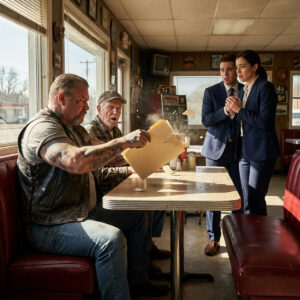
The air inside the Redwood Trail Diner was heavy with the scent of burnt coffee and the metallic tang of an approaching mountain storm. It was exactly noon on a Thursday—a time when the town usually settled into a predictable, sleepy rhythm. But predictability died the moment the low, guttural thunder of motorcycle engines vibrated through the floorboards. Five heavy machines, chrome gleaming under the overcast sky, settled outside like a squadron of heavy artillery.
When the riders stepped inside, the usual diner clatter—the scraping of silverware, the hum of the refrigerator—stalled into a collective held breath. These were men in worn leather vests, patches stitched with symbols that signaled a life lived on the fringes of the law. They moved with the unhurried, dangerous confidence of those who never have to ask for space because it is instinctively surrendered to them.
At the center of this group was Cole. Tall, broad-shouldered, with iron-gray hair tied back and a face carved by decades of sun, wind, and hard choices. He scanned the room with eyes that missed nothing, eventually settling into the corner booth with his crew. They were the “Iron Serpents,” and to the people of Maple Ridge, they were a force to be avoided.
But on this day, the most dangerous thing in the room wasn’t a biker. It was the crushing weight of a lonely man’s desperation.
Walter Hayes was 73 years old, a retired infantry sergeant whose body was a roadmap of past wars. His knees ached from the cold of long-forgotten trenches, and his spine carried a heavy, invisible burden that had nothing to do with age. He was a regular—tea with lemon, toast, and a polite smile for Lena the waitress.
But today, Walter wasn’t smiling.
His hands shook so violently that his spoon rattled against the porcelain saucer like a frantic heartbeat. Lena watched him from the counter, recognizing the look in his eyes: it was the look of a man who had run out of time and ammunition. Slowly, Walter rose. He didn’t head for the exit. Instead, he adjusted the brim of his old service cap and began a slow, agonizing trek across the checkered floor, straight toward the booth where Cole sat.
The diner went deathly quiet. One biker stiffened; another leaned back, eyes narrowing. Cole didn’t move. He simply watched the small man approach. Walter stopped at the edge of the table, clutching a worn manila envelope to his chest like a bulletproof vest.
“Sir,” Walter said, his voice raspy but disciplined. “I know this is strange. I know I shouldn’t be asking. But my nephew is meeting me here in fifteen minutes. He’s bringing legal papers. I was told it would be a quick signature… but I’ve learned it isn’t what he says it is.”
Walter swallowed hard, his fingers white-knuckled against the envelope. Then came the question that tilted the room on its axis.
“I don’t have anyone with me today. Would you… just for today… pretend to be my son?”
For a few agonizing seconds, the only sound was the hum of the fluorescent lights. One of the bikers started to snort in derision, but Cole silenced him with a single, sharp lift of his hand. Cole studied Walter’s face—not as a predator looking for weakness, but as a man measuring the weight of a soul. He saw the “thousand-yard stare” of a fellow warrior and the posture of a man who had been betrayed by the very systems he once protected.
Lena the waitress moved in then, ostensibly to refill coffee. She leaned in close to Cole and whispered a warning that changed everything: “They’re trying to take everything he has. I heard them last week. Power of attorney. They want to sign his life away between bites of pie.”
Cole’s jaw tightened. He looked at Walter, who stood there braced for the blow of a rejection, shoulders squared even as his knees threatened to give out.
“Sit down, Dad,” Cole said. The voice was calm, but it carried across the diner like a command. “You look like you’ve been standing too long.”
Walter’s breath hitched. As he slid into the vinyl booth, the leather creaked under the weight of an alliance no one saw coming. Cole draped a massive, tattooed arm around the old man’s shoulders. It wasn’t just a gesture; it was a wall.
“We were just waiting for you,” Cole added, his voice projecting to the rest of the room. “Family lunch.”
The bell above the door rang again, sharp and intrusive. Evan Brooks, Walter’s nephew, stepped inside with the polished arrogance of a man who believes he’s already won. He carried a slim leather briefcase—a quiet promise of a predatory victory. His wife, Maryanne, followed half a step behind, her eyes scanning the diner with the irritation of someone forced to visit a lower-class establishment.
They spotted Walter’s usual booth and stopped dead.
Walter wasn’t the broken, isolated old man they expected to find. He was seated at the center of a half-circle of leather-clad muscle. Evan’s rehearsed smile faltered as he approached.
“Uncle Walt,” Evan said, his voice too bright, too fake. “I thought we agreed this would be quick.”
Cole didn’t let Walter answer. He took a slow, deliberate sip of coffee, set the mug down with a heavy thud, and looked Evan dead in the eye.
“We’re having lunch,” Cole said evenly. “You’re interrupting family time.”
Evan let out a dry, nervous laugh. “Family? Uncle, what is this? Who is this man?”
“I’m his son,” Cole replied. The words landed like a lead pipe on a glass table.
“That’s not funny,” Evan snapped, his face reddening. “He doesn’t have a son.”
Cole leaned forward just enough to make the booth groan. “Careful. That’s a strange thing to say about someone’s father. Maybe you haven’t been paying enough attention, Evan.”
Maryanne, losing her patience, snapped open the briefcase and shoved a thick folder toward Walter. “This is for your benefit, Walter. The doctors agree. This will make your care so much easier.”
Cole didn’t let Walter touch them. He extended his own calloused hand, palm up. “Let me see the papers.”
Evan hesitated. He looked at the four other bikers who had now shifted their weight, their collective presence creating a physical barrier of intimidation. Trembling, Evan handed over the folder.
Cole didn’t read them. He looked Evan in the eye, gripped the edges of the legal documents, and with a sudden, violent motion, tore the entire folder in half. The sound of ripping paper was loud and final. He tore them again, and again, until the “medical confirmations” and “power of attorney” forms fell onto the table like confetti at a funeral for a scheme.
“That’s not happening,” Cole growled. “Any doctor you bring near him will answer to ours. Any lawyer you call will be speaking to ours. And you?” He paused, the silence stretching until Evan looked ready to bolt. “You’re done.”
Evan’s face went ghostly pale. He realized in that moment that his control had evaporated the second Walter stopped being alone. Without another word, he and Maryanne fled the diner, the bell jingling in sharp retreat behind them.
The diner remained wrapped in a fragile, stunned silence long after the vultures had vanished. Walter stared at the shredded remains of his captivity, his breathing ragged. The adrenaline that had kept his spine straight began to ebb, replaced by the sheer magnitude of the rescue.
His composure broke. He bowed his head, and for the first time in months, the tears came—soundless, heavy, and unrestrained. Cole, a man clearly uncomfortable with raw emotion, stiffened for a heartbeat. Then, he did the only thing a “son” would do. He wrapped his arm firmly around Walter’s back and pulled him close.
“You’re all right,” Cole whispered. “No one is taking anything from you.”
The diner erupted. An elderly man at the counter began to clap, followed by a couple in the back, then the entire room. It wasn’t an ovation for a show; it was a salute to a man who had finally found his voice.
But as the bikes roared to life outside to escort Walter home, everyone knew this wasn’t just a one-afternoon favor.
Real life doesn’t have credits that roll when the conflict ends. The Iron Serpents escorted Walter’s old sedan back to his small house on Cedar Lane, a convoy of chrome protecting a man who had spent too long in the shadows.
Inside the house, they didn’t just leave. One rider fixed a loose hinge on the front gate. Another checked the window locks. Before they left, Cole handed Walter a prepaid phone with a single number programmed into it. “You press it, we answer. Doesn’t matter what time.”
Walter didn’t call for three days. But when a pipe burst under his sink at midnight, he looked at that phone. Within forty minutes, two bikers were in his kitchen with wrenches and mops. No questions asked.
Slowly, the visits changed. They stopped being about repairs and started being about presence. Walter began showing up at the Iron Serpents’ clubhouse, not with legal papers, but with pots of homemade chili and stories of his days in the infantry. The bikers, men who lived by a code of silence and loyalty, understood Walter in a way his own blood never could.
The story of Walter and Cole is a powerful reminder that “family” is not always a matter of DNA. Sometimes, the people who share our blood are the ones most willing to spill it for their own gain. And sometimes, the people we fear the most are the ones who carry the exact kind of shield we need.
Walter Hayes asked for a performance, but he received a life. He asked for a son for an afternoon, and he found a brotherhood for his final years. It proves a universal truth: courage is contagious. When we stand up for ourselves, we often find an entire army standing right behind us, waiting for the signal to advance.
Have you ever had a “stranger” become more like family than your own relatives? Or have you ever stepped in to protect someone who had no one else? Share your story in the comments—your words might be the hope someone else is looking for today.
Disclaimer : This content may be created by AI for entertainment purposes. Any resemblance to real persons, events, or places is coincidental.






