The Cow, the Orphaned Brothers, and the Chief’s Daughter
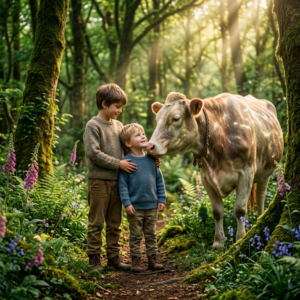
The air in the small hut was heavy with the metallic scent of sickness and the stifling weight of a mother’s final breaths. This was the beginning of a saga that would span years, traveling from the depths of a mystical forest to the blood-stained fields of tribal warfare. In the flickering firelight, the first wife of a man with two households realized her time had run out. She looked upon her two sons—vulnerable, wide-eyed, and trembling—and reached out a frail hand to draw them close for a final, harrowing goodbye.
CHAPTER 1: THE DYING VOW AND THE BITTERNESS OF THE STEPMOTHER
The mother’s eyes, clouded by fever yet sharp with maternal desperation, locked onto her children. “My dear children,” she whispered, her voice a dry rasp against the silence of the room, “soon I will die. Now kiss me and say goodbye.” The boys collapsed against her, their tears soaking into her linen wraps. They weren’t just mourning a parent; they were mourning their future safety. “Mother,” they choked out, “our father’s second wife hates us. If she doesn’t give us food, what shall we do?”
It was a valid terror. In a world where survival depended on the grace of the one who held the ladle, they were now outcasts. But the dying woman gave them a secret—a spiritual anchor to hold onto when the world turned cold. “Don’t worry,” she breathed, her final words a sacred prophecy. “When you are hungry, go into the forest. You will find someone to feed you there.”
With that, the light left her eyes. The boys wailed for days, their grief echoing through the compound, but their sorrow was met only with the stony silence of their stepmother. Eventually, hunger overcame their mourning. They approached the second wife, their stomachs tight with cramps. “Please,” they pleaded, eyes downcast, “we are hungry. Let us eat with you.”
The stepmother’s reaction was like a slap. Her face twisted with a cruel, territorial sneer. “What?” she barked, standing tall over them. “You want me to give you food? I don’t have enough for my own children. Go away. I haven’t got anything for you.” She turned her back, the finality of her rejection signaling a slow death by starvation.
CHAPTER 2: THE MIRACLE OF THE GOLDEN FOREST
The younger brother began to sob, the hollow ache in his belly becoming unbearable. “I’m hungry,” he whimpered. “I want something to eat.” The older brother, feeling the weight of his mother’s mantle fall upon his shoulders, gripped his brother’s hand. He felt the small, trembling fingers and remembered the promise. “Don’t worry,” he said, his voice finding a strength he didn’t know he possessed. “Remember what our mother said. We will go into the forest and find someone to feed us there.”
They stepped away from the cruel compound and into the emerald shadows of the great woods. There, among the ancient roots and dappled sunlight, they found their savior: a cow. This was no ordinary animal. Her eyes held an ancient, maternal kindness, and she stood still as the children approached. Every day, without fail, she provided them with sustenance. They would return to the village with bright eyes and strong limbs, their hunger a distant memory.
The second wife’s children were baffled. They watched their stepbrothers with suspicious, narrowed eyes. “Who feeds you?” they demanded, their voices laced with envy. “Why are you never hungry? And why do you go to the forest every day?”
One morning, the oldest girl of the second wife decided she would no longer be left in the dark. “I’m coming with you today,” she announced, her tone leaving no room for argument. “I want to know where you find your food.” The brothers tried to shield their secret, their hearts racing with the fear of discovery. “No, don’t come,” they urged. “You’ll be tired and hungry. We just walk all day until we’re exhausted.”
But the girl was relentless. She followed them deep into the heart of the trees until they arrived at the cow’s hidden glade. The older brother tried to maintain the silence, but the younger boy, driven by his natural appetite, couldn’t hold back. “Please, I’ll die if I don’t have some food,” he cried out. “Call the cow and let’s eat.” They called, and the miracle revealed itself. The girl watched in stunned silence as the cow nourished the boys. The secret was out.
CHAPTER 3: THE WICKED DEMAND AND THE POWER OF THE INNOCENT
When the girl returned home, she whispered the truth into her mother’s ear like a poisonous draft. The next day, the stepmother, fueled by spite and a calculated greed, approached her husband. She played upon her pregnancy, her voice thick with manipulation. “Husband,” she said, stroking her belly, “our new baby will soon be born. I need to eat very good food. If I don’t eat well, the baby won’t be strong. Bring me the cow from the forest.”
The husband was confused. “What cow? I don’t have a cow.” The woman’s eyes flashed with anger. “I know your secret. I want the cow that feeds your children.” Under the pressure of her rage, the husband relented. He led the gentle animal from her forest sanctuary into the village.
“Kill it,” the woman commanded, her eyes cold as flint. “I must eat its meat.” The husband argued, feeling a strange hesitation, but her will was absolute. He raised his knife and cut the cow’s throat—but the cow refused to die. The blade drew no final breath; the animal stood as if protected by a divine shield.
The stepmother’s cruelty reached its zenith. “If the cow doesn’t die, I will kill your two children,” she screamed. The boys, hearing this horrific ultimatum, realized their protector was willing to sacrifice herself for them. With heavy hearts, they whispered, “Let the cow die.” And she died.
The cycle of supernatural resistance continued. The skin would not come off the meat until the children commanded it. The meat would not cook in the pot until the children allowed it. The pot would not move from the fire until the children gave the word. Each step was a testament to the boys’ connection to the cow’s spirit. Finally, the woman gorged herself on the meat, thinking she had won. But the boys knew they were no longer safe. “Our stepmother has killed our cow and now she wants to kill us,” they whispered in the dark. “We must run.”
CHAPTER 4: THE STRANGER IN THE DARK AND THE SHADOW OF SMALLPOX
The brothers fled into the forest, but the dense undergrowth and the panic of the night separated them. They lost each other among the trees, one going east and the other west. Years passed. The older brother remained near the edges of the forest, growing into a strong, silent man who lived in the shadows of the village.
One day, he saw her: the daughter of the local Chief. She was a vision of grace, the most beautiful of all the Chief’s many daughters. They began to meet in secret, their love blooming in the quiet moments between the trees. But the world outside was not peaceful; a brutal war had erupted between neighboring villages.
Every night, as the sun dipped below the horizon and the enemies crawled toward the village, a mysterious stranger would appear in the tall grass. He fought with the ferocity of a lion, standing shoulder-to-shoulder with the Chief, his spear a blur of motion in the moonlight. He would vanish before the first light of dawn.
The Chief was moved by this loyalty. “Who is the stranger who comes every night and fights beside me?” he asked his men. “I want to meet him.” His advisors suggested he ask his daughters. So, a grand meeting was called. “Bring your husbands and your lovers here so that I can see them all,” the Chief commanded.
The daughters arrived in a procession of pride, accompanied by their suitors. But the young man from the forest was not among the proud. He sat far in the back, huddled in the dirt, his body ravaged by the sores of smallpox. He was weak, his skin scarred, and he could not bear to look the Chief in the eye.
The beautiful daughter didn’t hesitate. She broke away from the crowd and ran to the sick man, taking his scarred hand in hers. “What are you doing?” the Chief roared, his face turning purple with rage. “Come away from that man! He has smallpox!”
But the girl stood her ground, her voice ringing out over the gasps of the village. “Father, this is the man who fights beside you every night. He is brave and strong. I love him and I want to marry him.”
CHAPTER 5: THE FINAL CURSE AND THE RESTORATION OF BALANCE
The Chief’s anger was a physical force. He began to shout, intending to banish the stranger and punish his daughter for her defiance. But as he opened his mouth, a collective gasp rose from the crowd. “What’s the matter?” the Chief asked, his voice wavering. “Why are you all looking at me?”
“Your head, sir,” the people whispered, their eyes wide with terror. “Look, it’s growing. It’s getting bigger and bigger.”
The Chief reached up. It was true. His head was swelling, expanding with every breath of his arrogance. It was a divine manifestation of his swollen pride. His daughter knelt before him. “Please, father,” she said, her voice calm and wise. “Please let me marry this man. If you don’t, your head will grow and grow. If you do, it will become the right size again.”
The villagers, terrified of the spectacle, pleaded with him. “Yes, sir! Do what she says!” Facing his own monstrous reflection in their eyes, the Chief finally relented. “I agree,” he gasped.
At that moment, the swelling receded. His head returned to its natural size, and the heavy weight of his pride was lifted. The young man of the forest, the orphan who had been fed by a miraculous cow and forged in the fires of war, was married to the Chief’s daughter. The scars of his past—and his sickness—mattered little in the face of a love that had seen through the shadow to the hero beneath.
DEEP REFLECTION: THE SUSTENANCE OF THE SOUL
This story reminds us that even when our earthly protectors vanish, the universe—or the “forest”—finds a way to provide. The cow was not just an animal; she was the personification of the mother’s love, a love that resisted death and remained loyal through the fire and the knife. True bravery was found not just in the man who fought the village’s enemies, but in the woman who dared to hold the hand of the “unclean.” It is a testament to the fact that our external conditions—our hunger, our sickness, our scars—are never as powerful as the promises we keep and the love we choose to defend.
Disclaimer : This content may be created by AI for entertainment purposes. Any resemblance to real persons, events, or places is coincidental.






