When a Stranger’s Smile Becomes a Nightmare
The city is a tapestry of millions of lives, each tucked away behind the perceived safety of a locked door and a warm light. We tell ourselves that our homes are our fortresses—the one place where the chaos of the outside world cannot reach us. But sometimes, the chaos doesn’t just knock; it waits. It watches. It studies the rhythm of our breath through the wood of a doorframe. This is the chilling story of Anna, a woman whose quiet, predictable life was shattered on a rainy November night when she discovered that the thin line between safety and terror can be held in the palm of a stranger’s hand.
CHAPTER 1: THE COLD RHYTHM OF NOVEMBER
Anna’s life was a sanctuary of simplicity. At her job at the bank, everything followed a strict logic: numbers, ledgers, and the steady flow of transactions. Her apartment on the third floor was an extension of this order. It was small, modest, and quiet—a place where the only sounds were the hum of the refrigerator and the occasional creak of the floorboards. She liked her life that way. She found peace in the solitude of her evening routine: cooking a small dinner for one, the steam from the stove clouding the windows, and the soft embrace of her bed.
But November in the city has a way of turning that peace into something more atmospheric, something slightly more hollow. On this particular night, the wind had grown into a low, mournful howl. The rain wasn’t just falling; it was lashing against the glass, driven by a gale that cleared the streets of every living soul. Anna had stayed late at the bank, her fingers flying over the keys to finish extra tasks that had piled up. By the time she reached her building, she was drained—a deep, bone-weary exhaustion that made her apartment feel like the ultimate prize.
She followed her nightly ritual like a prayer. She shed her damp work clothes, the fabric feeling heavy and cold. She brewed a cup of tea, the warmth of the ceramic mug seeping into her tired palms. As she sat on her bed, listening to the soft, percussive rhythm of the rain on the window, she felt a profound sense of calm. The world outside was frantic and wet, but here, she was safe.
At 11:47 p.m., Anna reached for the lamp. The room plunged into darkness, the only light coming from the faint, watery glow of the streetlamps filtering through the curtains. She closed her eyes, letting the sound of the storm lull her toward sleep. She was almost there—in that liminal space where thoughts turn into dreams—when the world changed.
CHAPTER 2: THE MIDNIGHT VISITOR
The sound was slow. It was heavy. It was a knock.
Anna’s eyes snapped open. The darkness of the room suddenly felt thick, like it was pressing against her chest. She held her breath, her ears straining. Maybe I imagined it, she told herself. The mind can play tricks during a storm; a branch hitting a wall, the house settling, a trick of the wind. She waited, her heart beginning to thump a slow, rhythmic warning against her ribs.
Then came the second knock.
This time, there was no mistaking it. It was louder, more deliberate. It carried a weight that suggested a physical presence standing just inches away from where she slept. Anna sat up, her movements stiff. She looked at the clock. The red numbers glowed: 12:00 a.m. Midnight. The hour when the world is supposed to be asleep.
Anna did not get visitors. Not during the day, and certainly not in the dead of a rainy night. She stood up, her bare feet cold on the floorboards, and walked toward the door with the lightness of a ghost. She didn’t open it. She stood there, feeling the cold air seeping through the cracks, and whispered into the wood: “Who is it?”
A man’s voice drifted through the door. It was tired. It was calm. It was the voice of someone who knew exactly how to sound harmless. “Please, I need help,” he said.
The sound of his voice sent a ripple of nervousness through Anna. It wasn’t the plea itself, but the lack of urgency in his tone—a calm that didn’t match the desperation of his words. She leaned forward and looked through the peephole.
CHAPTER 3: THE STRANGE SMILE OF A STRANGER
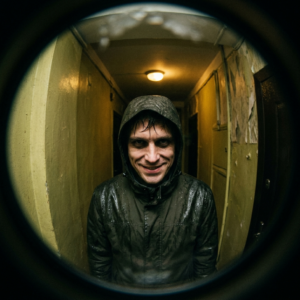
The distorted fish-eye lens of the peephole revealed a man drenched by the storm. He wore a dark jacket, the fabric slick with rain, and his hair was plastered to his forehead. He looked like a man who had been defeated by the elements. “My car broke down,” he said, his eyes searching the door. “Can I use your phone?”
Anna’s mind was a battlefield. One side—the side raised with compassion and social grace—wanted to help. It was a terrible night, and no one should be stranded in such a storm. But the other side—the primal, instinctual side—felt a cold shiver. Something in the man’s eyes felt wrong. They were dark, unblinking, and they didn’t match the vulnerability of his voice.
She compromised with her fear. She cracked the door just a few inches, keeping the heavy security chain taut. “You can use my phone,” she said, her voice steady despite the tremor in her hands. “I will bring it.”
The man smiled. It was a sudden, jarring movement of his lips. But as Anna looked closer, she realized with a shock in her chest that the smile ended at his mouth. His eyes remained cold, calculating, and fixed on her. “Are you alone?” he asked.
The question felt like a physical blow. There was no reason to ask it. It wasn’t important for a phone call. It was a tactical question.
“No,” Anna lied quickly, the words tumbling out as a shield. “My husband will come soon.”
The change in the man was instantaneous. The smile dropped away like a mask. His face became a blank slate, and he looked down at the floor for a heartbeat, as if recalculating his plan. Anna brought her phone and passed it through the crack. He took it slowly, his fingers brushing against hers—a touch that felt like ice.
CHAPTER 4: THE REVELATION IN THE DARK
Anna watched him. He held the phone to his ear with his left hand. But as she listened, she realized there was no sound. There was no beeping of numbers being pressed, no dial tone echoing in the small space between them. He was standing there, in the pouring rain, pretending to speak to someone who wasn’t there.
Then, her eyes drifted to his right hand.
He was keeping it partially hidden behind his back, but as he shifted, the hallway light caught a glint of metal. Anna’s body turned cold. In his hand, held firmly and ready, was a key. Not just any key—it was her key. The silver teeth and the specific shape of the head were unmistakable.
A wave of nausea and terror hit her. How? Had she dropped it in the lobby? Had he been watching her for days, waiting for the perfect moment to snatch it? Had he been outside her door earlier, testing the lock? The realization that he had the means to enter her sanctuary at any moment turned her legs to water.
He lifted his head. The pretense was over. His face remained calm, but his eyes were now voids of dark intent. He wasn’t a victim of a car breakdown; he was a predator who had found the way into the nest.
CHAPTER 5: THE LOCKS AND THE ECHO
Anna didn’t scream. She acted with a sudden, desperate burst of energy. She grabbed the handle and pulled the door shut with everything she had. For a split second, she felt the man’s weight press against the other side—a silent, powerful resistance. But her terror gave her strength. She slammed the door shut and threw every lock she had. The deadbolt clicked. The chain rattled into place. The secondary latch turned.
She leaned her back against the door, her breathing ragged and loud in the small hallway. Her legs finally gave out, and she slid down to the floor, her heart racing so fast it felt like it would burst.
She waited. For a long minute, there was only silence on the other side of the wood. No more knocking. No more pleas for help. Then, the faint, rhythmic sound of footsteps began to walk away, retreating down the carpeted hallway toward the stairs.
Anna called the police, her voice shaking as she described the man in the dark jacket. When they arrived, the hallway was empty. The rain continued to fall, washing away any footprints he might have left on the stairs. He was a ghost in the storm, gone as quickly as he had appeared.
CHAPTER 6: THE WAITING SHADOW
The next morning, the sun rose on a world that looked the same, but felt entirely different. The city was still there, the bank was still there, but the safety of the third floor was gone.
As Anna was leaving, her neighbor, a woman who lived across the hall, stopped her. Her face was pale. “I saw that man last night,” the neighbor whispered. “The one in the dark jacket.”
Anna felt the cold return. “You saw him?”
“He was standing there, Anna,” the neighbor said, her eyes wide. “He waited outside your door for a long time. Maybe twenty minutes. Just standing there in the dark, listening. I thought he was your friend. I thought he was waiting for you to let him in.”
The revelation was the final blow. He hadn’t just arrived when he knocked. He had been standing in the shadows of the hallway for nearly half an hour, listening to the sounds of her nightly routine, waiting for the lights to go out, waiting for her to be at her most vulnerable.
He was not lost. He was not a victim of circumstance. He was a man who had stood in the dark with a stolen key, waiting for a woman who lived alone. Anna eventually moved from that apartment, but she never truly left that night behind. She learned that the world doesn’t always knock to ask for help; sometimes, it knocks to see if you’re alone.
DEEP REFLECTION: THE ILLUSION OF SAFETY
Anna’s story is a haunting reminder of the fragility of our boundaries. We live our lives assuming that the locks on our doors are the final word in our security, but the true threat often lies in the things we lose without noticing—a dropped key, a moment of misplaced trust, or the simple assumption that everyone who asks for help truly needs it. It serves as a testament to the power of intuition; that “shiver” in the chest is often the only thing standing between a quiet life and a tragic end.
Disclaimer : This content may be created by AI for entertainment purposes. Any resemblance to real persons, events, or places is coincidental.






