Single Dad Left Waiting at His Own Office – Then He Fired Them All
Part 1:
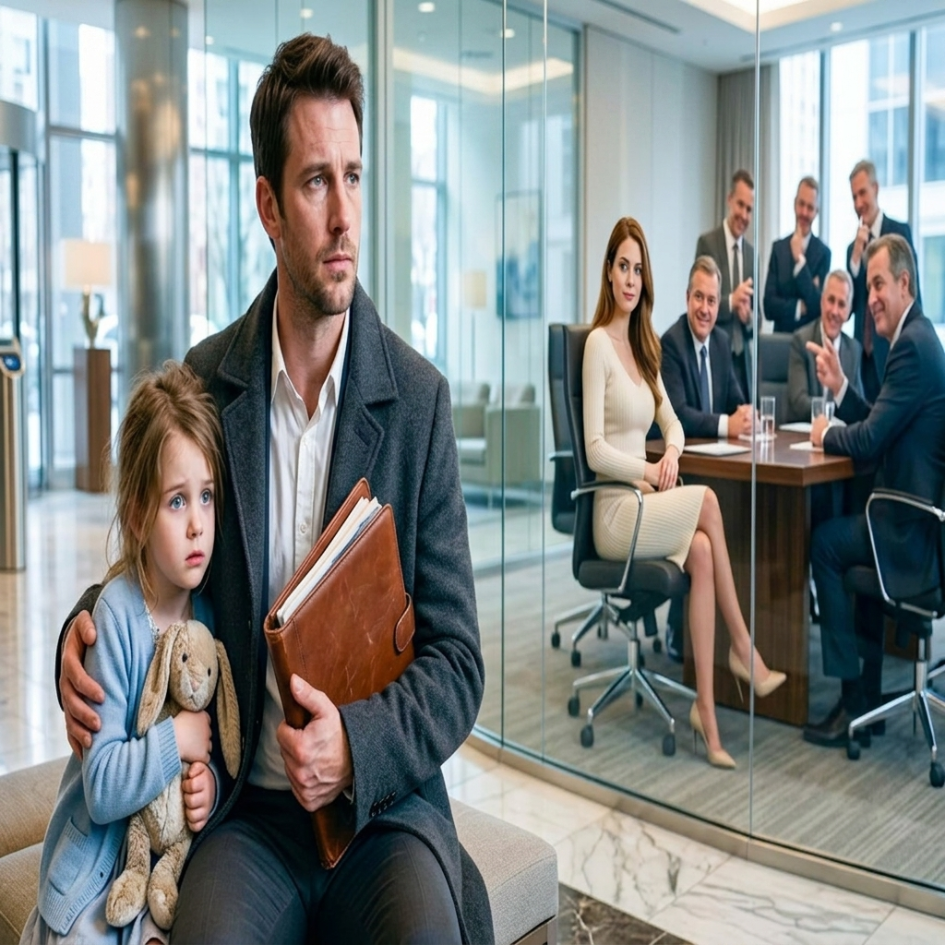
The morning in downtown San Francisco came in cold and silver. The Mercer Meridian Tower rose 64 floors into a slate sky. Its glass face washed pale by the early light. Inside the marble lobby, footsteps echoed across the polished floor as employees in tailored suits crossed toward elevators they had earned the right to use.
Almost nothing in the building remembered why it had been built. A man in a charcoal coat stepped through the revolving door. He was 29 years old, tall, broad in the shoulders, and tired in a way that had less to do with sleep than with what he was carrying. His white shirt was slightly wrinkled. His leather shoes were worn down at the heels.
In one hand he held a worn leather folder. In the other, the small hand of a 6-year-old girl in a pale blue cardigan. The girl was Matilda Mercer. Her hair was a little tousled from the early flight. She held the same stuffed rabbit her mother had once tucked under her arm in a hospital nursery. She looked up at the great silver letters on the wall and read the name slowly to herself.
Then she tugged her father’s sleeve. Daddy, is this the company Mommy used to talk about? Dante Mercer paused. Mercer Meridian. He had not stood in this lobby in 5 years. He nodded once and squeezed her hand. Behind the desk, Constance Whitaker looked up. She was 58 with silver hair pinned neatly behind her ears. The moment she saw him her hands stilled on the keyboard.
She knew him by the way he settled his hand on the small shoulder beside him. But Constance said nothing. She had worked long enough in this building to understand that some men only walked back through their own doors as strangers when they had a reason to. Dante said he had a scheduled interview for an entry-level operations analyst position.
The name on the calendar was not his real name. Constance handed him a visitor badge and gestured to the waiting area. He thanked her and led Matilda over. They sat together on a long bench. At first Matilda watched the elevators rise and fall. As the minutes passed her curiosity faded.
People in tailored suits walked by without looking at them. A young assistant glanced at Dante’s worn shoes and looked away. 10 minutes passed. 20. 40. An hour. No one offered them water. No one asked the child if she was hungry. Dante took a small package of crackers from his pocket and gave it to her. She ate carefully, but a few crumbs fell.
A passing assistant frowned. This is not a daycare, she said quietly and walked on. Dante bent down without a word and gathered the crumbs into his palm. Beyond the glass wall, an executive meeting was already in progress. Calista Reed sat at the head of the table, 28 years old, her chestnut hair loose around her shoulders, a cream V-neck dress, a calm and distant expression.
To her right, Oliver Blackwell, 48, polished, holding a fountain pen between two fingers as if it were a small impatient weapon. Across from him, Zane Caldwell, 45, leaned back with the easy contempt of a man who believed every room belonged to him. Zane glanced through the glass and saw the man on the bench and the little girl with the rabbit. His mouth curled.
Another desperate father, he said, just loud enough for the others to hear, who thinks a button-down shirt is an executive credential. A few directors laughed. Matilda heard. She lowered her head and pressed the rabbit harder against her chest. Dante did not look up. But his fingers closed slowly on the leather folder, the way a man closes his hand on something he has decided not to drop.
10 years before none of this glass had existed. There had only been a small rented warehouse outside Denver, a man in greasy work clothes, and a woman named Rosalind who refused to let him give up. Dante Mercer had not been born to comfort. He had grown up in a Colorado town where his father repaired engines and his mother worked nights as a nurse.
He had earned his engineering degree on a scholarship and three jobs at once. What he had always believed was that technology only earned its name when it served the people no one bothered to count. His first design had been a clean energy storage system meant to keep the lights on in rural hospitals, in country schools, in towns that storms tended to forget.
He had met Rosalind in the cafeteria of a small public hospital. She was not a businesswoman. She did not know how to raise capital. But she believed him. When his first investor turned him down and Dante came home ready to quit, Rosalind had looked across the kitchen table and said simply, “If what you are building can keep an emergency room lit, then it is worth continuing.
” When the rent on the warehouse came due, she had sold her car so they could pay it. Henry Lawson had been Dante’s closest friend since college, a quiet, blunt engineer whose loyalty did not announce itself. The three of them had slept on the warehouse floor in those first months. They had eaten cold meals. They had rebuilt circuits at 3:00 in the morning.
They had survived on faith in something many serious men had told them was impossible. When the prototype finally worked, Mercer Meridian was born. The press called Dante a young genius. He always corrected them. The company had been built by Rosalind’s belief, by Henry’s stubborn intelligence, and by the sweat of those who had stayed when leaving would have been wiser.
Then the bad year came. When Matilda was very small, Rosalind died of a complication that had nothing in it of mercy. A year later, Henry Lawson was killed in a testing accident at a remote lab. Two losses in 12 months. Dante did not have the strength left to stand at the center of anything. He stepped back. He handed daily operations to Oliver Blackwell, to Zane Caldwell, to the leadership team Henry had once helped recruit.
He kept his controlling He kept the founder’s emergency clause buried in the corporate charter. But he disappeared from public view. For 5 years, he lived the life of an ordinary father. He learned to braid his daughter’s hair. He drove her to kindergarten. He read her stories before sleep. He fixed cars in the garage on Saturdays and on Sunday nights he made simple dinners she could help stir.
To the world, he was the missing billionaire who had walked away. To Matilda, he was simply the man who was always there when she woke from a bad dream. The night the email came, the house on the hill was very quiet. Matilda was already asleep, her rabbit tucked under her chin. Dante sat at the kitchen table, his coffee cooling beside him.
On the screen he had opened an old video clip. Rosalind in their first warehouse, her hair tied back, dust on her hands, laughing and saying that one day Mercer Meridian would keep the lights on in places the rich never thought about. A new message blinked at the corner of the screen. The sender was unnamed.
The subject line was a single sentence. They’re selling what Rosalind died believing in. Dante stared at the words for a long time before he opened the message. Inside were 21 attached files. Closed session minutes, side contracts, budget transfers, internal correspondence, an almost finished sale agreement to a corporation called Blackridge Energy.
He read until the sky outside began to turn pale. The picture that emerged was patient and cruel. Oliver Blackwell and Zane Caldwell had been preparing to sell Mercer Meridian to Blackridge Energy, a fossil fuel conglomerate that had circled the company for years. The price was more than 40% below true value. After the sale, Blackridge intended to shut down the clean energy research division, lay off hundreds of engineers, and keep the patents only to prevent rivals from using them.
Every project Rosalind had cared about would die. The backup battery system for rural hospitals, the grid for underfunded schools, the disaster recovery program for storm-broken communities. None of these had been line items to her. They had been the reason the company existed. Oliver was scheduled to receive a personal payout of $95 million if the deal closed.
Zane was promised a board seat at Blackridge. Worse, the directors had spent 18 months quietly cutting research budgets so that Mercer Meridian would look weak on paper, weak enough to justify a cheap sale. The sender was Archie Bennett, a mid-level financial analyst, 31 years old.
Archie had noticed irregularities while reconciling vendor accounts. He had traced shell companies, missing approvals, repeated payment codes. He had not dared report it internally. He had not dared trust the board. The only person he had been able to think of was the founder. Dante did not call the press. Public noise would let Oliver erase the trail.
He did not call the board either because he did not yet know which members had been bought. He decided had to walk into the building himself as a stranger and see what the company had become. In the morning, Matilda saw him take an old charcoal coat from the back of the closet.
Disclaimer : This content may be created by AI for entertainment purposes. Any resemblance to real persons, events, or places is coincidental.