Part 30:
It was a small smile. She looked back at the photograph. “Thank you,” she said. For what? For not making me feel weird for saying that. Celeste. Yes. I’m not going to do anything about it, either. Yet. Yet. Yeah. Okay. Okay. That was the whole conversation. They went back to the binder. She left at 4:30. She didn’t hug him at the door.
She put her hand on his forearm for a second, and then she left, and he closed the door behind her, and he stood there in the apartment in his socks, and he thought about a woman in a charcoal coat sitting alone at a bus stop, and a woman in a braid sitting at his kitchen table, and a woman in a photograph with her hair in her face, and he thought about how a person’s heart could make room for things it had not expected to make room for, and how it did not, in the making of that room, have to throw anything
out. Spring came, the snow went. Emma turned eight at the end of March. Ryan threw her a small birthday party at the apartment. Rosa came. Two of Emma’s friends from school came with their parents. Celeste came. She had never been to a kids birthday party before, she told Ryan in the kitchen quietly. He had asked what she wanted to do.
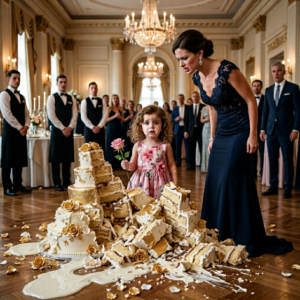
She said, “I want to be useful.” So, he gave her a bowl and a spatula and let her frost the cake. She frosted it badly. It came out looking like a cake that had been frosted by a person who had never frosted a cake. Emma loved it. Emma said it was the best cake she had ever seen. Celeste, who had been a CEO at 24 and had negotiated acquisitions worth more than most countries GDPs, sat at Ryan’s kitchen table and watched an 8-year-old blow out candles on a crooked cake, and her face did briefly a thing Ryan had
never seen it do before. It was something close to wonder. The federal case wrapped up by July. Sharp pled out and got 4 years. Voss pled out and got three. Marrow got probation because she had cooperated and because the judge had considered her role the smallest. Rineck, as already mentioned, went to trial and got nine.
His wife divorced him in August. His fountain pen stayed in Celeste’s desk drawer, now moved to a small wooden box that had been her grandmother’s. In August, Celeste took Emma and Ryan on a weekend trip to the coast of Maine. It was not a romantic trip. It was a weekend. Marcus drove them in a car that was not an SUV, which he did not like, but Celeste had insisted.
They stayed in a rented house overlooking a harbor in a small town Ryan had never heard of, and Emma collected sea glass on the beach for 3 hours on Saturday morning, and Ryan sat with Celeste on the porch and they drank coffee, and she read a novel, and he read the newspaper, and she told him, toward the end of the second day that this was the most rested she had been in 8 years.
On Sunday evening driving back, Emma fell asleep in the backseat. Celeste in the passenger seat turned to Ryan who was driving and said quietly, “Ryan?” “Yeah.” “Do you think about it?” “About what?” “Us.” He did not pretend to misunderstand. He had stopped pretending to misunderstand her a while ago. It was one of the things that had gotten easier between them. “Yeah, I do.
” “Okay.” “Do you?” “Yes.” “How often?” “Often.” He drove for a minute without saying anything. “Celeste?” “Yes.” “I don’t want to do it wrong.” “I know.” “Marlene’s been gone almost 5 years and I know that’s a long time and I know most people would say it’s past time, but yeah, I don’t want to do it wrong. I don’t want to do it wrong for Emma.
I don’t want to do it wrong for you. I don’t want “Okay.” “Does that make sense?” “It makes sense. Are you okay with it?” “I am okay with it. I’m not in a hurry, Ryan. I have waited 6 years. I can wait another year.” “Another year?” “Give or take.” He laughed quietly. “That’s very arithmetical of you.” “I told you, most things are arithmetic.
” “Some things aren’t.” “Yes.” “Which things aren’t?” She looked out at this road. The headlights of the truck threw long yellow cones into the dark. In the backseat, Emma’s breathing was deep and even. Celeste reached across the console and put her hand lightly on top of Ryan’s hand on the gearshift.
She did not hold it. She did not grip it. She just laid her hand there for a second, the way she had done in a conference room in Montpelier 9 months earlier. “This isn’t,” she said. They did not get married the following autumn the way you might expect in a story, because they were not ready. They were ready the autumn after that.
It was October again. Two years to the week since the morning Ryan had lost his job in Martin Delaney’s office. The leaves were turning. The air had that specific cold that only Vermont has. The cold that has wet pine in it. Emma was nine. She had grown 4 in in a year. She was taller than the yarn bracelets and the tear-stained copy of Charlotte’s Web.
Although she still had both, and she was starting to be a person with opinions about things. She had strong opinions about who Ryan was going to marry. She had, she told him solemnly in the kitchen one morning, three conditions. One, that Celeste was going to be called Celeste, not anything else, because that was her name, and Emma was not going to change it.
Two, that Celeste was going to teach her to drive when she was old enough, because Celeste had, Emma had discovered, learned to drive at 12 on a farm in the Adirondacks, and Emma wanted that. Three, that Ryan was not going to stop being her father for any part of any day, for any reason, and that was not up for discussion, and if it was up for discussion, Emma was going to have an opinion about that, too.
Ryan had said, “Okay,” to all three. He had said the third one was not something he was willing to agree to, because it was not something he was willing to do. And therefore it was not an agreement. It was a fact, and that facts didn’t need agreements. Emma had thought about that for a second. Then she had said that she supposed that was all right.
They held the wedding at the bus stop. That had been Celeste’s idea, and Ryan had laughed when she’d said it, and then he had looked at her face and realized she was serious, and then he had stopped laughing. The bus stop at Chestnut and Vine had not become famous or anything. It had stayed what it was, a little shelter with a bench and a plastic roof on a corner in a small town in Vermont, forgotten by the bus company.
But the town council, in an act of small local pride that Ryan had read about in the local paper a month after the federal case had wrapped up, had put a small plaque on the side of the shelter. The plaque said simply, “Kindness has been known to stop here.” No names, no dates. The town had not told Ryan or Celeste they were doing it.
Ryan had walked past the shelter one afternoon in April and seen the plaque and stood there for 10 minutes with his hand on his mouth, and then had walked home and called Celeste, and Celeste had gone very quiet on the phone, and then she had said, in the voice she used when she was about to cry, that she thought that was the most Vermont thing she had ever heard.
So, they held the wedding there. It was a small wedding, not in the way that weddings say they are small, actually small. There were 23 people. Rosa was there in a new dress she had made herself. Delia was there with her reading glasses on their chain, and she was crying quietly, which surprised everyone, including Delia. Marcus was there wearing a tie that did not match anything, and he was guarding the sidewalk out of professional habit, although there was nothing to guard.
Theo was there with his wife, who was a short woman who called Theo my bear. Owen, the red-haired technician, was there with a date. A man named Martin Delaney was there in a jacket that did not fit him, looking at the ground most of the time because he had asked to come and had been told yes, and he did not quite know what to do with his hands.
Ryan had forgiven him a long time ago. Martin had not quite forgiven himself. That was something Martin was going to work on for the rest of his life. Ryan hoped he would get there. Emma was the flower girl. Rosa had made her a dress that was a soft gold color. Emma had picked the color herself. She walked down the sidewalk toward the bus stop with a small basket of mums because there There no rose petals available in Vermont in late October, and Emma had solemnly explained to everyone that mums were practically the
same thing. The officiant was a woman named Iris who ran the hardware store on Maine. She had also been, in an earlier life, a justice of the peace. She was 72. She wore overalls under a wool coat. She was the only officiant Ryan and Celeste had ever wanted. The ceremony was short. Iris kept it short. She said a few things about how two people in front of her had walked into a hard autumn, one of them carrying nothing, and one of them carrying too much, and had recognized each other somehow in the middle of it, and had agreed,
without using the word, to help each other finish carrying what they had been carrying alone. She said that she did not know much about love, although she had been married herself for 41 years, but she knew a little about stubbornness, and she thought a good marriage was mostly stubbornness about each other.
She said she thought the two people in front of her had the right kind of stubbornness. She said a few other things. They were short, and they were good. Ryan and Celeste said their own vows. They had agreed the night before to keep them short. Ryan said, “Celeste, I didn’t know on the worst day of my life that I was going to look back on that day as one of the best ones.
I didn’t know that the worst day and the best day could be the same day. I know it now. I’m going to try every day to be the man you have decided to marry. I’m going to fail some days. I’m going to apologize on the days I fail. I’m going to do my best every other day. I love you.” Celeste said, “Ryan, I sat at this bus stop 2 years ago because I had stopped believing there were honest men in my company.
You pulled over. You didn’t know me. You gave me the last money you had. I have been rich my whole life. I have never been as surprised by anything as I was by that. I am marrying you because I have been surprised by you every week since. I hope I surprise you, too sometimes. I love you.
Emma watched from Rosa’s side. She was not crying. Emma rarely cried. But her small hand was in Rosa’s, and Rosa’s fingers were tight around Emma’s, and Rosa was crying enough for both of them. They exchanged rings. They kissed. It was not a long kiss. It was a small, correct kiss in a town that was full of small, correct things. The 23 people applauded.
A few cars honked as they drove by, although none of the drivers had any idea what had happened on the sidewalk. That was all right. Vermont drivers honk at things they don’t understand. It is a local tradition. Afterwards, they walked two blocks to a small restaurant that had a back room. They ate for a long time. They told stories.
Delia told one about Celeste from 5 years earlier that had everyone laughing. Marcus told one about Ryan from a morning 11 months ago in a logging road off Route 12A that had everyone very quiet and then laughing hard. Martin Delaney did not tell a story. He came up to Ryan at some point in the evening with a glass of cider in his hand, and he said simply, “I’m glad you made it, Ryan.
” And Ryan said, “Me, too, Martin.” And they shook hands. Emma danced with her father once, standing on his shoes. She danced with Celeste once, not standing on her shoes because Emma had recently decided she was too old to stand on anybody’s shoes. Celeste was not offended. Celeste had, she told Ryan quietly later, expected this day would come.
At some point in the evening, Ryan stepped outside to get air. The restaurant had a back patio with one string of lights over it. The air was cold. He stood with his hands in his pockets and looked at the sky, which was clear and had the kind of stars that only rural Vermont had. He thought about a lot of things standing there. He thought about Marlene.
He let himself think about Marlene. He thought that if she could see him, she would probably have something smart to say about the fact that he had married a billionaire, and the remark would be affectionate, and it would also in some way be the kind of thing that only she could have said. He thought that he was allowed to think about her and to be happy at the same time.
He had not been sure for a long time that he was allowed. He was sure of it now. He thought about Carl Voss, who was in a federal prison camp in New Hampshire, and who was, according to some reports someone had mentioned in passing a month ago, working in the kitchen. He did not feel sorry for Carl. He did not feel satisfaction either.
He mostly did not think about Carl. That had been the hardest thing to learn, that the people who had tried to destroy him had to be allowed eventually to become people he did not think about, because thinking about them was a form of letting them still own a small part of his life. He had been working on giving them back that part for a year.
He had mostly done it. He thought about Reinecke, about a fountain pen in a small wooden box in Celeste’s office, about a trust for a boy at a college in Rhode Island who had written a letter, about how the worst people in a person’s life did not always get what they deserved in a way that was satisfying. Sometimes they got what they deserved in a way that was only quiet, and that you had to be at peace with, because you couldn’t demand more than the world was going to give you.
He thought about the $40. He thought about how a person could do one small thing on a morning when everything else had gone wrong, and that thing could turn out to be the thing that opened every door for the rest of his life. He thought about how that should not be the lesson, exactly, because the lesson, if you made it the lesson, was too neat.
Most people who gave away their last $40 did not have a billionaire return to their door the next day. Most people who gave away their last $40 got nothing back for it, ever. That was the truth. He had been lucky. He had also been a certain kind of person on a certain kind of morning, and those two things together had made a door open that might not have opened otherwise.
But he thought, standing there under a single string of lights on a back patio in Vermont, that there was still a lesson in it. It was just not a neat one. It was that you had to be the kind of person who would do the thing even when the door did not open. Because most of the time it didn’t. Most of the time the $40 was just gone.
And you did it anyway because there was some part of you that was not for sale, some small part that was yours and yours alone. And every time you gave it away for something that could not pay you back, the part got a little bigger. And then, one Tuesday morning at a bus stop in the cold, a stranger sat down in your passenger seat, and she noticed the size of that part, and your life began.
That was the lesson, if you wanted one. He didn’t know if he was right. He was 34 years old, and he was now married to a woman who ran a company with 18,000 employees, and he had a daughter who could read chapter books and quilt, and who was telling everyone at the party inside that her father was a manager of an important thing, which was as close as Emma had gotten to describing what he did, and which was, he thought, better than most descriptions he’d heard from grown-ups.
He didn’t have everything figured out. He didn’t think anybody did. He thought that was probably all right. The door opened behind him. Celeste came out. She had a small glass of something in her hand. She came over and stood next to him and looked up at the stars. You’re missing the party. I’m coming back in. Ryan. Yeah. Thank you. For what? For pulling over.
He laughed quietly. You’re welcome. I mean it. I know. She took his hand. She held it properly this time, all the way, fingers through fingers. They stood there under the string of lights and the cold stars, two people who had been two different kinds of alone, and were now something else. Inside At restaurant, Emma was telling Marcus Pell, who was listening with enormous seriousness, about a worm that a substitute teacher had once eaten on a dare.
Outside, a car honked somewhere far off at nothing in particular. Ryan Hale stood on a back patio in a small Vermont town in the middle of an October that was cold but not unkind, and he let himself, for the first time in his adult life, believe that the story he was in was going to end well. It did. What began with a man giving away his last $40 ended with a wedding at a bus stop and a plaque that said kindness had been known to stop there.
Everything that was broken had been put back together, not perfectly because nothing is ever put back perfectly, but fully enough that a girl could blow out candles on a crooked cake, and a woman who had been alone could sit on a back patio holding a hand, and a man who had thought he had lost everything could look up at the stars and mean it when he said he was home.
Maybe the point is not that kindness always comes back. Most of the time, it doesn’t. The point is that you become the kind of person who does it anyway, and then, on the day you don’t expect it, something the size of your whole life walks up to you at a bus stop and asks you for $40, and you say yes, and a door opens that you didn’t know was there.
That’s the whole story. Thanks for staying until the end.
THE END.