They Thought the Desert Was Empty Then One Ex-SEAL Sniper Closed the Corridor
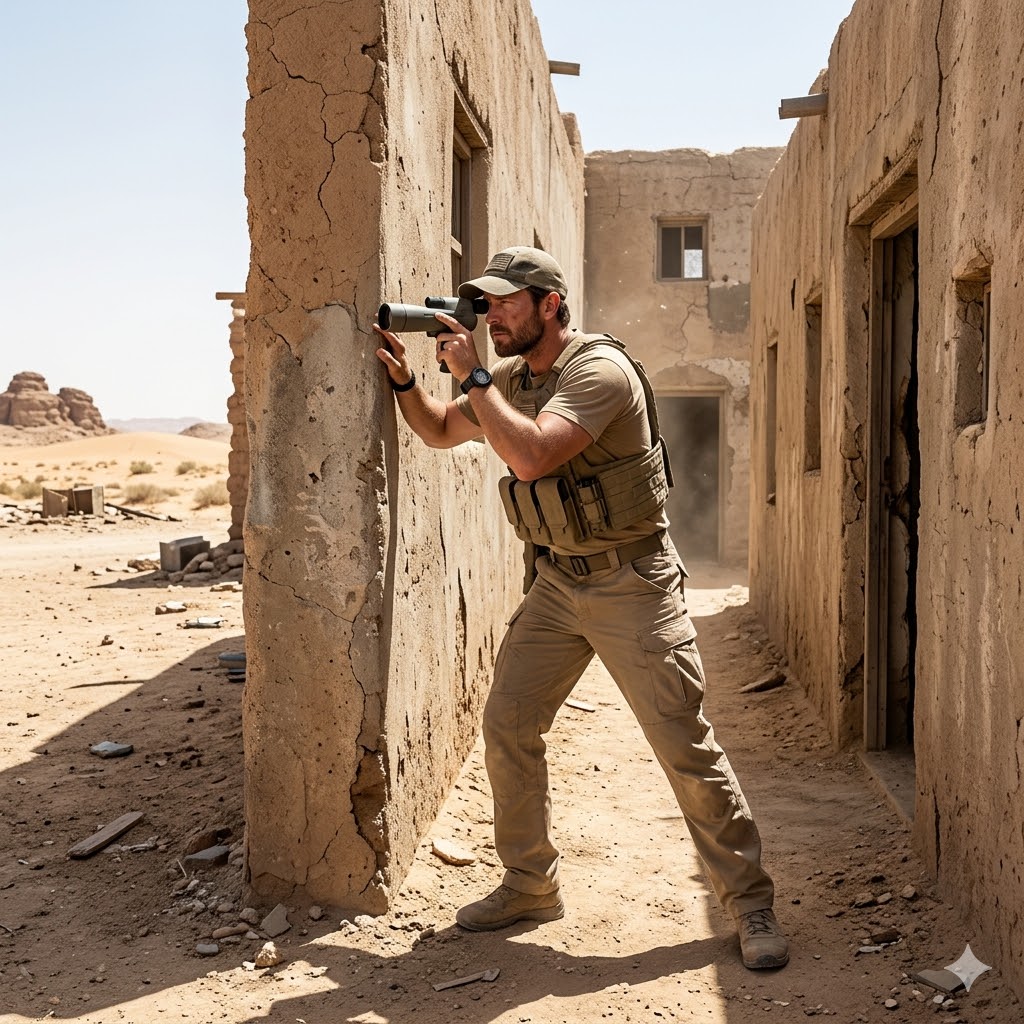
The desert held its breath at 21:40 hours. Eight vehicles emerged from the eastern darkness like predators testing the edge of firelight. Headlights extinguished, engines throttled low. The convoy snaked through the scrub brush with the disciplined precision of men who had crossed borders before. Men who understood that silence was currency and speed was survival.
At the front, a black suburban rolled on reinforced suspension, its armored panels catching the faint starlight. Behind it, two flatbed cargo trucks carried loads concealed beneath military-grade tarps cinched with ratchet straps that hadn’t come from any civilian hardware store. Four technicals followed, pickup trucks modified with welded mounts, their beds carrying belt-fed weapons pointed at the infinite darkness of the Harlo Ridge Corridor.
And at the rear, a vehicle that didn’t belong to any smuggling operation from the old playbook, a dedicated electronic warfare truck, its antenna array bristling from the roof like the quills of something venomous. A 30-m radius of RA jamming surrounded the convoy like an invisible shield. 32 men, eight vehicles, one objective.
They had done this 17 times across three continents. The man in the lead suburban, a seasoned criminal operator known only as Strand, had never lost shipment, never lost a vehicle, never left a trace that investigators could follow back to source. His record was perfect. 600 ft above them, pressed flat against the limestone shelf that had absorbed the day’s heat and now radiated it back into her bones, Cassidy Marlowe watched them through a scope that could count the stitches on a man’s tactical vest at 800 m. She had been here for 6
hours, motionless, silent, her breathing synchronized to the rhythm of the desert itself, slow, patient, and utterly without mercy. The convoy had no idea she existed. They wouldn’t understand until it was far too late. Cassidy’s finger rested outside the trigger guard as she tracked the lead vehicle’s progress through the thermal shimmer that still rose from the cooling sand.
Her logbook lay beside her, six pages already filled with meticulous observations, vehicle spacing, weapon counts, personnel assignments, communication patterns, the exact moment the EW truck’s jammer had flickered during a frequency hop 47 minutes ago. She knew them better than they knew themselves.
The convoy crossed an invisible boundary that locals called a marker, an unmarked line where county jurisdiction ended and federal authority began, where cell signals died and GPS receivers started lying. Rangers called the stretch the corridor. Smugglers called it the throat. The cartel had a different name, Tierra Muerta, deadland.
22 men had disappeared here in the last 3 years. Seven vehicles swallowed by terrain that didn’t appear on any federal map. Investigation teams sent to determine what happened had themselves required investigation teams. The official reports blamed the desert, extreme temperatures, disorientation, equipment failures, and the magnetic anomaly zones created by iron-rich rock formations. The desert was convenient.
The desert couldn’t testify. But Cassidy knew the truth because Cassidy was the truth. She had been watching from this exact position when the first cartel shipment had attempted the crossing 34 months ago. She had watched them roll through with the same arrogance, the same certainty that geography was the only obstacle between them and their destination. They had been wrong.
If that opening hooked you, trust me, this story only gets more intense. Subscribe now for more real stories of courage and hit that notification bell. Drop a comment and tell me where you’re listening from. Now, let me take you back to where it all began and who this woman really is. Three years earlier, Cassidy Marlowe had been someone else entirely.
She had been Lieutenant Commander Cassidy Marlowe, United States Navy SEAL, the first woman to complete the Naval Special Warfare Sniper Program without accommodation. Nine deployments across four continents, 312 confirmed engagements, a service record that read like fiction because most of it remained classified at levels that required congressional oversight to access.
She had believed in the system, believed in the chain of command, believed that the institution she served the people who bled for it. That belief had died in a canyon 200 miles south of where she now lay. The Sonoran operation had been classified from inception. No official mission designation, no paper trail in the conventional channels.
Nine personnel, four SEALs from Development Group, two DEA agents embedded for jurisdictional authority, two intelligence officers providing real-time coordination, and Cassidy providing overwatch from a ridge position that gave her eyes on the entire valley. The target was a high-value meeting between cartel leadership and their supplier network, a gathering that would have collapsed 3 years of investigative work into a single night of surgical precision.
They never reached the objective. The ambush came from positions that shouldn’t have existed, fighting positions that had been prepared days in advance, sighted on the exact route the team would take, manned by shooters who knew the timeline down to the minute. Cassidy had watched them a ridge as her team was systematically destroyed.
She had engaged targets until her barrel glowed. She had called for extraction that never came. She had watched the last of her teammates, a SEAL named Danny Reyes, who had taught her daughter to swim, take three rounds to the chest while screaming coordinates into a radio that had been jammed from the moment they crossed the insertion point.
Eight dead, one survivor. The after-action review had been conducted behind closed doors. Cassidy had presented her observations, the prepositioned fighting holes, the communications jamming, the impossible precision of the ambush timing. She had outlined the only logical conclusion, that someone in the eight-person command chain had provided the enemy with mission details.
She had named three suspects based on access and opportunity. She had submitted documentation supporting her analysis. The investigation had lasted 4 weeks. The finding had arrived in a single paragraph, “The matter has been reviewed and resolved. No further actions required or recommended. No explanation, no accountability, no justice.
” One of her three suspects had received a promotion 6 months later. The documentation Cassidy had submitted, the evidence she had risked her life to compile, had been reclassified to a level that required her removal from access. They had buried it. Not the dead, the truth. Cassidy had resigned her commission the following morning.
Not in protest, not in despair, in recognition of a simple mathematical reality, the system designed to deliver justice had been captured by those who benefited from its absence. She could not pursue legal channels without classified evidence she no longer held. She could not pursue journalistic exposure without violating oaths that still meant something to her.
She could not pursue legislative investigation without access she had been systematically denied. The institution had closed ranks around its failure like an immune system rejecting foreign tissue. But Cassidy had not broken. She had redirected. If justice could not flow through official channels, it would flow through her.
If the system could not hold the line, she would hold it herself. If the desert where her team had died could not be sanctified by accountability, it would be sanctified by presence. She had returned to the border corridor alone. That was 2 years, 11 months, and 16 days ago. In that time, Cassidy had transformed Grid 7 Tango, a decommissioned Border Patrol observation post abandoned when budget cuts eliminated its funding, into something the military would have recognized, a forward operating base designed for a single operator
conducting persistent surveillance and precision interdiction. The concrete block structure sat on an elevated ridge overlooking the primary east-west funnel through the corridor. 600 ft of deteriorating chain-link fencing surrounded the compound, maintained just enough to discourage casual approach. A steel observation platform bolted to the rock face above the structure provided 360° visibility out to the thermal shimmer line.
Inside, Cassidy had established the infrastructure of indefinite persistence, a water catchment system she maintained herself, 90-day provisions buried beneath the flooring in sealed containers, backup communications equipment that operated on frequencies the jammers couldn’t reach, and medical supplies sufficient to treat anything short of traumatic surgery.
Outside, she had prepared the terrain. Nine secondary cache positions spread across a 4-mile radius, weapons, ammunition, water, and observation equipment prepositioned at locations she could reach from any point in her operational area within 45 minutes. Each cache was invisible to aerial surveillance, protected from weather degradation, and accessible only through approaches she had memorized during hundreds of hours of movement across the same ground.
She knew every rock formation, every dry wash, every AO, the swallowing ravines that could consume vehicles without warning, every patch of caliche, the calcium crit soil that looked solid and behaved like quick sand when weight was applied. Two years ago, she had driven a confiscated pickup truck onto a caliche flat at the eastern edge of the corridor.
The vehicle had sunk to its axles in under 4 seconds. She had walked away and left it there, a permanent marker terrain she would use when the time came. The Harlo Ridge Corridor existed in a jurisdictional vacuum that made it perfect for her purposes. Officially, the land belonged to the federal government. Bureau of Land Management territory that appeared on topographical maps as undifferentiated brown.
No roads, no structures, no designated points of interest. The nearest paved surface was 47 miles to the west. The nearest operational Border Patrol station was 63 miles to the north. Unofficially, the corridor was a transit route that criminal organizations have been exploiting for decades. The magnetic anomalies by iron-rich rock formations disrupted GPS receivers and compass bearings.
The radio reflective canyon walls created dead zones where communication was impossible. The extreme temperature differentials, cracking ground at noon, near freezing at night, destroyed electronic equipment and human endurance with equal efficiency. The terrain was the first line of defense. Cassidy was a second. In 34 months, she had conducted four major interdiction operations.
The first had been the messiest. A 12-vehicle cartel convoy that scattered when her opening shots disabled the lead and trail vehicles simultaneously. Seven of those vehicles had never emerged from the corridor. 22 men had vanished into the rain that swallowed them without witness or trace. The second operation had been cleaner.
A six-man reconnaissance team sent to determine what had happened to the first convoy. They had arrived with confidence and departed with terror, leaving their vehicle behind when pursuit seemed more dangerous than flight. The third had been the most dangerous. An airmobile response team that had attempted to locate her observation post using thermal imaging from a helicopter.
Cassidy had used aviation warning lasers to blind their sensors, then disappeared into prepared positions that she had insulated with Mylar blankets to eliminate her heat signature. The helicopter had circled for 3 hours before fuel constraints forced it to withdraw. The fourth had been 2 weeks ago.
A single SUV carrying four men with the clean-shaven faces and the tactical vest of American contractors working for someone who preferred deniability. They had parked 800 m from grid 7 tango and begun photographing her position. They had not photographed it for long. Word traveled through networks that process such information.
The Harlow Ridge corridor was closed. The crossing that had been routine was now impossible. Something lived in that desert that did not appear on surveillance, did not respond to jamming, and did not negotiate. The cartels had stopped trying after the first disaster. The smugglers had rerouted their operations to crossings that cost more but did not cost lives.
The criminal organizations that had once treated the corridor as their private highway had written it off as a loss. Dead terrain that killed anyone who entered. Cassidy had not stopped them all. She had stopped enough to change the math. And now Strand was here to change it back. She watched his convoy approach the canyon entrance.
The natural choke point that funneled all east-west traffic through a gap barely wide enough for two vehicles abreast. Her scope tracked from vehicle to vehicle, logging details she had already recorded hours ago. The HK platforms visible through windshields, the belt-fed weapons on the technical mounts, the antenna arrays on the EW truck, the rigid posture men who were good at what they did and knew it.
32 men, eight vehicles, one season operator who had never lost. Cassidy exhaled slowly, feeling the familiar calm settle over her nervous system like a weighted blanket. Fear existed somewhere beneath it, the rational recognition of what she faced. But the fear was distant now, submerged beneath the deeper clarity that came from absolute preparation.
She had been ready for this moment since before they knew she existed. Her logbook showed their organization. Team one in the lead suburban with Strand and his command element. Team two split between the flatbeds, providing security for the cargo that made this crossing worth the risk. Team three distributed across the technicals, their mounted weapons pointed outward in a defensive formation.
Team four operating the EW truck, their attention focused on electronic warfare rather than the terrain. She had identified the flanker during hour three of her observation, a younger man in the fourth technical who kept breaking formation to check his phone despite the RF jamming. Undisciplined, impatient, the weak link in an otherwise professional operation.
He would be her first message, not her first kill. Her first message. Cassidy understood something that most operators never learned. Precision was not just about accuracy, it was about communication. Every shot she fired would tell Strand something about who he faced. The first shot would establish parameters.
The second would demonstrate capability. Everything after that would be calculated to achieve a specific psychological effect. She would wound the flanker at 580 m. A non-lethal shot to the right thigh. Painful enough to require immediate evacuation, precise enough to demonstrate that she could have killed him and chose not to. The message would be unmistakable.
I see you. I control this. I am deciding who lives and who dies. Strand would receive that message. He would understand it. And he would make decisions based on that understanding. Decisions she had already predicted and prepared for. The convoy entered the canyon at 22:14 hours. Cassidy watched them snake through the gap, their formation compressing as the rock walls closed around them.
The lead suburban moved with confident speed, its driver navigating terrain that had obviously been scouted in advance. The flatbeds followed at precise intervals, their suspension groaning under loads that exceeded manufacturer specifications. The technicals spread into a trailing defensive pattern that covered multiple angles of approach.
Professional, disciplined, exactly what she had expected. The EW truck entered last, its jammer throwing 30 m of radio silence around the convoy like an invisible cloak. Any listening post in range would hear only static. Any drones attempted to track them would lose signal the moment they entered the bubble. But Cassidy wasn’t using radio.
She wasn’t coordinating with backup that didn’t exist. She didn’t need external communication because she wasn’t working with anyone who required it. She was alone. She had always been alone. And that was her advantage. The convoy cleared the canyon at 22:15 hours. They had crossed the marker. For the next 48 minutes, Cassidy watched them advance across the valley floor toward the western transit route.
They moved efficiently, their spacing optimal, their security posture consistent. Strand knew his business. His men knew their roles. The operation was executing exactly as planned. At 23:03 hours, Strand dispatched a surveillance drone. Cassidy had been waiting for it. She had watched the EW truck’s crew preparing the launch for 17 minutes.
The preflight checks, the controller calibration, the thermal sensor testing that confirmed operational temperature within acceptable parameters. Commercial unit modified for military application. Likely Chinese origin with American software patches. Effective surveillance platform for conventional operations. This was not a conventional operation.
The drone lifted from the EW truck’s roof at 23:04, climbing in spiral pattern designed to provide expanding coverage as it gained altitude. Standard reconnaissance profile. At 500 m, it would have thermal visibility across the entire valley floor. At 1,000 m, it could track vehicle movement to the horizon. It never reached 200 m.
Cassidy tracked its climb through her scope, calculating angle, windage, and the precise moment when its motor housing would be most exposed. The drone was moving perpendicular to her position. Its camera pointed west while its vulnerable components faced east. One shot, one adjustment, one opportunity. She exhaled halfway and held the position.
The crosshairs settled on the intersection of motor housing and battery compartment. A target roughly the size of a playing card, moving at 15 m per second at a range of 540 m. The trigger broke clean. For 6/10 of a second, the bullet traveled through air that had finally begun to cool after the brutal August day. It crossed the valley floor at 3,000 ft per second, compensating for the 7-knot northwest wind through ballistic drift calculations Cassidy had made before the drone left the ground.
The impact was almost silent at this distance. A soft crack as plastic shattered and electronics died. The drone’s rotor stopped instantaneously. For a moment, it hung in the air like something that had forgotten how to fall. Then gravity remembered. The drone dropped 500 ft in just over 3 seconds, impacting the desert floor somewhere between the second flatbed and the first technical.
Even from her position, Cassidy could see the convoy halt as men scrambled to determine what had happened. Second message delivered. Strand’s response came within 90 seconds. Through her scope, Cassidy watched him emerge in the lead suburban, tall, athletic, moving with the economy of motion that indicated extensive operational experience.
He surveyed the down drone from a distance, then returned his vehicle without approaching it. Smart. He suspected booby traps or he suspected a shooter with eyes on the crash site. Either conclusion demonstrated that he was processing information correctly. The convoy resumed movement at 23:09, but the formation had changed. The technicals had pulled closer to the cargo trucks.
The mounted weapons were now scanning in wider arcs, their operators searching for threats they couldn’t identify. They were scared. They should be. Cassidy began her displacement. Moving position after engagement was fundamental to sniper operations. The first thing she had learned in the NSW sniper program. The first thing she had taught to students during her time as an instructor.
The rock shelf that served as her firing platform was now compromised. Anyone with competent optics and sufficient time could trace the bullet’s trajectory back to its origin. She would not give them sufficient time. Her secondary position was 370 m northwest. A shallow depression behind a rock formation that provided concealment from aerial observation and cover from direct fire.
She had cached a spare magazine there 8 months ago. Sealed in waterproof wrapping and buried 6 in beneath the surface. The movement took 14 minutes. She traveled in complete darkness navigating by terrain features. She had memorized during dozens of previous traversals. No light. No GPS. No electronic signature of any kind.
Just a woman who knew this desert the way some people knew their childhood homes. From her new position, Cassidy watched Strand reorganize his forces. He was doing exactly what she had predicted. The textbook response to a sniper engagement was to split forces. Send pursuit teams to locate and eliminate the shooter while the primary element continued toward objective.
Strand had clearly attended the same schools. Through her scope, she watched him divide his convoy into three elements. Team one would continue west with the cargo trucks maintaining the original timeline. Team two would sweep north toward the rock formations where the shot might have originated. Team three would establish a blocking position east cutting off any escape route back toward the marker.
Standard doctrine. Competent execution. Fatal assumption. Strand’s plan assumed he was hunting a shooter who wanted to escape. He assumed the sniper had achieved their objective disrupting the convoy and would now attempt extraction while his team swept the area. He assumed he was dealing with conventional threat that could be cornered and eliminated through superior numbers.
He was wrong about all of it. Cassidy had no extraction plan because she had no intention of leaving. Grid 7 Tango was her home. This corridor was her responsibility. She would not be running from Strand’s sweep teams. She would be running them into terrain that had been waiting for them for 3 years. At 23:31 hours, she fired her third shot.
The flanker had been bothering her since hour or two of observation. Young. Probably mid-20s. Carrying an 416 Hong Kong dollars with confidence that suggested range time but not combat experience. He had been assigned to team two sweep element moving on foot through the rock formations that bordered her first firing position.
He was 400 m from where she had been. He was 580 m from where she was now. The shot took him in the right thigh. High and lateral away from the femoral artery. Through the quadriceps muscle and out the back without bone contact. Painful. Debilitating. Not fatal unless infection set in and medical care was delayed. She could have killed him. She chose not to.
That was the message. The young man screamed in the desert stillness. The sound carried. A human voice breaking against the indifferent soil of the terrain that had watched men die for millennia. His teammates scrambled for cover. Their weapons sweeping in directions they didn’t understand. Their training meeting a situation they hadn’t prepared for.
Through her scope, Cassidy watched their confusion. They had been expecting to hunt. Instead, they were being hunted. The psychological shift was visible in their body language. The tension. The hesitation. The frantic scanning of terrain that refused to reveal its secrets. Team two’s advance stalled completely. Two men crawled to their wounded comrade while the others established defensive positions that faced every direction except the one that mattered.
Radio traffic would be useless inside the EW truck’s jamming bubble. They had no way to coordinate with Strand or the other teams. She had cut them off. Now she would move them. The false thermal signatures activated at 23:15 hours. Exactly on schedule. Three positions across the valley floor. Remote triggered chemical heat packets she had placed 6 days ago.
Each one generating a thermal signature roughly equivalent to a human body. Commercial products modified for her purposes. Purchased from camping supply stores and hunting outfitters. Total cost approximately $40 per unit. From the air or through thermal optics, they would appear as stationary targets. Human shapes holding position.
Shooters waiting in prepared fighting holes. Strand’s blocking element would see them first. Team three. Positioned east to cut off escape would detect three heat signatures that hadn’t been there before. They would report contacts. They would adjust their positioning. They would move to investigate or engage. They would move exactly where she wanted them.
The Kalachi flat waited in the darkness like a patient trap. 700 m east of the false thermal positions. Invisible to anyone who hadn’t driven a vehicle into its depths and walked away. The surface looked identical to the surrounding desert. Hard packed soil with a thin crust of calcium deposits. But beneath that crust, the ground was essentially quicksand.
She had tested it. She knew its parameters and she had spent 2 years planning how to use it. Through her scope, Cassidy watched team three’s response to the thermal signatures. Five men in two vehicles moving east from their blocking position to investigate the contacts. They were being careful. Good tactical spacing. Weapons ready. Scanning for ambush.
But they weren’t scanning the ground. The lead vehicle hit the Kalachi at 23:42 hours. The front wheels broke through the crust first followed by the rear. In under 4 seconds, the pickup truck sank to its axles. Its momentum carried it forward into deeper material that swallowed it like water. The second vehicle stopped short.
Its driver recognizing the danger too late to help but soon enough to avoid the same fate. Through her scope, Cassidy watched three men struggle to exit the trapped vehicle. Their legs sinking to mid-thigh as they tried to reach solid ground. They weren’t going anywhere. The radio call went out at 23:59 hours.
Cassidy couldn’t hear it. The EW truck’s jammer blocked all frequencies. But she could read it in Strand’s body language. He emerged from the lead suburban again. His posture different now. Tighter. Controlled anger replacing confident assessment. He had lost contact with team three. He had a wounded man in team two. His drone was destroyed.
His timeline compromised. And somewhere in the darkness, a shooter was dismantling his operation with precision he had never encountered. For the first time in his career, Strand’s math was coming back negative. Through her scope, Cassidy watched him make a decision. He walked to the EW truck and spoke to its operator through the driver’s window.
The conversation lasted 40 seconds. Then the operator began working his console adjusting frequencies boosting output. He was calling for backup. The jamming bubble contracted briefly. A deliberate gap in coverage that allowed a single transmission to escape. Cassidy could intercept it but she could calculate its purpose.
Strand had contingency assets staged somewhere within response range. He was activating them. She had expected this. The previous operations had taught her that cartels and their logistics partners maintained rapid reaction capabilities for exactly this scenario. Helicopters usually. Fast moving aerial platforms that could provide reconnaissance, fire support, and extraction on short notice.
The question was response time. If Strand’s backup was staged at the nearest airship with fuel and crews already on standby, she had perhaps 90 minutes. If they required activation from a more distant location, she might have 3 hours. She would use every minute. At 00:15 hours, Cassidy began hurting team two.
The wounded flanker had been evacuated to one of the technicals. Two of his teammates carrying him through the rain that slowed their movement to a crawl. The remaining four members of team two were still searching the rock formations. Their sweep pattern increasingly erratic as frustration replaced discipline. She gave them something to find.
The aviation warning laser was visible only to whoever it was pointed at. A concentrated beam of green light that registered on retinas and thermal optics but left no trace in the surrounding environment. Cassidy aimed at a rock face 400 m west of team two’s position holding it steady for exactly 3 seconds. Someone saw it.
Through her scope, she watched when the sweepers called his teammates pointing toward the flash location. The team pivoted west moving toward contact that had already disappeared. Three more flashes over the next 12 minutes. Each one positioned to draw team two further from the convoy’s main element. Each one leading them toward a canyon that would funnel them into a kill zone she had prepared years ago.
Cassidy didn’t need to use the kill zone. She didn’t need to eliminate team two. She needed to separate them from Strand long enough for the helicopters to arrive. Because the helicopters were a real threat. The convoy had resumed movement at 00:30 hours. Strand down two full teams had made a decision to continue toward objective rather than sweep for a shooter he couldn’t find.
The cargo trucks rolled west with only the EW vehicle and one technical as escort. He was calculating acceptable losses. Professional to the end. At 00:47 hours, Cassidy’s RF scanner detected the helicopter approach. Two aircraft flying formation at low altitude. Their rotor signatures distinctive even at extreme range.
She had been monitoring the frequencies outside the jamming bubble waiting for exactly this sound. The helicopters were approaching from the southwest following a direct line toward the convoy’s last reported position. ETA approximately 90 minutes from Strand’s call. Staging distance roughly 200 miles.
Commercial helicopters modified for speed and payload. Probably civilian registration with equipment that contradicted their paperwork. This was the moment she had been preparing for. Cassidy abandoned her position and began moving northwest toward the elevated ridge that gave her the longest sight lines across the valley floor.
The helicopters would search in patterns she could predict. Grid sweeps focused on the terrain where the convoy had encountered resistance. They would use thermal imaging. They would use searchlights. They would be methodical and thorough. She would be none of those things. The Mylar blankets were cached at her primary position.
Thin, lightweight, and capable of disrupting thermal signatures enough to make them unreadable. She draped one over her shoulders and continued moving. Her heat signature now scattered into visual noise that sensors would dismiss as terrain reflection. The first helicopter arrived at 01:53 hours. It swept over the valley floor at 300 ft.
Its searchlight cutting through the darkness in systematic arcs. Behind the light, Cassidy could see the glow of thermal imaging equipment. A forward-looking infrared pod mounted beneath the nose. The second helicopter followed 300 m behind offset to provide overlapping coverage. They were searching for her.
Their pattern clearly designed to locate a single shooter who had caused disproportionate damage to a professional operation. Cassidy watched them from her position 900 m away partially concealed beneath an overhang that blocked her heat signature from above. The helicopters were fast, maneuverable, and armed. She could see door gunners positioned behind mounted weapons that would tear through her position if they achieved targeting solution. She had one advantage.
They didn’t know where she was and she knew exactly where they would be. The lead helicopter completed its first pass at 02:07 hours banking east to begin a return sweep. Its flight path would carry her across the open ground between two rock formations. A corridor roughly 200 m wide with minimal terrain cover for anyone caught beneath.
Cassidy had measured this corridor 17 times. She knew its distances to the meter. She knew its wind patterns, its thermal gradients, its magnetic interference effects. She had practiced the calculations that would govern the shot until they were as automatic as breathing. 930 m. Night engagement. Moving target at approximately 65 knots ground speed. Altitude 320 ft.
Wind 7 knots northwest with variable gusts. Temperature 91° Fahrenheit. Elevation advantage plus 4°. Time of flight approximately 1 second. The helicopter entered the corridor at 02:11 hours. Cassidy tracked it through her scope calculating lead angle based on velocity and distance, adjusting for the crosswind that would push her bullet slightly left during flight.
She exhaled halfway and held. The crosshairs settled on a point approximately 30 ft ahead of the helicopter’s cockpit where the aircraft would be when the bullet arrived. One shot. One opportunity. One chance to communicate something Strand’s backup would understand. The trigger broke. For one eternal second, the bullet traveled through air that seemed to thicken with every foot it crossed.
930 m of darkness, wind, and uncertainty. The margin for error measured in inches at this range. The helicopter jerked violently as the round found its mark. Not a critical hit. Not a kill shot. Cassidy had aimed for the tail rotor assembly. The component that provided directional control without contributing to lift.
The impact shattered something important because the helicopter immediately began spinning. Its nose yawing left as the pilot fought for control. It didn’t crash. The pilot was skilled or lucky or both managing to arrest a spin and maintain altitude through raw muscle memory. But the aircraft was crippled. Its flight capability reduced to straight-line movement at decreased speed.
The second helicopter broke formation immediately. Through her scope, Cassidy watched it bank hard left climbing for altitude and distance. Its searchlight died as the crew prioritized survival over mission. Within 30 seconds, both aircraft were heading southwest retreating toward whatever staging area had launched them. One crippled. One fled.
She had let the second one go deliberately. A messenger. Someone who would report what happened. Who would describe the capabilities they had encountered. Who would add to the legend that was already spreading through networks that process such information. The helicopters were gone. Strand was alone. At 02:47 hours, Cassidy began her approach to the final engagement.
She moved through darkness that had become as familiar as her own skin navigating by starlight and memory toward the position where Strand would make his last decision. The convoy had stopped moving. She could see the lights of the remaining vehicles clustered near a natural formation that provided partial concealment. Strand was assessing. Calculating.
Determining whether the mission could still be salvaged. He would conclude that it couldn’t. Cassidy knew this because she had designed this conclusion. Every engagement. Every casualty. Every demonstration capability had been calculated to produce a specific psychological effect. The recognition that continuing forward meant total destruction. Strand was a professional.
Professionals understood math. The math said 32 men deployed. Significant casualties sustained. One drone destroyed. Communications compromised. Two search teams neutralized through terrain and misdirection. Helicopter supporting engaged. One aircraft crippled. Backup withdrawn. Shooter unlocated. Capabilities unknown.
Intentions clear. The math said retreat. At 03:15 hours, Strand orders remaining forces to consolidate. Through her scope, Cassidy watched them assemble. The survivors of team two. The crew of the EW truck. The security element that had stayed with the cargo trucks. Fewer than 15 men now.
Their weapons still ready but their posture defeated. Strand moved among them speaking words she couldn’t hear but could interpret. He was not panicking. He was not raging. He was doing what professionals do when operations fail. Organize withdrawal. Prioritizing personnel recovery. Accepting that this particular mission was over.
He left the cargo trucks where they stood. The flatbeds with their military grade straps and their concealed loads. Whatever weapons or equipment they had been transporting remained in the valley as abandoned assets. The cost of retrieval exceeded the value of the cargo. The surviving vehicles turned east moving back toward the marker at reduced speed.
No headlights now. No formation discipline. Just men retreating from terrain that had rejected them with absolute finality. Cassidy could have let them go. That would have been a tactically sound decision. The choice that minimized risk while maximizing the psychological impact of the defeat. Strand’s surviving men would carry the story back to whoever had sent them.
The corridor would remain closed through reputation alone. But Cassidy needed something more. She needed Strand to understand personally and completely what he had encountered. She needed him to carry not just the story of his failure but the weight of having stood face to face with the person who had caused it.
She needed the message to be unmistakable. At 03:42 hours, Cassidy positioned herself at the mouth of the AO. The swallowing ravine cut through the valley floor like a wound. A 60-ft drop into terrain that had claimed vehicles and men for as long as anyone could remember. The only east route that avoided the AO required passing through a gap barely 30 m wide bordered by rock walls on one side and the ravine’s edge on the other.
Everyone leaving the valley would pass through that gap. Everyone would see her. She stood in the open. Her weapon slung but accessible. Her posture deliberately non-threatening. The approaching vehicles would see a single figure silhouetted against the slightly lighter darkness of the eastern horizon. A human shape that shouldn’t been there.
That couldn’t have survived what they had just experienced. The lead vehicle stopped 200 m out. Headlights remained dark. But she could hear the engine idling. Could imagine the conversations happening inside. Someone was asking Strand what to do. The vehicle crept forward. 150 m. 100. 75. 50. At 20 m, the engine died.
The door opened and Strand emerged. He was taller than she had estimated from scope observation. 6’2″ or 6’3″ with a lean build of someone who prioritized functional fitness over appearance. His face was invisible in the darkness. But his posture communicated everything. Cautious. Calculating. Not afraid but deeply aware.
He carried a sidearm but didn’t draw it. You could have killed all of us. His voice was surprisingly calm. Accented Eastern European origin she estimated overlaid with American English from extended residence. Yes. One word. Sufficient. Strand stood in the darkness for several seconds processing. When he spoke again, his tone had shifted, not softer, but more measured.
“Who do you work for?” “Nobody.” “That’s not possible.” And yet, Cassidy’s response hung in the air between them. She could feel his confusion, the inability to categorize what he was experiencing. In his world, shooters work for organizations. Operators follow chains of command. Individual actors didn’t control terrain through precision and persistence alone.
His world was about expand. “What do you want?” Strand asked. The question was sincere, a negotiation attempt. He was looking for the transactional framework that governed his profession, the understanding that everyone wanted something, that everything had a price, that conflicts resolved through exchange rather than elimination.
Cassidy considered her response carefully. She had rehearsed this conversation in her head a hundred times, testing different approaches, different framings. The words mattered. They would determine whether this ended with violence or with something more valuable. “I want you to understand something,” she said.
“This corridor is closed, not sometimes, not conditionally, closed. Whatever you’re moving, wherever it’s going, this route doesn’t exist anymore.” Strand processed this. “That’s not a reasonable position. I’m not negotiating. Everyone negotiates.” “No.” Cassidy’s voice remained flat, emotionless. “Everyone who wants something negotiates.
” “I don’t want something from you. I want you to not be here. Those aren’t the same thing.” Silence stretched between them. In the vehicles behind Strand, men waited with weapons they knew wouldn’t matter. The outcome of this conversation would determine whether they lived or died, and they had no voice in it. Finally, Strand spoke again.
“What happens if I come back?” “You don’t come back.” “Hypothetically.” “There is no hypothetically. You don’t come back. Nobody comes back. The 17 convoys that tried before you are still here, scattered across a range that doesn’t appear on any map. You saw what I can do from distance. You haven’t seen what I prepared for closer engagement.
” She let that settle. The mention of previous convoys, the implication of extensive infrastructure. Strand was calculating, comparing the value of the cargo they had abandoned against the cost of attempting retrieval, comparing the value of future operations through this corridor against the risk of the same outcome. The math didn’t work.
She knew it didn’t work, and he was realizing it, too. “Your people are waiting,” Cassidy said. “Walk east. Don’t look back. Don’t send scouts. Don’t try to map my positions or estimate my capabilities. This is the only conversation we have. There isn’t second version where you negotiate better terms.” Strand stood motionless for several seconds.
She could see his hands, positioned carefully away from his sidearm, a deliberate signal that he was not reaching for it. When he finally moved, it was the step back toward his vehicle. He opened the door, paused, and turned. “What’s your name?” Cassidy considered not answering, then decided the truth served her purpose better than mystery.
“Marlow.” He nodded once, acknowledgement without agreement. Then he was inside the vehicle, the engine starting, the headlights remaining dark as the convoy resumed its retreat toward the marker. She watched them until they disappeared over the eastern horizon. Three vehicles, fewer than 15 men, carrying nothing but survival and a story they would never forget.
At 0420 hours, Cassidy began her walk back to grid 7 tango. The route was familiar, three and a half miles across the range she had crossed hundreds of times, through darkness that felt more like home than any city ever had. Her muscles ached from hours of stillness and movement. Her eyes burned from sustained scope work.
Her hands still carried the residual tension of trigger pulls that had shaped the outcome of the night, but her mind was quiet. She had done what she came to do. Not killed, communicated. Not destroyed, redirected. The cargo trucks remained where they stood, abandoned assets that the desert would claim over time. Strand’s organization would absorb the loss and reroute their operations to crossings that cost more, but didn’t cost lives.
The corridor was closed. It would stay closed. And word would spread through networks that processed such information with mathematical efficiency. The sun rose at 0547 hours. Cassidy sat on the steel observation platform at grid 7 tango, watching the light spread across a valley that showed no trace of what happened during the night.
From this elevation, she could see the abandoned flatbeds, distant shapes that would attract investigation eventually, would become data points in reports that nobody would read with understanding. The official explanation would blame the desert, equipment failure, disorientation. The same language that had explained every previous disappearance in this corridor.
The desert was convenient. The desert didn’t testify. Her logbook lay open beside her, the final entry from the night’s operation drying in the morning air. 12 pages total, documenting every engagement, every movement, every tactical decision from the moment the convoy had appeared on her scope until Strand’s vehicles had disappeared over the eastern horizon.
She would preserve this record the way she preserved all the others, sealed in waterproof containers, cached at multiple positions, available for recovery if anyone ever needed to understand what had happened here and who had made it happen. Documentation mattered. Truth mattered. Even when the institutions designed to act on truth had abandoned their purpose.
Three years, one month, and four days since the ambush that had killed her team. Three years since she had stood before the review board and presented evidence of betrayal, only to watch it disappear into classification levels that existed to protect the guilty rather than innocent. The mole was still out there, still operational, still protected by the same institutional immunity that had allowed eight people to die without consequence.
Cassidy had not forgotten. She would never forget. But she had accepted something that most people never learned. Some injustices could not be corrected. Some betrayals could not be avenged. Some wounds stayed open because closing them required resources that didn’t exist and systems that had failed.
What she could do was hold this line. What she could do was stand in this corridor and ensure that the weapons and drugs and human misery that passed through it found another path, a path that cost more, that required more risk, that made the operations marginally less profitable. It wasn’t justice. It was presence. Six days after the operation, DA Handler-Donnelly received a classified report about the abandoned cargo trucks and the missing convoy personnel.
He read in his office at the regional headquarters, comparing it against reports from three other organizations that had independently rerouted their operations away from the Harlo Ridge corridor. He wrote a single note on the margin of the report, “Leave it alone.” Then he filed in a drawer that would never be opened again.
The corridor remained closed. At 11:30 hours, Cassidy detected movement on the eastern horizon. Through her spotting scope, she watched a dust plume materialize. Another convoy, another organization, another attempt terrain that looked empty on every official map. They were coming from a different staging point than Strand’s operation, moving on a slightly different azimuth, but their destination was the same.
She began her observation log. Vehicle count, personnel estimate, weapon identification, formation pattern. They were 3 hours out. She had time. Cassidy Marlow settled behind her scope and began the work that never ended. She had been here for 2 years, 11 months, and 17 days. She would be here tomorrow, and the day after, and the day after that.
Not because she expected victory. Some battles couldn’t be won. Not because she expected recognition. No one would ever know what she had done. Not even because she expected justice. That word had lost its meaning the morning she resigned her commission. She stayed because someone had to stay. Because a line existed whether or not the institutions acknowledged Because the way into communities that had no defense against them, and the only barrier between those communities and that violence was a woman with a rifle and an
absolute refusal to leave. Cassidy’s story shows us that sometimes justice isn’t delivered by systems. It’s defended by individuals who decided to remain. If this kept you engaged, hit that like button and drop a comment telling me where you’re listening from. Tell me, if the institution you trusted betrayed you, would you walk away, or would you find another way to hold the line? Subscribe if you haven’t already.
More stories like this are coming. Hit that notification bell so you don’t miss the next one. The sun climbed higher, burning away the night’s chill. The new convoy crept closer, unaware of what waited. Cassidy watched them come. This is where I belong. The desert held its breath, and a woman with steady hands prepared to remind them why.






